
Quick Withdrawal Casinos in Australia: Who Actually Pays Fast
No online casino holds an Australian licence. Every brand on this page operates offshore. That is the single fact most “fast payout” rankings skip past, and it shapes every other claim that follows. A quick withdrawal is still quick, but the operator behind it has no Australian consumer protection, no Australian complaints body, and can have its site blocked by ISPs at any time with a balance still on it.

The rest of this page works from that starting point. It ranks ten offshore casinos Australians actually reach, ordered by tested payout speed from published 2026 real-money tests. It breaks down the three withdrawal-speed tiers by the method that actually determines them — crypto, PayID, bank transfer — and walks through the IGA prohibition, the 2026 reform bill, and the offshore risk that comes with using any of these brands. The reader who wants a fast payout gets one; the reader who also wants to know what that speed costs gets both.
Data current as of 22 November 2026, verified against the ACMA’s published enforcement figures and the Interactive Gambling Act 2001 as amended.
Table of Contents
- What a “Quick Withdrawal Casino” Really Means in Australia
- How Fast Do Australian Casino Withdrawals Actually Land?
- The Fastest Offshore Casinos Australians Use in 2026
- The Legal Reality: Every Fast-Withdrawal Casino Is Offshore
- When Fast Payouts Meet Problem Gambling
- How We Selected and Tested These Casinos
- What Australian Players Should Actually Do About Fast Withdrawals
- Frequently Asked Questions
What a “Quick Withdrawal Casino” Really Means in Australia
The phrase does a lot of work it was not designed to do. “Quick withdrawal casino” is a marketing label. The actual withdrawal time is set by three things the operator does not control by itself: the payment method chosen, the account’s verification status, and whether the request lands inside or outside the operator’s auto-approval threshold. Speed is not a feature the operator flips on. It is the product of an assembly line, and the method is the longest single piece.
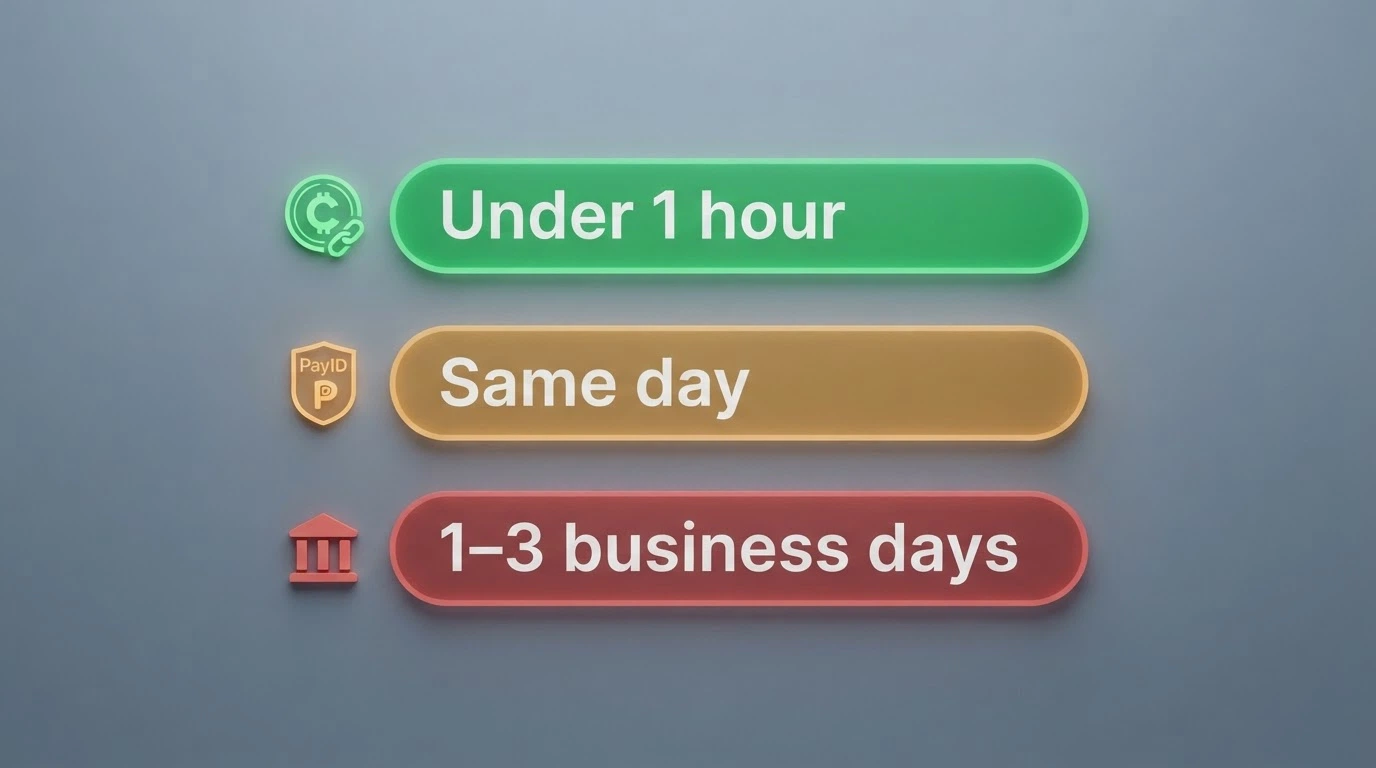
Australian-facing operators cluster into three speed tiers that the industry itself has settled on:
- Instant — under one hour. Crypto only, and only on operators that auto-approve verified accounts. The fastest verified single withdrawal on a 217-cashout dataset landed in one minute forty seconds (USDT TRC20 from LuckyDreams).
- Same-day — within twenty-four hours. Crypto, PayID and e-wallets, on operators that process requests quickly and on a payment rail that runs in real time. SkyCrown and MadCasino cleared every test withdrawal within the same calendar day, including a 10 PM Saturday request that cleared before midnight.
- Fast payout — one to three business days. Bank transfer, card withdrawals and any operator that batches requests through manual review.
The honest reading of those tiers is that speed is a method property before it is an operator property. Pick crypto and you are already at the fast end of the table, regardless of which offshore casino you chose. Pick bank transfer and you have bought yourself three to five business days before the rail has even engaged.
The speed promise — what “quick withdrawal” actually covers
Operators advertise “instant” or “10-minute” payouts, but the time they quote is measured from the moment they approve the request, not from the moment the player submits it. That single distinction is the gap between the marketing claim and the lived experience. The full withdrawal is a two-stage process: casino-side processing (KYC check, internal approval, pending period) followed by payment-rail transmission. The advertised number covers only the second stage.
Internal approval can take anywhere from two minutes to forty-eight hours, depending on the operator, the amount and the KYC status. A player who verifies at signup sees minutes; a player who verifies at first withdrawal sees twenty-four to seventy-two hours added to that first cashout. After that first verification, the subsequent withdrawals move at the operator’s normal processing speed — and that speed is what the marketing page is actually quoting.
Why payout speed is the read-across quality signal of the whole market
A fast payout is not just convenient. It is the most visible sign that an operator has its back office in order. Solvent, automated operators approve verified withdrawals inside an auto-approval threshold (typically around A$2,000) without human review and let the payment rail carry the rest. Insolvent or under-resourced operators batch every request through a manual review queue, and the queue is where withdrawals go to die.
The split between the two groups is visible in the limits they advertise. Top-tier fast-payout operators carry crypto withdrawal ceilings of A$5,000 to A$20,000+ per transaction. Older RTG-skinned operators still enforce weekly ceilings of A$2,000 to A$5,000 — a structural sign that the operator is not set up to move large sums quickly. A player with a four-figure balance who picks the second group is not getting fast withdrawals; they are getting the illusion of fast withdrawals followed by a slow drip. The speed bar and the limit bar move together.
How Fast Do Australian Casino Withdrawals Actually Land?
The honest answer comes from real tests, not from operator marketing pages. The 2026 dataset behind this section draws on published cashout tests from PayoutVerdict, Wildfish, SlotSpeak, Betsquare and PokiesAustralia — every figure cited is a tested real-money payout, not an advertised window.
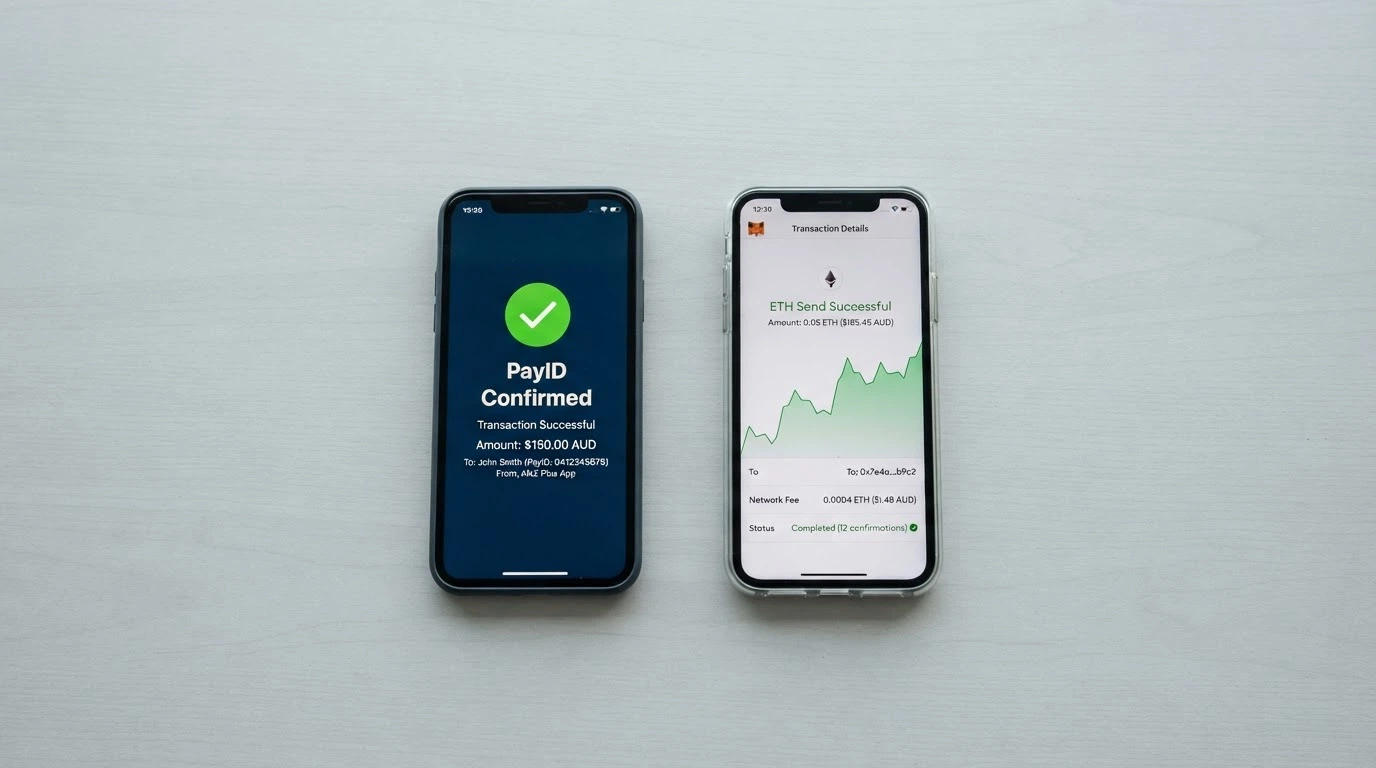
The three speed tiers — instant, same-day, and fast payout
The three tiers map onto the methods that drive them:
| Method | Best Tested Speed | Typical Speed | Worst Case |
|---|---|---|---|
| Crypto (USDT TRC20) | 1 min 40s | 5–15 min | 45 min |
| PayID / Osko | 4 min | 10–40 min | 4 hours |
| Bank Transfer | 1 business day | 1–3 business days | 5 business days |
PayID vs crypto vs bank transfer — the method that sets your clock
Three rails, three different clocks:
- USDT TRC20. Network confirmations in one to three minutes, fees under A$2, end-to-end times measured in minutes on the best-tested operators. ETH is markedly slower at six to eight hours typical. BTC is comparable to ETH on speed but with higher fees. The trade-off is that the funds arrive in a crypto wallet, not in an Australian bank account — converting to AUD costs another step, another fee and another delay.
- PayID / Osko. Australia’s real-time fiat rail, running on the New Payments Platform twenty-four hours a day. PayID is the fastest way to get winnings into an Australian bank account — and the only practical fast-fiat option for AU players in 2026. Best verified test: four minutes. Typical: ten to forty minutes. Worst case: four hours. Ricky Casino’s six-test PayID average sat at two hours forty minutes.
- Bank transfer. The slow rail. Three to seven business days at most operators. POLi, which used to be the standard AU deposit rail, shut down on 30 September 2023 — any operator still listing POLi in 2026 is running outdated payment documentation.
The method decides the clock before the operator enters the picture. A player choosing crypto at a slow operator will still beat a player choosing bank transfer at the fastest operator on most days.
PayID and the NPP — Australia’s real-time fiat rail
PayID is the practical fast-fiat answer for Australian players. The infrastructure underneath it is the New Payments Platform, a real-time settlement system operated by Australian banks and running twenty-four hours a day. Setting up PayID means linking a mobile number, email address or ABN to a bank account through the bank’s own app or online banking — once linked, anyone sending to that PayID routes through Osko and the funds clear in seconds.
The real-world speed is set by the operator’s processing time, not the rail’s. SkyCrown’s eleven-minute PayID test (A$500 deposit, A$920 withdrawal cleared to a CommBank account) sits at the fast end of what the rail delivers when the operator cooperates. The four-hour worst case in the published data happens when the operator’s manual review queue is the bottleneck, not when the rail is slow. Ricky Casino’s PayID cashouts cleared in one hour fifty-five minutes to three hours twenty minutes across six tests — average two hours forty minutes, every cashout processed without delay. The rail itself is not the constraint; the operator is.
PayID is still slower than crypto end-to-end, even at the best-tested operator. The reader choosing between the two is choosing between a crypto wallet and an Australian bank account, not between two identical experiences. If the funds need to land in AUD in a bank the player already uses, PayID is the answer. If the funds can sit in a wallet and convert later, crypto is faster.
The two-stage withdrawal — why “instant” is never instant
Every withdrawal is two legs stacked on top of each other. The first leg is the casino side: identity verification, anti-fraud checks, internal approval, pending period. The second leg is the payment rail: the network that carries the funds once the operator has released them.
The first leg is the bottleneck on every operator that is not fully automated. Internal approval runs anywhere from two minutes (a verified account, under the auto-approval threshold, on a queue-light operator) to forty-eight hours (an unverified account, an above-threshold request, or a weekend batch). The second leg runs in the time the rail sets: minutes for USDT TRC20, minutes for PayID, days for bank transfer.
The advertised time on the operator’s payments page is the second leg only. A “10-minute payout” claim means ten minutes after approval — and approval is the part that varies, that depends on the player’s account status, and that the operator does not put in its marketing. The two-stage structure is why a casino can advertise “instant” and still take hours in practice, and why the player who verifies at signup experiences a different product from the player who verifies at first withdrawal.
Same-day withdrawal — what it actually takes to clear before midnight
“Same-day” is a real promise on operators that deliver it, and a fragile one. First, the account must be fully verified, meaning KYC done at signup rather than waiting until first withdrawal. Second, the method must be crypto or PayID on a rail that runs in real time. Third, the request must land under the operator’s auto-approval threshold (around A$2,000 at most operators), so the request skips manual review and the queue.
A request at 10 PM Saturday, on a verified SkyCrown or MadCasino account, under A$2,000 in USDT or PayID, clears before midnight. A request at 10 PM Saturday on an unverified account, on a bank transfer, or on an operator that batches all withdrawals, does not clear before Monday. The same-day label is earned by the combination, not by the method alone.
The Fastest Offshore Casinos Australians Use in 2026
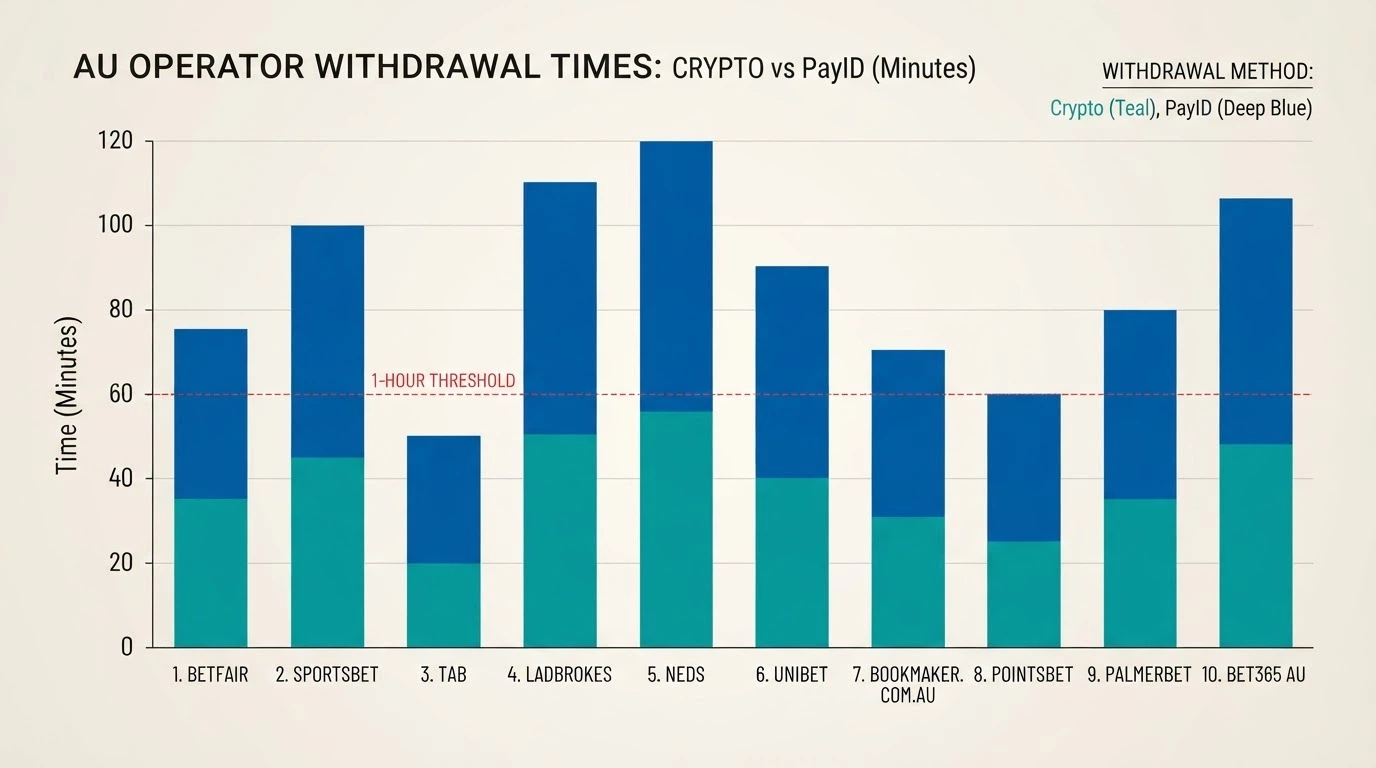
The table below ranks the ten offshore casinos by tested payout speed from published 2026 real-money tests. None holds an Australian licence — online casino cannot be licensed in Australia under the Interactive Gambling Act 2001. The ranking is ordered by what was actually measured, not by what any operator’s marketing page claims.
| Operator | Tested Fastest Payout | Payment Methods |
|---|---|---|
| SkyCrown | 11 min (PayID, A$920 to CommBank) | PayID, crypto (10+), MiFinity, card, bank |
| BitStarz | 12–30 min processing, 0.2–2h end-to-end crypto | Crypto (BTC, USDT, others); limited fiat; no PayID |
| Stake | 1–2h crypto | Crypto only; no PayID; no fiat |
| Wild Fortune | 5h 24m avg USDT TRC20 (5 tests); 26h 11m PayID | PayID, crypto, Interac, card |
| Rocket Casino | ~6h USDT TRC20 | PayID supported; other methods not confirmed |
| Rocket Play | Instant crypto/MiFinity after processing; 3–7 days bank | Crypto, MiFinity, bank (A$6,000 max) |
| WinSpirit | 1–24h e-wallet/crypto; 3–5 days card/bank | E-wallet, crypto, card, bank |
| Royal Reels | — | — |
| FairGO | — | — |
| Bizzo Casino | — | — |
Three of the ten (Royal Reels, FairGO, Bizzo Casino) carry no confirmed payout-speed data from a primary test source in the 2026 dataset. They appear on the list because they are AUD-positioned offshore brands Australians reach, not because they have been independently measured.
SkyCrown
SkyCrown sits at the top of the tested-speed ranking by a wide margin. A 2026 real-money test recorded an eleven-minute PayID payout — A$500 deposit, A$920 withdrawal cleared to a CommBank account. A separate USDT TRC20 test recorded a twelve-minute withdrawal with a A$0.90 network fee and a forty-two-second deposit credit. The operator’s advertised average sits at around ten minutes for verified accounts on crypto or PayID, and the tests come in faster than the marketing claim.
The same-day track record is what separates SkyCrown from the field. Across the published test withdrawals, every cashout cleared within the same calendar day — including a 10 PM Saturday request that hit a bank account before midnight. KYC happens at first payout rather than at signup, so the first withdrawal carries a verification delay that subsequent ones do not. Once verified, the operator processes inside the auto-approval window and PayID carries the rest in minutes.
For an Australian player whose priority is speed to an Australian bank account, SkyCrown is the strongest tested option on the page. The trade-off is the standard offshore one: no Australian consumer protection, no BetStop coverage, and a site the ACMA can have blocked at any time.
Rocket Play
Rocket Play’s fastest rail is crypto or MiFinity — instant after platform processing, with the operator releasing the funds and the rail carrying them in minutes. The slow leg is bank transfer: three to seven business days, capped at A$6,000 per transaction, with a A$30 minimum. The crypto minimums vary by token — 0.00084 BTC, 20 USDT and similar.
The structure tells the reader where Rocket Play fits. A player with a small balance withdrawing in crypto gets the operator’s fastest experience. A player trying to clear a five-figure win to an Australian bank account hits the A$6,000 single-transaction cap and is then waiting three to seven business days per leg. The crypto ceiling is not the constraint; the bank-transfer ceiling is.
Welcome-bonus structure on Rocket Play is the standard matched-deposit-plus-free-spins pattern, but specific figures and wagering requirements were not confirmed from a primary source this run. The general shape — a deposit-gated welcome package with free-spin component — matches the field, and the absence of confirmed wagering figures means the reader should check the bonus terms page before claiming.
Rocket Casino
Rocket Casino is a separate operator from Rocket Play — same first word, different brand, different cashier. The 2026 test data on Rocket Casino is thin: a PayoutVerdict table lists USDT TRC20 clearing at around six hours end-to-end, and PayID as a supported method. No operator-side payments page, no welcome-bonus confirmation and no licence confirmation came through the same source.
Six hours on USDT TRC20 is slower than the field’s fast end (SkyCrown at twelve minutes, BitStarz at the operator-processing end of twelve to thirty minutes), and the gap is enough to put Rocket Casino in the middle of the ranking rather than the top. What the brand does offer is a confirmed PayID rail, which means the slow-crypto / fast-PayID structure that works for an AU bank account is at least available. Everything beyond that needs verification from the operator’s own pages.
Royal Reels
Royal Reels is an AUD-positioned offshore brand with no confirmed payout-speed data from a primary test in the 2026 dataset. No licence confirmation, no payment-method list and no bonus terms came through the same source. The brand is real and Australian-facing — its positioning is the AUD-first, AU-payments-friendly niche — but the absence of independently tested speed data means there is nothing to rank it on beyond that positioning.
For a reader who values AUD-first positioning over speed-verification, Royal Reels is a brand they will encounter. For a reader who wants to know what they will actually experience on the first withdrawal, the honest answer is that the published 2026 tests do not cover it. The brand should be approached the way any unmeasured operator is approached: with a small first deposit and a small first withdrawal, to see what the cashier actually does.
Stake
Stake runs on crypto only — no PayID, no fiat, no Australian bank account on either end of the withdrawal. The 2026 tested payout sits at one to two hours end-to-end on crypto, processed on the Curaçao licence held by Medium Rare N.V. The proprietary platform sits alongside games from Pragmatic Play, Evolution and Hacksaw.
The structural difference from the rest of the field is the bonus model. Stake does not run a traditional matched welcome bonus. The brand runs a rakeback and loyalty structure that pays a percentage of house edge back to active players over time, not a one-time deposit match. A reader who arrived on this page looking for a welcome package will not find one at Stake; a reader who values ongoing return over a single match will.
For an Australian player comfortable holding crypto, Stake is a tested, licensed, low-friction option. For a player who needs funds to land in an Australian bank account, the brand is structurally the wrong fit — the conversion from USDT back to AUD happens off-platform and adds its own time and cost.
BitStarz
BitStarz posts the fastest operator-processing time in the field: twelve to thirty minutes from approval to the blockchain, on the Curaçao licence held by Dama N.V. End-to-end, the published window is 0.2 to 2 hours for crypto. The brand supports crypto (BTC, USDT and others) plus limited fiat, with no PayID.
The structure here is the inverse of SkyCrown’s. SkyCrown wins on PayID to an Australian bank account; BitStarz wins on crypto end-to-end and is not in the PayID race at all. A reader whose priority is speed to a bank account reads BitStarz and moves on; a reader whose priority is speed to a wallet and who has no need for PayID reads BitStarz and finds the fastest-tested operator-processing window on the page.
The welcome package is a multi-deposit structure, but specific figures and wagering requirements were not confirmed from a primary source this run. As with Rocket Play, the reader should check the bonus terms page before claiming.
Wild Fortune
Wild Fortune is the most transparently tested operator on the page. Five real-money USDT TRC20 withdrawals were recorded between 14 January and 8 May 2026, averaging five hours twenty-four minutes end-to-end. A separate PayID test to a CommBank account cleared at twenty-six hours eleven minutes — meaningfully slower than SkyCrown’s eleven-minute PayID, and the gap is real.
The licence sits with the Tobique Gaming Commission #0000064, operated by Metlait SRL. The game catalogue runs to 3,800+ pokies from 90+ providers, the largest on the page. The welcome package is a 225% match up to CA$7,500 plus 250 free spins, with 0x wagering on the free spins and 40x on the bonus funds — meaning free-spin winnings withdraw directly, while the bonus funds need forty times their value in bets first. The max-bet rule during bonus play sits at AU$5, with winnings voided if exceeded. The daily withdrawal cap runs around A$5,600 (US$4,000 equivalent).
For a reader prioritising game variety and a transparent wagering structure over raw PayID speed, Wild Fortune is the strongest pick on the page. The PayID clock is the slower of the top three, but the bonus terms are the clearest.
WinSpirit
WinSpirit runs on e-wallet and crypto at the fast end — one to twenty-four hours — and falls back to three to five days on card and bank. No licence confirmation came through the 2026 source set, and the welcome-bonus structure was not confirmed from a primary source either.
The shape here is standard for an offshore casino that does not run a Curacao-licensed, primary-source-tested brand. The reader gets the speed tier the operator advertises, with the standard offshore risk attached. As with several others on the page, the bonus terms need verification from the operator’s own pages before any deposit.
FairGO
FairGO is an AUD-first offshore brand with no confirmed payout-speed test data from a primary source in the 2026 dataset. The brand’s reputation in the Australian-facing market is built on AUD positioning and a RealTime Gaming software backbone — though the RTG attribution was not confirmed from a primary source this run, so it should be treated as the brand’s own positioning rather than independently verified.
The honest reading is that FairGO is a known AUD-facing brand with a slower-than-tested-elsewhere reputation in the wider AU-facing market, but no independently measured speed figure to anchor the ranking on. For a reader comparing operators, FairGO belongs on the list because Australians reach it; the speed ranking within the list is not possible from the 2026 dataset alone.
Bizzo Casino
Bizzo Casino is an offshore brand with no confirmed payout-speed data, no confirmed payment-method list and no confirmed welcome-bonus terms. The brand appears on the list because it is an offshore casino Australians reach, not because the available datasets carry independent speed figures for it.
The reader who arrived looking for a ranked list finds Bizzo in the lower half of the ranking, with the same caveat that applies to Royal Reels and FairGO: the brand is real, the AUD-facing position is real, and the absence of tested speed data means the reader should verify on the operator’s own pages before committing more than a small first deposit.
The speed bar — what earns a casino a place on this list
Two inclusion criteria. First, a published 2026 real-money payout test from a recognised source — PayoutVerdict, Wildfish, SlotSpeak, Betsquare, PokiesAustralia or a comparable tester. Operator self-reported speeds are excluded because they are measured from approval, not from submission, and the gap between the two is the gap the page exists to close. Second, an Australian reach: a brand that operates in AUD, accepts Australian players, and routes payments through methods an Australian player can actually use. The 217-cashout dataset that produced the one-minute-forty-second fastest verified single test is the same kind of source these criteria rest on.
Payout limits, auto-approval thresholds and the real speed bottleneck
A fast method means nothing if the operator caps the withdrawal at A$2,000 a week or flags every request for manual review. Two thresholds matter:
The auto-approval ceiling is the first key factor. Most fast-payout operators auto-approve verified-account withdrawals under around A$2,000 without human review. Above that, the request lands in a manual queue and the clock becomes the queue’s clock, not the rail’s.
The withdrawal ceiling is the second factor. Top-tier operators carry crypto ceilings of A$5,000 to A$20,000+ per transaction. Older RTG-skinned operators still enforce weekly caps of A$2,000 to A$5,000. Wild Fortune sits at around A$5,600 daily. Rocket Play’s bank-transfer ceiling is A$6,000 per transaction.
A reader with a five-figure balance picking a low-ceiling, high-review operator will wait longer than the marketing page implies, even on the fastest rail. The ceiling is as much a part of the speed story as the rail is.
The Legal Reality: Every Fast-Withdrawal Casino Is Offshore
Online casino is illegal to provide in Australia under the Interactive Gambling Act 2001 (IGA), strengthened by the Interactive Gambling Amendment Act 2017. There is no licence for online casino anywhere in Australia — not federally, not in any state or territory. Every operator on this page is offshore and unlicensed. The speed claims stand; the legal architecture underneath them does not.
The IGA targets the provider, not the individual player. An Australian punter is not prosecuted for using an offshore online casino. What the player gives up by using one is the subject of the rest of this section.
The IGA prohibition — why online casino cannot be licensed in Australia
The Interactive Gambling Act 2001 prohibits the provision of online casino games, online pokies and in-play sports betting to people in Australia. The 2017 amendment closed the loopholes that had let overseas operators continue serving Australian customers. What is licensed is wagering on races and sport placed before the event begins, plus lotteries and keno, through operators licensed by a state or territory body. In practice, the Northern Territory Racing and Wagering Commission via Licensing NT is the de facto national licensor — Sportsbet, bet365, Ladbrokes and around fifty others hold NT licences for pre-event wagering, not for casino games.
The payment-method rules came in 2024. Credit cards, credit-related products and digital currency (crypto) are banned as payment for online wagering since 11 June 2024, under the Interactive Gambling Amendment (Credit and Other Measures) Act 2023. Penalties for operators that fail to enforce the ban run to A$247,500. Legal deposit routes for licensed Australian wagering are debit card, bank transfer, PayID/Osko and BPAY — and the licensed wagering that accepts those methods is pre-event sport and race, not casino games. An offshore casino accepting credit card or crypto is operating outside Australian rules; the reader should read the deposit method list as a signal, not just as a payment option.
“No verification” casinos — what skipping KYC actually costs the player
“No KYC” is sold as a speed feature. It is not. Identity verification is mandatory to open an account at any Australian-licensed wagering operator, and the offshore operator that skips it is offering a prohibited product to Australians while removing the player’s last safeguard.
The KYC step is the operator’s check on fraud, on underage play, on multi-accounting and on the kind of account-takeover that empties a balance overnight. A casino that does not run KYC at signup defers the check to first withdrawal — which adds twenty-four to seventy-two hours to that first cashout, as research notes — or skips it entirely, in which case the player has no proof of identity attached to their account if the operator refuses a withdrawal, voids a win or simply disappears. The “speed” of skipping KYC is paid for in the loss of every protection KYC was put there to provide.
What you give up when you play offshore — no ACMA, no BetStop, no recourse
The concrete losses are not abstract:

First, there is no Australian complaints body because the ACMA cannot recover anyone’s money from an offshore operator. Its role is enforcement against the provider, not redress for the player.
Second, there is no BetStop coverage, as BetStop binds Australian-licensed wagering operators only. An offshore casino is not connected to the register, which means a self-excluded player can still deposit, play and lose at an offshore brand.
Third, there is no Australian Consumer Law protection. Offshore operators are outside the ACL’s reach, meaning a refused withdrawal, a voided win or a closed account has no Australian legal remedy.
Fourth, there is a site-blocking risk with funds on it. Since November 2019, the ACMA has had 1,788 illegal gambling and affiliate websites blocked by Australian ISPs at its request. A site can be blocked at any time with a balance still on it, and the player has no path to recover funds from a blocked site.
The ACMA’s own framing is direct: even if a service looks legitimate, it is unlikely to have important customer protections, which means Australians who use illegal gambling services risk losing their money.
The 2026 reform and the 1 January 2027 bank-blocking shift
The Interactive Gambling Amendment (Gambling Reform) Bill 2026 passed Parliament on 19 August 2026. Its measures commence on 1 January 2027. The headline change is express authority for banks and payment providers to block transactions to illegal gambling operators — meaning a deposit attempt to an offshore casino can be stopped at the bank level, not just at the ISP level. The advertising side of the bill is narrower: three wagering ads per hour maximum between 6am and 8:30pm, a live-sport blackout, no athlete or celebrity promotion, and inducement marketing prohibited for fourteen days after signup and three months after BetStop deregistration.
For a reader using an offshore casino today, the practical implication is that the deposit side of the speed story is tightening. The PayID rail that delivers an eleven-minute SkyCrown payout is the same rail that, from January 2027, a bank may decline to send to an illegal-gambling destination. The payout side is less directly affected, but the broader direction is clear: the Australian payments system is being given the tools to refuse to carry funds in either direction.
When Fast Payouts Meet Problem Gambling
The same payment rails that deliver fast withdrawals also enable fast re-deposits. A PayID or USDT transfer that lands in eleven minutes on the withdrawal side lands just as fast on the deposit side. Speed is not neutral — it cuts friction on both legs of the cycle.
Approximately 2.1% of Australian adults — around 430,000 people — experience problem gambling, with the Australian Institute of Health and Welfare putting high-risk gambling at 1.8% in 2022. The figure is small enough to be invisible in any single session and large enough to make the design of fast-payout rails a public-health question.
The speed-deposit loop — how instant funding accelerates harm
The mechanism is straightforward. A loss on a fast-payout casino is followed, in minutes rather than days, by a re-deposit funded through the same PayID or crypto rail that just delivered the withdrawal. The friction barrier — the cooling-off period that a three-to-five-day bank transfer imposes between sessions — is removed by the speed that makes the same rail attractive on the withdrawal side.
The credit-card and crypto ban for licensed wagering since June 2024 is partly a response to this. The 2026 reform’s bank-blocking authority, from January 2027, extends the response further. Neither change touches the offshore casino directly, and the offshore operator accepts the same instant rails the licensed wagering operator cannot.
BetStop — what it covers and why offshore casinos sit outside it
BetStop, the National Self-Exclusion Register, has been live since August 2023. As at 31 July 2026 it had 67,480 registrations, of which 41,290 exclusions were still active. Seventy-eight per cent of registrants were under 40; thirty-eight per cent chose lifetime exclusion. The register binds Australian-licensed wagering operators — a self-excluded player’s account is closed across the licensed bookmaker network.
An offshore casino is not connected to the register, meaning self-exclusion has no effect there. This gap defines every other protection on the page: BetStop is a strong tool inside the licensed market and has no reach outside it.
Where to get help — 1800 858 858 and Gambling Help Online
The National Gambling Helpline is 1800 858 858 — free, confidential, twenty-four hours a day. Online chat and counselling are available through Gambling Help Online at gamblinghelponline.org.au. The services are independent of any operator, licensed or offshore, and a player who is concerned about their own play or someone else’s can reach them without going through a casino’s responsible-gambling page.
The help infrastructure is the one part of this page that is not offshore, not constrained by the IGA, and not subject to the trade-offs that shape every other section. A reader who needs it should use it.
How We Selected and Tested These Casinos
Every speed figure on this page comes from a published 2026 real-money payout test, drawn from PayoutVerdict, Wildfish, SlotSpeak, Betsquare and PokiesAustralia. Operator self-reported speeds were excluded because they are measured from approval, not from submission, and the gap is the point of this page. The 217-cashout dataset behind SlotSpeak’s analysis, the Wildfish PayID tests on SkyCrown and Ricky Casino, and the Betsquare USDT TRC20 tests on SkyCrown and WestAce are the published sources behind the specific numbers cited in the operator sections.

Every operator on the ranked list was checked against the ACMA’s published enforcement record and against the IGA prohibition. None holds an Australian casino licence, because none can. The ranking is ordered by tested payout speed, not by any editorial weighting or scoring system. Where the 2026 dataset carries no independently tested speed figure for an operator (Royal Reels, FairGO, Bizzo Casino), that absence is recorded in the operator section rather than papered over with an estimate.
The legal sections draw on the ACMA’s published enforcement figures (1,788 sites blocked since November 2019; 23 investigations, 45 sites, 69 IGA breaches in Q4 2025), on the Interactive Gambling Act 2001 as amended in 2017 and 2023, and on the Gambling Reform Bill 2026 as passed on 19 August 2026.
What Australian Players Should Actually Do About Fast Withdrawals
Four checks, in order:

First, choose the method before the operator. Crypto is fastest end-to-end, but the funds arrive in a wallet, not in an Australian bank account. PayID is the fastest fiat-to-bank route for AU players, running on the NPP twenty-four hours a day. Bank transfer is the slow leg at every operator.
Second, verify the operator’s KYC policy before depositing. Operators that verify at signup pay out in minutes on the first withdrawal. Operators that verify at first withdrawal add twenty-four to seventy-two hours to that first cashout.
Third, test with a small amount first. A$100 deposit and withdrawal on the chosen method takes an afternoon and confirms whether the cashier delivers on the marketing claims.
Fourth, decide what the speed is worth. Every operator here is offshore, with no Australian consumer protection or ACMA recourse. From January 2027, banks may block transactions to these sites. Speed is real; the trade-offs of using an unlicensed operator are also real. Prioritise licensed wagering operators for pre-event sport and race betting if you prefer not to accept these risks.
No speed figure on this page is worth a balance the player cannot afford to lose to an operator with no Australian remedy. The fastest payout in the field is still an offshore payout, and the offshore part of that is what the speed does not pay for.
Frequently Asked Questions
Is it legal to use fast-payout casino sites in Australia?
The Interactive Gambling Act 2001 prohibits the provision of online casino games to Australians, but it targets the provider, not the player. Using an offshore casino is not illegal for the individual. What the player gives up by doing so is the subject of the legal section above: no ACMA recourse, no BetStop coverage, no Australian Consumer Law protection, and the risk of site-blocking with funds still on the account.
What is the fastest withdrawal method — PayID or crypto?
Crypto on USDT TRC20 is faster end-to-end than PayID — best verified test at one minute forty seconds, typical five to fifteen minutes, worst case forty-five minutes. PayID’s best verified test sits at four minutes, with a typical window of ten to forty minutes and a worst case of four hours. The trade-off is the destination: PayID lands in an Australian bank account, crypto lands in a wallet. The method that wins is the one that matches where the funds need to arrive.
Does BetStop cover offshore casino withdrawals?
No. BetStop binds Australian-licensed wagering operators only. Offshore casinos are not connected to the register, and a self-excluded player can still deposit, play and lose at an offshore brand. The 67,480 BetStop registrations as at 31 July 2026 are real and meaningful inside the licensed market; they do not extend to the operators on this page.
Can the ACMA block a casino site while my money is still in my account?
Yes. The ACMA directs ISPs to block illegal gambling sites under section 313 of the Telecommunications Act 1997, and 1,788 sites have been blocked since November 2019. A site can be blocked at any time with a balance still on it, and the ACMA cannot recover funds from an offshore operator. The block removes access, not the balance — and the balance, once stranded, has no Australian remedy.
Do I pay tax on casino winnings in Australia?
No, for the player who is not carrying on a business of gambling. Betting and gambling winnings are not assessable income under section 6-5 of the ITAA 1997, and losses are not deductible under section 8-1. The wagering operator pays tax — a 5% NT wagering tax plus state point-of-consumption taxes of 10–15% of net wagering revenue — but the player’s own winnings, however large, are not taxable income in the typical case.
Why do some casinos advertise “instant withdrawal” but still take hours?
Because the advertised time is measured from the moment the operator approves the request, not from the moment the player submits it. The full withdrawal is two stages — internal approval plus the payment rail — and the approval stage is what varies. A request at 10 PM Saturday on an unverified account, above the auto-approval threshold, or on an operator that batches withdrawals through manual review, will take hours or days even if the rail itself runs in seconds. The “instant” in the marketing claim refers to the rail, not to the experience.
Pokies, table games and live dealer — does game type change the payout clock?
The cashier does not know what was played. Withdrawal speed is independent of game type — the same PayID rail carries a payout from a pokies session, a blackjack hand or a live dealer round at the same speed. The only place game type changes the experience is bonus wagering.
Casinos weight game types differently when calculating wagering contribution. Pokies typically contribute 100%, table games often 10–20%, and live dealer somewhere in between. A 40x bonus requirement on pokies only plays out at pokies-only contribution rates; the same requirement played partly at blackjack takes longer to clear because fewer cents of every dollar bet count toward the requirement. This is the wagering cost, not the payout cost — but it is a real one for a player who accepts a bonus and tries to clear it on a mixed-game session.
The published wagering range at fast-withdrawal casinos serving Australians sits at 30x to 60x on the deposit, the bonus or both. Crownplay’s welcome package carries 35x on deposit plus bonus, 40x on free-spin winnings, with ten days to clear. Wild Fortune’s package runs 40x on bonus funds and 0x on the 250 free spins — meaning free-spin winnings withdraw directly, while the bonus funds need forty times their value in bets before withdrawal.