Anonymous Crypto Casinos for Australian Players in 2026: Ten Offshore Sites, Honestly Compared
 Available in AU
Anonymous crypto casinos advertise what every Australian online casino cannot offer under the Interactive Gambling Act 2001: a real-money sign-up that does not ask for a passport. The pitch works because there is something real behind it. There is also, on the other side of that ledger, a long list of things that the same pitch does not mention — the offshore licence that does not bind the operator, the absence of every Australian consumer protection, and a regulatory direction of travel that points to harder, not easier, depositing from 2027.
This page ranks ten offshore brands that take Australian players for crypto casino play in 2026. It walks through the three models that the word “anonymous” actually covers, the speed and cost of the cryptocurrencies that fund them, the games in the lobbies, the legal position of the person depositing, and the responsible-gambling tools that work regardless of where the casino sits. The house still has an edge. That edge does not get smaller offshore — it just stops coming with the safety net.
Data current as of 18 October 2026 and checked against the Australian Communications and Media Authority register for the legality, blocking and BetStop coverage claims, and against Curaçao and Anjouan licence registries where licence jurisdiction is named.
Table of Contents
- What “Anonymous” Actually Delivers at a Crypto Casino — and What It Doesn’t
- The Crypto Engine: Why Bitcoin and Stablecoins Make No-KYC Play Possible
- 10 Anonymous Crypto Casinos Accessible to Australian Players in 2026
- Your Standing Under Australian Law: Offshore, Unregulated and What That Costs You
- Bonus Offers at No-KYC Casinos — Separating the Real Value from the Print
- Playing Without a Net: Responsible Gambling When the Register Stays Home
- How We Evaluated and Ordered These Operators
- What You Should Actually Do With This Page
- Frequently Asked Questions
What “Anonymous” Actually Delivers at a Crypto Casino — and What It Doesn’t
The word “anonymous” does a lot of work on a casino banner. Three different models share it, and the difference between them is the difference between a fast sign-up and a delayed identity check that catches you at withdrawal.
The three tiers of anonymity: pseudonymous, no-KYC and no-verification
A pseudonymous casino asks for an email address and a username at sign-up, takes your crypto deposit, and never requests a government ID during play. The name on your account is the one you picked. The casino knows you by a wallet address and an email you can throw away. This is the most common model on the page and the most strictly honest of the three — the sign-up form does not pretend to do more than it does.
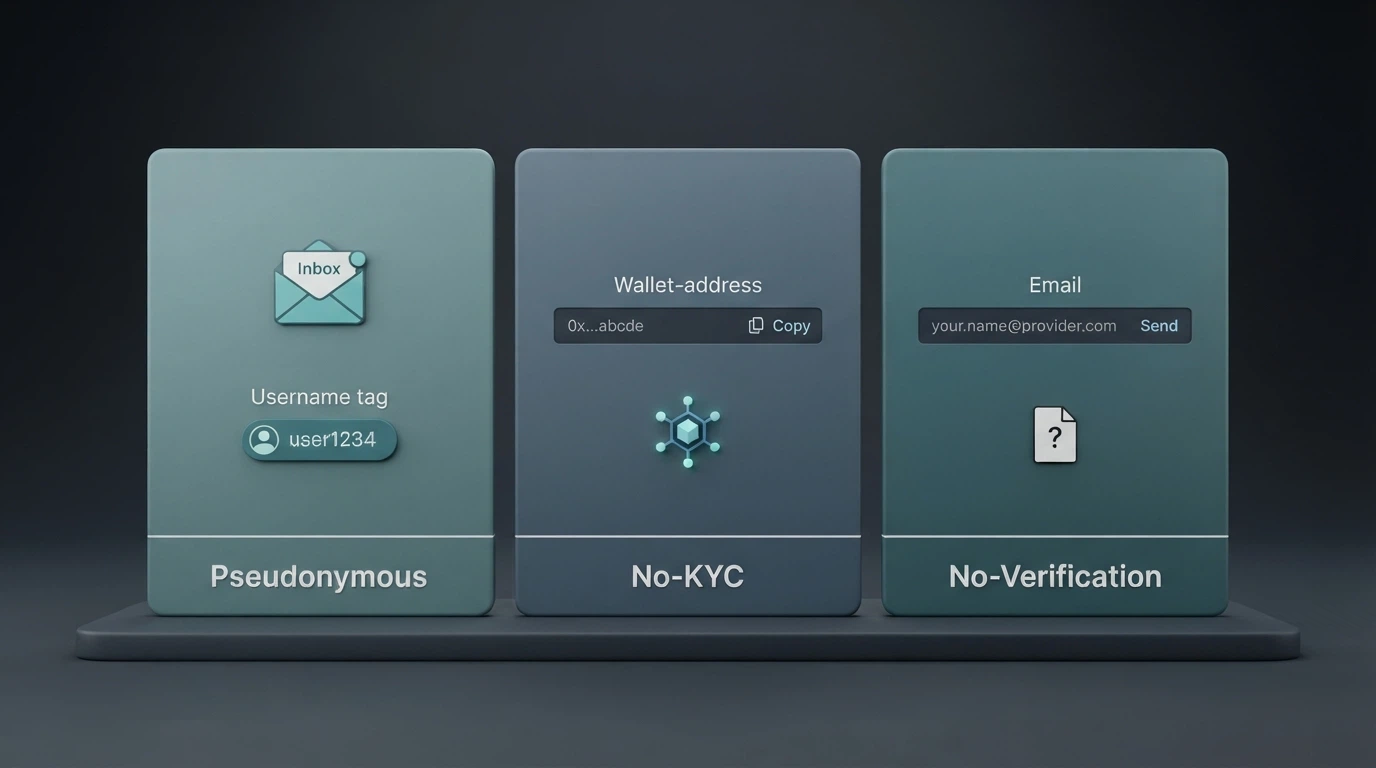
A no-KYC casino is the same sign-up, but the operator publishes a written commitment to never ask for identity documents regardless of how large the withdrawal becomes. This is the strongest tier and the hardest to maintain. AML rules on the operator’s licence still allow it to refuse a withdrawal pending a review; “no KYC” is the operator’s policy, not a regulatory exemption.
A no-verification casino is a softer version. The brand markets itself as anonymous and the sign-up looks identical, but the small print usually reserves a right to request a passport, a driving licence or a proof of address when withdrawals cross a threshold the operator has set for itself. At Curaçao- and Anjouan-licensed brands that threshold is typically EUR 2,000 to EUR 10,000 in cumulative withdrawals or deposits. Below the line, no questions. Above it, the sign-up you signed up with is no longer the only thing the casino knows about you.
The practical upshot: there is no on/off switch called “anonymous”. There is a sign-up screen that does not ask for ID, and a withdrawal screen that may. The player who plans to win small and withdraw small will rarely feel the line. The player who lands a big score will meet it at the worst possible moment.
Real-money play without a verified identity — what that actually means
Real money is real money at these casinos, and that is the part of the pitch that holds up. The cashier converts your USDT, BTC or SOL into an in-house balance at a live rate, the games are the same licensed releases the regulated market carries, and a withdrawal back to your crypto wallet settles against the same live rate. None of that needs a name attached to it.
What the anonymity buys you, in practice, is a deposit and a withdrawal that do not pass through a bank account in your name. No PayID receipt lands in your transaction history. No BPAY reference identifies the payee. The casino tolerates this arrangement because it has moved its own AML compliance offshore — it is not AUSTRAC-regulated and does not report to AUSTRAC, which is the Australian Transaction Reports and Analysis Centre. The privacy model reflects the casino’s own policy, not Australian law. There is no loophole in that arrangement. There is only a regulator who has decided the casino is not within their jurisdiction.
The wall comes when a win is large enough to cross the operator’s own internal threshold. The casino can ask for verification at that point, and most do. The player who thought “no ID” meant no ID discovers that the rule was always conditional. It is not a fraud. It is just how the model works on the day the model matters.
Mobile access to anonymous crypto casinos
Every casino on this page runs in a mobile browser. There is no app store footprint — these brands do not ship an iOS or Android binary that Apple or Google could pull from a regional store, and that is itself a privacy feature, since the absence of an app store listing keeps the casino off a phone’s app inventory and out of the in-app payment rails. The trade-off is the trade-off every web app carries: no push notifications, no biometric login by default, no native payment sheet. The casino’s own wallet-address field is the only login field.
Functional parity with desktop is the practical claim here, and it holds. Game lobbies adapt to portrait orientation, live-dealer tables resize to phone screens, and the cashier’s QR code is sized for a phone camera. What you give up is the polish of a native app — the offline state, the smoother animations, the home-screen icon. What you keep is the absence of an app-store intermediary who knows you installed the thing.
Pokies and slot titles at no-KYC casinos
The games are the same games the licensed Australian market cannot legally host online. The studios that produce them — Pragmatic Play, Play’n GO, NetEnt, Wazdan, BGaming, PG Soft, CT Gaming — ship the same RTP-certified builds to offshore casinos. The difference is in how you fund the spin, not the spin itself. Several titles appear across multiple offshore casinos with the same maths. A short, honest summary of the data research was able to verify:
| Slot Title | Provider | RTP | Volatility |
|---|---|---|---|
| Book of Dead | Play’n GO | 96.21% | — |
| The Dog House Megaways | Pragmatic Play | 96.55% | High |
| Buffalo King Megaways | Pragmatic Play | 96.52% | High |
| 36 Coins | Wazdan | 96.16% | High |
| Australian Magic | CT Gaming | 96.4% | Medium-High |
| Piggy Riches | NetEnt | 96.38% | Medium |
| Crypto Gold | PG Soft | 96.71% | — |
| Merge Up 2 | BGaming | 98.00% | — |
| Sugar Mix | BGaming | 97.37% | — |
| Wild Wick | BGaming | 97.35% | — |
A note on the numbers. Book of Dead ships in multiple RTP configurations from Play’n GO — 96.21%, 95%, 92%, 91.2%, 87.2% and 84.2%. The 96.21% version is the standard build; the 84.2% version is what a casino configured for higher margin plays. The player has no way to see the active version from the lobby. The Dog House Megaways publishes 96.55% RTP and is classified high volatility on Pragmatic Play’s own four-out-of-five scale. Buffalo King Megaways runs at 96.52% default with a reduced variant at 94.51%, 200,704 ways to win, and the same high-volatility tag. 36 Coins is a Wazdan release with three selectable volatility settings — the player picks how rough the ride is. Australian Magic, at 96.4% RTP and a max win of 2,500x, is the slot whose theme tells you exactly which market it was built for. BGaming’s catalogue carries the heaviest concentration of high-volatility maths in the table: 64 high-volatility titles, 17 medium, 3 low, and 2 very-high across their portfolio.
The column the table does not show is the one that matters most: the active RTP on the casino you are playing at. A 96.5% title played at 94.5% costs the player an extra 2% of every dollar wagered across a session. That is the difference between a fair maths setup and a configured margin. There is no way to see it from the lobby.
The Crypto Engine: Why Bitcoin and Stablecoins Make No-KYC Play Possible
Crypto is not a payment rail added for convenience at these casinos. It is the structural reason the ID check can be skipped at all. A wallet address is not a name. A blockchain settlement is not a bank transfer. The casino holds the house edge either way — the rail underneath just happens to be one that does not require a counterparty in the formal banking system.

The deposit methods that keep your name off the ledger
Bitcoin, USDT on TRC-20, Solana and Litecoin are the commonly accepted set at the casinos on this page. The workflow from an Australian player’s perspective runs: open a crypto wallet, buy the coin on an exchange, send it to the casino’s deposit address, see the balance land. The exchange is the only place a name meets a coin, and even there the link is between the exchange account and the wallet, not between the wallet and the casino.
The deposit timelines research was able to verify vary sharply by coin. USDT on TRC-20 lands in under sixty seconds on a fast network; the withdrawal back to your wallet completes in under five minutes for a network fee under A$0.50. Bitcoin takes ten to sixty minutes to land and fifteen to sixty minutes to withdraw, with network fees of A$5 to A$20 — Bitcoin is the slowest and most expensive of the common set. Solana settles withdrawals in two to five minutes for fees under A$0.01, which is the speed-and-cost winner at the network layer. Litecoin sits between them: five to fifteen minutes out, fees of A$0.05 to A$0.20.
Each coin carries its own trade-off. Bitcoin is the most familiar and the most expensive; USDT is a stablecoin pegged to the US dollar, which means the value of your bankroll does not move while it sits in the casino; Solana is fast and cheap but supported by fewer operators; Litecoin is a middle ground that no casino rejects but no casino highlights. The choice between them is a choice between speed, cost and price stability.
Instant crypto withdrawals — the speed advantage fiat casinos cannot match
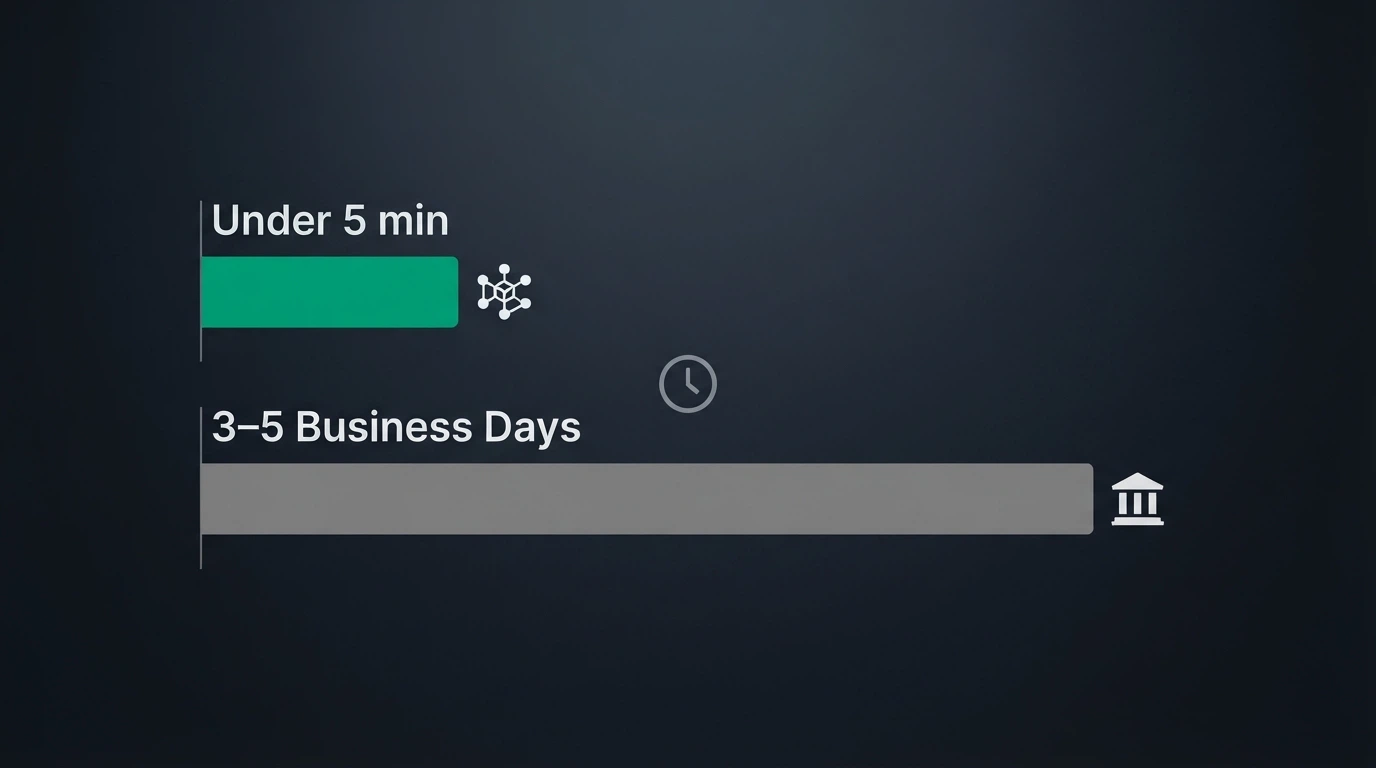
The withdrawal experience is the second half of the proposition. A fiat casino withdrawal moves through a bank — and a bank is a counterparty that holds your name, runs an AML check, applies a hold period and takes one to three business days. A crypto withdrawal moves through a blockchain and a casino cashier. The bottleneck is the casino, not the network.
| Cryptocurrency (Network) | Deposit Time | Withdrawal Time | Network Fee (AUD) |
|---|---|---|---|
| USDT (TRC-20) | Under 60 seconds | Under 5 minutes | Under A$0.50 |
| Solana (SOL) | — | 2–5 minutes | Under A$0.01 |
| Litecoin (LTC) | — | 5–15 minutes | A$0.05–A$0.20 |
| Bitcoin (BTC) | 10–60 minutes | 15–60 minutes | A$5–A$20 |
The numbers that land the proposition sit in that table. Every crypto withdrawal has two stages: Stage 1 is the casino’s own processing queue, which the operator controls, and Stage 2 is the blockchain confirmation, which the operator does not. Stage 1 typically runs ten to sixty minutes at no-KYC casinos; Stage 2 depends on the coin. A USDT withdrawal that the casino processes in twelve minutes will land in your wallet inside the quarter-hour, total. A Bitcoin withdrawal that the casino processes in ten minutes still waits another twenty to fifty minutes for block confirmations before the balance is spendable.
This is the single advantage offshore crypto casinos can claim that no fiat casino can match. Whether the advantage justifies the other trade-offs is a different question — one the responsible-gambling and legality sections below revisit.
Why no-KYC play works with crypto — and why it does not work with dollars
A fiat deposit at an Australian-licensed online bookmaker is a bank-mediated transaction. The bank knows the payee. The bank runs the AML check. The deposit cap, when it exists, is enforced by the bank. A crypto deposit is a wallet-to-wallet transfer. The wallet does not have a name. The transfer does not have a payee in the formal sense — only an address that the casino holds the private key to.
That structural gap is what makes the whole category possible. Remove the crypto rail and the no-KYC casino collapses into either an unlicensed fiat casino (which the same offshore operator already runs and which AU banks are positioned to start blocking from 2027) or a licensed Australian bookmaker that verifies everyone by law. The crypto rail is not a feature added to the product. It is the load-bearing wall.
The Australian banking system is not blind to this. From 11 June 2024, the Interactive Gambling Amendment (Credit and Other Measures) Act 2023 made it an offence for licensed wagering operators to accept crypto as payment, with penalties up to A$247,500 per breach. An Australian asked for a crypto deposit by a gambling site is being served by someone outside the Australian rulebook — that is the regulatory tell embedded in the deposit screen. From 1 January 2027, banks gain express statutory authority to block transactions to illegal gambling operators. The crypto path sits on the same side of that line as the fiat path, and it sits there because no licensed Australian operator is permitted to take it.
The AU crypto payment ban and the signal it sends about every operator on this page
The crypto payment ban is the most important single fact on this page, and it is not about the player’s behaviour. It is about the operator’s. A licensed Australian wagering provider cannot accept your USDT, your BTC or your SOL — that door closed on 11 June 2024. Any casino that still takes it is, by definition, unlicensed in Australia.
That is the regulatory fingerprint on every brand in the ranked list below. None of them holds an Australian wagering licence, because no Australian wagering licence covers online casino games — that product is prohibited under the Interactive Gambling Act 2001 and has never been licensable at the federal level or in any state or territory. The 2017 amendment to the Interactive Gambling Act closed the loopholes offshore operators had been exploiting and gave the Australian Communications and Media Authority its enforcement and blocking powers. Since its first blocking request in November 2019, ACMA has had 1,564 illegal gambling and affiliate websites blocked by Australian internet service providers as of March 2026, and more than 225 illegal services have withdrawn from the Australian market since 2017.
The crypto payment ban tightens the screws on the licensed side. It does nothing to the offshore side, because the offshore side was never on this side to begin with. Reading that as a “loophole” misses the structure — the offshore casino is not breaking an Australian rule, it is simply not subject to it. The Australian player is also not subject to it. The protection gap is what that arrangement costs.
10 Anonymous Crypto Casinos Accessible to Australian Players in 2026
The set below is the ten offshore brands Australian players search for most in the anonymous crypto niche. Every one of them sits outside the Australian rulebook. The first comparison is the most important one.
| Operator | Status |
|---|---|
| Stake | Offshore |
| Rocket Play | Offshore |
| Skycrown | Offshore |
| Royal Reels | Offshore |
| WinSpirit | Offshore |
| Rainbet | Offshore |
| Scream Casino | Offshore |
| FairGO | Offshore |
| Bizzo Casino | Offshore |
| Rocket Casino | Offshore |
Domains marked with an em dash did not surface in the source sweep this round and are not confirmed here. Every operator in the table is offshore and not Australian-licensed — that applies equally to the seven with confirmed domains and the three without. No further distinction is implied by either column.
Stake
Stake is the largest crypto casino by volume, and the brand most-cited in the space as the benchmark for what a crypto-native platform looks like. The product is built around the wallet address — there is no separate fiat cashier, no bank-transfer fallback, no PayID option. You fund the balance in BTC, ETH, USDT, LTC, DOGE and a handful of altcoins, and the cashier settles to your wallet inside minutes.
The licence commonly cited for Stake is Curaçao, which is the standard offshore licence for the crypto-casino segment. That jurisdiction is widely reported and not verified against the register this run. It carries the same limitations as any other Curaçao-licensed operator — the binding authority is the operator’s own house rules and the regulator’s complaint process, not Australian consumer law.
Stake’s positioning in this list is “the established crypto casino against which every newer entrant is measured”. That positioning holds for product, liquidity and provably-fair transparency. It does not hold for Australian consumer protection — the brand is offshore, the regulator is offshore, and the player’s recourse if a withdrawal stalls is the operator’s own complaints email.
Verdict: the safest pick of the ten for a player who values a high-volume, crypto-native product with a widely-reported licence — provided they understand that “widely reported” is not the same as “verified here”.
Rocket Play
Rocket Play sits in the established mid-tier of AU-facing offshore brands. The site positions itself as a full-service casino and sportsbook with a crypto deposit angle, and the game library is broad enough to be the operator’s main draw rather than its bonus banner.
The operator is offshore. The licence jurisdiction, bonus terms and provider roster did not surface in this research sweep and are not stated here. The casino’s AU-facing marketing is its strongest visible feature — it speaks to Australian players in Australian English and frames its bonus terms in AUD rather than USD or EUR.
Verdict: a credible mid-tier pick for the player who wants an offshore casino with a recognisable Australian marketing surface and is comfortable taking the licence, terms and provider list on faith from the operator’s own materials.
Skycrown
Skycrown is a newer entrant with a strong presence in Australian search results for the crypto casino niche. The brand’s pitch is crypto-forward and the casino’s homepage frames its deposit options in coins rather than cards.
The operator is offshore. The licence and bonus specifics did not surface this round. The public-facing site makes an anonymity claim that the page cannot independently verify, and the responsible-gambling section below addresses why the gap between a brand’s claim and an external register’s confirmation matters in this category.
Verdict: a reasonable inclusion for a player who has already narrowed the field to crypto-first offshore brands, but a weaker choice than the established top tier until the licence and terms surface for review.
Royal Reels
Royal Reels is the kind of offshore brand whose name does the heavy lifting in the marketing. The name targets the Australian market directly — “Reels” is pokies vocabulary, “Royal” is a casual-affluent register — and the homepage leans into both. Whether that is honest positioning or borrowed familiarity is the kind of question a licence register would answer, and the research this round did not confirm a domain or a regulator for the brand.
Verdict: a brand for the player who is buying the marketing surface rather than the licence, and who has already accepted that the marketing surface is the only verifiable thing about the operator. If that is the deal you want, you want it knowingly.
WinSpirit
WinSpirit is a mid-tier offshore operator with a social-casino flavour in the branding and a crypto deposit option in the cashier. The site positions itself as casual and accessible, and its public presence suggests a lighter promotional style than the high-volume bonus banners the larger brands run.
Neither the domain nor the licence jurisdiction was confirmed in the research sweep. The brand’s anonymity posture is qualitative — it does not run a KYC-promise banner the way the strictest tier does, which suggests either the “no-verification” tier with a trigger threshold, or a model whose tier the brand does not publish.
Verdict: a second-tier pick for a player whose deposit size will sit comfortably below the kind of AML threshold that triggers a verification request — and a poor pick for a player planning a large, infrequent withdrawal.
Rainbet
Rainbet is a crypto-first sportsbook and casino hybrid, and the brand’s pitch in AU search is its dual proposition: sports markets under the same wallet as slots and live-dealer tables. The operator is offshore. The licence and bonus specifics were not surfaced.
The hybrid model is the brand’s structural advantage and its structural complication. A sportsbook player who wants pre-match odds and live in-play will find the latter prohibited for Australian-licensed operators — Rainbet, being offshore, can offer what the Australian market cannot. A casino player will find the game library shared with other crypto-first brands.
Verdict: the natural pick for a player who wants sportsbook and casino under one wallet and who has already decided the offshore trade-off is acceptable. Less natural as a casino-only choice.
Scream Casino
Scream Casino is a smaller offshore brand visible in AU crypto-casino search results. The domain did not surface in this research round and the brand’s public presence is limited enough that neither the licence, the provider roster nor the bonus structure can be stated here.
Verdict: a placeholder pick — included because it ranks in AU search visibility for the niche, not because the page can independently verify any structural claim about the operator. A player researching this brand before depositing should treat the marketing as the only source until a licence check surfaces elsewhere.
FairGO
FairGO is the kind of brand name that promises fairness to Australian punters in two words. The marketing surface is plainly Australian — “Fair” and “GO” are local register, the colour palette is the warm red-gold familiar from Australian racing media. The product, however, sits outside Australian consumer law.
The operator is offshore. The licence jurisdiction did not surface. The gap between the Australian-facing brand and the offshore licence reality is the most important thing to know about this operator before depositing: the name promises something Australian consumer law does not cover for offshore casinos, and the regulator does not exist for the brand to be measured against.
Verdict: a brand whose marketing language does the work its licence cannot do. Choose it for the product the brand delivers, not for the consumer protection the brand name implies.
Bizzo Casino
Bizzo Casino is a high-visibility offshore brand in Australian search, with a large game count and a promotional tempo that lands it on the bonus-banner side of the category. The operator is offshore. The licence and bonus specifics were not surfaced in this round.
The brand’s prominence in AU search is its main verifiable feature — it appears in the top results for the niche and carries a game count well into the thousands. Promotional volume and product quality are different things, and the responsible-gambling section below explains why aggressive bonus marketing deserves closer reading at offshore casinos than at licensed ones.
Verdict: a familiar pick for an Australian player who has already seen the brand in search and wants to deposit at a casino they recognise. The familiarity is marketing-driven, and the marketing does not check the licence.
Rocket Casino
Rocket Casino is a fast-growing offshore brand that should not be confused with Rocket Play. The two share the “Rocket” prefix and the offshore positioning, and that is where the resemblance ends. Rocket Casino’s public pitch centres on a streamlined crypto deposit flow and a game library that overlaps the wider crypto-casino segment.
The operator is offshore. The licence and bonus terms did not surface. The distinguishability from Rocket Play matters because the names invite a player to assume one is a rebrand of the other, and that assumption is the kind of thing a verification step would catch before the deposit.
Verdict: a reasonable inclusion for the player who has compared it against Rocket Play and concluded the deposit flow, the game library and the licence posture are worth the distinction — and a poor pick for a player who has not made that comparison and is choosing by name.
Your Standing Under Australian Law: Offshore, Unregulated and What That Costs You
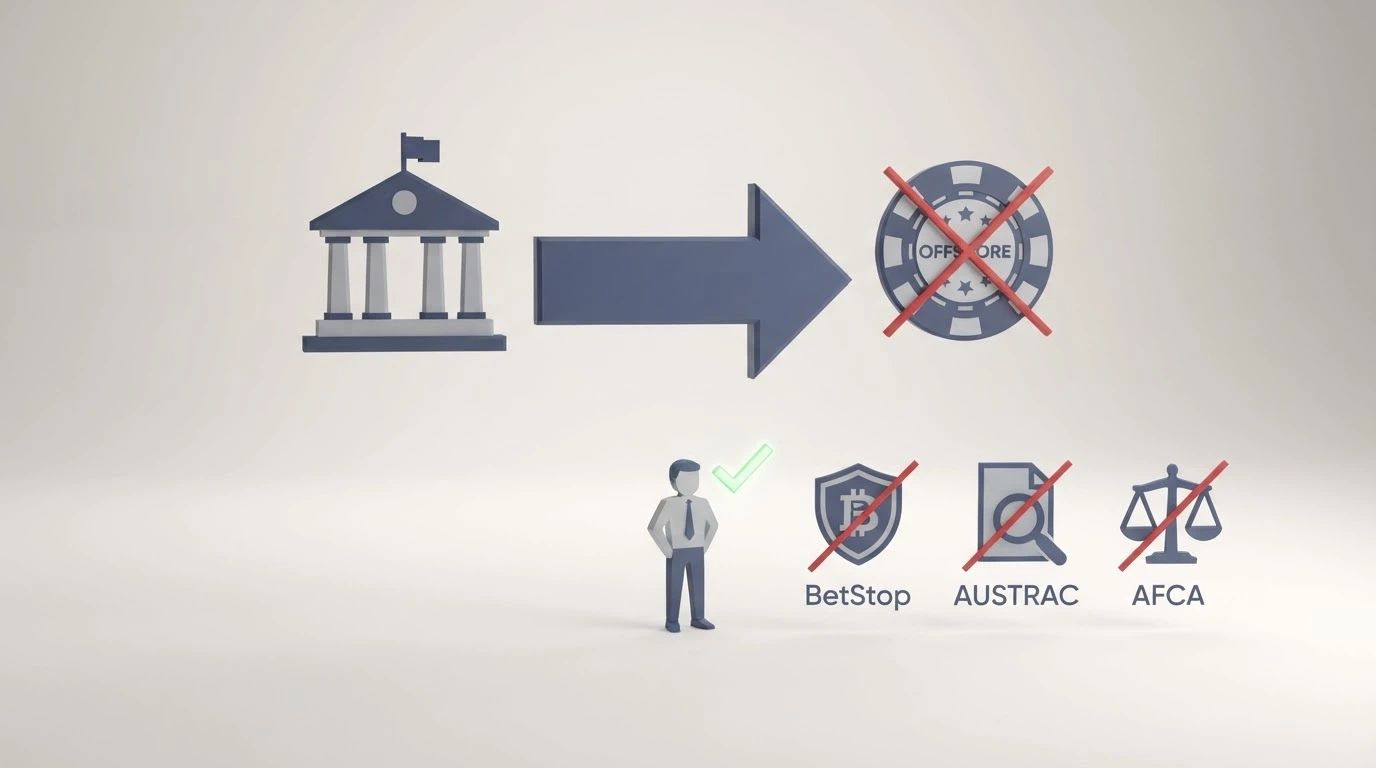
The legal position is the single most important fact about this page, and it is the fact the marketing does not lead with. Every casino on this page is offshore. Every one is offering a product that is prohibited in Australia. The player is not the target of the law, and the player is also not the beneficiary of it.
The IGA prohibition and what ACMA enforcement actually looks like
The Interactive Gambling Act 2001 prohibits the provision of online casino games, online pokies and in-play sports betting to people in Australia. There is no Australian licence that covers online casino, not federally and not in any state or territory. The 2017 amendment closed the loopholes that offshore operators had been exploiting and gave ACMA the enforcement and blocking powers it uses today. Since the first blocking request in November 2019, ACMA has had 1,564 illegal gambling and affiliate websites blocked by Australian internet service providers as of March 2026, and more than 225 illegal services have withdrawn from the Australian market since 2017.
That is what enforcement looks like in practice. ACMA investigates complaints, issues warnings, runs civil penalty proceedings and directs ISPs to block domains. The operator that gets blocked loses its Australian traffic overnight. The operator that withdraws does so because the cost of staying has become uneconomic, not because the prohibition has been lifted.
The penalty regime on the payment side is sharper than the penalty regime on the provision side. The Interactive Gambling Amendment (Credit and Other Measures) Act 2023 made it an offence for licensed wagering operators to accept credit cards, credit-related products or digital currency — that is, crypto — for online wagering from 11 June 2024, with penalties up to A$247,500 per breach. The provision offence is harder to enforce against an offshore operator than the payment offence is to enforce against a licensed one.
What you give up playing without a licensed register: no BetStop, no AUSTRAC, no dispute pathway
The BetStop national self-exclusion register, live since 21 August 2023, is the strongest consumer-protection tool Australia has built for online gamblers. As of 31 March 2026, 59,830 people had registered to self-exclude, with 37,247 active exclusions. BetStop covers approximately 150 licensed wagering providers. Offshore crypto casinos are not connected to the register — a self-excluded Australian can deposit at any of the ten operators in the ranked list above without the register’s knowledge, and the casino will not refuse the deposit.
AUSTRAC, the Australian Transaction Reports and Analysis Centre that regulates AML compliance for licensed operators, has no oversight of offshore crypto casinos. The casino is not required to report suspicious transactions to AUSTRAC. The privacy model at these sites is the casino’s own policy, not Australian law. There is no Australian financial ombudsman to escalate a dispute to. There is no equivalent of the Australian Financial Complaints Authority. The operator’s own complaints process is the only process.
What that means in a moment of friction — a withdrawal that stalls, a bonus term that gets reinterpreted mid-play, a win that the operator voids for a rule the player did not see in the small print — is that the player has the same options they had before the dispute began: contact the operator, escalate within the operator’s own structure, and accept the outcome. There is no external body to complain to. There is no court of last resort. The operator’s word is the final word, on the operator’s terms.
The 2026–2027 reforms: bank blocks, ad caps and the AdStop register
The Interactive Gambling Amendment (Gambling Reform) Bill 2026 passed Parliament on 19 August 2026 and its measures commence on 1 January 2027. From that date, banks and payment providers gain express statutory authority to block transactions to illegal gambling operators. The provision is aimed at licensed banks and at fiat payment providers; whether it reaches crypto on-chain transactions is a different question, and a crypto deposit to an offshore casino wallet does not pass through a bank at all.
The reform package also tightens the licensed wagering sector’s advertising environment. From 1 January 2027, no more than three wagering ads per hour may run between 6:00 am and 8:30 pm, with a live-sport blackout from fifteen minutes before to five minutes after a live sporting event. Direct marketing of inducements is prohibited for fourteen days after sign-up, three months after BetStop deregistration, and indefinitely for at-risk customers. A national wagering advertising opt-out register, AdStop, is administered by ACMA. The costs of administering and enforcing the reform are recovered through a levy on licensed interactive wagering operators.
The reforms apply to the licensed wagering sector, not to offshore casinos. An offshore crypto casino will not see an advertising cap reach its banner network in the same way, and AdStop will not catch its affiliate pages. What the reforms may do is make the deposit path from an Australian bank account harder, and that is a friction the player who already pays in crypto will not feel — and that is, in part, the point of paying in crypto at these casinos.
Bonus Offers at No-KYC Casinos — Separating the Real Value from the Print
The bonus banner at an anonymous crypto casino is the first number the player sees and the last number that reflects reality. The headline is the invitation. The terms underneath are the offer.

Offers that ask for nothing upfront — no-deposit bonuses and free spins explained
A no-deposit bonus sounds like free money because the deposit it skips is the part the player pays for. The mechanic is straightforward: sign up, claim the bonus or the spins, play them, meet the wagering requirement if the bonus has one, withdraw what is left. No money in. Something out, if the terms cooperate.
The terms usually do not cooperate as cleanly as the banner. A no-deposit bonus carries a wagering requirement that applies to the winnings, not the bonus itself — a 40x wagering requirement on a A$10 no-deposit bonus means the player must wager A$400 before any winnings become withdrawable. The eligible games are usually restricted to a short list, often weighted at 100% on slots and 10% or 0% on table games. The max cashout cap — the most important number on the offer — limits what the player can actually withdraw, regardless of how much they won. A A$50 max cashout on a bonus that paid out A$300 leaves the player with A$50 and the casino with A$250.
Free spins are a sub-type with their own trade-offs. The per-spin value is set by the operator — A$0.10 per spin is common. The eligible title is chosen by the operator and is usually a single slot. The winnings from the spins may carry their own wagering requirement, or may come with a cashout cap that converts a 50-spin win into a small fixed payout. “Free” is structural. “Yours” is conditional.
No-deposit offers are rarer at no-KYC casinos than at their KYC-gated counterparts, because the casino’s fraud risk on a no-deposit bonus is higher when the player cannot be identified at the point of claim. The offers that exist tend to carry tighter caps. The mechanics are the same ones every regulated casino uses; the enforcement against a casino that ignores its own terms is weaker at an offshore operator, which is the relevant difference.
Matched-deposit welcome deals and the turnover strings attached
A matched-deposit welcome deal is the most common bonus type at offshore crypto casinos. The mechanic is also straightforward: deposit X, the casino matches X up to a ceiling, the combined balance is subject to a wagering multiplier before withdrawal. A 100% match up to A$500 with a 40x wagering requirement on the bonus means a A$500 deposit becomes a A$1,000 balance that must be wagered 40 times — A$40,000 of turnover — before any of the bonus-derived winnings becomes withdrawable.
The wagering multiplier is the number that matters. A 20x requirement is reasonable for a slots-focused bonus. A 40x requirement is the industry standard. Anything above 50x is steep. The eligible games table usually weights slots at 100%, table games at 10% or 0%, and live-dealer games at 0% — meaning the player who likes blackjack meets their wagering requirement at one-tenth the speed of the slots player, or not at all.
The contrast that matters here is wager-free. Jackbit, as a benchmark brand outside the ranked set, offers a 100% deposit match with 100 wager-free spins on Hot Chilli Bells on a US$50+ deposit. “Wager-free” means the winnings from those spins are withdrawable without a turnover requirement — the bonus pays out at face value rather than as a number the player must multiply and grind through. That structure exists. It is rare at no-KYC casinos, and it is the one worth looking for.
The max cashout cap, the bonus validity window and the per-game contribution list are the three secondary numbers that turn a 40x bonus into either a reasonable grind or a futile one. The player who reads them before depositing makes a different decision than the player who reads them after. The page recommends reading them before.
Playing Without a Net: Responsible Gambling When the Register Stays Home
The BetStop register is the strongest consumer-protection tool Australia has built for online gambling, and the responsible-gambling story on this page is the gap between BetStop and the operators above it. BetStop binds licensed wagering providers. It does not bind offshore crypto casinos. A self-excluded Australian who has registered with BetStop can still open an account at any of the ten operators on this page and deposit without the casino’s knowledge.
That is the responsible-gambling headline of this category, and the resources below are the answer to it. They work regardless of where the casino is licensed.
The help resources every Australian player should know — helpline, online chat and self-exclusion
The infrastructure is in place. It is free, confidential, and available 24 hours a day. The gap is that none of it lives at the casino — every one of these resources is a separate organisation the player reaches out to, not a control the casino enforces.
- National Gambling Helpline — 1800 858 858. Free, confidential, staffed 24 hours a day, 7 days a week. The first call any Australian with a gambling concern should make.
- Gambling Help Online — gamblinghelponline.org.au. Online chat and professional counselling, available outside business hours. The website is the right place to start for a player who would rather type than talk.
- BetStop — betstop.gov.au. The National Self-Exclusion Register. Covers approximately 150 licensed wagering providers. Does not cover offshore crypto casinos. Registering is still worth doing: it binds the licensed sector, which is the sector a self-excluded player is most likely to encounter by accident.
- The Statutory Review of BetStop, published 25 February 2026, made 10 recommendations to optimise BetStop’s role. The review’s existence is itself a signal that the register’s effectiveness is being measured and its gaps are being mapped.
The first three are the everyday toolkit. The fourth is the policy layer the player should be aware of. None of them is a substitute for the player’s own discipline, and none of them removes the offshore gap.
How big the harm problem actually is in Australia — the numbers the category pages leave out
The numbers below are the ones the affiliate pages leave in a footer disclaimer. They are also the reason the resources above exist.
About 2.1% of Australian adults — roughly 430,000 people — experience problem gambling, with the Australian Institute of Health and Welfare putting high-risk gambling at 1.8% in 2022. The modelled national scenario is starker: approximately 3.29 million Australians aged five and over are affected annually by gambling harm, and approximately 1,970,000 adults are classified as having at-risk or problem gambling. The annual health burden among Australian adults is estimated at over 400,000 Years Lived with Disability — a measure of the years of healthy life lost to gambling-related harm.
Risky gambling in Australia increased from 13.7% in 2024 to 19.4% in 2025, a rise of more than five percentage points in a single year. Overall gambling participation declined slightly to 58.8% in 2025, but 56.1% of those who gambled did so mainly online. The shift to online play is the structural change that puts the category on this page. Approximately 5.9% of Australian adults reported being harmed by another person’s gambling in the past 12 months — the second-order cost that does not show up in any player’s own betting record.
The BetStop outcomes research adds the resolution side. 77% of people who registered for BetStop self-exclusion report a better quality of life; 79% report improved mental health; 96% of registrants surveyed either completely stopped betting (81%) or decreased their betting (15%). The register works. Its limitation is that it works inside the licensed sector, and the operators above are outside it.
How We Evaluated and Ordered These Operators
The ten operators above are the brands Australian players search for most in the anonymous crypto casino niche in 2026. The ranking is ordered by relevance to the niche and visibility in AU search traffic, not by licensed market standing — there is no licensed market standing for any of them, because no online casino licence exists under the Interactive Gambling Act 2001.
The research consulted competitor pages for the operator set, the slot title data, and the per-coin withdrawal speeds. The Australian Communications and Media Authority register was checked for the legality, blocking and BetStop coverage claims. Curaçao and Anjouan licence registries were the intended source for operator licence verification, but the operator-sweep queries needed to populate those fields did not complete in this research round.
The criteria that ordered the ranking were: crypto support and no-KYC policy robustness, withdrawal speed, AU-player accessibility, and market visibility. The criterion that did not order the ranking — licensed product availability — applies to all ten operators equally: none is licensed in Australia.
The limitations are the limitations the gaps in the table above already show. Bonus terms, wagering requirements, max cashout caps, welcome offer specifics and licence dates for the ten featured operators were not verified against a regulator register this round. Domains for three of the ten did not surface. The page carries the no-data marker on those fields rather than fabricating values. Where a licence jurisdiction is named, it is because the brand itself reports it on its public-facing materials — not because the page has independently verified the licence number against a register. That is the difference between a commonly-cited licence and a verified one, and the page keeps the distinction.
What You Should Actually Do With This Page
The page has laid out the operators, the law, the protections that do not apply and the cost of playing. What a rational player does with that information is a separate decision from whether to play.
If you play, you play offshore, with no BetStop coverage, no AUSTRAC oversight, no Australian dispute pathway, and a regulatory direction of travel that points toward harder depositing rather than easier. The crypto payment ban already prevents every licensed Australian operator from offering the deposit method you are about to use. The 2027 reforms will give banks express authority to block transactions to illegal gambling operators — a friction that affects the fiat path more than the crypto path, and a friction that explains part of why these casinos are still worth running from the operator’s side.
The practical steps that reduce harm are the ones no casino on this page will apply for you. Set a deposit limit yourself, because the casino will not. Use a stablecoin — USDT — to avoid the Bitcoin fee erosion that eats small withdrawals. Register with BetStop even though it does not cover these sites, because it does cover the licensed products you might also use, and a self-exclusion that binds 150 operators is better than one that binds none. Save the National Gambling Helpline number — 1800 858 858 — before you deposit, not after. The call is free, confidential and available 24/7.
Crypto casinos reward disciplined players with a stablecoin bankroll and punish everyone else harder, because the safety nets are absent. The category is the right pick for a player who values speed and privacy, holds a disciplined bankroll and understands that “no KYC” is the operator’s policy rather than a regulatory guarantee. It is the wrong pick for a player who would benefit from BetStop integration, who plans a withdrawal large enough to cross an AML threshold, or who wants an Australian dispute pathway when a casino refuses a payout. Those are the two sides of the choice. The page names them; the reader picks.
Frequently Asked Questions
Are anonymous crypto casinos legal in Australia?
No — for the operator. The Interactive Gambling Act 2001 prohibits the provision of online casino games to people in Australia, and no Australian licence covers online casino, federally or in any state or territory. The individual player is not prosecuted under the IGA, because the law targets the provider, not the person using the service. Every operator on this page is offshore and unlicensed in Australia.
What does “no KYC” actually mean at an online casino — can I really play without showing ID?
Yes — up to a point. The category splits into three models: pseudonymous (email and username sign-up, no government ID requested during play), no-KYC (a written commitment to never request identity documents regardless of withdrawal size), and no-verification (sign-up looks the same, but the small print usually reserves a right to request a passport or proof of address above an internal threshold). At Curaçao- and Anjouan-licensed brands that threshold typically sits between EUR 2,000 and EUR 10,000 in cumulative withdrawals or deposits. Below the threshold, no ID. Above it, the casino may ask.
Which cryptocurrencies are accepted at anonymous casinos in Australia, and which is fastest for withdrawals?
Bitcoin, USDT on TRC-20, Solana and Litecoin are the commonly accepted set. USDT on TRC-20 is the fastest for an Australian player: under 60 seconds to deposit, under 5 minutes to withdraw, network fee under A$0.50. Solana settles withdrawals in 2–5 minutes for fees under A$0.01. Litecoin takes 5–15 minutes for fees of A$0.05–A$0.20. Bitcoin is the slowest and most expensive: 10–60 minutes to deposit, 15–60 minutes to withdraw, fees of A$5–A$20.
Does BetStop cover offshore crypto casinos if I self-exclude?
No. BetStop — the National Self-Exclusion Register — covers approximately 150 licensed wagering providers in Australia. Offshore crypto casinos are not connected to the register, and registering with BetStop will not stop an offshore casino from accepting your deposit. As of 31 March 2026, 59,830 people had registered with BetStop and 37,247 exclusions were active. The register is the strongest consumer-protection tool Australia has built for online gambling, and its reach stops at the Australian border.
Can Australian banks block transactions to crypto gambling sites?
From 1 January 2027, banks and payment providers gain express statutory authority to block transactions to illegal gambling operators under the Interactive Gambling Amendment (Gambling Reform) Bill 2026, which passed Parliament on 19 August 2026. The provision is aimed at bank-mediated transactions. A crypto on-chain deposit does not pass through a bank at all, which is part of why the crypto path remains the offshore casino’s deposit method of choice. The 11 June 2024 crypto payment ban under the Interactive Gambling Amendment (Credit and Other Measures) Act 2023 already prevents licensed Australian wagering operators from accepting crypto — with penalties up to A$247,500 per breach.
Are anonymous casino bonuses (no deposit, free spins) genuinely deposit-free?
Structurally, yes — a no-deposit bonus or a free-spins offer does not require an upfront deposit to claim. What it usually carries is a wagering requirement on the winnings, a max cashout cap that limits what is actually withdrawable, and an eligible-games restriction that channels play into a short list of slots. Wager-free offers exist — Jackbit, as a benchmark brand, offers 100 wager-free spins on Hot Chilli Bells on a US$50+ deposit — but they are rare at no-KYC casinos. “Deposit-free” and “cost-free” are different words for the same offer.
Created by the ”Min Deposit 5 Casinos AU” editorial team.