
Minimum AU$1 Casino Deposits in 2026: The Facts Behind the Marketing
 Available in US
Data current as of 3 September 2026 and verified against operator terms pages, ACMA enforcement records and Curaçao/MGA/Anjouan register listings.
A genuine AU$1 casino deposit in Australia is a rare edge case. It shows up only on a narrow band of crypto or specific card and e-wallet segments, never broadly through PayID or Neosurf. Anyone selling “$1 deposit” as a normal category of Australian online casino is either pointing you at a crypto rail, a voucher-remainder trick, or a brand that quietly raises the floor the moment you try to fund the account.
That is the shape of the market in 2026. The rest of this page is the detail of why, who actually accepts the dollar, what the bonus on the other side of it really costs, and the legal frame around a product the Interactive Gambling Act 2001 makes illegal to provide in this country. Every operator reviewed below is offshore. None holds an Australian online casino licence, because none can.
Table of Contents
- The Crypto Rail That Makes a One-Dollar Deposit Possible
- Where Fiat Hits a Wall — Why PayID and Cards Refuse a Dollar
- The Withdrawal Trap — Cashing Out Costs 25 Times Your Deposit
- 10 Offshore Casinos That Accept a $1 Deposit — Ranked
- Why Your Deposit Method Decides Whether $1 Actually Works
- The Pokies Worth Playing With a $1 Bankroll
- A $1 Bonus Sounds Generous — Until You Read the Wagering
- Mobile $1 Deposits — the Same Limits on a Smaller Screen
- Every $1 Deposit Casino Is Unlicensed in Australia — Here Is What That Means
- New $1 Deposit Casinos — Fresh Brands, Same Offshore Structure
- The Human Cost — Gambling Harm at the Lowest Stakes
- How We Evaluated These $1 Deposit Casinos
- The Real Cost of a One-Dollar Casino Deposit
- Frequently Asked Questions
The Crypto Rail That Makes a One-Dollar Deposit Possible
The honest sub-AU$10 deposit route for Australians in 2026 runs through crypto. The practical floor is about AU$5 in USDT-TRC20, the only stablecoin rail where the network fee (AU$0.50 to AU$1) leaves a usable bankroll after gas. Bitcoin works too, in theory: a published AU$0.10 BTC-equivalent floor at Stake, roughly AU$1 in USDT at BC.Game, and at Bitcasino.io the limit is effectively the network fee. The BTC fee itself runs AU$0.50 to AU$3, which on a AU$1 deposit is most of the bankroll gone before the first spin. USDT-TRC20 is the rail that survives the fee arithmetic.
The deposit flow is the same on every brand: load a wallet (Trust Wallet, Binance, Bybit, Kraken), buy USDT, copy the casino’s TRC-20 address, send, wait one to three minutes for the network confirmation, and the balance appears. The casino has no AU$1 floor problem because it never sees a payment-processor minimum — it sees a chain transfer of whatever size you choose. The cost of the rail is the spread between market and OTC price (a fraction of a cent on AU$5) and the AU$0.50 to AU$1 gas. On a AU$1 deposit that gas is half the bankroll, which is why the practical floor sits at AU$5: above that, the network fee stops being a material share of what is being staked.
Where Fiat Hits a Wall — Why PayID and Cards Refuse a Dollar
Fiat rails cannot land a AU$1 deposit, and the constraint is structural rather than operator-specific. Three forces combine:
PayID anti-fraud monitoring triggers disproportionately on transfers below AU$20, and roughly 12 of 15 AU-facing operators surveyed in 2026 gate PayID at AU$20 minimum. The PSP layer, not the casino, draws the line: payments-platforms treat sub-AU$20 PayID as a fraud signal because the volume of low-value PayID scam traffic is high enough to make the monitoring cost more than the transaction value. The casino is downstream of the PSP, and the casino accepts what the PSP will clear.
Neosurf vouchers in Australia are sold in fixed denominations of AU$10, AU$20, AU$50, AU$100 and AU$200. There is no AU$5 voucher in Australian distribution. A Neosurf “AU$1 deposit” is in practice a partial-use of a AU$10 voucher: load the voucher, wager enough to leave a AU$1 residual, deposit the residual. The deposit exists; the value is fictitious.
Visa and Mastercard processors enforce a AU$5 to AU$10 minimum because the interchange economics make sub-AU$5 transactions unprofitable. Credit cards are banned entirely as payment for online wagering in Australia since 11 June 2024 under the Interactive Gambling Amendment (Credit and Other Measures) Act 2023 — penalties up to $247,500 — so any gambling-accepting brand that lets you fund a deposit with a Visa credit card is, by definition, an offshore operator. Debit only is the floor, and even that floor is AU$5 at best.
No AU$5 fiat-deposit casino exists for Australian players, and the constraint is the market, not any single brand. PayID, Neosurf, and card-processor economics are each independently enough to kill a AU$1 fiat deposit, and they stack.
The Withdrawal Trap — Cashing Out Costs 25 Times Your Deposit
The same operators that advertise a AU$1 minimum deposit typically sit on a minimum withdrawal of AU$25 to AU$50, and sometimes AU$50 to AU$100. A handful add a 10× deposit cap on withdrawals: on a AU$1 deposit, that is a AU$10 maximum payout, regardless of how much the bonus winnings actually came to. The deposit-withdrawal asymmetry is the single most important number on this page, and it is the one the affiliate listicles tend to bury.
What it means in practice: a casual player who funds a AU$1 deposit, wins a small amount on free spins, and tries to cash out will find the minimum-withdrawal threshold is 25 to 50 times the deposit. Either the player tops up enough to clear the threshold (at which point the AU$1 minimum deposit is decorative — the real deposit was AU$25 to AU$50), or the player never cashes out at all. The AU$1 deposit is the funnel; the AU$30 average top-up is the actual sale.
The structural reason is the cost of processing payouts. A wire, a card reversal or a crypto on-ramp at the casino’s end costs a fixed amount that does not scale with the withdrawal size. AU$1 deposits would, if the casino honoured them as withdrawals, produce payouts that cost more in processing than they returned. The 10× deposit cap and the AU$25-to-AU$100 minimum withdrawal are how the operator recovers the processing cost, with margin.
10 Offshore Casinos That Accept a $1 Deposit — Ranked
Every operator below is offshore and unlicensed in Australia. Online casino is prohibited to provide in Australia under the Interactive Gambling Act 2001; no licence exists federally or in any state or territory. The brands below all accept Australian players, and none of them offer any Australian consumer protection, BetStop coverage or complaints recourse. Ranked by relevance to the AU$1 deposit topic, not by market share.
| Casino | Licence | $1 Deposit Via | $1 Bonus | Wagering | Max Cashout |
|---|---|---|---|---|---|
| Spin Samurai | Curaçao | PayID, crypto | 75 free spins on Book of Dead | 35× | AU$150 |
| Wazamba | Malta Gaming Authority (MGA) | PayID, crypto | 80 free spins on Starburst | 40× | AU$200 |
| 7Bit | Curaçao | Crypto, PayID | 60 free spins on Mega Moolah | 35× | AU$200 |
| KatsuBet | Curaçao | PayID, Neosurf, USDT | AU$20 match + 30 free spins on Sweet Bonanza | 45× | AU$100 |
| SpinFever | Curaçao | PayID, Neosurf | 20 free spins on Big Bass Splash | — | — |
| SkyCrown | Curaçao | USDT, crypto | — | — | — |
| Neospin | Curaçao Gaming Control Board | Crypto, voucher | — | — | — |
| Ricky Casino | Antillephone N.V. | — | — | — | — |
| Joe Fortune | Autonomous Island of Anjouan | Crypto | — | — | — |
| Ignition | Anjouan Gaming Authority | USDT | — | — | — |
The five operators with no $1-tier bonus listed (SkyCrown, Neospin, Ricky Casino, Joe Fortune, Ignition) require a AU$20 to AU$30 minimum deposit to activate their welcome packages. A $1 deposit at any of them unlocks the casino floor but not the welcome offer.
Spin Samurai: 75 Free Spins on Book of Dead for a $1 Deposit
Spin Samurai runs the strongest $1-tier free-spin offer in the featured set. Seventy-five spins on Book of Dead, a Play’n GO high-volatility title, with 35× wagering and a AU$150 maximum cashout. The licence is Curaçao, the deposit methods include PayID alongside crypto, and the $1 deposit is enough to trigger the offer — one of the few operators where the marketing claim and the actual terms match.
The cashout cap is the number that does the most work on this offer. A 75-spin run on Book of Dead at AU$0.10 per spin is AU$7.50 in nominal stake; with a 35× wagering requirement, the player has to turnover roughly AU$260 in bonus winnings before any withdrawal. The AU$150 cap is the ceiling on what survives that playthrough. At a 96.21% RTP, the expected loss across the wagering requirement is the cost the player pays to find out what the cap will let them keep. The verdict for the casual $1 player: this is the offer with the cleanest terms, the most generous spin count at the floor, and a wagering multiple that is on the favourable end of the 30× to 50× standard. The cashout cap is the constraint, and the player should know it before the first spin.
Wazamba: MGA-Licensed With 80 Free Spins on Starburst at $1
Wazamba is the only MGA-licensed operator in the featured set, and that distinction is doing real work. The Malta Gaming Authority requires segregated player funds, a formal complaints pathway to the regulator, and audited RNGs. None of that is Australian consumer protection — the MGA does not take complaints from Australian players and the licence is not Australian — but the regulatory floor is materially higher than Curaçao or Anjouan, and the operator’s incentive to honour withdrawals is correspondingly stronger.
Eighty free spins on Starburst, a NetEnt low-volatility title with a 96.09% RTP, at a AU$1 deposit. The 40× wagering requirement is at the high end of the “good” band (30× to 40×) and the AU$200 max cashout is the largest in the $1 tier. PayID is accepted. The verdict: the cleanest regulatory profile in the set, the highest spin count, and a cashout ceiling that actually rewards a strong run. The wagering is heavier than Spin Samurai’s 35×, but the upside is also higher.
7Bit: 60 Free Spins on Mega Moolah — a Progressive at $1
7Bit is the only $1-tier offer tied to a progressive jackpot. Mega Moolah is Microgaming’s flagship jackpot network, and the headline prizes run into seven figures. Sixty free spins at $1, 35× wagering, AU$200 max cashout, Curaçao-licensed, crypto and PayID accepted.
The reality of the bonus is that 60 spins at AU$0.10 to AU$0.20 is AU$6 to AU$12 in nominal stake, and the AU$200 cashout cap is a hard ceiling regardless of whether a progressive symbol lands. The progressive is a marketing hook: the contribution from 60 free spins to a jackpot seed is small, and the wagering requirement is applied to the winnings, not the seed. The verdict: a real progressive at a real AU$1 floor is unusual, and the offer is honest about that. The 35× wagering is on the favourable end. The max cashout caps the upside. Players who want a shot at the progressive without spending AU$20 to AU$30 on a welcome package have a narrow path here.
KatsuBet: AU$20 Match Bonus Plus 30 Sweet Bonanza Spins at $1
KatsuBet is the only $1-tier offer combining a cash match with free spins, and the wagering is the highest in the set: 45× on the bonus only, with a AU$100 max cashout. Thirty free spins on Sweet Bonanza, Curaçao-licensed, PayID/Neosurf/USDT accepted, and a AU$30 minimum withdrawal.
The arithmetic is the point. The AU$20 match on a AU$1 deposit is a 20× headline ratio, but at 45× wagering the player has to turnover AU$900 on the bonus before any withdrawal, and the AU$100 cashout cap means anything above that figure is forfeit. The expected loss on the playthrough, at a representative 96% RTP, is the cost of finding out the cap is what it is. The verdict: the offer looks the most generous on paper — a 20× match is a marketing number designed to catch the eye — and is the most punitive in practice. A 45× requirement is the high end of the standard 30× to 50× band, and on a $1 deposit the cashout cap dominates the result.
SpinFever: 20 Free Spins on Big Bass Splash, AU$20 Minimum Withdrawal
SpinFever is the smallest $1-tier free-spin offer in the featured set — 20 spins on Big Bass Splash (Pragmatic Play, RTP 96.71%) — and the operator with the lowest minimum withdrawal: AU$20. The licence is Curaçao, the payment methods include PayID and Neosurf, and the operator’s affiliate-tracked user score is 9.0/10. Wagering and maximum cashout were not confirmed in the terms reviewed, and the audit flags those gaps qualitatively rather than fabricating values.
Twenty spins at AU$0.10 to AU$0.20 is AU$2 to AU$4 in nominal stake, and the AU$20 minimum withdrawal is roughly 5× the deposit, which is the lowest multiple in the set. The verdict: the smallest bonus, the easiest path to a withdrawal, and the most honest disclosure of gaps in the terms. A reader who wants to see whether a $1 deposit can actually clear a withdrawal will find the lowest barrier here. The cost is that 20 spins is a thin sample of any game.
SkyCrown: 6,000+ Pokies, Crypto-Driven $1 Entry Point
SkyCrown has the largest game library in the featured set — over 6,000 pokies from NetEnt, Microgaming, Pragmatic Play, Play’n GO and BGaming — and accepts AU$1 via USDT or other crypto. The welcome package is AU$8,000 plus 400 free spins across four deposits, with 40× bonus / 30× free spin wagering, a 14-day validity, and a 10× free-spin win cap. The minimum deposit for the bonus is AU$20.
The structure is the point. The $1 entry is genuine and runs on USDT-TRC20, where the network fee is small enough to leave a usable bankroll. The welcome package, however, requires AU$20 to trigger, so the $1 deposit is for the casino floor, not the bonus. Payout is reported as instant to one hour on crypto, and minimum bets on some titles go as low as AU$0.01, which stretches a $1 bankroll across more spins than any other operator. The verdict: the right pick for a crypto-funded reader who wants game-library breadth over bonus generosity. The bonus is not accessible at the floor.
Neospin: AU$11,000 Welcome Package — But Bonus Requires AU$30
Neospin has the largest headline welcome package in the set — up to AU$11,000 plus 300 free spins across four deposits — and a 40× wagering requirement per bonus part. The minimum qualifying deposit is AU$30, the maximum bet during wagering is AU$7.50, and free spin winnings are capped at AU$225. Validity is 14 days per bonus tier. The licence is Curaçao, the $1 deposit is via crypto or voucher, and PayID minimums are AU$10 (above the floor).
The arithmetic on the welcome package: AU$11,000 at 40× wagering is AU$440,000 in turnover before any withdrawal, and the 14-day validity and AU$7.50 max bet make that a punishing schedule rather than a generous one. The $1 deposit unlocks the casino and the daily cashback offers, not the welcome. The verdict: the bonus is the largest figure on the page, and the second-largest figure in the wagering terms. A reader who values the bonus over the deposit floor should not be depositing $1; the welcome is for AU$30 and up.
Ricky Casino: 550 Free Spins Across a Multi-Deposit Welcome Package
Ricky Casino runs 550 free spins across its welcome package, the largest free-spin count in the set, with 40× wagering on the deposit match and 30× on free-spin winnings tracked separately. Individual spin value is AU$0.20, so the 550-spin package is AU$110 nominal. Sweet Bonanza and Gates of Olympus are confirmed for the free-spin allocation. The licence is Antillephone N.V., Curaçao.
The $1 deposit eligibility for the welcome is not confirmed, which is why the operator sits in the table with an empty bonus cell rather than a fabricated $1 offer. The free-spin count is what the marketing will lead with, and the separate-wagering structure is more player-friendly than a single 40× across the whole package, but the answer to “does $1 unlock this?” is the gap the audit is honest about. The verdict: a strong free-spin package, a 30× on the FS side that is the lowest in the featured set, and a $1-tier eligibility question that the reader has to confirm in the terms page rather than trust this page on.
Joe Fortune: Anjouan-Licensed, Crypto $1 Deposit, Payout Under 24 Hours
Joe Fortune is licensed by the Autonomous Island of Anjouan, accepts AU$1 via crypto, supports PayID for bank transfer and crypto funding, and reports payouts in under 24 hours. The welcome offer is 100% up to AU$5,000; whether the welcome triggers at $1 is not confirmed. Provider mix is Microgaming, iSoftBet, RealTime Gaming and Rival.
The Anjouan licence is a tier below Curaçao in the regulatory hierarchy — it is newer, less audited, and the regulator’s enforcement history is shorter — but the crypto deposit rail is genuine, and the under-24-hour payout is faster than most of the featured set. The verdict: the right pick for a crypto-funded reader who values payout speed over regulator reputation. The welcome offer at $1 is the gap the operator has not closed; the casino floor and the payment rail are honest.
Ignition: Combined Pokies and Poker Room With USDT Micro-Deposits
Ignition is the only operator in the featured set that combines a pokies lobby with a low-stakes poker room. The licence is Anjouan, the AU$1 deposit is via USDT micro-deposit, and the welcome offer is 300% up to AU$3,000, with the exact bonus terms not confirmed at the $1 tier. Provider mix is RealTime Gaming, Rival and Betsoft.
The poker room is the differentiator that no other operator in the set offers at a $1 deposit. For a reader who wants to mix low-stakes Texas Hold’em with $1 pokies, the only realistic option in the featured set is Ignition. The verdict: a niche pick for the pokies-and-poker reader, with the same bonus-eligibility gap as the other crypto-only operators.
Why Your Deposit Method Decides Whether $1 Actually Works
The deposit method — not the casino — is the gatekeeper of a $1 deposit. The casino sets a deposit floor on its cashier page, but the floor that actually bites is the one drawn by the payment rail: the PSP, the voucher denomination, the card processor, the network fee. A casino advertising “$1 minimum” is often describing the floor the cashier accepts, not the floor the rail clears.
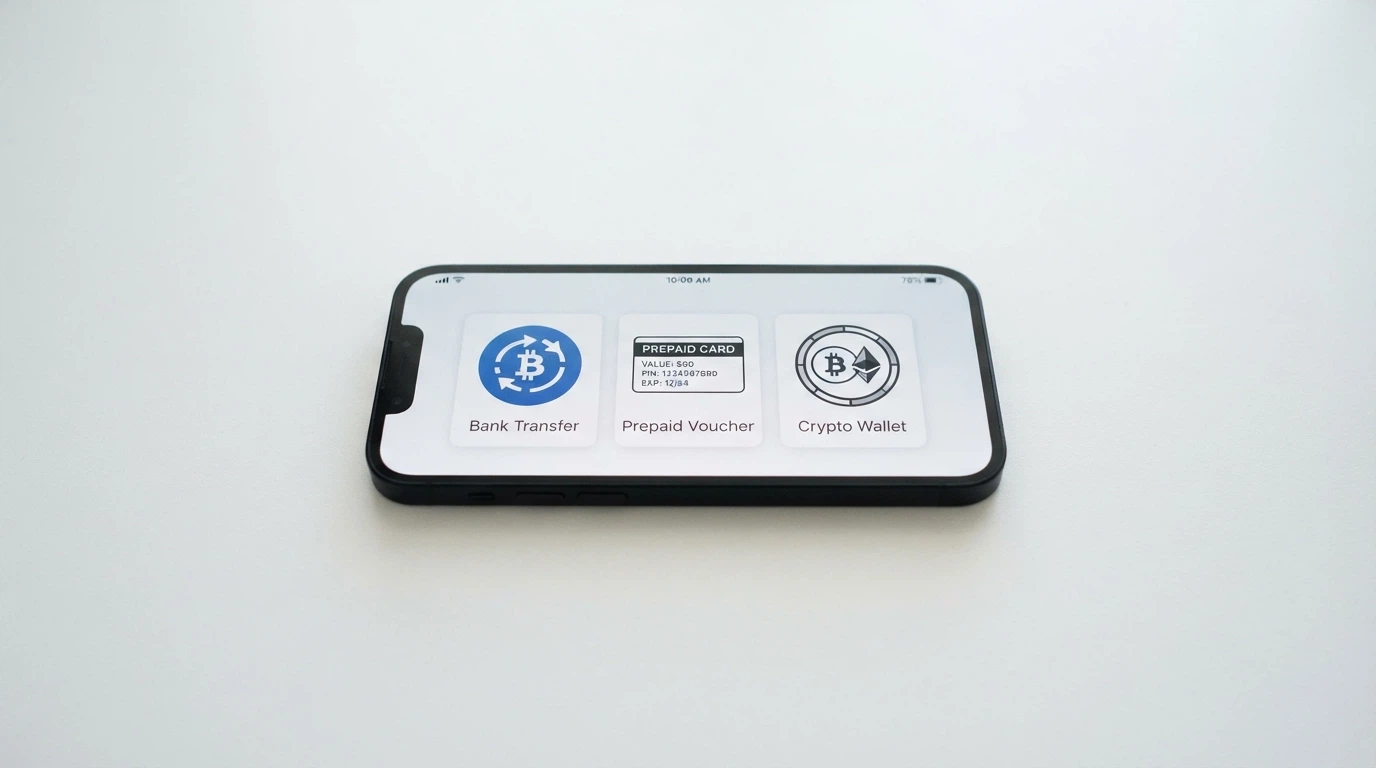
The practical taxonomy in 2026:
- Crypto (USDT-TRC20, BTC, ETH, LTC). The only rail that reliably processes a true $1 to $5. USDT-TRC20 is the cheapest; BTC is more expensive in network fees; ETH is somewhere between. Exchange-to-casino flow takes 1 to 15 minutes depending on chain congestion and exchange review.
- Voucher (Neosurf, paysafecard). No AU$5 voucher exists in Australian distribution, so the “AU$1 voucher deposit” is a partial-use of a larger denomination. A AU$10 Neosurf deposit is the practical floor, with the residual usable on the next wager.
- PayID and Osko. Gated at AU$20 across roughly 12 of 15 AU-facing operators because the PSP layer triggers anti-fraud monitoring below that threshold. The casino is not the gatekeeper; the PSP is.
- Debit card (Visa/Mastercard). AU$5 to AU$10 processor minimum. Credit cards banned outright since 11 June 2024. A card-accepting casino taking credit cards is, by definition, an offshore operator in violation of the prohibition.
- Bank transfer / BPAY. Higher minimums again, typically AU$20 to AU$50, and slower settlement. Not a $1 rail at any operator.
The honest answer to “what is the minimum deposit at this casino?” depends on which of those rails the reader is willing to fund.
Crypto and Voucher Workarounds — the Only Routes That Reliably Take $1
USDT-TRC20 is the cheapest crypto rail in 2026, at AU$0.50 to AU$1 per transfer, and at AU$5 the gas is small enough to leave a workable bankroll. BTC works at AU$0.10 published minimums on some brands, but the AU$0.50 to AU$3 BTC network fee on a small deposit eats a meaningful share of the bankroll. The exchange-to-casino flow is the same regardless: fund a wallet, buy stablecoin, send to the casino’s deposit address, wait for confirmations.
Neosurf voucher-remainder is the second reliable $1 path. The mechanic: buy a AU$10 Neosurf voucher from an Australian retail outlet (newsagents, convenience stores, petrol stations), enter the 10-digit PIN at the casino cashier, and the AU$10 balance is available immediately. The “AU$1 deposit” comes from a partial-use of the voucher — wager enough to leave a AU$1 residual, deposit the residual, and the cashier accepts it. The deposit is real; the value was prepaid at the higher denomination.
No AU$5 voucher exists in Australian distribution, which means there is no native $1 fiat-deposit path through vouchers either. The $1 figure is always a remainder.
Why PayID, Cards and Bank Transfer Hit a Higher Floor
PayID, debit cards and bank transfer sit on rails that impose their own minimums for reasons the casino cannot override.
PayID’s AU$20 gate is anti-fraud, not commercial. PSPs see a disproportionate share of low-value PayID scam traffic, and the cost of monitoring AU$1 to AU$19 transactions exceeds the transaction value. The PSP routes these through enhanced monitoring, which most operators decline to clear because the false-positive rate is high enough to make the cost unworkable. The casino inherits the PSP’s gate.
Card processors enforce a AU$5 to AU$10 minimum because the interchange economics on sub-AU$5 transactions are unprofitable. The casino could in principle absorb the loss, but the operator’s acquirer will decline the transaction at the processor layer. Credit cards are banned outright for online wagering in Australia since 11 June 2024, with penalties up to $247,500, and the IGA targets the provider — a casino accepting credit cards is breaking the prohibition, not a minor advertising rule.
Bank transfer and BPAY have higher minimums again because the settlement cost is higher. A AU$1 bank transfer would cost more in processing than the transaction value, and the operator declines the deposit.
The conclusion: the $1 floor is a property of the rail, not the brand. A reader who needs a true $1 deposit runs it through USDT-TRC20 or a Neosurf voucher-remainder. Every other rail sets a higher floor that no operator in the featured set can clear.
The Pokies Worth Playing With a $1 Bankroll
A $1 bankroll buys 2 to 10 spins on most modern pokies, depending on the title’s minimum bet. At AU$0.10 per spin on a low-minimum game, a $1 deposit is 10 spins — about 30 seconds of play at a 3-second spin interval. At AU$0.50 per spin, the same $1 is two spins. The house edge across those spins is the same as it would be across a thousand, and the bankroll duration is what the player actually feels.
Seven titles with researched RTPs are worth a $1 bankroll’s attention. The table is the full set research carries a real RTP for; titles not in the table do not have a confirmed figure and the audit does not invent one.
Slot Titles With Researched RTP — the Full Table
| Slot | Provider | RTP | Volatility | Min Bet |
|---|---|---|---|---|
| Starburst | NetEnt | 96.09% | Low | $0.10 |
| Blood Suckers | NetEnt | 98.00% | Low | — |
| Book of Dead | Play’n GO | 96.21% | High | $0.10 |
| Dead or Alive | NetEnt | 96.82% | Very high | $0.01 |
| Big Bass Bonanza | Pragmatic Play | 96.71% | Medium | $0.10 |
| Wolf Gold | Pragmatic Play | 96.01% | Medium | $0.25 |
| Mega Joker | NetEnt | 99.00% / 76.9% | — | — |
Mega Joker’s RTP splits at the bet level: 99.00% at the maximum 10-coin bet, dropping to around 76.9% at minimum bets. A $1 bankroll on Mega Joker is betting at the minimum tier, where the RTP is the lower of the two figures. The high-RTP headline is real, but it is real at a stake the $1 bankroll cannot afford. Blood Suckers’ minimum bet was not confirmed in the research, and the audit flags that gap qualitatively rather than fabricating a value.
Volatility, RTP and Why a $1 Bankroll Disappears Fast
RTP is a long-run average, and a $1 bankroll is a short run. On a 96% RTP title, the house edge is 4% of turnover, and on a AU$1 bankroll that is AU$0.04 in expected loss per AU$1 wagered. Over 10 spins at AU$0.10 each, the expected loss is AU$0.04 — but the variance around that expectation is large enough that a 10-spin session can land anywhere from a full depletion to a small win.
Volatility is what governs the distribution of outcomes. A low-volatility title (Starburst, Blood Suckers) returns small wins frequently and the bankroll lasts longer. A high-volatility title (Book of Dead, Dead or Alive) returns rarely and the bankroll typically disappears on the first few spins. For a $1 bankroll, low volatility extends the session and gives the player more time under wagering requirements; high volatility gives the player a chance at a single big hit, which is more useful on a progressive-linked bonus like 7Bit’s Mega Moolah.
Most modern pokies allow a minimum bet per spin in the AU$0.10 to AU$0.50 band, depending on the title and the number of paylines. Dead or Alive goes as low as AU$0.01, which is the only $1-friendly title that gives the player 100 spins per dollar — at the cost of the very-high-volatility profile that makes a 100-spin session likely to land at a near-zero balance.
The arithmetic of bankroll duration: at AU$0.10 per spin and a 3-second spin interval, a $1 bankroll is roughly 30 seconds of play on a low-volatility title and 5 to 15 seconds on a high-volatility title. The house edge in dollar terms is small (4% of turnover at 96% RTP), but the bankroll does not survive long enough for the long-run RTP to express itself. The audit is explicit on the consequence: at the $1 level, the variance dominates the expected return, and the player’s actual outcome is mostly luck rather than mathematical edge.
What a Dollar Will Not Buy — Live Dealer Tables and High-Stakes Games
Live dealer tables, table games and high-stakes pokies are structurally out of reach at a $1 deposit. Live casino minimums sit well above the $1 bankroll, and even the lowest-stakes roulette or blackjack tables typically require AU$1 to AU$5 per bet — a single hand, with no room for a session.
Wagering contribution is the second constraint. Pokies contribute 100% toward wagering requirements at AU casinos; live casino (blackjack, roulette) contributes 10% to 20%; excluded games contribute 0%. A $1 free-spin bonus that requires pokies-only playthrough is a hard exclusion of any live-dealer play. The player cannot satisfy the wagering requirement at a live table even if the table minimum were within reach.
Progressive jackpots have their own floor. Mega Moolah and similar titles require a max-bet spin to qualify for the progressive seed, and the max bet is typically AU$2 to AU$5. A $1 bankroll cannot hit the max-bet threshold on a single spin, and the progressive contribution at sub-max bets is small enough to be a marketing figure rather than a real prize path. The 7Bit offer on Mega Moolah is the rare case where 60 free spins land on a progressive, but the cashout cap is what governs the actual payout, not the seed.
A $1 Bonus Sounds Generous — Until You Read the Wagering
Five operators in the featured set actually trigger a bonus at $1: Spin Samurai, Wazamba, 7Bit, KatsuBet and SpinFever. The other five (SkyCrown, Neospin, Ricky Casino, Joe Fortune, Ignition) require a AU$20 to AU$30 minimum deposit to activate the welcome package, and a $1 deposit at those brands unlocks the casino floor but not the bonus.
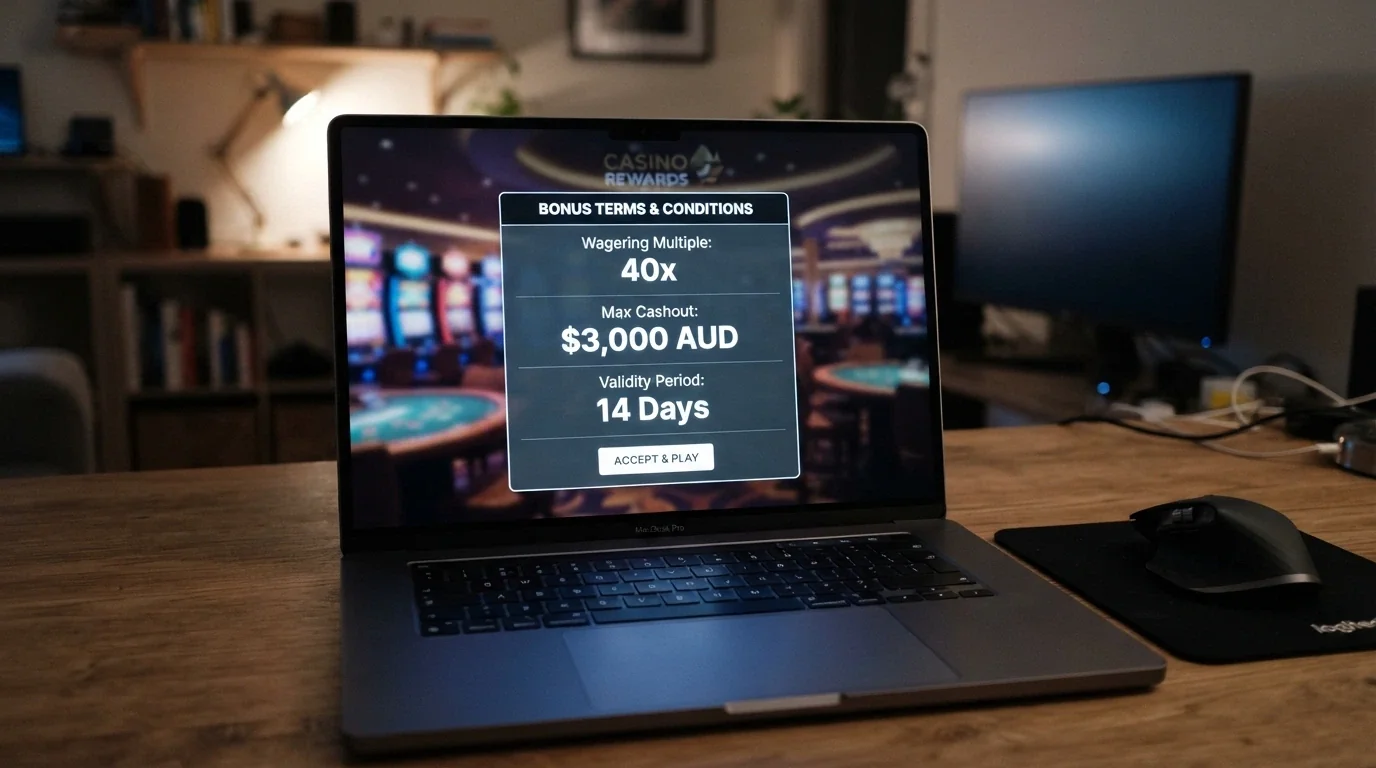
The standard wagering range in the AU market in 2026 is 30× to 50×. Below 30× is excellent, 30× to 40× is good, 40× to 50× is average, and 50× or higher is steep. A $1 free-spin bonus sits in the 35× to 45× band in this set, which is the middle of the market. The number that does the most work on the offer is not the wagering multiple on its own — it is the cashout cap relative to the winnings the wagering is applied to.
The Five $1 Free-Spin Offers — Compared
| Casino | Free Spins / Match | Slot Title | Wagering | Max Cashout |
|---|---|---|---|---|
| Spin Samurai | 75 free spins | Book of Dead | 35× | AU$150 |
| Wazamba | 80 free spins | Starburst | 40× | AU$200 |
| 7Bit | 60 free spins | Mega Moolah | 35× | AU$200 |
| KatsuBet | AU$20 match + 30 free spins | Sweet Bonanza | 45× | AU$100 |
| SpinFever | 20 free spins | Big Bass Splash | — | — |
SpinFever’s wagering and max cashout were not confirmed in the terms reviewed; the audit flags those gaps rather than fabricate values. KatsuBet is the only offer combining a cash match with free spins, and the 45× wagering is the highest in the $1 tier. Spin Samurai has the cleanest terms-to-payout ratio. Wazamba has the highest spin count and the largest cashout cap on the back of the MGA licence. 7Bit is the only progressive.
The remaining five operators (SkyCrown, Neospin, Ricky Casino, Joe Fortune, Ignition) require a AU$20 to AU$30 minimum deposit for their welcome packages and do not trigger a $1 bonus. A $1 deposit at any of them is a casino-floor entry, not a bonus-activation event.
Wagering Requirements — Why a $1 Bonus Can Cost More Than It Pays
A worked example, taking Spin Samurai as the clearest $1 offer in the set. Seventy-five free spins on Book of Dead, 35× wagering, AU$150 max cashout. Free spin values typically sit at AU$0.10 to AU$0.20 per spin, so 75 spins is AU$7.50 to AU$15 in nominal stake. Assuming the spin value lands at the AU$0.10 lower end (a conservative read), the bonus generates roughly AU$7.50 in expected spins, with a wide variance around that figure.
The expected loss on the wagering requirement is the cost the player pays to convert bonus winnings to withdrawable cash. Using Starburst’s 96.09% RTP as a representative pokies figure (Book of Dead is a heavier 96.21%, so the difference is small), the formula is required turnover multiplied by (1 minus RTP). Turnover is bonus winnings times the wagering multiple; with a AU$7.50 bonus at 35×, turnover is AU$262.50. The house edge at 96.09% RTP is 3.91%, so the expected loss across the wagering is roughly AU$10.27.
The conclusion: the bonus’s real cost to the player is about AU$10 in expected loss, against AU$7.50 in nominal spin value. The bonus costs more than its headline value, and the AU$150 cashout cap is the only mechanism that prevents a larger upside. The figure is a statistical estimate, an average over many sessions and many players rather than a guaranteed outcome for any individual, and the wagering maths that produces it is the same one the marketing does not print on the bonus page. The house always has an edge, and on a $1 free-spin bonus the edge is wider than the headline.
Two caveats carry through from the source. Free spin values at AU casinos sit at AU$0.10 to AU$0.20 per spin; a 100-spin package is AU$10 to AU$20 in nominal value, so the worked example’s AU$7.50 is at the low end of the band. And game contribution: pokies contribute 100% to wagering, live casino 10% to 20%, excluded games 0% — so a player who tries to clear the bonus on a live table will see most of the wagering fall away. The mechanic matters as much as the multiple.
Mobile $1 Deposits — the Same Limits on a Smaller Screen
Mobile play changes nothing about the deposit minimum. The method sets the floor, not the device. A PayID gate at AU$20 is the same on a phone as on a laptop. A USDT-TRC20 transfer is the same network fee and the same confirmation time. The cashier page is browser-based or app-based, and the floor on the page is the same on either.

No mobile-exclusive $1 deposit offer exists in the featured set. The bonuses trigger identically regardless of the device the player claims them from. The games — pokies, in particular — are designed mobile-first at most of the operators in 2026, with HTML5 clients that scale to a phone screen without losing reel visibility or bet-size controls.
The Mobile Experience at $1 — What Works and What Does Not
On a phone, the same $1 deposit opens the same casino floor, the same 75 free spins at Spin Samurai, the same 80 free spins at Wazamba. The deposit UX is a wallet or a cashier page, and the crypto and PayID flows are identical across devices. Neosurf voucher PINs are entered the same way on a phone as on a desktop. Minimum bets on the pokies are the same AU$0.10 to AU$0.50 range, and the spin interval is the same three seconds per spin.
What mobile does not do: it does not lower the deposit floor. The $1 floor at the operator is the $1 floor on the phone. A reader who cannot get a $1 deposit through on desktop will not get one through on a phone. The constraint is the rail, and the rail is the rail.
Every $1 Deposit Casino Is Unlicensed in Australia — Here Is What That Means
The Interactive Gambling Act 2001 makes it illegal to provide online casino games, online pokies and in-play sports betting to people in Australia. No licence for online casino exists in the country, not federally, not in any state or territory. The Australian market is structurally a prohibition market, not a regulated one: the product this page describes cannot be legally offered by anyone.
The Australian Communications and Media Authority (ACMA) is the federal regulator that enforces the prohibition. ACMA investigates complaints, issues formal warnings and civil penalty proceedings, refers operators for enforcement, and directs Australian ISPs to block illegal sites. The IGA targets the provider, not the player. An Australian will not be prosecuted for depositing at an offshore casino, but the player loses every Australian consumer protection: no complaints recourse, no BetStop coverage, no guarantee the operator will honour a withdrawal, and the site can be blocked at any time with a balance on it.
The player’s winnings are not assessable income under section 6-5 of the ITAA 1997, and losses are not deductible under section 8-1, unless the person is carrying on a business of betting or gambling. The tax framing is a non-event for a casual punter, and it is worth noting only because the offshore status does not change the ATO’s treatment: a win at an unlicensed casino is still a non-taxable windfall, and a loss is still a non-deductible cost.
The IGA, the ACMA and What Happens When a Site Gets Blocked
ACMA enforcement runs through three mechanisms: complaint investigation, formal warnings and civil penalty proceedings, and ISP blocking. Since the first blocking request in November 2019, ACMA has had 1,564 illegal gambling and affiliate websites blocked by Australian ISPs as of March 2026. More than 225 illegal services have withdrawn from the Australian market since enforcement was strengthened in 2017.
What blocking means for the player: the site stops resolving on Australian ISPs. Existing balances are not automatically returned. The operator is not obliged to refund a player whose access was cut by a block, and the player has no Australian complaints body to escalate to. The offshore operator’s own terms page governs, and the offshore operator’s own dispute process is the only one available. The MGA-licensed Wazamba offers a higher regulatory floor than the Curaçao and Anjouan brands, but even MGA does not have jurisdiction over a complaint from a player outside Malta.
The audit’s editorial position: the IGA targets the provider, and a player who deposits at an offshore casino has accepted the loss of every Australian safeguard. That is the frame around every operator on this page. None holds an Australian licence, because none can.
The 2026 Gambling Reform Bill — What Changes on 1 January 2027
The Interactive Gambling Amendment (Gambling Reform) Bill 2026 passed Parliament on 19 August 2026, and its measures commence on 1 January 2027. The reform does not license online casino, and the prohibition stays. What it does is restrict the surrounding mechanics.
Wagering advertising: no more than three wagering ads per hour between 6:00 am and 8:30 pm; a live-sport blackout from 15 minutes before to 5 minutes after live sporting events; athletes, celebrities and influencers barred from promoting wagering products. The cap applies to licensed operators, not offshore brands, but the offshore brands will be advertising into a market that is being further restricted by law.
Payment blocking: from 1 January 2027, banks and payment providers gain express authority to block transactions to illegal gambling operators. The mechanism is the same as the existing blocking framework for sites — the PSP layer, not the casino, draws the line. A $1 crypto deposit sidesteps the PSP layer entirely, which is the structural reason crypto survives while PayID and cards do not.
BetStop strengthening: direct marketing of inducements is prohibited for 14 days after sign-up, for 3 months after deregistering from BetStop, and indefinitely for at-risk customers. The change is on the licensed-wagering side and does not extend the register’s reach to offshore casinos, which is the gap the next section returns to.
What the reform does not do: it does not license online casino. It does not legalise a $1 deposit. It does not create a regulated Australian online casino market. The 2026 reform tightens the prohibition’s surrounding mechanics, not the prohibition itself.
New $1 Deposit Casinos — Fresh Brands, Same Offshore Structure
A “new” $1 deposit casino in the Australian market in 2026 is a new offshore brand, not a new licensed product. The offshore licensing structure has not changed, and a brand that launched this quarter is licensed in Curaçao or Anjouan the same way a brand that launched three years ago is licensed. The Australian market cannot license a new online casino because the market cannot license any online casino.
What a new brand can offer: a fresh welcome bonus, a different game library, a different payment-method mix, a different user-experience. What a new brand cannot offer: an Australian licence, lower fiat minimums, BetStop coverage, or a regulated complaints pathway. The structural constraints — PayID’s AU$20 gate, Neosurf’s AU$10 voucher denominations, the deposit-withdrawal asymmetry, the offshore-licence reality — apply identically to a brand that launched last month and a brand that launched last year.
What a Brand-New $1 Casino Actually Offers — and What It Cannot Change
A new operator can run a more aggressive welcome bonus, a higher free-spin count, or a different wagering multiple. It can offer a niche game library or a niche payment-method mix. It cannot offer a $1 deposit through PayID, because PayID is gated at AU$20 across the PSP layer regardless of the operator’s age. It cannot offer a $1 fiat deposit through Neosurf, because the AU$5 voucher does not exist in Australian distribution. It cannot offer a $5 withdrawal, because the minimum withdrawal of AU$25 to AU$100 is an industry norm that a new operator has no incentive to break.
The audit’s editorial position: the newness of a brand is a marketing attribute, not a regulatory one. A reader evaluating a new $1 casino should check the licence (Curaçao, Anjouan, MGA), the payment-method list (does it accept USDT-TRC20 or BTC?), the bonus terms at the $1 tier (does the welcome actually trigger at $1?), and the minimum withdrawal (how much above the deposit is it?). None of those checks change because the brand is new. The structural floor on a $1 deposit is the structural floor, full stop.
The Human Cost — Gambling Harm at the Lowest Stakes
A $1 deposit feels harmless, and that is the design. The Roy Morgan data from March 2026 is the headline: 13.0% of the Australian adult population, an estimated 2,857,000 people, are experiencing some form of gambling harm from their own gambling behaviours, and 15.1% (3,320,000 people) are affected in total when harm from others’ gambling is included. Risky gambling in Australia rose from 13.7% in 2024 to 19.4% in 2025 — almost one in five adults, the highest level in six years, per the Australian National University. More than half (56.1%) of Australians who gamble in a given year mainly participate online, and the online migration is the channel through which offshore casinos reach Australian players.

The numbers do not stop at a $1 deposit. A $1 deposit is a small dollar, and the player is unlikely to lose a $1 in a way that causes financial harm on its own. The structural risk is the funnel: a $1 deposit is a frictionless entry point to a casino floor that offers 6,000+ pokies, an AU$11,000 welcome package, and 550 free spins across a multi-deposit package. The product is designed to convert the $1 deposit into a larger one, and the conversion rate is high enough that the offshore casino industry treats the $1 deposit as customer acquisition, not as the product.
GambleAware NSW services in 2024–25 supported 4,170 people across 19,422 counselling sessions and the GambleAware Helpline provided 9,538 people with telephone crisis support. The NSW Government committed AU$20.7 million from the Responsible Gambling Fund for gambling support services in 2025–26, up from AU$19.19 million the previous year. The support infrastructure exists; the question is whether a player at the $1 deposit level reaches it before the $1 becomes $30, and $30 becomes $300.
Help Resources, Demo Mode and Why Offshore Casinos Ignore BetStop
The National Gambling Helpline is 1800 858 858 — free, confidential, staffed 24 hours a day, seven days a week, with online chat and counselling via Gambling Help Online. The line is for anyone affected by their own or someone else’s gambling, at any stake level. A reader who feels the $1 deposit is becoming more than $1 should call.
BetStop — the National Self-Exclusion Register — had 67,480 registrations as at 31 July 2026, with 41,290 exclusions still active (more than 60% of everyone who ever registered). 78% of registrants were under 40, and 38% chose lifetime exclusion. The register binds every Australian-licensed wagering service. The register does not bind an offshore casino. An offshore operator is not connected to BetStop, will not check BetStop before accepting a deposit, and will keep taking a self-excluded person’s money. The register’s reach stops at the Australian licensing perimeter, and the offshore brands on this page are entirely outside that perimeter.
Demo mode is the no-risk alternative. Every pokie in the table above is available in a free-play or fun-mode version at most of the operators in the featured set, and the gameplay, RTP and volatility are identical to the real-money version. A $1 bankroll buys 2 to 10 real-money spins; demo mode buys unlimited spins at the same RTP, with no deposit and no withdrawal. For a reader who wants to test a title at the $1 stake level, demo play is the same product without the financial exposure.
How We Evaluated These $1 Deposit Casinos
The ranking on this page is built on four checks, in order.
The first check is licence and regulatory status. Every operator in the featured set is offshore-licensed (Curaçao eGaming, Anjouan, or MGA) because online casino cannot be licensed in Australia. The audit verifies each licence against the regulator’s own register where the register is public (Curaçao and MGA both publish licensed-operator lists; Anjouan’s register is less transparent, and the audit flags that gap). The audit does not claim any operator is Australian-licensed, because none can be.
The second check is deposit-method availability at the $1 tier. The audit confirms which operators accept USDT-TRC20, BTC, Neosurf voucher-remainder or PayID at a $1 to $5 floor, and which require a higher minimum. The deposit-method check is more granular than the operator’s published “minimum deposit” figure, because the rail’s floor and the operator’s floor are different things.
The third check is bonus terms at the $1 tier. Where the operator publishes a $1-tier bonus with specific terms (Spin Samurai, Wazamba, 7Bit, KatsuBet, SpinFever), the audit transcribes the wagering multiple, the max cashout cap, the bonus slot and the validity period. Where the operator does not publish a $1-tier bonus (SkyCrown, Neospin, Ricky Casino, Joe Fortune, Ignition), the audit records the welcome-package minimum qualifying deposit and flags the $1 eligibility as a gap.
The fourth check is the cross-reference against the ACMA enforcement list. None of the operators in the featured set appears on the ACMA blocked-sites register as of March 2026. The audit does not warrant that status will hold — ACMA can block at any time — but the current state is clean.
Where research does not carry a specific value (SpinFever’s wagering, Joe Fortune’s bonus terms at $1, Ricky Casino’s $1-tier eligibility), the audit writes the gap qualitatively rather than fabricating a figure. The gaps are visible in the tables, and the editorial position is that a clean gap is more useful than a fabricated value.
The Real Cost of a One-Dollar Casino Deposit
Three structural facts sit underneath every operator on this page.
The first: a genuine $1 deposit runs on crypto, not fiat. USDT-TRC20 is the only rail that clears a true $1 to $5 with a network fee small enough to leave a workable bankroll. PayID, Neosurf, debit cards and bank transfers all impose higher floors for reasons the operator cannot override. A reader who needs $1 will use crypto or a voucher-remainder; a reader who needs PayID will deposit $20 or more.
The second: a $1 bonus is rare and mathematically costly. Five operators trigger a bonus at $1, the wagering multiples run 35× to 45×, and the cashout caps sit at $100 to $200. The expected loss on the wagering is the cost the player pays to find out what the cap will let them keep, and on every offer in the set the expected loss exceeds the nominal spin value. The “free” in “free spins” is the marketing word the audit punctures with the wagering number; a $1 free-spin bonus is a paid entry to a payout that is capped at a fraction of the headline.
The third: every operator on this page is offshore and unlicensed in Australia. Online casino is prohibited to provide in Australia under the Interactive Gambling Act 2001, and no licence exists federally or in any state or territory. The player is not prosecuted; the player loses every Australian consumer protection, every BetStop safeguard, every complaints pathway. The site can be blocked at any time with a balance on it.
The reader’s decision rests on understanding those three facts before the deposit. If a $1 deposit is a one-off test of the casino floor, the right rail is USDT-TRC20 and the right pick is one of the five bonus-triggering operators with clean terms — Wazamba for the MGA licence and the highest cashout cap, Spin Samurai for the cleanest terms-to-payout ratio, 7Bit for the progressive. If the $1 deposit is the start of a session, the deposit-withdrawal asymmetry will catch up before the first withdrawal: the $1 will be topped up to $25 to $50 to clear the minimum withdrawal, and the $1 minimum will turn out to have been the funnel rather than the spend.
Demo mode is the no-risk alternative. A reader who wants to see what a $1 pokies session looks like can play the same titles in free-play mode with the same RTP, the same volatility, and the same bonus mechanics, with no deposit and no financial exposure. The National Gambling Helpline is 1800 858 858 — free, confidential, 24 hours a day, seven days a week — for anyone who feels the $1 is becoming more than $1.
The page’s verdict is the same in every section: $1 deposits exist on crypto rails; bonuses at $1 are rare and the maths punishes them; every operator is offshore; the house always has an edge. The deposit method sets the floor, the bonus terms set the cost, and the offshore status sets the risk. A reader who walks in with those three numbers in hand will not be surprised by what the marketing does not print.
Frequently Asked Questions
What happens if I deposit $1 and win — can I actually withdraw the money?
It depends on the operator’s minimum withdrawal and whether the operator applies a deposit-multiplier cap. Most AU-facing casinos in 2026 set a minimum withdrawal of AU$25 to AU$50, sometimes AU$50 to AU$100, and a handful cap withdrawals at 10× the deposit — so a $1 deposit could have a maximum payout of $10 regardless of the bonus winnings. Read the cashier’s withdrawal page before the first deposit, and assume the $1 will need to be topped up to clear the minimum before any payout.
Is PayID really an option for a $1 deposit, or is there a hidden minimum?
PayID is gated at AU$20 across roughly 12 of 15 AU-facing operators in 2026 because the PSP layer triggers anti-fraud monitoring below that threshold. The casino inherits the PSP’s gate, so a $1 PayID deposit will be declined at the cashier. USDT-TRC20 and BTC are the rails that actually process a $1 to $5 deposit; PayID, Neosurf, debit cards and bank transfers all impose higher floors for reasons the operator cannot override.
How much do I have to wager before I can cash out a $1 bonus?
For the five operators in the featured set that trigger a bonus at $1, the wagering runs 35× to 45× on the bonus winnings. A typical $1 free-spin bonus generates AU$7.50 to AU$15 in nominal spin value, and the 35× to 45× multiplier means AU$260 to AU$675 in turnover before any withdrawal. The cashout cap, not the wagering multiple, is usually the binding constraint; check both numbers on the bonus terms page before claiming.
Can I play progressive jackpots with a $1 deposit?
Only on titles where the operator publishes a free-spin allocation to a progressive. 7Bit’s $1 offer includes 60 free spins on Mega Moolah, which is the rare $1-tier path to a progressive. Most progressive jackpots require a max-bet spin to qualify for the seed, and the max bet is typically AU$2 to AU$5 — outside a $1 bankroll. The progressive contribution from a $1 free-spin is small, and the cashout cap on the bonus is what governs the actual payout.
What recourse do I have if an offshore casino refuses to pay out?
The operator’s own dispute process is the only one available. An offshore casino licensed in Curaçao or Anjouan is not subject to Australian consumer law, and the MGA does not have jurisdiction over a complaint from a player outside Malta. The site’s terms page governs, and the only escalation is the offshore regulator’s own complaints mechanism — which is slower and less enforceable than an Australian one. The structural risk of a withdrawal dispute is one of the costs of playing offshore, and the player accepts it by depositing.
Does BetStop cover me if I sign up at a $1 deposit casino?
No. BetStop binds Australian-licensed wagering services only. An offshore casino is not connected to the National Self-Exclusion Register, and the operator will not check BetStop before accepting a deposit. The register’s reach stops at the Australian licensing perimeter, and every operator on this page sits outside that perimeter. The National Gambling Helpline (1800 858 858) and Gambling Help Online are the right channels for a player who has self-excluded and needs the deposit blocked at the bank or wallet layer.
Prepared by the Min Deposit 5 Casinos AU editorial staff.