
Best Aussie Online Casino in 2026: The Offshore Market, Explained
 Available in AU
Every page that ranks “Aussie online casinos” is ranking offshore operators. There is no such thing as a licensed Australian online casino. The Interactive Gambling Act 2001 prohibits the product outright — no state or territory issues the licence that would make one legal. Australian players who run this search are choosing between offshore brands that target AUD accounts, accept PayID or crypto, and operate outside every protection Australian law extends to a domestic wagering customer.

This page does the work the marketing copy skips. It names the offshore status of every operator before the welcome bonus is mentioned, walks through the wagering maths on every confirmed bonus, and lays out the protections an Australian player leaves behind the moment they deposit at any of them. Verified against the ACMA register as of 18 October 2026.
Table of Contents
- The Real Aussie Online Casino Landscape in 2026
- The 10 Offshore Casinos Australian Players Are Using Right Now
- New Aussie Casino Sites in 2026 — Fresh Brands, Familiar Reality
- Why Your Aussie Casino Bonus Is Never as Big as It Looks
- PayID and Crypto at Aussie Casinos — How Fast Your Money Actually Moves
- Playing Casino Games on Your Phone in Australia — What Works and What You Lose
- Australia’s Gambling Laws — The Prohibition, the Regulator and Where You Stand
- Staying in Control — Gambling Help, Self-Exclusion and the Offshore Blind Spot
- How We Picked and Ranked These Aussie Online Casinos
- What Australian Casino Players Should Actually Do in 2026
- Frequently Asked Questions
The Real Aussie Online Casino Landscape in 2026
The scale of Australian gambling is large and the harm is documented at scale. Australians lose roughly A$25 billion a year on legal forms of gambling according to the Department of Social Services — and that figure covers licensed wagering and lottery products only, not the offshore casino market that exists outside it. Roy Morgan’s July 2026 Gambling Harm Index puts 15.1% of Australian adults — about 3.32 million people — into the bracket experiencing gambling harm, with 13.0% (2.86 million) harmed by their own gambling and 5.4% (1.18 million) harmed by another person’s gambling. ANU’s 2025 Gambling Participation survey found risky gambling at 19.4% of adults, up from 13.7% the year before, and 56.1% of those who did gamble mainly played online.
That is the market a “best Aussie online casino” search lives inside. It is also the market where the product the searcher is looking for — a real-money online casino licensed in Australia — does not exist. The 3.32 million people in Roy Morgan’s harm bracket are being harmed by gambling; the legal status of the offshore casino they play at is downstream of that fact.
What “Aussie Online Casino” Actually Means for a Real-Money Player in 2026
The phrase describes a de facto market, not a legal category. An “Aussie online casino” is an offshore operator that accepts Australian customers, processes deposits in AUD, and runs marketing aimed at Australian players. The Australian-dollar deposit option and the “.com.au” branding some of them carry are market positioning, not regulatory signals. None of the operators on this page hold an Australian casino licence, because no such licence exists to be held.
The legal shape of the prohibition is sharp and one-sided. The Interactive Gambling Act 2001 prohibits the supply of online casino games to a person in Australia — section 8AA is the operative section, after the 2017 amendments strengthened the framework. The individual player is not the target of the Act. Online gambling is legal for the player; what is illegal is the operator providing the service from within Australia or to Australians from overseas. The IGA’s enforcement tools — civil penalty proceedings, formal warnings, ISP blocking directions — all run against operators. Punters are not prosecuted for playing.
The practical consequence is that an Australian player who deposits at an offshore casino is operating inside a regulatory vacuum. The operator runs under the licence of whichever jurisdiction it chose — Curaçao is the most common in the featured set — and the player has no Australian consumer-law recourse if a withdrawal is refused, a bonus term is enforced against them in a way they dispute, or the site goes dark. Every protection that applies inside the licensed wagering market — BetStop, deposit-limit obligations, activity statements, dispute resolution through an Australian regulator — falls away at the site boundary.
The same prohibition is enforced. The ACMA has directed Australian ISPs to block 1,564 illegal gambling and affiliate websites since November 2019, and more than 225 illegal services have withdrawn from the Australian market since enforcement was strengthened in 2017. A blocked site does not refund balances. A player with funds on a blocked domain has no Australian recourse to recover them. That is the operational risk the rest of this page maps against.
The 10 Offshore Casinos Australian Players Are Using Right Now
The table below ranks offshore operators by tracked Australian traffic and fit to this page’s commercial-investigational intent, not a regulator’s endorsement. Every operator below is offshore. Every operator carries no Australian casino licence. The “ACMA status” column records what is publicly visible — a formal warning, a blocking action, or the absence of any public enforcement outcome this far. The “Best For” column names one distinguishing trait per operator from research; it is a starting question for due diligence, not a recommendation.
| Casino | Offshore Licence & ACMA Status | Best For |
|---|---|---|
| 1. Rocket Play | Offshore, no AU licence; ACMA formal warning to Dama N.V. (Q2 2025) | Largest AU-trafficked brand with confirmed regulatory heat |
| 2. Skycrown | Offshore, no AU licence; no public ACMA action this run | Highest-traffic brand not yet named on an enforcement outcome |
| 3. Royal Reels | Offshore, no AU licence; ACMA blocked | Biggest game library (5,400+ pokies, 40+ providers) with a 10-tier VIP |
| 4. Stake | Offshore, no AU licence | Fastest tested crypto withdrawal at 1–2 hours |
| 5. FairGO | Offshore, no AU licence | AU-themed branding for a niche following |
| 6. Bizzo Casino | Offshore, no AU licence | Beginner-facing with a 10-free-spin no-deposit offer |
| 7. Rocket Casino | Offshore, no AU licence | Largest stated welcome package — 150% up to A$1,500 + 150 free spins |
| 8. Scream Casino | Offshore, no AU licence | Growing AU traffic with thin public data |
| 9. WinSpirit | Offshore, no AU licence | Solid AU share with no confirmed offer details |
| 10. Rainbet | Offshore, no AU licence | Crypto-native platform with no confirmed bonus |
High traffic is not a safety signal. The numbers that put these brands on the ranking reflect how many Australian players reach the site, not how the site treats them when they get there.
How We Ordered These Rankings — Trust Signals, Transparency and the Offshore Filter
The ranking weights three things and explicitly does not weight a fourth. What it weighs: tracked Australian traffic (which orders the list), the public availability of offer terms and game-count figures from third-party casino review sites, and the operator’s published ACMA record where one exists. What it does not weigh: a star rating or composite “safety score,” because the data is not there to ground one in.
The ranking sources the data from independent third-party casino reviews. Independent reviews like CasinoAudit reviewed Royal Reels; Cloudwash and Gamblingsites covered Bizzo Casino and Rocket Casino; Australiangamblers carried bonus terms for both; and Payoutverdict’s January–May 2026 test run provided the crypto-withdrawal timings. The ACMA’s quarterly “Action on Interactive Gambling” reports were checked for formal warnings and blocking actions. The ACMA has blocked 1,564 illegal gambling and affiliate websites since November 2019, so a brand’s absence from that list indicates the absence of a public action, not a clearance.
The ranking does not endorse any operator as a place to play. No test deposits were made for this page. No operator was contacted for comment. The numbers in the table are what is publicly available; the gaps in research are gaps in research, and the verdict at the end of each operator write-up is an editorial read of what those gaps and that public record together suggest for a player evaluating the brand.
Rocket Play
Rocket Play is the largest AU-trafficked brand in the featured set and the only operator in the top half of the ranking with a confirmed ACMA enforcement outcome against it. The ACMA issued a formal warning to Dama N.V. — the operator group behind Rocket Play — in Q2 2025, alongside warnings to the operator group’s other brands. The warning is part of an enforcement pattern that has touched several Dama N.V. brands: Q4 2025 saw Dama N.V. named again for Vegas Now, Rooster Bet and Rocketspin.
A formal ACMA warning is not a fine and it is not a blocking action. It is the regulator’s documented finding that the operator is providing a prohibited interactive gambling service to Australian customers — the step that usually precedes civil penalty proceedings or an ISP blocking request. For a player, the practical meaning is straightforward: the brand is on the regulator’s record, and that record is what future enforcement reads from. Whether Rocket Play is the next Dama N.V. brand the ACMA escalates against is not a question any third party can answer.
Verdict: this is the brand to read the bonus terms on twice. The traffic lead is real, the regulator’s attention is also real, and the next move is the regulator’s, not the player’s.
Skycrown
Skycrown sits second on AU traffic and carries no public ACMA enforcement outcome this run. The absence of a warning or a blocking action is a data point — the ACMA has had 1,564 sites blocked since November 2019 and 225+ services withdrawn since 2017, so the regulator’s pipeline is active, and Skycrown has not surfaced on the two most recent quarterly reports checked for this page. That is the full extent of what the silence tells.
What it does not tell: Skycrown is licensed. It is not. The site operates from offshore, and the same offshore status that keeps it off the ACMA warning list for now also keeps it off every Australian consumer-protection regime. No third-party casino review consulted for this page confirmed a welcome bonus, free-spin allocation or wagering multiplier for Skycrown this run, which leaves the operator’s offer mechanics as opaque as its regulatory status. AU traffic at this volume means real money is moving through the site; the operator’s public documentation of what happens to it is thin.
Verdict: second on AU volume, and second on AU volume is not a clearance. The ACMA pipeline runs in real time, and the next quarterly report is the one that decides where Skycrown sits.
Royal Reels
Royal Reels is the operator that best illustrates the offshore trade-off in one profile. The game library is the largest on the list — 5,400+ pokies across 40+ software providers, per Casinoaudit.net’s review — and the welcome bonus carries a 30x wagering multiplier, which is the lower end of the range on this page. It also offers an AU$10 no-deposit bonus after phone verification, a 10-tier VIP program, and a domain that the ACMA has directed Australian ISPs to block.
A blocked domain is the practical end-state of the prohibition for a player: the site is reachable one day and not the next, depending on which ISP the player is on and when the blocking request was last refreshed. A player with funds in a Royal Reels account at the moment a blocking instruction takes effect has no Australian mechanism to recover them. The operator runs under its own jurisdiction’s terms; the ACMA blocking authority does not unwind balances. This is the cleanest single illustration of what “offshore” buys a player: bigger game libraries and no recourse.
Verdict: best on the page for breadth of games and VIP structure, worst on the page for jurisdictional fragility. A player considering Royal Reels should know what a blocked domain means for an open balance before they fund the account.
Stake
Stake is the brand with the fastest tested crypto withdrawal on the list — between one and two hours end-to-end in Payoutverdict.com’s January–May 2026 testing run. Crypto-native operators carry a different rhythm from AUD-funded ones: deposits confirm on the blockchain, withdrawals do not wait on a bank, and the slowest part of the run is the operator’s internal approval queue, not a card scheme or an Osko window.
Stake carries no confirmed welcome bonus this run. The site is crypto-only by design, AUD funding is not the central use case, and the absence of a deposit-match offer is structural — the brand’s retention model is its original games and its sportsbook, not its bonus page. For an AUD-funded Australian player the friction is real: an AUD deposit becomes USDT or another crypto before it can be played, and an Australian bank declining a PayID transfer over its internal threshold (CommBank declined two of three AU$5,000 test transfers to Binance Australia in March 2026) is the kind of friction the crypto-only model was built to side-step.
Verdict: best on the page for crypto speed, weakest for a deposit-match welcome. Stake is a dedicated crypto-native platform, and users paying for that speed should expect minimal bonus perks.
FairGO
FairGO is the operator on this page whose brand reads most Australian without being Australian at all. The name, the marketing copy and the visual identity are pitched at a local audience — the kind of niche positioning an offshore operator builds to look familiar to a player who has already learned not to trust unfamiliar brand names.
The brand is offshore. The licence is offshore. The game library, welcome bonus terms and wagering multiplier are not confirmed in third-party reviews consulted for this page. FairGO’s place on the ranking is its AU traffic volume, which is real, and the AU-facing branding, which is positioning. Neither is a regulatory signal. An AU-themed brand name is not a domestic licence any more than a flag in a footer is.
Verdict: AU-themed, AU-branded, offshore. A reader who treats the branding as a regulatory signal will be reading marketing as a licence.
Bizzo Casino
Bizzo Casino is pitched as a beginner-friendly offshore brand — a “best Australian casino for beginners” label from Gamblingsites.com — and the offer structure leans into that positioning. The site carries 4,000+ games per Cloudwash.com.au, a welcome bonus package that combines a deposit match with free spins, and a 10-free-spin no-deposit offer with a 40x wagering multiplier.
The no-deposit offer is the part to read closely. Ten free spins is a small absolute number of plays, and a 40x multiplier is the second-heaviest wagering requirement on this page. The combination is small upside against heavy clearance terms: a player would need to multiply any winnings from the ten spins by forty before a withdrawal becomes possible, and the maximum cashout ceiling on a no-deposit bonus at offshore casinos is typically a hard cap the bonus terms confirm per operator. Bizzo’s specific cashout cap was not confirmed this run. The welcome package is the more useful entry point for a new player; the no-deposit offer is the marketing hook.
Verdict: a reasonable entry point if the player reads the welcome package terms before the no-deposit. The 40x multiplier on the ten no-deposit spins is the kind of fine print a beginner skips at their own cost.
Rocket Casino
Rocket Casino carries the largest stated welcome package in the featured set: 150% up to A$1,500 plus 150 free spins, per Australiangamblers.com. The headline figure is the largest on the page by a clear margin. The headline figure is also the least informative number on the offer — what matters is the wagering multiplier, and Rocket Casino’s confirmed 45x wagering multiplier is on its no-deposit offer of up to 125 free spins.
The 45x multiplier is the heaviest confirmed wagering requirement on this page. The bonus page’s framing — “150% up to A$1,500 + 150 free spins” — leads with the size. The 45x leads with what the size costs. Applying Rocket Casino’s confirmed 45x to the A$1,500 welcome bonus gives required turnover of A$67,500. At A$1 per spin, this requires 67,500 spins, which takes 93.75 hours of continuous play.
Verdict: the headline is marketing, the 45x is the offer. A player valuing the largest match number finds it here; for those wanting a clearance time measured in single-digit hours, it is best to look elsewhere.
Scream Casino
Scream Casino is on this ranking on AU traffic alone. Tracked AU market share puts the brand ahead of several operators with much fuller public profiles, and the absence of a welcome bonus, free-spin allocation, wagering multiplier or game-count figure in the third-party casino reviews consulted for this page is itself a piece of information. The public profile is thin.
Thinness at this traffic level is a flag. Operators with this volume typically run bonus pages, partner with affiliate reviewers for coverage, and post terms and conditions in a form third parties can summarise. Scream Casino has not produced that paper trail this run, which leaves a prospective player with no third-party-confirmed basis to evaluate what the welcome offer is, what the wagering requirement is, or what the maximum cashout from a bonus is. The site is offshore; the licence is offshore; the silence is the data point.
Verdict: volume is real; documentation is not. For the player, this silence is the cost of entry.
WinSpirit
WinSpirit sits in a similar position to Scream Casino on the public-records axis. The brand carries tracked AU market share above several operators with confirmed offers, and the third-party review sources consulted for this page did not produce a welcome bonus, wagering multiplier, no-deposit offer or game-library count for the brand this run. What WinSpirit has is traffic. What it does not have, on the public record, is terms.
This is not the same as the operator having no offer. It is the operator having no offer that the third-party reviews consulted for this page have summarised. The site may carry bonus terms on its own pages; this page does not summarise terms no third party has been able to verify. The information gap is a feature of the public record, not of the operator.
Verdict: if a player chooses WinSpirit on the third-party evidence, this run’s third-party reviews are not where they will find it. The minimum diligence is reading the operator’s own terms page before depositing.
Rainbet
Rainbet is the crypto-native platform on this ranking — built on cryptocurrency deposits and withdrawals by design rather than as a payment-method add-on. The site carries tracked AU market share on a par with Stake’s, and the third-party review sources consulted for this page did not confirm a welcome bonus, wagering multiplier or game-library count for the brand this run. What Rainbet does have is a clear payment rail.
A crypto-first platform is built for a player whose AUD funding converts to USDT (or another crypto) before reaching the site. The conversion happens on the player’s side of the transaction — through a local exchange, an on-ramp service, or a peer-to-peer transfer — and from the operator’s side the deposit is a blockchain credit, not a PayID transfer. That is a faster rail end-to-end at the operator boundary, and a slower one at the player’s bank. AUD funding on a crypto-first platform means the player takes on the exchange-rate friction, the conversion fee, and the bank-side flagging risk that any Australian-issued transfer into a crypto exchange can carry. CommBank declined two of three AU$5,000 PayID transfers to Binance Australia in March 2026; transfers under A$2,000 typically clear.
Verdict: best for a player whose deposit path already runs through crypto. Worst for a player whose first instinct is to fund from an AUD bank account — the friction is at the conversion, not the casino.
New Aussie Casino Sites in 2026 — Fresh Brands, Familiar Reality
New casino brands launch into the Australian-facing market regularly. A “new” label on a casino site typically signals a recent domain registration and a fresh marketing push, not a new legal status. Every brand launched into this market is offshore by definition — no Australian casino licence exists to be issued — and the operational question for a player is not whether the brand is new but whether the operator group behind it carries a track record.

Newly Launched Casino Brands Accepting Australian Players
A genuinely new offshore casino targeting Australian players is identifiable by a few signals: a domain registered in the last 12–24 months, a small game library in the early months (often a single aggregator integration rather than 40+ providers), and a marketing push built around a high headline bonus to fund initial player acquisition. The launch pattern is a familiar one in the offshore segment — affiliate marketing ramps ahead of the site’s first thousand depositors, terms and conditions are published before the welcome bonus is, and the operator group is the same handful of Curaçao-licensed companies that supply most of the offshore casino market.
The featured set on this page includes several operators whose AU traffic has built over time — Royal Reels’ 5,400-pokie library, Stake’s crypto rails, Bizzo Casino’s beginner-friendly positioning — and several whose public profile is thinner. None of the operators on this page is identified as a brand-new launch in the sense of a 2026 domain registration; all of them have a tracked AU market share position that implies an operating history. A player searching for a freshly launched brand needs to exercise deep caution, as a new name frequently hides an old, regulated operator group.
Why an Offshore Casino’s “New” Label Tells You Less Than You Think
The brand age and the operator-group age are different things, and they usually diverge. A new casino brand launched into the Australian market in 2026 may be operated by a company group that has been accepting Australian players for years, under other brand names, with an enforcement record that predates the new launch by the same years. The ACMA’s enforcement patterns from Q2 2025 and Q4 2025 illustrate the dynamic directly: Dama N.V. was named across RocketPlay in Q2 and across Vegas Now, Rooster Bet and Rocketspin in Q4; NovaForge Ltd was named across CrownPlay, Spinsy, Cashed, Spinight, King Maker, QuickWin and Vegasino in the same Q4 round; Hollycorn N.V. was named for Neospin in Q2. The brand name is the marketing. The operator-group name is what the regulator tracks.
A player evaluating a new offshore casino should look past the brand to the operating company. The footer of most offshore casinos carries a corporate entity name and a Curaçao licence number; the operator-group name is searchable against the ACMA’s published enforcement outcomes. A new brand operated by a group already on the ACMA’s warning list is the same regulatory risk as the existing brands, with a fresh name on the door.
Why Your Aussie Casino Bonus Is Never as Big as It Looks
A bonus’s headline figure is its least informative number. What determines what a bonus is worth to a player who claims it is the wagering multiplier, the game weighting, the maximum cashout ceiling, and the validity window — four numbers that operate as a single cost structure once the player commits. Each of the three featured operators with a confirmed wagering multiplier illustrates one piece of the structure: Royal Reels’ 30x on its welcome bonus, Bizzo Casino’s 40x on its 10-free-spin no-deposit, and Rocket Casino’s 45x on its no-deposit. None of those figures is the headline.

The 30x, 40x and 45x are also not the same number multiplied. A wagering multiplier applies to the bonus amount (or to the deposit plus the bonus in some structures, though the standard practice on no-deposit offers is the bonus alone) — and on no-deposit offers, to the winnings generated by the bonus, not the face value of the free spins. The arithmetic therefore starts from a different base on each offer type, and the headline number sits even further from the actual cost than the wagering multiplier does.
Welcome Bonuses and Sign-Up Offers — The Headline vs the Fine Print
A 150% match up to A$1,500 means a player depositing A$1,000 receives a A$1,500 bonus. That is the part the marketing page leads with. The part that determines whether the bonus is worth claiming is the wagering multiplier on the bonus, the validity window, the maximum cashout ceiling, and the game weighting — the percentage of each spin’s stake that counts toward the turnover requirement.
Royal Reels’ 30x on its welcome bonus is the most player-friendly confirmed multiplier in the featured set. At 30x, a A$1,000 deposit matched by A$1,000 in bonus money requires A$30,000 in turnover, or 30,000 spins at A$1 per spin. Rocket Casino’s 45x is the heaviest: a player depositing A$1,000 to claim the maximum A$1,500 welcome bonus faces a required turnover of A$67,500, or 67,500 spins at A$1 per spin. The difference between the two is a 37,500-spin gap, adding over 50 hours of play to the clearance requirement.
The free spins bundled with a welcome offer carry their own terms. Rocket Casino’s 150 free spins with the welcome package are spin allocations, not a cash bonus — they are played at a fixed stake on a named slot, the winnings are usually subject to a separate wagering multiplier, and the slot title and the spin value were not confirmed in third-party reviews this run. A player claiming the welcome package should treat the free spins as a sample, not a separate bonus pool, and the wagering on their winnings as additional turnover on top of the welcome bonus’s.
No-Deposit Bonuses and Free Spins That Actually Exist for Aussie Players
Three operators in the featured set carry a confirmed no-deposit or free-spin offer this run. Royal Reels’ AU$10 no-deposit bonus is unlocked after phone verification — a deposit is not required, but a phone-confirmed identity is, which removes the “no-KYC” framing that “no-deposit” implies. The 30x wagering requirement on the welcome bonus applies across the brand’s bonus structure; the no-deposit bonus carries its own terms.
Bizzo Casino’s 10 free spins no-deposit is the simplest of the three in structure and the heaviest in multiplier. Ten spins at a stake typically around A$0.10–A$0.20 each (operator-specific, not confirmed this run) generates a small absolute win — the marketing value of “free spins” — and the 40x wagering multiplier turns that small win into a turnover obligation the player has to clear before withdrawal. A player winning A$2 from the ten spins faces A$80 in turnover before the A$2 can be withdrawn.
Rocket Casino’s up to 125 no-deposit free spins at 45x is the largest no-deposit allocation on the page and the heaviest multiplier. The combination is large absolute volume against the worst clearance terms — 125 spins is more than ten times Bizzo’s allocation, but the 45x multiplier is five points higher. The cost-per-spin ratio is what determines the value: a 45x requirement on a small no-deposit win can be cleared in fewer total spins than a 40x requirement on a larger no-deposit win, depending on the win amount.
The remaining seven operators in the featured set carry no confirmed no-deposit or free-spin offer this run. That is not the same as offering nothing — it is offering nothing that the third-party reviews consulted for this page have summarised. A player who is specifically shopping for a no-deposit entry point can narrow the comparison to these three on the public record available.
Loyalty Rewards, VIP Tiers and What They Are Worth Over Time
Royal Reels’ 10-tier VIP program is the only confirmed loyalty structure in the featured set. A 10-tier structure is at the long end of what offshore casino loyalty programs run — most sit at 4–7 tiers — and what a 10-tier system offers a player is a longer ladder of small upgrades rather than a small ladder of large ones. The bonus value at each tier, the point-earning rate on real-money play, the point-to-cash conversion ratio, and the cashback or rakeback equivalent are the four numbers that determine what the program is worth.
The diligence question for any VIP program at an offshore casino is what happens to the points at withdrawal. Some programs void accumulated points on a withdrawal request; some lock tier status for a cooling-off period; some pay cashback as bonus money with a fresh wagering multiplier. None of these mechanics were confirmed for Royal Reels this run, and the absence of a third-party summary of the program’s mechanics is itself a piece of information. The program may be generous. The player has no third-party basis to know.
The general rule for offshore casino loyalty programs is to treat the tier label as marketing and the conversion mechanics as the offer. A “Diamond” or “Platinum” tier name is a position on a leaderboard, not a dollar value. The dollar value is in the point-conversion ratio and the wagering terms on the rewards the tier unlocks — both of which the player reads in the program’s terms before claiming any tier benefit.
PayID and Crypto at Aussie Casinos — How Fast Your Money Actually Moves
The fastest deposit rail and the fastest withdrawal rail at an offshore casino serving Australian players are not the same rail. PayID deposits clear instantly at most operators that accept them; PayID withdrawals run 24 to 48 hours end-to-end in tested timings. Crypto deposits confirm on the blockchain in 1–3 minutes on USDT TRC20; crypto withdrawals at tested offshore operators ran 12 minutes to 4 hours in Payoutverdict.com’s January–May 2026 tests, with Stake the fastest at 1–2 hours and Wild Fortune the slowest at 3–4 hours.
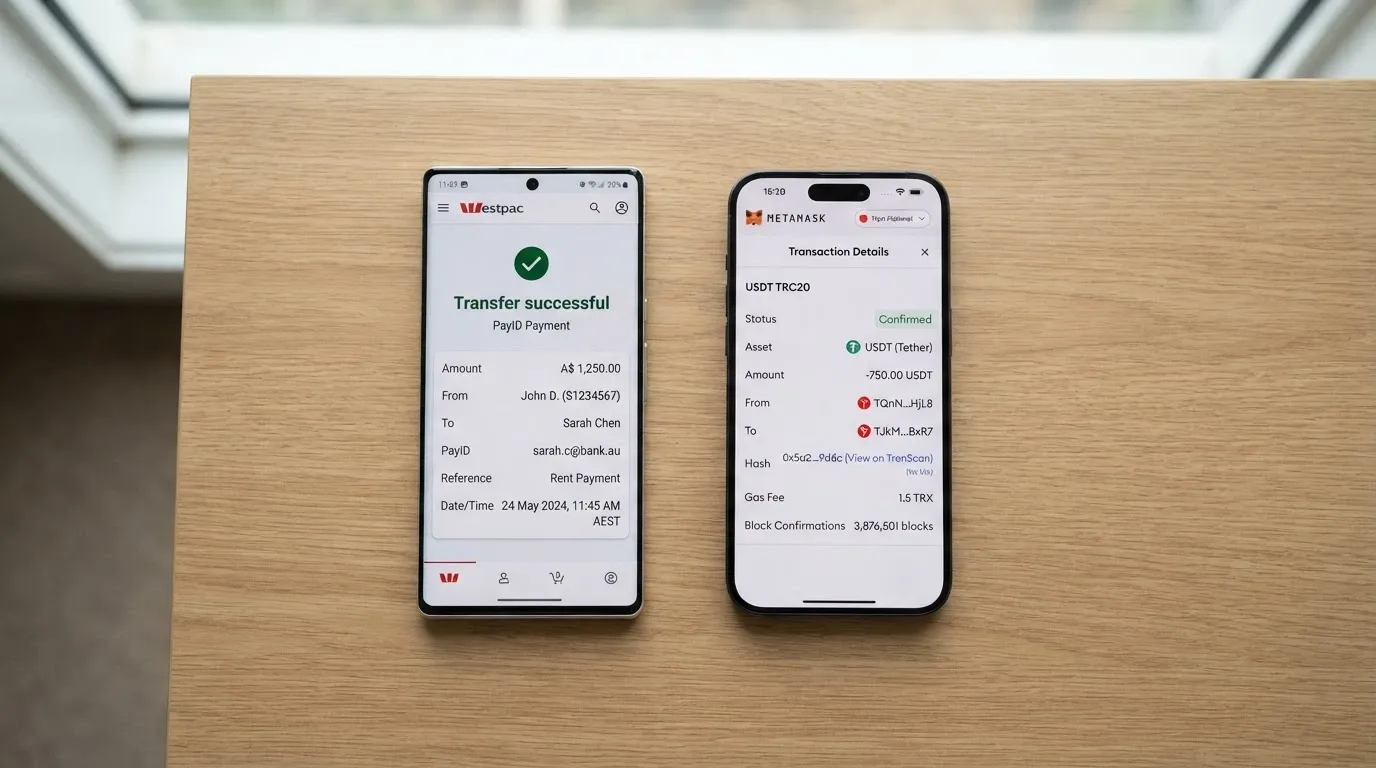
The legal status of crypto for gambling payments is sharper than the rail itself suggests. Credit cards, credit-related products and digital currencies have been banned as payment methods for online wagering since 11 June 2024 under the Interactive Gambling Amendment (Credit and Other Measures) Act 2023, with penalties of up to A$247,500 for operators that accept them. The ban applies to operators licensed in Australia — offshore operators are not bound by Australian law, and most of the featured set accepts crypto at the deposit and withdrawal end. The ban is therefore a player-side tell: an Australian-licensed operator asking for crypto is asking for an illegal payment method; an offshore operator asking for crypto is asking for the payment rail the brand was built around.
The table below covers the payment methods the featured operators accept. Deposit speed is what the player sees on confirmation; withdrawal speed is what tested operators returned in Payoutverdict.com’s 2026 runs.
| Payment Method | Deposit Speed | Withdrawal Speed | Key Limitation or Restriction |
|---|---|---|---|
| PayID / Osko | Instant | 24–48 hours end-to-end | Bank-side flagging above ~A$2,000 (CommBank declined 2 of 3 AU$5,000 PayID test transfers, March 2026) |
| Crypto (USDT TRC20) | 1–3 min wallet-side | 12 min – 4 hours operator-side | Banned for licensed AU wagering payments since June 2024; AUSTRAC Travel Rule applies at AU$10,000+ |
| Debit Card | Instant | 1–5 business days | Card issuer may decline gambling transactions even at offshore sites |
| Bank Transfer / BPAY | 1–2 hours to same day | 2–5 business days | Slowest rail for withdrawals; POLi shut down 30 September 2023 — any operator still listing POLi in 2026 is running outdated documentation |
| Neosurf | Instant (deposit only) | Not supported | Vouchers sold at Coles and 7-Eleven; deposit-only — no withdrawal path |
PayID at Online Casinos — How It Works and How Long It Really Takes
PayID deposits clear instantly because the rail is the New Payments Platform (NPP) with Osko overlay — the same instant-payment infrastructure that runs between Australian bank accounts, routed to the operator’s merchant account by the payment processor the operator uses. The deposit-side experience is identical to sending money to a friend. The withdrawal-side experience is not.
PayID withdrawals at the offshore operators tested by Payoutverdict.com ran 24 to 48 hours end-to-end in 2026 — that is operator approval queue plus Osko clearing plus any bank-side screening on the receiving account. The gap between instant deposit and same-day withdrawal is the practical shape of the rail. A player funding an account at 9 pm and withdrawing at 11 pm is unlikely to see the funds until the next business day.
The friction point that does not appear on the operator’s payment page is bank-side. CommBank declined two of three AU$5,000 PayID transfers to Binance Australia in March 2026; transfers under A$2,000 typically clear without flagging. The same bank’s screening applies to PayID transfers to offshore gambling merchants — the bank’s transaction monitoring is pattern-driven, and a large first-time transfer to an unfamiliar beneficiary is the kind of pattern that triggers a hold. A player moving more than A$2,000 in a single PayID transfer to an offshore casino should expect friction on either the sending or the receiving end.
Crypto Funding at Aussie Casinos — Speed, Costs and the Legal Fine Print
Crypto is the rail where the deposit and withdrawal times are closest. USDT on the Tron network (TRC20) confirms in 1–3 minutes with network fees under A$2 — the fastest rail for Australian casino withdrawals on the public record. The operator-side crypto withdrawal times tested in Payoutverdict.com’s January–May 2026 run were BitStarz 12–30 minutes, Stake 1–2 hours, Wild Fortune 3–4 hours. The variance is operator-internal — approval queues, fraud-screening windows, weekend staffing — not blockchain-side.
The legal fine print on crypto for gambling is the part the operator’s payment page usually does not carry. Credit cards, credit-related products and digital currencies have been banned as payment methods for online wagering since 11 June 2024, with penalties up to A$247,500 for licensed operators. The ban does not bind an offshore operator — the featured set accepts crypto without exception — but it tells an Australian player something the operator will not: crypto funding is the rail that no Australian-licensed operator can offer. The 2026 Gambling Reform Bill extends this direction; from 1 January 2027, banks and payment providers gain express authority to block transactions to illegal gambling operators. The enforcement is moving in the direction of less anonymity, not more.
AUSTRAC’s Travel Rule applies to crypto transfers at AU$10,000 and above. Transfers below that threshold are not subject to the rule, but Australian-issued exchanges apply their own internal reporting thresholds well below A$10,000 — CommBank’s pattern of declining AU$5,000 PayID transfers to Binance Australia is the visible shape of that. A player funding a casino account from an Australian exchange at a meaningful size is on the receiving end of the same screening infrastructure.
Playing Casino Games on Your Phone in Australia — What Works and What You Lose
Mobile play at offshore casinos serving Australian players is overwhelmingly browser-based. None of the operators in the featured set was confirmed to have a dedicated Australian app store presence this run. The default experience is the HTML5 mobile browser — Safari on iOS, Chrome on Android — pointed at the operator’s responsive website. That experience is good enough that most players do not look for a native app, and the operator’s incentive to build one is correspondingly small.

Mobile Browser Play vs Dedicated Casino Apps — What Australian Players Actually Get
A mobile browser on an offshore casino’s responsive site gives the player the full game lobby, the full cashier, and the full bonus page, on the same screen footprint as a desktop session scaled down to a phone. The HTML5 standard is what most modern slot and live-dealer games are built to, and the experience is comparable to a native app for most game types. What the browser experience does not give is push notifications, biometric login, and offline lobby access — the three things a native app adds on top of a responsive website.
The reasons offshore casinos default to the browser are operational, not technical. App-store policies on real-money gambling are restrictive in both the Apple App Store and Google Play, and an app that accepts AUD deposits from Australian users is in the kind of policy grey zone that gets apps removed. A responsive website carries no such policy risk: the operator updates the site server-side and the player reloads in the browser. The trade-off is real-time engagement tools — a player who opts in to push notifications on a sportsbook is opting in to a channel the browser does not provide — and the player who wants those tools is the player an offshore casino’s mobile offering is weakest for.
Real-Money Mobile Pokies — Game Selection, Performance and What You Trade Off
Mobile pokies libraries at the offshore operators in the featured set are large but not identical to desktop. Royal Reels’ 5,400+ pokies and 40+ providers on desktop do not all carry through to a portrait-mode mobile session — providers filter their portfolios for HTML5 compatibility, and older titles built in Flash or in fixed-aspect desktop layouts drop off the mobile lobby. Bizzo Casino’s 4,000+ games and Rocket Casino’s 2,000+ games carry a similar profile: large on desktop, smaller on mobile, and the smallest on a phone running the game in a low-power-mode browser session.
The performance considerations are practical: data use is meaningful on a long session (slot games stream graphics continuously through the spin), battery drain is faster than on a native app (the browser tab does not benefit from the same power-management optimisations), and connection stability matters more on mobile because cellular handoffs drop a session that a stable home connection does not. The deposit-and-play-and-withdraw loop from one device works at every featured operator — the cashier, the game lobby and the withdrawal request are all browser-based, all reachable from the phone — and the player’s experience is the same operator’s experience with a smaller screen and a less stable connection.
Australia’s Gambling Laws — The Prohibition, the Regulator and Where You Stand
The legal shape of online casino in Australia is a federal prohibition enforced by the ACMA, with a 2026 reform bill passed but not yet in force. The shape has not changed materially since the 2017 amendments to the Interactive Gambling Act 2001 strengthened the framework; the 2026 reform adds the advertising, inducement and payment-blocking extensions that come into effect on 1 January 2027.

The Interactive Gambling Act 2001 — What It Prohibits and What It Does Not
The Interactive Gambling Act 2001, as amended by the Interactive Gambling Amendment Act 2017, prohibits the supply of online casino games, online poker, in-play online sports betting, betting on lottery outcomes, and unlicensed online wagering services to a person in Australia. Section 8AA is the operative prohibition on supplying a prohibited interactive gambling service; the civil penalty provisions, formal warning power, and ISP blocking direction all run off section 8AA and its sibling sections.
What the IGA does not prohibit is wagering on racing and sport placed before the event begins, through operators licensed by a state or territory regulator. The licensing concentrates with the Northern Territory Racing and Wagering Commission through Licensing NT — brands such as Sportsbet, Ladbrokes, Bet365, TAB and PointsBet hold NT wagering licences — and the player’s interaction with a licensed wagering operator runs through the Australian consumer-protection framework the offshore casino does not reach. The IGA also does not prohibit the individual player from placing an online wager or playing an online casino game. The Act targets the provider; the player is the customer of an illegal service, not the perpetrator of an offence.
This is the legal distinction every “best Aussie online casino” page sits on. The product is prohibited; the player is not prosecuted; the operator is the regulatory target. The offshore casino market exists because operators in jurisdictions outside Australia are willing to provide the service to Australian customers, and the IGA’s enforcement tools — civil penalty, formal warnings, ISP blocking — target the operator’s ability to reach Australian customers, not the customer’s ability to seek them out. The minimum age for any commercial gambling in Australia is 18.
ACMA Enforcement — Blocking Powers, Investigations and What They Mean for a Player
The ACMA’s enforcement program against offshore casinos serving Australian players has run since the 2017 amendments gave the regulator its operational powers. The headline figures on the public record: 1,564 illegal gambling and affiliate websites blocked by Australian ISPs since November 2019, and more than 225 illegal services withdrawn from the Australian market since 2017. Both numbers update each quarter; both are the visible shape of an active enforcement pipeline that touches every brand on the featured set.
The Q4 2025 quarter saw 483 enquiries and complaints received, 23 investigations completed into 45 gambling sites, 69 breaches found, and 10 formal warnings issued. 38 of those breaches were for providing a prohibited interactive gambling service to Australian customers and 26 were for providing an unlicensed regulated interactive gambling service — the second category covering wagering brands operating without an Australian licence. 133 websites were referred to ISPs for blocking in the same quarter, alongside 133 URLs reported to family-friendly filter providers. The pipeline’s outputs are visible: investigations turn into warnings, warnings can turn into civil penalty proceedings, and the ACMA has used ISP blocking as the operational lever for the worst offenders.
For a player with funds on a site the ACMA has directed to be blocked, the practical consequence is sharp. The blocking instruction operates at the ISP level — the site is unreachable through the player’s Australian internet connection — and the player has no Australian mechanism to recover an open balance. The operator runs under its own jurisdiction’s dispute resolution; the ACMA’s enforcement does not unwind balances or compel withdrawals. A blocked domain is the costliest version of “offshore” for the player holding funds at the moment the block takes effect.
Staying in Control — Gambling Help, Self-Exclusion and the Offshore Blind Spot
Australia has built one of the world’s most comprehensive responsible-gambling frameworks. BetStop, the National Gambling Helpline, Gambling Help Online, deposit limits at licensed operators, take-a-break tools, activity statements — the infrastructure exists and it produces measurable outcomes for the people it reaches. None of it reaches an offshore casino.

BetStop, Self-Exclusion and Deposit Limits — The Tools That Work Inside the Licensed System
BetStop is the National Self-Exclusion Register, live since 21 August 2023. By 31 March 2026, 59,830 people had registered to self-exclude and 37,247 exclusions were active. A single BetStop registration excludes a person from every licensed online and phone wagering service in Australia — approximately 190 licensed wagering providers are connected to the register, and the exclusion applies across the lot, not to one operator at a time.
The outcomes data from the ACMA’s November 2025 survey of self-excluded gamblers is the strongest evidence the register is working. 77 per cent of registrants reported experiencing a better overall quality of life after self-excluding. 79 per cent reported improved mental health. 69 per cent reported better personal relationships. 96 per cent reported they had either completely stopped betting (81%) or decreased their betting (15%). The BetStop exclusions run for a minimum of three months and can be extended up to a lifetime; the registrants who extend and who report the strongest outcomes are the ones who treat the exclusion as the line rather than the pause.
The other tools inside the licensed system work at the operator level. Deposit limits at licensed wagering operators are customer-set and customer-adjustable, with a 24-hour cooling-off period before an increase takes effect. Take-a-break tools let a player suspend their account for 24 hours to six months without registering for the full self-exclusion. Activity statements at licensed operators show a player their monthly deposit, loss and time-on-site history — the kind of data an offshore casino does not routinely provide. Each of these tools is a layer in the framework an Australian-licensed operator runs on. Each is missing from the offshore casino a player reaches through a search for “best Aussie online casino.”
The National Gambling Helpline is 1800 858 858 — free, confidential and staffed 24 hours a day, seven days a week. Gambling Help Online (gamblinghelponline.org.au) provides online chat and counselling. Both are reachable from anywhere in Australia and both cover any form of gambling harm, licensed or not.
The Offshore Blind Spot — What Happens to Player Protections When a Casino Sits Outside Australian Law
The protections listed above disappear at the offshore casino boundary. BetStop does not cover offshore casinos. Deposit-limit obligations do not apply. Activity statements are not provided in the format the Australian regulator requires. Self-exclusion is a single-operator decision the player has to repeat for every brand they play at, and a self-excluded person’s deposits to offshore casinos continue without any interruption. The Springer Nature model published in the Journal of Gambling Studies estimates approximately 3.29 million Australians aged 5 and older are affected annually by gambling harm, with 1.97 million adults with at-risk or problem gambling and 1.38 million affected others. The annual health loss is over 400,000 Years Lived with Disability — a measure of the lived burden of harm in the population. The framework that exists to mitigate this harm is built around licensed wagering operators, and offshore casinos are not in that framework.
The harm data makes the offshore gap consequential. 15.1 per cent of Australian adults — 3.32 million people — are experiencing gambling harm according to Roy Morgan’s July 2026 Gambling Harm Index. ANU’s 2025 survey found 56.1 per cent of those who gambled did so mainly online. 5.9 per cent of Australian adults reported being harmed by another person’s gambling in the past 12 months. The gambling harm is being done where the players are — and the players are on offshore sites in significant volume. BetStop’s 59,830 registrants are a meaningful intervention for the people it covers. It does not cover an offshore casino’s player.
For a person with a BetStop exclusion who is playing at an offshore casino, the exclusion does not interrupt the play. The self-exclusion is a barrier to licensed wagering; it is invisible to the offshore brand. The offshore casino accepts the deposit, processes the withdrawal, and has no mechanism to check the customer’s name against a register that does not include them. The harm-prevention tool the player activated for themselves stops working at the boundary they did not register it across.
How We Picked and Ranked These Aussie Online Casinos
The featured operators on this page were selected on three criteria, listed in order of weight: tracked Australian player traffic, the public availability of third-party-confirmed offer terms (welcome bonus, wagering multiplier, free-spin allocation, game library), and the operator’s ACMA enforcement record where one exists. The traffic data orders the ranking. The third-party coverage determines how much this page can say about each operator — Royal Reels’ 30x wagering and 5,400+ pokies are third-party-confirmed figures; Scream Casino’s absence of a confirmed offer is also a third-party fact. The ACMA record is the regulatory context each operator sits inside.
What this ranking does not do is assign a star rating or a safety score. The data to ground a composite safety score in is not there: no test deposits were made, no payouts were verified for this page, no player balances were opened, no customer-service interactions were recorded. The third-party data — Payoutverdict.com’s January–May 2026 crypto-withdrawal timings, Casinoaudit.net’s Royal Reels review, Cloudwash.com.au and Gamblingsites.com’s Bizzo Casino and Rocket Casino coverage, Australiangamblers.com’s bonus term summaries — is the verification layer this page sits on. A reader who wants a deeper check on any specific operator should follow those third-party sources through.
The ranking also does not claim the absence of public ACMA enforcement is a safety endorsement. The ACMA’s quarterly pipeline (covered in the enforcement section above) runs in real time, and an operator not on the public warning or blocking list this run is an operator not yet on the regulator’s pipeline at the time of writing. That is a fact about the regulator’s visibility, not a clearance of the operator.
What Australian Casino Players Should Actually Do in 2026
The choice at the centre of this page is not between offshore casinos. It is between playing offshore and not playing at all. The IGA prohibits the product; every operator on this list operates outside Australian law; the player’s recourse at any of them runs through whichever offshore jurisdiction the operator chose to licence in. That is the frame.
Inside that frame, three checks matter most. First: read the bonus terms before claiming. The wagering multipliers on this page run 30x at Royal Reels, 40x at Bizzo Casino, 45x at Rocket Casino, and the cost difference between them is measured in tens of hours of continuous play — the worked example in the welcome-bonus section puts the 45x at 93.75 hours to clear a A$1,500 welcome match, against 41.7 hours for the 30x on an equivalent bonus. Second: verify the withdrawal record at a third-party source, not the operator’s own claims. Stake’s 1–2 hour tested crypto withdrawal is a Payoutverdict.com figure, not a Stake marketing line, and the third-party source is what makes the claim usable. Third: check the operator-group name against the ACMA’s quarterly enforcement outcomes — Q2 2025 and Q4 2025 are the two most recent, and Dama N.V., NovaForge Ltd, and Hollycorn N.V. are the operator groups named across both.
The protection tools available inside the Australian licensed system are the baseline every offshore casino fails to meet. BetStop covers approximately 190 licensed wagering providers and produces the strongest self-exclusion outcomes of any tool in the framework. The National Gambling Helpline (1800 858 858) and Gambling Help Online (gamblinghelponline.org.au) are free, confidential and reachable from anywhere. Deposit limits at licensed wagering operators are a real intervention. None of these reach an offshore casino, and that gap is the single most concrete consequence of the offshore route.
The 2026 Gambling Reform Bill adds the next layer from 1 January 2027: wagering-ad caps (no more than three per hour between 5:00 am and 8:30 pm), a live-sport blackout (15 minutes before to 5 minutes after each event), a prohibition on notable-person endorsements, an inducement-free period of 14 days after signup and 90 days after BetStop deregistration, an AdStop opt-out register, and explicit authority for banks and payment providers to block transactions to illegal gambling operators. The reform is passed but not yet in force. The direction of travel is toward more protection and less reach for the offshore product. A player who has been delaying engagement with the offshore market on the expectation the space will become more accessible has misread the reform.
The single most important check before depositing at any offshore casino is the one the operator does not make easy: read the terms. The wagering multiplier, the maximum cashout from a no-deposit bonus, the game weighting on the slots a player actually wants to play, and the validity window on the bonus are the four numbers that determine whether a bonus is worth claiming. The headline figure is the marketing. The four numbers are the offer. The rest of this page is the comparison that lets a reader see both.
Frequently Asked Questions
Are online casino winnings taxable in Australia?
Betting and gambling winnings are not assessable income under section 6-5 of the ITAA 1997, and losses are not deductible under section 8-1, unless a person carries on a business of betting. Recreational players do not pay tax on casino winnings; a professional punter is taxed on net profits at the marginal rate.
What is BetStop and does it cover offshore casino sites?
BetStop is the National Self-Exclusion Register, live since 21 August 2023. By 31 March 2026, 59,830 people had registered, with 37,247 active exclusions across approximately 190 licensed wagering providers. One registration excludes from every Australian-licensed online and phone wagering service. BetStop does not cover offshore casinos; the operator is not connected to the register.
Is it legal to play at online casinos in Australia?
Online gambling is legal for the player under Australian law. Section 8AA of the Interactive Gambling Act 2001 prohibits operators from providing prohibited interactive gambling services to Australian residents. The Act targets the provider, not the customer. The player’s act of playing is not an offence.
How does the Interactive Gambling Act 2001 affect Australian casino players?
The IGA prohibits the supply of online casino games, online poker, in-play online sports betting, betting on lottery outcomes, and unlicensed online wagering services to Australian customers. The ACMA enforces through formal warnings, civil penalty proceedings and ISP blocking — 1,564 sites blocked since November 2019. The player is not the target of enforcement.
What responsible gambling tools are available for Australian players?
The principal tools are BetStop (covering approximately 190 licensed wagering providers), the National Gambling Helpline (1800 858 858, free, 24/7), Gambling Help Online (gamblinghelponline.org.au), and operator-level deposit limits and take-a-break tools at Australian-licensed operators. The 2026 reform adds the AdStop wagering-advertising opt-out register from 1 January 2027. None of these tools reach offshore casinos.
Published by the Min Deposit 5 Casinos AU team.