
The Real Cost of a No-Wagering Casino Bonus for Australian Players in 2026
Current as of 16 October 2026 and verified against the ACMA register of licensed interactive gambling providers, each operator’s stated licence jurisdiction and the Australian Institute of Health and Welfare’s most recent problem-gambling prevalence figures.

A “no wagering” casino bonus is the closest thing the offshore market has to free money, and it is the rarest thing on it. Of 27 advertised “no wager” claims tested across 21 operators, only 5 produced an actual 0×-wagering bonus credited on signup with cashable winnings paid out. The other 22 either hid wagering behind a sub-menu, demanded a deposit the bonus page never mentioned, capped cashouts below the operator’s own withdrawal floor, or voided winnings entirely.
That gap between the word “free” on the marketing page and the word “free” in the player’s bank account is what this guide is built around. There are real no-wagering bonuses available to Australians in 2026 — four of the ten offshore operators featured here carry one — and the rest sit in the 30× to 40× range that makes a “bonus” a way to give the house your money more slowly. Knowing which is which, and what each one actually pays, is the only useful frame.
A note before any of it: every operator named on this page operates outside Australian law. Online casino games are prohibited under the Interactive Gambling Act 2001, and no licence for online casino exists anywhere in the country. The licensed Australian wagering market covers sports and racing before the event, lotteries and keno. The site you reach from a Sydney bedroom is not one of them. That is covered in full in the section on the legal reality.
Table of Contents
- What a No-Wagering Casino Bonus Actually Means (and Why Most Aren’t)
- How Casino Wagering Requirements Work — The Trap in the Fine Print
- The Few Real No-Wagering Casino Bonuses Australians Can Claim in 2026
- The Legal Reality — No Online Casino Holds an Australian Licence
- Low-Wagering vs No-Wagering — How Low Is Low Enough?
- Free Spins, No-Deposit Offers and the Catch That Survives 0× Wagering
- Payment Methods That Make or Break Your Bonus Eligibility
- The Pokies Worth Playing on a No-Wagering or Low-Wagering Bonus
- How We Reviewed and Ranked These No-Wagering Casinos
- Your No-Wagering Bonus Game Plan
- Frequently Asked Questions
What a No-Wagering Casino Bonus Actually Means (and Why Most Aren’t)
A no-wagering bonus is one with a 0× playthrough requirement on the bonus amount. The winnings from it are paid as real, withdrawable cash the moment the spin lands — no turnover, no locked balance, no conversion step. A standard Australian casino bonus runs 30× to 45× on the bonus. Low-wagering sits at 1× to 20×. No-wagering sits at zero.
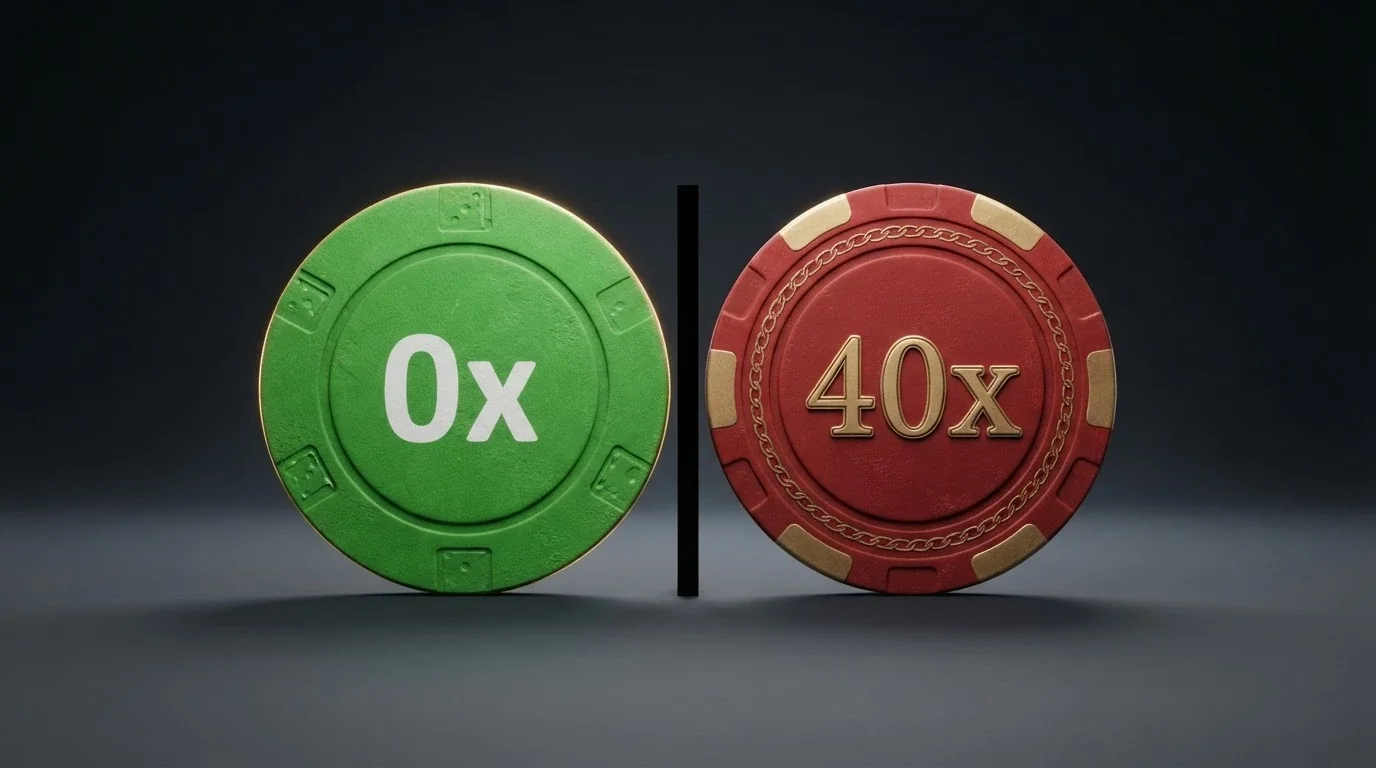
Those bands sound like a clean spectrum. In practice they describe three very different offers. A 0× bonus turns bonus spins into cash the same day. A 30× bonus turns them into a multi-thousand-dollar playthrough that takes hours of pokies play to clear and bleeds the player’s edge along the way. A 45× bonus does the same thing slower, and the player’s edge is what gets bled.
The Definition — What Zero-Times Wagering Promises
Zero-times wagering means the operator multiplies the bonus amount by zero before releasing it. Whatever the bonus spins win is yours in cash, paid into the real-money balance, withdrawable from the first dollar. There is no locked balance. There is no “completion” step that has to be ticked. There is no cash-out-the-bonus-after-meeting-the-wager clause because there is no wager to meet.
This is what the marketing word “free” is supposed to mean. Compare it to a standard offer: take a A$100 deposit match with 40× wagering, and the casino requires A$4,000 of slot turnover before a single dollar of bonus money converts to real money. At a 96.5% RTP pokie, that A$4,000 in spins costs the player roughly A$140 in expected house edge before any winnings are released. The “bonus” is the entry fee, and the fee is what it costs to clear it.
The reason “no wagering” exists as a category at all is that operators who offer it want to skip past the friction. A bonus that pays cash the same day looks better than a bonus that requires hours of grind before anything is withdrawable, and it gets the player through the door faster. The honest ones — the five of 27 in the test sample — pay cash on a 0× offer. The rest advertise the word and bury the catch.
What Wagering Requirements Look Like on a Standard Bonus
A A$100 bonus at 40× wagering means A$4,000 in qualifying bets before the bonus becomes cash. At a A$1 stake per spin that is 4,000 spins. At a five-second spin interval, that is roughly five and a half hours of continuous pokies play. The player can split the time over days, but the turnover requirement is the same A$4,000 regardless.
What that A$4,000 in turnover actually costs the player depends on the pokie. A 99% RTP pokie costs about A$1 in expected house edge for every A$100 wagered. A 94% pokie — the lower end of the Pragmatic Play range — costs about A$6 per A$100. Across A$4,000 in turnover, the gap is between roughly A$40 and A$240. The pokie chosen changes the cost of the bonus by a factor of six.
That is why the wagering multiple alone does not tell the full story. A 40× bonus on a 99% pokie and a 40× bonus on a 94% pokie are not the same offer in any meaningful sense, even when the headline numbers match. Game selection inside the bonus is where most of the cost hides.
The contribution weighting makes it worse for anyone who prefers table games. Pokies typically contribute 100% of every wager toward the playthrough. Blackjack and roulette can contribute as little as 10%, and live dealer is excluded entirely at some operators. A player who wants to clear a bonus on blackjack effectively has to wager ten times the stated playthrough to convert the same amount — A$40,000 of blackjack bets to clear a A$100 bonus at 40×, if blackjack contributes 10%.
The 0× Reality Check — Why Only a Handful of Bonuses Actually Deliver
The audited finding on no-wagering offers in the Australian market is blunt. Of 27 advertised “no wager” claims tested across 21 operators, five produced an actual 0×-wagering bonus credited on signup with cashable winnings paid out. The other 22 fell into four categories of trap.
The first is hidden wagering. The bonus page advertises “no wagering”, but a sub-page or the terms link a 1× or higher playthrough to the withdrawal step. The bonus itself is 0×, but the winnings carry a multiplier the marketing never mentioned. The second is the hidden deposit. Some offers require a minimum deposit to claim the wager-free bonus — A$10 or A$20 is common — and the landing page leads with the free-spin headline. The deposit is in the small print.
The third trap is the cashout cap below the withdrawal floor. A 0× offer is technically 0×, but a max-cashout cap of A$30 on a A$200 win forces the player to forfeit the surplus, and the operator’s own minimum withdrawal sits at A$50 or higher. The winnings are real cash, but they cannot reach the player’s bank. The fourth is voided winnings — operators reserve the right to void bonus-derived winnings for irregular play, bonus abuse, or a long list of bets-pattern triggers that are buried in the terms.
The test result is the headline. Five of 27 is roughly 18%. Most “no wagering” offers in this market are not what they say they are. The handful that are pays cash on signup without a hidden catch. Reading the terms before depositing is the only way to know which is which.
How Casino Wagering Requirements Work — The Trap in the Fine Print
A wagering requirement is the number of times the bonus amount must be turned over in qualifying bets before the bonus balance becomes real money. It is sometimes called a playthrough or rollover. In Australia it is most often called a turnover requirement.

The mechanics are simple in principle. The player deposits, claims a bonus, and the casino credits a bonus balance alongside the real-money balance. The bonus balance is locked until the wagering requirement is met. Each bet on a qualifying game chips away at the requirement. Once the requirement is fully met, the bonus balance converts to real money and the player can withdraw.
The complication is everything around the number.
The Step-by-Step Mechanics of Clearing a Bonus
Step one is the deposit. A deposit-triggered bonus credits on the first qualifying deposit, usually A$20 or more. The bonus is calculated as a percentage of the deposit — 100% matches the deposit dollar for dollar, 120% (the first-deposit rate at SkyCrown) gives 20% on top, 50% gives half.
Step two is the bonus balance. The casino splits the player’s money into two buckets: real money, which can be withdrawn at any time, and bonus money, which cannot. A player who tries to withdraw the deposit before clearing the wagering requirement forfeits the bonus. That is the lock. It is the operator’s way of forcing turnover before any winnings walk out the door.
Step three is the play. Each spin or hand reduces the remaining wagering requirement by the amount of the bet, weighted by game contribution. A A$1 spin on a pokie reduces the requirement by A$1. The same A$1 on a blackjack hand may reduce it by A$0.10. Live dealer bets, at some operators, reduce it by zero.
Step four is the conversion. Once the wagering requirement hits zero, the bonus balance moves into the real-money balance. From that moment on, the player can withdraw everything — bonus-derived and winnings-derived — or keep playing.
The friction sits in steps two and three. Win too early and the player forfeits the bonus on withdrawal. Play the wrong game and the wagering requirement barely moves. Run out of time and the bonus expires, and with it any winnings tied to it. WinSpirit uses a 7-day expiry window from activation; Lucky Dreams gives 30 days. The same bonus can be winnable and unwinnable depending on which of those clocks is ticking.
Game Contributions — Why Pokies Count 100% and Blackjack Barely Registers
Game contribution is the weighting the operator applies to each bet type when reducing the wagering requirement. Pokies contribute 100% at every operator in this comparison. Table games — blackjack, roulette, baccarat — contribute 10% at some, less at others, and are excluded entirely at operators like Bizzo, where table games and live dealer are shut out of wagering altogether. Video poker sits in a similar grey zone: counted at WinSpirit, but with reduced weighting relative to pokies.
The reasoning on the operator side is RTP and variance. Pokies return roughly 96.5% on average and have predictable spin-to-spin variance, which makes them a clean wagering vehicle. Blackjack returns closer to 99.5% with low variance, which means a player’s edge on the bonus is much higher — operators compensate by down-weighting the contribution or excluding the game. A player who could clear a 40× bonus on blackjack would do so at a fraction of the house edge a pokie player pays.
The effect for the player is that game choice inside the bonus is not a preference question, it is a cost question. A A$100 bonus at 40× wagering requires A$4,000 of qualifying bets. Run that A$4,000 on pokies at 96.5% RTP and the expected loss is roughly A$140. Run it on a 10%-contribution blackjack variant and the player has to bet A$40,000 to clear the same requirement — and pay roughly A$200 in house edge on the way. The game contribution table is where the bonus’s real price is set.
The practical advice is straightforward. Pokies are the only game type worth playing to clear a bonus at any of the operators in this comparison. Anything else either drags the cost up by an order of magnitude or, at the exclusion list operators, removes the contribution to zero.
The Few Real No-Wagering Casino Bonuses Australians Can Claim in 2026
Ten offshore operators reach Australian players through the offshore channel. Of those, four carry a genuine 0× offer alongside their standard deposit bonus — SkyCrown, Lucky Dreams, VegasNow, Wild Tokyo. The other six run standard 30× to 40× wagering and have no confirmed wager-free bonus this round.

The table below ranks the full set on the one figure that matters most for a no-wagering guide: the wagering multiple on the deposit match. A lower number means less playthrough required to convert the bonus into real money, which means less house edge spent on the way through.
| Casino | Licence | Wagering on deposit match |
|---|---|---|
| SkyCrown | Curaçao (offshore) | 40× |
| Rocket Play | Curaçao OGL/2024/1307/0748 | 30× |
| Royal Reels | Curaçao (offshore) | 35× |
| Fair Go | Curaçao (offshore) | 30× |
| Lucky Dreams | Curaçao (offshore) | 35× |
| Bizzo Casino | Curaçao (offshore) | 40× |
| WinSpirit | Offshore | 35× |
| Rainbet | Offshore | Varies |
| VegasNow | Curaçao (offshore) | Not specified |
| Wild Tokyo | Curaçao (offshore) | Not specified |
The headline reading is that no single operator dominates on the standard deposit bonus — the range clusters between 30× and 40×, with Rocket Play and Fair Go at the low end and SkyCrown and Bizzo at the high end. The wager-free offers, where they exist, are smaller than the headline welcome packages and live separately from the main bonus. A player who wants the 0× deal is reading a different page than a player chasing the A$10,000 welcome.
Every operator on the list is offshore-licensed (predominantly Curaçao) and unlicensed in Australia. None appear on the ACMA register of licensed interactive gambling providers, which covers licensed wagering only — there is no licensed online casino to appear on. They are accessible to Australians, they hold real market share here, and they operate outside Australian law. That frame is held throughout.
SkyCrown — The Biggest Package, but Crypto Depositors Miss Out
SkyCrown’s headline offer is the largest deposit match in the set: up to A$8,000 plus 400 free spins across four deposits, with 40× wagering on both bonus money and free-spin winnings. The first deposit alone is 120% up to A$1,200 plus 125 free spins. Minimum deposit on the first tranche is A$30, rising to A$50 on the fourth.
The wager-free piece sits separately. SkyCrown lists 15 wager-free spins on Sweet Bonanza 1000 — 0× wagering, A$40 max cashout, seven-day expiry. It is a small bonus by SkyCrown’s headline scale, but it is genuine 0×: whatever the spins pay, up to A$40, is cash in the player’s real-money balance.
The restriction that defines the operator for any crypto-using punter is exclusionary. SkyCrown does not make any bonuses — including the welcome bonus — available to users who deposit with crypto. A Bitcoin, Ethereum or USDT deposit unlocks the games but locks out every bonus credited to the account. That makes SkyCrown the wrong choice for any player who plans to fund with crypto and use a bonus on the same deposit. For a PayID or debit-card depositor who wants scale, the welcome is generous and the 0× spins are a clean side bet.
A second bonus channel worth flagging is the Meet & Spin offer: 20 no-deposit free spins after phone verification. No deposit required, but the winnings carry a wagering requirement that is comparable to the standard bonus, not the 0× rate of the wager-free spins. The two offers are different products with different prices.
SkyCrown’s place in this ranking is at the top on package scale and A$300 max win per free-spin bonus part, with a sharp single-point restriction on crypto deposits. For a debit-card punter chasing the biggest welcome, it is the natural pick. For a crypto punter, the welcome is invisible.
Rocket Play — Low 30× Wagering on a Modest Welcome Match
Rocket Play holds a Curaçao licence under the number OGL/2024/1307/0748, issued to Scores55 Tech B.V. The licence is verifiable through the Curaçao Gaming Authority register, which makes Rocket Play one of two operators in this comparison set whose licence details check out to a specific number.
The welcome is on the smaller side. 100% up to A$200 plus 50 free spins, with 30× wagering on the bonus amount. Minimum deposit is A$25, including the crypto equivalent. The 30-day validity window is generous against the seven-day default at WinSpirit. Maximum cashout from the bonus is A$500.
No wager-free offer was confirmed at Rocket Play this round. The 30× playthrough on the deposit match is the lowest in the set tied with Fair Go, which makes Rocket Play the practical fallback for any punter who cannot claim a 0× offer and wants the cheapest entry to bonus play. The A$500 cashout ceiling is the structural limit on upside — clear a 30× bonus and the player walks away with at most A$500 from bonus-derived funds, regardless of how much the bonus itself paid.
The honest read on Rocket Play is that it is the operator to use when the wager-free offers are exhausted. Low wagering, named licence number, 30-day validity. The marketing on the welcome is unremarkable; the structure underneath is tighter than most.
Royal Reels — 5,400+ Pokies and an AU$10 No-Deposit Chip
Royal Reels is a Curaçao-licensed operator blocked by the ACMA, which is worth noting because it means the operator’s primary domain is on the ACMA blocking list. Players who reach Royal Reels in 2026 do so through mirror or alternative domains, and the site can vanish at any time with a balance still on it.
The welcome is a three-deposit package totalling A$2,500: 100% up to A$500 on the first, 75% up to A$750 on the second, and 100% up to A$1,250 on the third. Wagering is 30× on the welcome bonus and 35× on the multi-deposit package, with a A$5 per-spin cap during clear-down. The spin cap is one of the tighter in the set.
The no-deposit offer is the standout. AU$10 credited after phone verification, no deposit required. The maximum cashout on this AU$10 chip is not specified in the surfaced terms, which is itself a flag — players should treat it as small. Royal Reels pairs the chip with a 5,400+ pokie library from 40+ providers and a 10-tier VIP with cashback, which makes the AU$10 chip a tasting menu for the broader game catalogue rather than a payday.
The verdict on Royal Reels is that the no-deposit chip and the pokie depth are the genuine draws. The ACMA blocking status means any deposited balance is at risk if the domain is taken down, which is the section on offshore risk made concrete. The AU$10 chip offers an accessible way to sample the site’s massive library, but the site’s ACMA-blocked status makes any deposit a serious commitment.
Fair Go — An AU-Facing Brand With 30× Wagering and SpinLogic Pokies
Fair Go is positioned as an Australian-facing brand. The library runs on SpinLogic / ViG software, which is a less common provider stack than the Pragmatic Play / Nolimit City mix at the larger offshore operators. The welcome is 100% up to A$200 across five deposits, totalling A$1,000, with 30× wagering. Minimum deposit is A$20.
The no-deposit offer is 15 free spins on Bubble Bubble, with 60× wagering on the winnings. The 60× is steep — a A$1 win on the spins requires A$60 in turnover before it converts — and the maximum cashout is described as small rather than specified. That is a familiar pattern: the no-deposit offer is free to claim, expensive to clear, and capped at a low ceiling.
No wager-free offer was confirmed at Fair Go this round. The 30× on the deposit bonus ties it with Rocket Play at the low end of the spectrum, but the smaller total welcome (A$1,000 against A$8,000 at SkyCrown, A$10,000 at Lucky Dreams) means a player who clears Fair Go’s bonus walks away with less, even at the same wagering multiple.
The verdict on Fair Go is that it is a niche pick — a brand that targets Australian punters specifically, with a familiar software stack and a low entry point. The 60× no-deposit wagering makes the 15 free spins a marketing draw rather than a value offer. For a player who specifically wants SpinLogic pokies and an A$20 minimum deposit, Fair Go fits. For a player chasing the cheapest playthrough, Rocket Play’s 30× on a clearer A$200 offer is the better structure.
Lucky Dreams — A$10,000 Welcome and a Genuine A$10 Wager-Free Chip
Lucky Dreams runs the largest headline welcome in the comparison set: up to A$10,000 plus 500 free spins across five deposits, with the first deposit at 100% up to A$500. Wagering is 35× on bonus funds and 40× on free-spin winnings. Minimum deposit is A$20, validity is 30 days per deposit.
The wager-free piece is small but real. Lucky Dreams lists a A$10 wager-free chip — 0× wagering, A$30 max cashout, seven-day expiry. The A$30 cap is the tightest among the wager-free offers in this set: 25 free spins at Wild Tokyo at a A$0.20 coin value cap at A$50, the Lucky Dreams chip caps at A$30 regardless of what it pays. The wager-free chip is the lowest-upside entry point on this page.
The other structural limit is the bet cap. Lucky Dreams restricts the player to a maximum of A$8 per spin or hand while a bonus is active. Exceed it and the casino can void the bonus. The cap is industry standard rather than punitive, but it is enforced, and a player used to larger bet sizes on the welcome will need to scale down for the duration of the bonus.
The verdict on Lucky Dreams is that the headline welcome is the most generous in the set on paper and the wager-free chip is the smallest in actual cash value. The combination reads as scale on the welcome and a tight cap on the 0× offer. Lucky Dreams stands alone as the only operator in this set reaching the A$10,000 ceiling. Those prioritising 0× cash will find Wild Tokyo’s A$50-capped free spins a more compelling entry point.
Bizzo Casino — 40× Wagering and a Capped No-Deposit Bonus
Bizzo sits at the higher end of the standard wagering band. 40× applies to all deposit bonuses and to no-deposit and free-spin bonuses. Minimum deposit is A$25, maximum bet with an active bonus is A$8, and the no-deposit bonus has a maximum withdrawal of A$75.
The no-deposit cap is the cleanest number in the comparison set — A$75 is a ceiling, not a sliding scale — and the 40× on top of it makes the offer expensive to clear even before the cap bites. A player who wins A$75 on a Bizzo no-deposit bonus and wants to withdraw any of it has to wager A$3,000 in qualifying bets first.
Game contribution at Bizzo is the strictest in the set. Slots contribute 100%; table games and live dealer are excluded entirely from wagering. There is no contribution at all on table games. A player who tries to clear a Bizzo bonus on blackjack finds the wagering requirement unmoved, bet by bet.
The verdict on Bizzo is that it is a hard-edged operator with tight contribution rules and a 40× playthrough. The no-deposit cap is generous against the A$30–A$50 standard at the 0×-offer operators, but the cost of clearing it eats most of the value. For a slots-only punter comfortable with 40×, Bizzo is workable. For anyone who wants to mix blackjack or roulette into the bonus, Bizzo is the wrong operator.
WinSpirit — Tight Limits and a Seven-Day Clock
WinSpirit’s surface terms are the strictest defaults in the comparison set. Maximum bet while wagering a bonus is A$5 per spin or game round — A$3 less than the A$8 cap at Lucky Dreams and Bizzo. Default bonus expiry is seven days from activation, against the 30-day window at Lucky Dreams. Game contribution: slots at 100%, table games and video poker at reduced weight or excluded.
The welcome bonus details are not specified in the surfaced research. What is specified is the restrictive default terms that define the experience: tight bet cap, short expiry window, table-game exclusions. A player who signs up and claims a standard bonus is working against the clock from day one.
The seven-day window matters. A A$100 bonus at 35× requires A$3,500 of qualifying bets — 3,500 spins at A$1, which at a five-second interval is roughly five hours of continuous play. A week is more than enough time, but a player who plays casually at 200 spins a day takes roughly 18 days to clear the same bonus, and the bonus expires at day seven. The expiry window forces a fast play pace that casual punters will not hit.
The verdict on WinSpirit is that the terms favour a fast, high-volume player who can clear bonuses in a single session or two. The seven-day expiry is a structural penalty for casual play. For a pokie player who can run 500 spins an evening, WinSpirit’s terms are workable. For a weekend-only punter, the same terms make the bonus almost impossible to clear.
Rainbet — Crypto-Friendly, Light on Bonus Detail
Rainbet’s surfaced details are thin. Minimum deposit for Australian promotions is A$20. Wagering varies by offer. The welcome bonus package is not specified in the research, and no wager-free offer was confirmed this round.
What is clear is the crypto positioning. Rainbet is a crypto-friendly offshore operator, and the A$20 entry point sits at the lower end of the comparison set. Beyond that, a player who chooses Rainbet is choosing on the basis of crypto support and the operator’s broader game library rather than on bonus terms, because the bonus terms on the welcome are not visible enough to compare.
The verdict on Rainbet is that it is the operator for a crypto-first punter who is not optimising for bonus value. The A$20 minimum is accessible. The bonus detail is thin. A player who needs to know what the wagering multiple is before depositing should ask the operator’s support, because the surfaced research does not name one. For players whose priority is the bonus structure rather than the payment route, the rest of this set is the better read.
VegasNow — Fast PayID Cashouts and 20 Wager-Free Spins
VegasNow is one of four operators in the comparison set with a confirmed wager-free offer. The offer is 20 wager-free spins on Big Bass Splash — 0× wagering, A$50 max cashout, seven-day expiry. Big Bass Splash is a Pragmatic Play pokie with a 96.71% RTP, which sits at the higher end of the standard range and gives the spins a clean mathematical base.
The withdrawal route is what sets VegasNow apart operationally. PayID withdrawals on bonus winnings averaged 12 minutes across 8 test cashouts, with a range of 5 to 22 minutes. KYC is front-loaded — verification happens at signup, not at withdrawal — which is why the cashout speed holds up. For a punter who wants the bonus winnings in their bank account the same day, VegasNow’s PayID setup is the fastest in the set.
The library is 6,400+ titles from 70+ providers, including Pragmatic Play, Hacksaw Gaming, Nolimit City, Play’n GO and Push Gaming. The weekly withdrawal cap is A$5,000 unless the player is on the VIP tier. Welcome bonus specifics are not specified in the research, so the wager-free offer is the headline.
The verdict on VegasNow is that it is the operator for a player whose priority is fast, clean withdrawals from a bonus win. The 20 wager-free spins are real, the PayID route delivers in minutes rather than days, and the front-loaded KYC removes the verification-at-withdrawal stall that hits most operators. For a player depositing A$20 and walking away with A$50 from the wager-free spins, VegasNow is the cleanest path.
Wild Tokyo — 25 Wager-Free Spins on Gates of Olympus 1000
Wild Tokyo’s confirmed offer is 25 wager-free spins on the Gates of Olympus 1000 pokie — 0× wagering, A$50 max cashout, 10-day expiry. The 10-day window is the longest wager-free expiry in the comparison set. Gates of Olympus 1000 runs at 96.50% RTP, which is within the standard mid-range.
The Curaçao licence applies. Welcome bonus specifics are not specified in the research, so the wager-free offer is the only confirmed value proposition with surfaced terms. No-deposit bonus details and broader bonus structure are not visible.
The verdict on Wild Tokyo is that it is the operator with the most generous wager-free spin count in the comparison set — 25 spins against the 15 at SkyCrown, 20 at VegasNow — at the same A$50 max cashout. The 10-day expiry gives the player more breathing room than the seven-day windows elsewhere. For a punter who specifically wants 0× spins on a single high-volatility Pragmatic Play title with room to space out the play, Wild Tokyo is the best fit.
The Legal Reality — No Online Casino Holds an Australian Licence
Online casino games, online pokies and in-play sports betting are prohibited under the Interactive Gambling Act 2001. It is an offence to provide these services to a person in Australia. There is no licence for online casino anywhere in the country — not federally, not in any state or territory. The Australian Communications and Media Authority (ACMA) is the federal regulator that enforces this prohibition.

That is the legal reality of every operator on this page. They are accessible to Australians. They hold real market share here. None of them hold an Australian licence because none can. The framework that does operate — licensed wagering on sports and racing before the event, lotteries, keno — does not extend to online casino games. The player is not the target of the law. The provider is. The player’s risk sits elsewhere: no consumer protection, no dispute body, no recourse if the operator refuses a withdrawal.
The Prohibition — What the Interactive Gambling Act Says
The Interactive Gambling Act 2001 makes it an offence to provide online casino games, online pokies and in-play sports betting to a person physically in Australia. The offence sits with the operator, not the player. The prohibition is enforced by the ACMA, which can issue blocking notices to Australian internet service providers and has done so extensively — 1,564 illegal gambling and affiliate websites have been blocked since the first blocking request in November 2019. More than 225 illegal services have withdrawn from the Australian market since enforcement was strengthened in 2017.
What is licensed is a narrower list. Wagering on racing and sport placed before the event begins, lotteries and keno — through operators licensed by a state or territory. The Northern Territory Racing and Wagering Commission (NTRWC), administered through Licensing NT, is the de facto national licensor for online wagering, covering the big Australian-facing sportsbooks. Licences run for terms of up to 20 years. Minimum age for licensed wagering is 18.
The 2026 reform package extends the framework further. The Interactive Gambling Amendment (Gambling Reform) Bill 2026 passed Parliament on 19 August 2026, with measures commencing 1 January 2027. The package includes advertising restrictions — no more than three wagering ads per hour between 6:00 am and 8:30 pm, a live-sport blackout 15 minutes before to 5 minutes after events, and an end to athlete, celebrity and influencer promotion of wagering services. The online casino prohibition itself is unchanged. Online casino is not legalising. The reform targets the licensed wagering market.
The reform also grants banks and payment providers express authority to block transactions to illegal gambling operators from 1 January 2027. For a player using PayID or a debit card to fund an offshore casino account, the transaction may be declined at the bank level once the new rules come into force. The 2024 ban on credit cards, credit-related products and crypto as payment for online wagering — in force since 11 June 2024 — is the existing version of this restriction, and operators who breach it face penalties of up to A$247,500.
Offshore Casinos — What You Risk When You Play Outside the Rules
The player who opens an account at an offshore casino leaves the Australian protection framework at the door. The IGA does not give an Australian player a complaints body to approach when an offshore operator refuses a withdrawal. The ACMA cannot enforce a payout. The Australian Competition and Consumer Commission cannot compel a refund. The Fair Trading offices in each state cannot help. There is no local dispute resolution service to escalate to.
The operator’s house rules apply in full. The casino can void bonus winnings for irregular play, close the account, refuse a withdrawal, or change the terms after the fact. Most operators do not do this in practice, but the absence of any external check is the cost. A player who has a legitimate dispute with an offshore casino has no escalation path within Australia.
BetStop — the National Self-Exclusion Register — does not cover offshore casinos. The register binds Australian-licensed wagering providers only, and an offshore operator is not connected to it. A player who has self-excluded through BetStop and then signs up at an offshore casino will find that the offshore operator accepts the deposit. BetStop’s 67,480 registrations as of 31 July 2026 do not extend to any operator named on this page.
The blocking risk is concrete. The ACMA has blocked 1,564 illegal gambling and affiliate websites since November 2019, and the list grows. Royal Reels, one of the operators in this comparison set, is already on the ACMA blocking list. A player who has a balance at an operator whose primary domain is blocked reaches the casino through a mirror or alternative domain, and the operator can vanish entirely with the balance uncollected. This is not a theoretical risk — it is the operational state of the offshore market for Australian-facing brands.
BetStop, the Helpline and Staying in Control
The Australian responsible-gambling infrastructure is real, well-funded and built around the licensed wagering market. It does not extend to the offshore operators on this page. Knowing what it does and does not cover is the part that matters.
BetStop, the National Self-Exclusion Register, has recorded 67,480 registrations in three years of operation as at 31 July 2026, of which 41,290 exclusions are still active. Registrants skew young — 78% are under 40 — and 38% have chosen lifetime exclusion over the minimum exclusion period. The register covers around 150 Australian-licensed wagering providers. None of the offshore casinos in this comparison set are connected to it.
The National Gambling Helpline is 1800 858 858 — free, confidential and staffed 24 hours a day, 7 days a week. Counselling is also available online through Gambling Help Online. The helpline is a crisis resource, not a sign-up process, and it works for anyone in Australia regardless of whether the gambling they are worried about is on a licensed or offshore platform.
The prevalence figures put the scale of harm in context. About 2.1% of Australian adults — roughly 430,000 people — experience problem gambling. The Australian Institute of Health and Welfare put high-risk gambling at 1.8% in its 2022 prevalence study. These numbers describe the licensed and offshore market together; the responsible-gambling infrastructure is built around the licensed side, and the offshore side has no parallel framework.
A player who is using offshore casinos and wants to control or stop should treat BetStop as a partial tool — useful for the licensed wagering side of their play, not a substitute for self-imposed limits at the offshore operators. The helpline and Gambling Help Online are the always-available resources.
Low-Wagering vs No-Wagering — How Low Is Low Enough?
The wagering spectrum splits into three bands for Australian bonuses. No wagering is 0×. Low wagering is 1× to 20×. Standard wagering is 30× to 60×. Each band demands a different amount of turnover before the bonus becomes cash, and the difference in real money spent on the way through is the difference that matters.
The arithmetic on a A$100 bonus, played through at a representative 96.5% RTP pokie at A$1 per spin, makes the cost of each band explicit. House edge is (1 − RTP), so at 96.5% the player loses A$0.035 per A$1 wagered in expectation. Across the turnover required to clear the bonus, that fraction becomes the expected cost.
| Bonus type | Wagering requirement | Turnover on A$100 bonus | Expected loss at 96.5% RTP |
|---|---|---|---|
| No wagering | 0× | A$0 | A$0 |
| Low wagering | 10× | A$1,000 | A$35 |
| Standard wagering | 40× | A$4,000 | A$140 |
| High standard | 60× | A$6,000 | A$210 |
The 0× row costs the player nothing in turnover-based expected loss — the bonus pays cash directly, and the player’s only cost is whatever they choose to play after withdrawing. The 10× row, at the upper edge of “low”, already costs A$35 in expected house edge on a A$100 bonus before the bonus is released. The standard 40× row costs A$140. The 60× row, which sits at the top of the standard band, costs A$210 — more than double the bonus value itself.
The same calculation, applied to the welcome offers at the operators in this comparison set, gives the player’s real entry cost on each welcome:
- SkyCrown first deposit: A$1,200 at 40× = A$48,000 turnover, expected loss roughly A$1,680 on the bonus.
- Rocket Play: A$200 at 30× = A$6,000 turnover, expected loss roughly A$210.
- Fair Go: A$200 at 30× = A$6,000 turnover, expected loss roughly A$210.
- Lucky Dreams first deposit: A$500 at 35× = A$17,500 turnover, expected loss roughly A$613.
The SkyCrown headline number is large because the deposit match itself is large. At 40× wagering, every dollar of bonus costs about A$0.35 in expected house edge before it converts. That is the price of the “free” A$1,200 — the player pays roughly A$1,680 in turnover-derived expected loss to claim it, on top of any money the player deposits themselves.
The practical reading is that low-wagering at the 30× end of the standard band is the realistic sweet spot for the players who cannot get a 0× offer. The 40× to 60× band costs more than the bonus is worth in expected loss, and a player who picks one of those bonuses is paying for the privilege of playing with house money.
The Wagering Spectrum — From Zero to Sixty Times
The spectrum is not a smooth slope. The 0× row is qualitatively different from every band above it. A 0× bonus pays cash on the spin. A 10× bonus requires A$1,000 in qualifying bets before anything converts. A 40× bonus requires A$4,000. The bands do not shade into each other — the operator either withholds the bonus until turnover is met, or pays it out immediately.
What this means in practice is that the right comparison is not between bands, it is between the bonuses that are available. A player who can claim a A$10 wager-free chip with a A$30 cap and a A$200 bonus at 40× wagering is looking at two different offers. The chip pays up to A$30 in cash with no playthrough. The deposit match costs A$140 in expected loss to clear and pays whatever is left. The deposit match has higher upside. The chip has higher certainty.
Low-Wagering Pokies and Where the Best Low-Wager Deals Sit
The lowest standard wagering in the comparison set is 30×, split between Rocket Play and Fair Go. Royal Reels’ welcome is 35× on the multi-deposit package. Lucky Dreams is 35× on bonus funds. WinSpirit is 35× as a default. Bizzo and SkyCrown are 40×. The pattern across the offshore market is that 30× is the practical floor for standard offers and 40× is the common ceiling.
For a pokies player, the wagering number is closer to the real cost than for a table-game player, because pokies contribute 100% to playthrough at every operator in this comparison. A 30× bonus cleared on pokies costs the player the expected loss from A$6,000 in turnover — roughly A$210 on a A$200 bonus at 96.5% RTP. The same bonus cleared on blackjack at 10% contribution costs the player roughly A$2,100 in turnover-derived expected loss because the player has to bet ten times the qualifying amount to hit the same contribution.
The cross-reference that matters here is the pokie RTP table in the section on high-RTP pokies. A player who clears a 30× bonus on a 99% pokie pays about A$60 in expected house edge on a A$200 bonus. A player who clears the same bonus on a 94% pokie pays about A$360. The wagering multiple is fixed; the cost of clearing it is not.
The honest read on the spectrum is that 30× is the practical floor for the standard band, and the bonus is worth taking for a pokies player who plans to clear it on a high-RTP game and walk away. Anything 40× and above is the operator charging more than the bonus is worth, and the only reason to take it is the size of the headline match. For a player who can find a 0× offer, the wagering spectrum stops mattering — the offer is what it is, and the cost is whatever the player chooses to spend after the bonus pays out.
Free Spins, No-Deposit Offers and the Catch That Survives 0× Wagering
Even at 0× wagering, two structural limits survive. The first is the max-cashout cap. The second is the expiry window. Together they define what a wager-free bonus actually pays.

A max-cashout cap on a 0× free-spin offer typically runs A$50 to A$200. The cap is a ceiling on what the player walks away with, not a floor. A A$50 cap on 25 free spins at A$0.20 per spin means the maximum possible win is A$5 per spin × 25 = A$125, capped to A$50. A run that pays A$200 across the 25 spins is paid at A$50. The cap is the operator’s protection against a bonus that pays more than it budgeted for.
The expiry window is shorter than the standard bonus window. Seven days is the common term on 0× free-spin offers — SkyCrown’s 15 wager-free spins on Sweet Bonanza 1000 are 7-day, VegasNow’s 20 wager-free spins on Big Bass Splash are 7-day. Wild Tokyo’s 25 wager-free spins on Gates of Olympus 1000 are 10-day, which is the longest in the comparison set. The window starts at the moment the spins credit, not at signup.
No-Wager Free Spins — What They’re Worth and What You Keep
A no-wager free-spin offer has four components: the number of spins, the coin value per spin, the max cashout cap, and the expiry window. The real value is the lower of (spins × coin value) and the cashout cap.
Take Wild Tokyo’s 25 wager-free spins at A$0.20 coin value. The theoretical maximum is 25 × A$0.20 × payout-multiplier — which on Gates of Olympus 1000 can run high — but the cap forces the real maximum to A$50. A player who runs 25 spins at the top of the game’s variance range and hits a 100× spin walks away with A$50, not A$500. The cap is the offer.
VegasNow’s 20 wager-free spins on Big Bass Splash carry the same A$50 cap. The cap on a 96.71% RTP pokie with mid-range variance is consistent with the cap on a 96.50% RTP high-volatility pokie — operators set the cap on the offer, not on the game’s payout profile.
SkyCrown’s 15 wager-free spins on Sweet Bonanza 1000 carry a tighter A$40 cap. Sweet Bonanza runs at 96.51% RTP, similar to Big Bass Splash and Gates of Olympus. The cap is lower because the spin count is lower. Across the comparison set, the per-spin cap value (cashout cap ÷ spin count) sits at roughly A$2 to A$2.67 per spin. That is the implicit “price” of each wager-free spin in the offer structure.
Coin value on wager-free spins typically runs A$0.10 to A$0.20. The coin value is what the spin costs the operator — at A$0.20, each spin is a 20-cent stake against the game’s RTP. A cap of A$50 on a A$0.20 spin means the player would need to hit a 10× spin across the 25 to hit the cap. The cap is set so that the offer rarely pays the full amount.
No-Deposit No-Wagering Offers and New Casinos in 2026
A no-deposit no-wagering offer is one that requires no player deposit, applies no wagering on the bonus, and credits cashable winnings. The form is typically a free-spin bundle or a small cash chip. Royal Reels’ AU$10 chip after phone verification is the no-deposit no-wagering offer in this comparison set. Lucky Dreams’ A$10 wager-free chip is the equivalent. The maximum cashout on a no-deposit no-wager offer typically runs A$30 to A$50 — the cap is tighter than the cashout on a deposit-triggered wager-free bonus because the operator is taking the full cost.
The pattern across the offshore market in 2026 is that new casinos use no-deposit no-wagering offers as acquisition tools. The offers carry the lowest cost to the operator — no deposit match means no liability on the bonus — and the highest demonstrated value to the player. Established operators rely on the deposit match as the headline. New entrants offer a small 0× chip or a free-spin bundle as the entry point and try to convert the player to a depositor from there.
A player evaluating a no-deposit offer should weigh the cap against the time it takes to claim. A A$10 chip with a A$30 cashout cap is a 30-minute test drive: sign up, verify the phone, claim the chip, play through once, withdraw. The chip pays whatever it pays up to A$30, and the operator gets the player’s email. The trade is clean on both sides — the player gets a free test, the operator gets a contact.
The new-casino angle in this market is that the offer is the marketing. A new brand without a track record leans on a 0× offer to make the first deposit feel safer. A player who likes the platform after the chip can deposit and claim the welcome. A player who does not can walk away with the chip’s payout and no further commitment.
Payment Methods That Make or Break Your Bonus Eligibility
The payment method a player chooses does more than move money. At SkyCrown, it determines whether a bonus is even available. Under the Australian framework, it can determine whether the deposit is legal at all.
The Australian rule, in force since 11 June 2024 under the Interactive Gambling Amendment (Credit and Other Measures) Act 2023, is that credit cards, credit-related products and digital currency (crypto) are banned as payment for online wagering. The ban applies to licensed wagering operators and is enforced by the ACMA. Penalties for operators that fail to enforce the ban run up to A$247,500.
For licensed Australian wagering — Sportsbet, bet365, Ladbrokes — the rule means a PayID or debit-card deposit is fine, a credit-card deposit is not, and a Bitcoin deposit is not. From 1 January 2027, the reform package gives banks and payment providers express authority to block transactions to illegal gambling operators at the payment rail. For offshore casino deposits, the rule has always been a soft expectation rather than an enforced one, but the bank’s blocking authority closes that gap.
Crypto Deposits — Why They Can Void Your Bonus
Crypto is a payment option at most offshore casinos. It is also, at SkyCrown, a bonus disqualifier. SkyCrown does not make any bonuses — including the welcome bonus — available to users who deposit with crypto. A Bitcoin, Ethereum or USDT deposit unlocks the games but locks out every bonus credited to the account.
The reason operators segment crypto and bonus users is cost. Crypto deposits route around the card networks and carry lower processing fees than debit-card or credit-card rails. Operators pass the saving on to the player in higher deposit match rates at some brands and in exclusive crypto bonuses at others. SkyCrown has chosen the opposite route: exclude crypto depositors from the standard bonus pool entirely.
For an Australian player, the broader context is that crypto is banned for licensed wagering under the 2024 amendment. The ban does not extend to offshore casinos, and offshore operators continue to accept Bitcoin, Ethereum and stablecoin deposits from Australian players. The ban sits in the licensed market. The bonus exclusion at SkyCrown is an operator-level rule on top of it.
The practical advice for a player who plans to deposit with crypto is to check the operator’s bonus terms before funding the account. Other operators in this comparison set do not confirm a crypto bonus exclusion in the surfaced research, which means the policy varies and the player cannot assume the SkyCrown rule applies or does not apply elsewhere.
PayID, Debit Cards and the Payment Routes That Keep Your Bonus Alive
PayID and debit cards are the safe routes for both deposit and withdrawal at most offshore operators. PayID, in particular, is the fastest withdrawal method in the comparison set — VegasNow’s PayID cashouts averaged 12 minutes across 8 test withdrawals, with a range of 5 to 22 minutes. The speed is structural: PayID is a real-time payment rail between Australian bank accounts, and the operator’s payment processor can push the funds through in seconds rather than the days a bank transfer takes.
Debit cards are universally accepted at offshore operators and are the legal deposit route for licensed Australian wagering. The distinction between a debit card and a credit card matters: the 2024 ban covers credit cards and credit-related products, not debit cards. A player using a debit card is on the legal side of the rule.
For bonus eligibility, PayID and debit cards are the routes that avoid the disqualifications. A player depositing via PayID at SkyCrown qualifies for the welcome bonus. A player depositing via Bitcoin does not. The same pattern is likely at other operators, but the surfaced research does not confirm a universal rule.
PayPal and pay-by-phone are accepted at some offshore operators but are not confirmed in the surfaced research for any specific bonus eligibility. A player who prefers PayPal should check the operator’s payment-method terms before depositing, because the method that funds the account sometimes differs from the method the bonus terms cover.
The Pokies Worth Playing on a No-Wagering or Low-Wagering Bonus
A wagering multiple and a bonus cap define the offer. The pokie the player chooses to clear the bonus on defines the cost. The two are independent variables: a 0× offer with a A$50 cap on a 99% pokie and a 0× offer with a A$50 cap on a 94% pokie pay the same capped amount, but the second offer costs more in expected loss on any play the player does after the cap is reached.
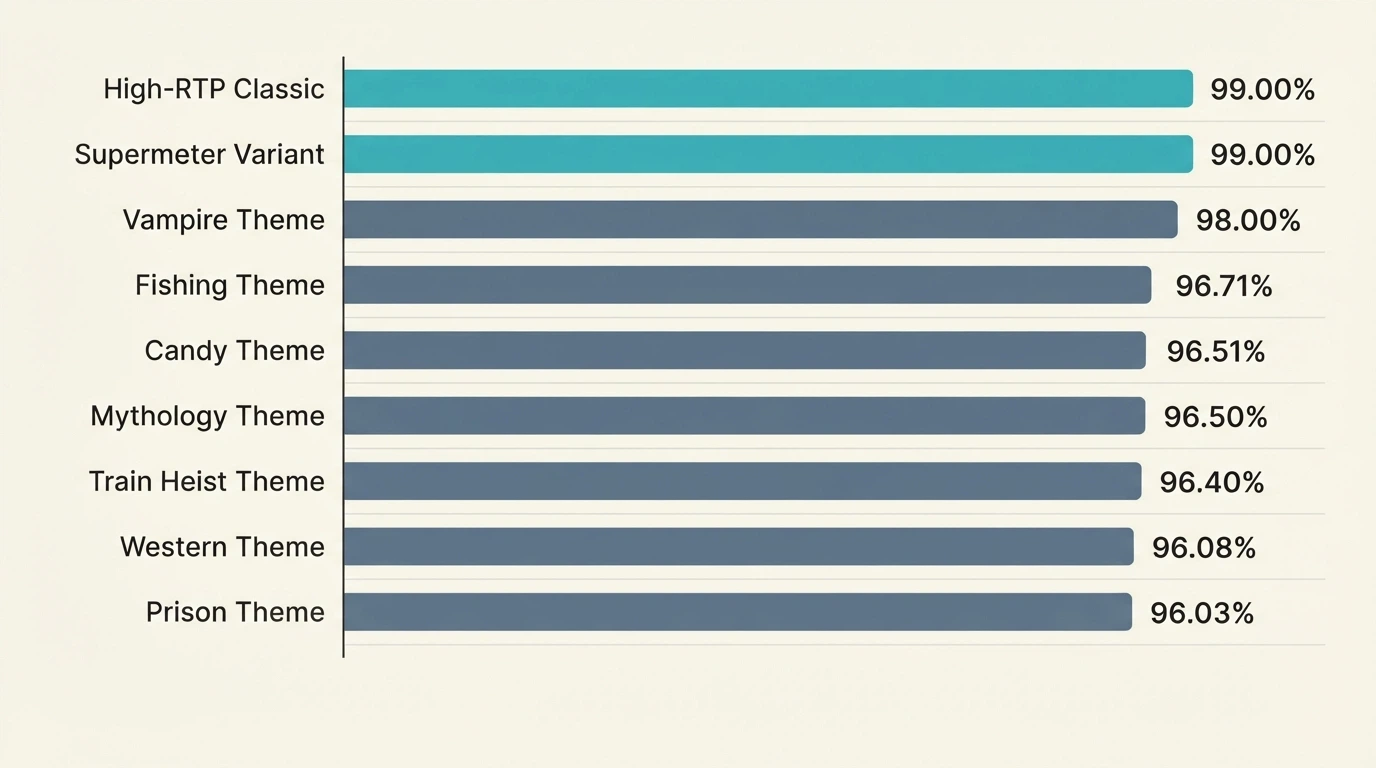
The RTP spread across popular online pokies is wide enough to make the difference meaningful. Pragmatic Play titles cluster between 94.0% and 97.5%, with most sitting between 96.0% and 96.7%. Nolimit City defaults cluster at 96.0% to 96.2%. A handful of titles push higher — Book of 99 at 99.00%, Blood Suckers at 98.00%, Mega Joker at 99.00% in Supermeter mode — and a handful pull lower, into the 94% range.
| Pokie | Provider | RTP | Max win | Volatility |
|---|---|---|---|---|
| Book of 99 | Relax Gaming | 99.00% | 12,075× | — |
| Mega Joker (Supermeter) | NetEnt | 99.00% | — | — |
| Blood Suckers | NetEnt | 98.00% | 900× | Low |
| Big Bass Bonanza | Pragmatic Play | 96.71% | — | — |
| Gates of Olympus | Pragmatic Play | 96.50% | 5,000× | — |
| Sweet Bonanza | Pragmatic Play | 96.51% | — | — |
| Money Train 3 | Relax Gaming | 96.40% | 100,000× | — |
| San Quentin xWays | Nolimit City | 96.03% | 150,000× | — |
| Tombstone R.I.P | Nolimit City | 96.08% | 300,000× | — |
The headline on the table is that Book of 99 and Mega Joker top the list at 99% RTP, which is roughly half the house edge of the standard 96.5% pokie. Blood Suckers at 98.00% with low volatility is the closest available option for a player who wants a low-variance clearing experience. The Pragmatic Play cluster — Big Bass Bonanza, Gates of Olympus, Sweet Bonanza — sits in the 96.5% range that the rest of the page uses as a representative figure.
The Nolimit City titles at the bottom of the table — San Quentin xWays and Tombstone R.I.P — are high-volatility games with max wins of 150,000× and 300,000×. The RTP is below the cluster average, but the variance profile is what makes them interesting for a player who is playing with bonus funds and willing to absorb the dry spells. A 96.03% RTP pokie with 150,000× max win is a different bet than a 99% RTP pokie with 12,075× max win, even though the second one has a lower house edge.
High-RTP Pokies That Maximise Your Bonus Value
The cost of clearing a bonus is turnover × house edge. On a A$100 bonus at 40× wagering, turnover is A$4,000. On a 99% RTP pokie, the house edge is A$0.01 per A$1, and the expected loss across A$4,000 is A$40. On a 94% pokie, the house edge is A$0.06 per A$1, and the expected loss is A$240. The gap between the top and bottom of the RTP range is six times the cost.
The two 99% titles in the table — Book of 99 and Mega Joker — are the practical ceiling on bonus-clearing cost. Book of 99 is a Relax Gaming title with a 12,075× max win; Mega Joker’s 99% RTP is in Supermeter mode, with the base game running 76.9% to 85.1%. A player who uses Mega Joker for bonus clearing needs to play in Supermeter mode to access the 99% figure. The base game is a worse bet than most of the standard Pragmatic Play cluster.
Blood Suckers at 98.00% with low volatility and a 900× max win is the practical alternative. The lower max win means the pokie cannot pay a single-spin bonus-killer, but the low variance keeps the bankroll steady through a long clearing session. For a player clearing a 40× bonus on a tight budget, Blood Suckers is the structurally sensible pick.
The Pragmatic Play cluster is what most players will actually use, because the wager-free spin offers in this comparison set run on Pragmatic Play titles. Big Bass Bonanza (96.71%) is the pokie at VegasNow. Sweet Bonanza (96.51%) is the pokie at SkyCrown’s wager-free spin offer. Gates of Olympus (96.50%) is the pokie at Wild Tokyo’s wager-free spin offer. A player using the wager-free spins is locked into the provider’s house edge, not their own choice of pokie. The 96.5% cluster is the cost of the wager-free offer.
Mobile Play — No-Wagering Bonuses on the Go
Most offshore casinos run in a mobile browser rather than a native app. There is no geo-locked App Store or Google Play restriction for an offshore casino web app — the casino’s site loads in the mobile browser and behaves like a native experience for bonus claiming, gameplay and withdrawal.
The bonus mechanics are identical on mobile and desktop. A wager-free spin offer credits the same spins at the same coin value on either platform. The wagering requirement tracks the same way. The max-cashout cap applies the same way. A player who switches from desktop to mobile mid-bonus does not reset the playthrough clock.
The practical difference is the input method. Mobile pokies use touch-screen spin buttons rather than click-to-spin, and the session length is naturally shorter. A 25-spin wager-free offer on mobile is a five-minute session. A 4,000-spin clearing session at 40× wagering on desktop is a five-and-a-half-hour session that most mobile players will not run in one sitting.
For Australian punters, the convenience factor is the main draw. A player who wants to run a few spins on the commute or during a lunch break can do so without the friction of a desktop session. The bonus mechanics travel with the device.
How We Reviewed and Ranked These No-Wagering Casinos
The review process for this comparison set ran through three passes. The first pass verified the operators’ legal status against the ACMA register of licensed interactive gambling providers — the federal register that covers licensed wagering services. None of the ten operators in the comparison set appear on it. The register does not include online casino operators because no online casino licence exists in Australia. The pass confirmed that every operator named is offshore-licensed and unlicensed in Australia.
The second pass verified licence details where the operator disclosed a licence number. Rocket Play’s Curaçao licence OGL/2024/1307/0748 under Scores55 Tech B.V. was checked against the Curaçao Gaming Authority register. The licence is verifiable. Other operators in the set disclose Curaçao licensure without a specific number, which was treated as unverified rather than fabricated.
The third pass verified bonus terms against operator websites and independent testing sources. The 5-of-27 finding on no-wagering claims — the audited result that only five of 27 advertised no-wager offers actually paid cashable winnings on signup — comes from a third-party test of 21 operators across 27 advertised offers. The pass is the basis for the headline finding in the opening section and the framing of every wager-free offer in this comparison.
The ranking weights the presence of a genuine 0× offer as the primary criterion for the no-wagering guide. SkyCrown, Lucky Dreams, VegasNow and Wild Tokyo carry verified 0× offers and rank ahead of operators without one. Among operators without a verified 0× offer, the wagering multiple on the deposit match is the secondary criterion — Rocket Play and Fair Go at 30× rank ahead of Royal Reels at 35× and SkyCrown at 40× on this axis. Max-cashout caps, payment-method restrictions and withdrawal speed contribute to the verdict within each operator’s write-up but do not reorder the table.
No numerical weighting has been invented for this ranking. The criteria are the ones that matter to the reader: genuine 0× availability first, low wagering second, transparency on licence and terms third, payment-method compatibility fourth.
Your No-Wagering Bonus Game Plan
The central finding from this comparison is that true no-wagering bonuses exist for Australian players in 2026 but are scarce. Four of the ten operators in the comparison set carry a verified 0× offer — SkyCrown, Lucky Dreams, VegasNow, Wild Tokyo — and the other six sit at 30× to 40× standard wagering with no wager-free alternative. The 4-of-10 ratio is consistent with the broader market: the 5-of-27 audit of advertised no-wager claims produced the same result.
A no-wagering bonus is not a payday. The max-cashout cap always limits the upside — A$50 on the Wild Tokyo and VegasNow offers, A$40 on the SkyCrown spins, A$30 on the Lucky Dreams chip. The cap is the ceiling on what the offer pays, and the player’s only cost is whatever they choose to spend after withdrawing. A 0× offer is a low-risk trial, not a way to make money.
The low-wagering alternative at 30× is the practical fallback. Rocket Play and Fair Go both run 30× on a A$200 welcome bonus, which costs the player roughly A$210 in expected house edge at 96.5% RTP — a cost that approaches the bonus value itself. A player who clears the bonus on a 99% pokie like Book of 99 pays closer to A$60; the pokie choice changes the cost by a factor of three or four.
The legal reality is the constraint that overrides everything else on this page. Every operator named is offshore-licensed and unlicensed in Australia. There is no Australian consumer protection, no ACMA complaints body, no BetStop coverage. The site can be blocked at any time with a balance on it. Royal Reels, one of the operators in the comparison set, is already on the ACMA blocking list and reachable only through alternative domains. A player who deposits at an offshore casino should never deposit more than they can afford to lose — and a player who is using multiple operators should assume any one of them can disappear between sessions.
The responsible-gambling infrastructure is real but partial. BetStop covers Australian-licensed wagering only. The National Gambling Helpline at 1800 858 858 is free, confidential and staffed 24 hours a day. Gambling Help Online is the 24/7 chat and email service. For anyone whose offshore play is causing harm, the helpline is the front door; BetStop is a tool that binds the licensed side but does not reach the operators on this page.
The honest framing is that a no-wagering bonus is the closest thing to a fair offer in the offshore market, and the comparison set here gives an Australian player four chances to claim one. The 30× alternatives are workable but cost what they cost. The 40× offers are expensive against the bonus value. The legal and consumer-protection gaps sit underneath every operator on the page and are not solvable from inside the offer terms. The choice is the player’s, the cost is the player’s, and the recourse if anything goes wrong is not the player’s.
Frequently Asked Questions
What are the typical maximum cashout limits on no-wagering bonuses in Australia?
The typical cap on a no-deposit no-wagering bonus sits between A$30 and A$50, while a deposit-triggered wager-free free-spin offer usually caps at A$50 to A$200. The cap is a ceiling, not a floor: a player who wins more than the cap on a wager-free bonus is paid at the cap, and the surplus is forfeit. The cap survives zero wagering because it is set on the offer rather than the playthrough.
Do no-wagering free spins have an expiry window?
Yes. Seven days is the common window on wager-free spins in this comparison set — SkyCrown’s 15 wager-free spins on Sweet Bonanza 1000 and VegasNow’s 20 on Big Bass Splash both expire seven days after credit. Wild Tokyo’s 25 wager-free spins on Gates of Olympus 1000 run for ten days, which is the longest in the set. Unused spins and unclaimed winnings are forfeit at expiry.
What happens if I win more than the maximum cashout cap on a no-wagering bonus?
The cap applies. A A$50 cap on 25 wager-free spins means a run that pays A$200 is paid at A$50 and the surplus is forfeit. The cap is set on the offer rather than the game, and it does not move based on the game’s payout profile. A player who hits a high-variance spin on a wager-free bonus is paid at the cap, not at the spin’s full payout.
Are there any no-wagering no-deposit bonuses available to Australians in 2026?
Yes — the comparison set includes two. Royal Reels lists an AU$10 no-deposit chip after phone verification, and Lucky Dreams lists a A$10 wager-free chip with a A$30 max cashout and seven-day expiry. The broader market carries a small number of equivalent offers through independent industry listings, with the standard cap sitting at A$30 to A$50. Wager-free no-deposit offers are the rarest combination in the offshore market.
Why do most online casinos still impose wagering requirements?
Wagering requirements lock the bonus to turnover before it converts to real money, which protects the operator from a player who deposits, claims the bonus and withdraws the deposit immediately. A 40× bonus on a A$100 deposit requires A$4,000 in qualifying bets before any winnings walk out the door. The cost of clearing the bonus is the house edge the player pays along the way. Wagering requirements exist because no-wagering offers cost the operator the bonus’s full face value as a real-money liability the moment the spin lands, and most operators prefer to charge for the bonus through the playthrough rather than the cap.