Where Australian Keno Players End Up in 2026 — And What the Law Says About It
 Available in AU
For an Australian punter searching for keno online, the route to a real-money draw runs through one kind of operator: offshore, unlicensed, and outside the local framework entirely. There is no Australian-licensed online casino — not one. The Interactive Gambling Act 2001 has closed that door for a quarter of a century, and the 2017 amendments gave the regulator the teeth to enforce it. The page that follows names ten offshore brands ranked by the share of Australian traffic they attract, walks through the legal ground an AU punter stands on, and lays out the protections that drop away the moment a deposit leaves a domestic account.
Current as of 18 October 2026 against the ACMA register and the Interactive Gambling Act framework.
Table of Contents
- Online Keno Isn’t Pokies — Here’s Why That Matters for Australian Players
- The 10 Keno Casinos Australians Actually Play At in 2026
- Why Picking the Right Keno Variant Changes Everything
- Free Keno Won’t Cost You a Cent — But It Won’t Pay You One Either
- Why Your Keno Casino Bonus Looks Bigger Than It Really Is
- Keno on Your Phone: What Mobile Play Gets Right (and Wrong)
- Bitcoin Keno and the Crypto Trap for Australian Players
- Online Keno and Australian Law: What the IGA Actually Says
- Playing Keno Without Losing Yourself: Limits, Help and the BetStop Gap
- How We Selected and Ranked These Keno Casinos
- What You Should Actually Do About Online Keno in Australia
- Frequently Asked Questions About Online Keno in Australia
Online Keno Isn’t Pokies — Here’s Why That Matters for Australian Players
Keno sits in a strange legal pocket in Australia. It is a permitted and licensable product — the IGA names it alongside wagering and lotteries as something state and territory authorities can license. The only places a punter can actually play keno under that licence, though, are pubs, clubs and licensed venues on land. The moment the same game moves online, the product changes category. Online casino games — and keno played as a casino game is one — fall under the IGA’s prohibition. So the same game, the same format, sits inside the law when the draw happens over a pub terminal and outside it when the draw happens in a browser tab.
That gap is what every “best keno casino Australia” list is built on. A page like this one is naming offshore sites that reach Australian customers through avenues the local regulator is actively trying to shut. The offshore operators are not hidden from ACMA — they are targeted by it. Since November 2019, the regulator has had 1,564 illegal sites blocked at the ISP level. More than 225 services have withdrawn from the Australian market entirely since 2017. The list below is what remains, and “best” here means “most-used by Australians” — not “best regulated,” because none of them are.
How a keno game actually works at the digital table is what most Australians who play the pub version have already absorbed. You mark numbers on a card — usually called “spots” — pick how many to play, stake a dollar amount, and watch a random draw select twenty numbers from one to eighty. The more of your numbers the draw catches, the more the paytable pays. The fewer, the less. House edge is built into the paytable, and the paytable rewards the operator the more numbers you mark. Pick one spot and you are playing in roughly 25% house edge territory. Pick ten spots and the edge can climb past 40% on standard online draws. There is no skill. There is no “hot number.” The draw is random, the structure is fixed, and the only decision a player makes is how much to lose per round.
That bluntness matters when comparing keno to a pokie. A modern online pokie sits in a 3–6% house edge band, with some titles even tighter. Standard online keno sits between 5% and 30% depending on the variant and the spot count. A player who treats keno as “just another casino game” is paying a hidden premium for the entertainment. The paytable looks generous, but the structure that makes the top prize reachable also makes the average round bleed faster than a spin on a standard reel game.
How Keno Works: Picks, Spots and the Random Draw
The mechanics are simple enough to fit on the back of a coaster, and that simplicity is part of why keno keeps finding an audience. A punter chooses between two and ten numbers — the “spots” — from a grid of eighty. Most online keno games let you mark them automatically with a “quick pick” button, the same way a lotto outlet hands out a randomised ticket. The stake goes down, the draw runs, twenty numbers come up, and the paytable maps how many of your spots the draw caught to a payout.
The core term is “catch.” If you marked four numbers and three of them come up in the draw, your catch is three-of-four. The paytable pays on that count. The catch can be zero, in which case the stake is gone, or it can hit the maximum, in which case the paytable — at least the one the operator publishes — produces the headline number on the marketing page. Between those two outcomes is a sliding scale where the house edge lives.
The “house edge” is the slice of every dollar staked that the operator keeps over the long run. A standard online keno paytable is built to deliver 65–75% back to the player as the average return, which means the operator pockets 25–35% of turnover. That is the operator’s margin before marketing, before payment processing, before the licence fee in whatever jurisdiction the offshore brand sits in. Pokies by comparison return closer to 95–97% of turnover to the player. The gap is the cost a keno player pays for the format.
The draw itself is run by a random number generator, and that is where the trust question lands. A pub keno terminal draws from a physical ball machine under the supervision of the venue staff. The online equivalent is a piece of software whose randomness is certified by an independent testing lab. The operator that publishes the certificate — and most reputable offshore casinos do — has had its RNG audited. The operator that does not publish one is asking the punter to take its word that the draw is fair.
Pub Keno vs Online Keno: What Changes When the Screen Replaces the Card
The pub version of keno in Australia is run through state and territory licensed operators — Tabcorp and Keno (the brand) being the dominant names — and the draw happens in the venue on terminals that print a paper ticket. The draw cycle is typically every few minutes, the stake is set by the venue in line with the state licence, and the payout is settled at the counter or credited to a member’s card. The whole thing is wrapped in Australian Consumer Law, BetStop coverage, the state-level Responsible Gambling Code, and a venue that is a licensed business with a name, an address and an obligation to pay out a winning ticket.
Online keno, by contrast, runs at whatever pace the operator sets. Most online keno games offer a draw every few seconds — the operator chooses the interval, and a turbo mode can spin a round every two or three seconds. That compression is the headline difference and the one most often pitched in marketing: “play keno whenever you want, as fast as you want.” It is also where the harm lives. A draw every three minutes at the pub is a slow, social affair; a draw every three seconds on a phone is something else entirely. The fast version scales the loss rate up by an order of magnitude, and that is the format the offshore keno sites default to.
Multi-card play is another digital-native feature. A punter can mark a single set of numbers and have it played across two, four, eight or even twenty cards per round, with each card generating a separate catch against the same draw. The casino’s marketing describes this as “more chances to win.” The honest version is that multi-card play multiplies the stake by the card count for the same single draw outcome, so a $1 stake across four cards costs $4 per round with four chances at the catch — but the player has paid four times the stake for the same one draw. Bankroll burn accelerates with the card count, and the punter who has not done the maths feels like the game is being generous.
Bet sizing is the third difference, and it cuts both ways. Online keno lets a punter stake a few cents per spot or several dollars per spot, depending on the operator’s range. The pub version has a fixed denomination per venue. The flexibility online is real, and a low-stakes player who wants ten-cent keno has more game options at an offshore casino than at a pub. The downside is that the same flexibility extends upward — the offshore site will happily take a $50 or $100 stake per spot where a pub terminal might cap at $5. The pace, the format and the stake range together change the shape of the game.
What “Best Keno Casino” Actually Means (And What It Doesn’t)
The honest reading of “best” in a market without a licensed online casino is “most-used by Australians.” It is not “most trusted.” It is not “best regulated.” It is not “safest for your money.” Any list in this niche, including this one, ranks operators by revealed preference — by the share of Australian traffic each one attracts — and then describes what that share means in practice.
A page that describes “the best licensed online casinos in Australia” is describing something that does not exist. There is no licence for online casino anywhere in the country — not federally, not in any state or territory. The ACMA’s position is unambiguous on this point. So when a comparison site writes “best licensed Australian online keno casino,” the reader is being told a falsehood, and the rest of the comparison inherits that falsehood’s authority. The honest version — the one this page is built around — is: the operators Australians reach, what their offshore status costs the punter, and how to read the gap between the marketing and the law.
What this ranking measures is real enough. AU market share, as collected by industry trackers, reflects where Australian players actually deposit, play and (sometimes) withdraw. It is not a recommendation. It is a description of what is happening in the market. Whether a punter should follow that description is a different question, and it is the one this page tries to answer honestly.
The 10 Keno Casinos Australians Actually Play At in 2026
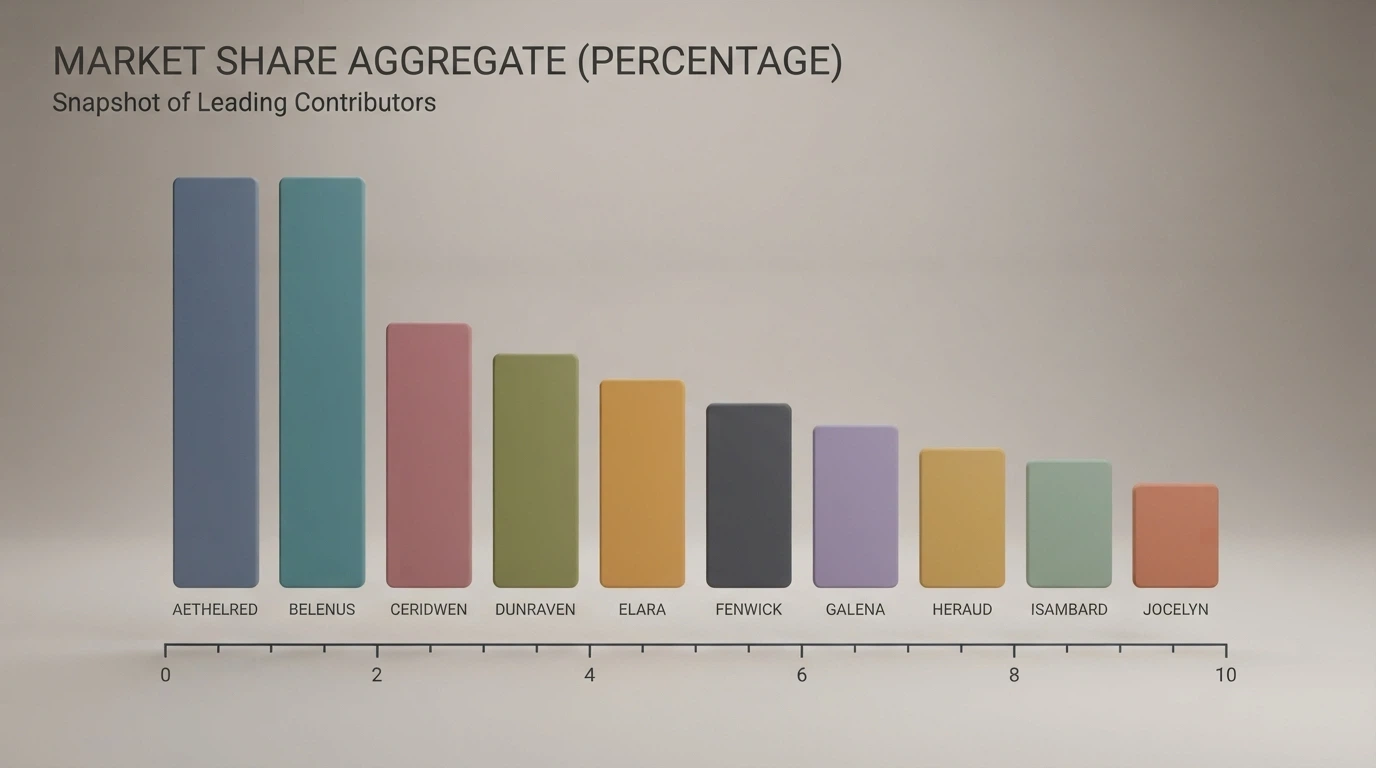
The table below ranks the offshore keno destinations by their share of Australian traffic. The data is the most recent available from industry tracking; every operator here is offshore and unlicensed in Australia. The ranking is a measure of where AU players go, not a recommendation of where they should go.
| Operator | AU Market Share (%) | Legal Status in Australia |
|---|---|---|
| Rocket Play | 9.40 | Offshore — no AU licence |
| Skycrown | 8.55 | Offshore — no AU licence |
| Royal Reels | 2.51 | Offshore — no AU licence |
| WinSpirit | 1.55 | Offshore — no AU licence |
| Stake | 1.28 | Offshore — no AU licence |
| Rainbet | 1.28 | Offshore — no AU licence |
| Scream Casino | 0.99 | Offshore — no AU licence |
| FairGO | 0.80 | Offshore — no AU licence |
| Bizzo Casino | 0.57 | Offshore — no AU licence |
| Rocket Casino | 0.57 | Offshore — no AU licence |
The spread tells its own story. Rocket Play and Skycrown together take close to 18% of Australian offshore casino traffic — a remarkable concentration at the top of an unlicensed market. The remaining eight operators share another roughly 9.5%, with most of them sitting under 2% each. The gap between the leader and the smallest operator in the featured set is roughly seventeen-fold, and that gap is what the operator write-ups below try to put into plain language.
A second observation sits underneath the table. Every operator is offshore. The featured set includes no licensed alternative because none exists. A punter reading this list who wants an Australian-regulated keno game has only one path: the pub, the club, or the licensed wagering operator that runs keno on land through a state or territory licence. That path is covered in the section on where keno can legally be played.
What We Look For in a Keno Casino (And Why It Matters)
The criterion that anchors this ranking is AU market share, and the reason it works as a proxy is that it measures revealed preference. A punter who chooses one offshore keno casino over another is, in aggregate, telling the market something about what they find appealing — the bonus headline, the keno game range, the theme, the payment options, or simply the path of least resistance from a Google search. None of those choices is being made on regulation, because no offshore operator can offer Australian regulation. The market share figure picks up everything else.
Keno game availability is a second-order criterion and one this page treats qualitatively rather than with hard counts. Most of the offshore casinos in this ranking run a similar suite of RNG keno games — typically a handful of variants from a small set of providers, with the bulk of the library in pokies, live casino and table games. A punter looking for a keno-dedicated site will not find one in this market at any meaningful scale; the keno offering is a side attraction on a general offshore casino. The casino that has invested in keno variants tends to look like the casino that has invested in market share, but the relationship is loose rather than tight.
The distinction between a keno-dedicated site and a general casino that carries keno is, in practice, almost academic for the AU market. The dedicated keno sites that exist at the international level tend not to accept Australian customers under the offshore arrangements that suit general casinos. The Australian-facing offshore casino is, by and large, a general casino with keno as one of several hundred games in its lobby.
Why AU-facing traits matter more than global brand recognition is the practical upshot. A punter in Brisbane is not deciding between an Australian-licensed operator and an international brand. The Australian option does not exist online. The choice is between one offshore operator and another, and the factors that distinguish them — payment methods, theme, keno game selection, customer support hours, withdrawal speed, the responsiveness of dispute handling — are AU-facing traits by definition. A globally recognised brand with a poor AU payment setup loses to a lesser-known brand that accepts PayID and pays out in AUD without a conversion fee.
Rocket Play: The Offshore Giant With 9.4% of the AU Market
Rocket Play sits at the top of the Australian offshore keno market with 9.4% of the country’s casino traffic — the largest single share among operators in the unlicensed category. The operator runs a general casino lobby with keno as one of several RNG game categories, alongside pokies, live dealer tables and the usual suite of instant-win and crash games. For an Australian punter, the practical implication is that the casino’s investment in the Australian market is large enough to keep AU-facing payment methods live, AU dollar balances supported, and an Australian-facing customer service window open.
The offshore status is the constraint that no amount of market share removes. Rocket Play holds no Australian licence, sits outside the BetStop register, and is not bound by Australian Consumer Law. A punt dispute is handled under the operator’s own terms and the licensing regime in whatever jurisdiction it operates — typically Curaçao for this tier of operator. The site’s policy on withdrawals, KYC checks, bonus terms and complaint escalation is the only policy that applies, and the punter has agreed to it by signing up. The IGA does not criminalise the player; the protections the IGA confers on players of Australian-licensed operators do not transfer.
9.4% of Australian casino traffic is, in plain terms, where the bulk of the AU punter population is currently playing. The number is the verdict — that is what Australian players actually choose, and the choice is what the rest of this page puts under the microscope.
Skycrown: A Close Second at 8.55% AU Market Share
Skycrown sits one step behind Rocket Play at 8.55% of Australian traffic. The two together make up the bulk of the top tier in the offshore AU market, and the gap between them is narrow enough that most punters would not pick a clear winner on the game range alone. Both run similar general casino lobbies, both are offshore, both sit outside the Australian regulatory framework. The second-largest is rarely the best — but in a market without a licensed alternative, the second-largest is the second-most-used, and that is the comparison the table supports.
The distinction between Skycrown and Rocket Play for an Australian punter is in the details, and most of those details are not public. Keno game count, payment method coverage, withdrawal times, customer service responsiveness — none of these are captured by market share. The punter who values one over another will find out from trying the operator, and that trial cost is itself part of the offshore experience. A licensed operator publishes its payout times publicly; an offshore one typically does not.
Skycrown’s verdict in plain language: the obvious second choice, with all the caveats that follow from being offshore.
Royal Reels: Drawing 2.51% of Australian Keno Players
Royal Reels holds 2.51% of the Australian offshore casino market, a step down from the top two but still well clear of the long tail. The brand positions itself as a premium-feeling general casino, and the share it holds suggests Australian players find the proposition workable. Keno is one game category in a broader lobby, not a keno-dedicated site.
The offshore caveats that apply to Rocket Play and Skycrown apply in full to Royal Reels. No Australian licence. No BetStop binding. No Australian Consumer Law. Withdrawal terms are the operator’s own, dispute resolution runs through the operator’s nominated jurisdiction, and the punter has agreed to all of it at sign-up. The market share figure does not change those ground rules — it just tells the punter that 2.51% of Australians have decided to play on those terms.
WinSpirit: Carving Out 1.55% of the AU Keno Audience
WinSpirit sits at 1.55% of the Australian offshore market — a smaller share than Royal Reels but a meaningful foothold. The brand runs a general offshore casino lobby with keno in the mix. The Australian-facing positioning is limited compared with the top two operators, and the practical implication is that AU-specific payment methods and customer support windows are less developed than at the bigger players. For a punter who values AU optimisation above market-share validation, WinSpirit is a thinner offering.
The judgment here is for a player who already knows what they want from a keno game and is happy to use an offshore operator that meets the minimum bar. The 1.55% figure is the revealed-preference slice for that profile.
Stake: A Global Brand With 1.28% AU Keno Market Share
Stake is the best-known crypto-native casino brand in the world, and 1.28% of Australian players use it for keno among other games. The brand’s identity is built around cryptocurrency deposits, esports betting and a sportsbook-plus-casino product, with keno as a small piece of the broader lobby. For an Australian punter, the crypto-native positioning creates a specific problem: the Interactive Gambling Amendment (Credit and Other Measures) Act 2023 banned credit cards, credit-related products and digital currency as payment for online wagering in Australia from 11 June 2024. A casino that asks for Bitcoin from an Australian customer is, by definition, an operator that has decided to operate outside the Australian payment rules.
Stake is a global brand with a small Australian footprint. The intersection of those two facts is the section on crypto below.
Rainbet: Holding 1.28% of the Australian Keno Market
Rainbet sits alongside Stake at 1.28% of Australian traffic, but the two operators reach that figure in different ways. Stake is a globally recognised crypto brand with a small AU slice. Rainbet is a smaller operator in absolute terms whose Australian share happens to match Stake’s at this snapshot. Both sit in the long tail of the AU market — the band where niche offshore brands find a few thousand Australian customers each without dominating the space.
The position for an Australian punter is straightforward. Rainbet is an offshore casino like the rest of the set, with the same lack of Australian licence, the same gap from BetStop, and the same withdrawal terms dictated by the operator. The 1.28% figure is the niche it occupies.
Scream Casino: Just Under 1% of AU Keno Traffic
Scream Casino holds 0.99% of the Australian offshore market — a small but real slice. The brand operates as a general offshore casino with keno in the lobby. The Australian-facing infrastructure is thinner than the top-tier operators, and the punter experience reflects that: fewer AU-specific payment methods, less polished AU dollar support, customer service windows that may not match Australian time zones.
The verdict on Scream Casino is qualified. A 0.99% slice is not nothing — it reflects a thousand or more Australian customers — but it is a thin base for an offshore operator to maintain AU-facing investment on. Traffic here comes mostly from search engine results rather than brand recognition.
FairGO: An Australia-Themed Offshore Casino at 0.8%
FairGO takes its name and theme from the country it targets, which is unusual in a market where most offshore brands use generic casino positioning. The 0.8% Australian share suggests the theme lands — Australian punters respond to a brand that signals it knows the local market. The theme, though, is exactly that: a theme. FairGO is offshore like the rest of the set, holds no Australian licence, and operates under the same constraints as every other operator in the table. The Australian flag in the logo does not change the legal ground underneath the deposit.
The theme-versus-reality gap is the thing to read carefully here. FairGO’s marketing sells familiarity. The regulatory reality sells nothing — because there is nothing to sell. The punter who values Australian-facing branding above a licence will find FairGO a comfortable choice; the punter who values a licence has no choice in this market at all.
Bizzo Casino: 0.57% of the Australian Keno Market
Bizzo Casino holds 0.57% of the Australian offshore market — a small slice that places it near the bottom of the featured set. The brand operates as a general offshore casino with keno among the game categories. The Australian-facing infrastructure is limited compared with the top of the table, and the punter experience is correspondingly less tailored to AU specifics.
0.57% is a thin base, and the verdict on Bizzo is restrained. The operator exists, takes Australian customers, and runs keno among other games. The punter who lands here is one for whom this operator showed up in a search and met the minimum bar to sign up. The Australian-facing investment is light, and the offshore caveats apply in full.
Rocket Casino: Another 0.57% Slice of the AU Keno Market
Rocket Casino shares the bottom rung with Bizzo at 0.57% of Australian traffic, and the two operators together make up just over 1% of the AU market. Rocket Casino is a smaller brand in the same general offshore casino category as the rest of the set. The “Rocket” naming creates confusion with Rocket Play at the top of the table — different operators, similar names — and that ambiguity is itself a small signal about how thin the marketing differentiation is at the long tail.
The verdict on Rocket Casino is the ambiguity observation. The punter who ends up here is one for whom the brand name on a search result looked close enough to the bigger Rocket Play to be worth a try. The legal ground is identical to every other operator in the table, and the AU share is a mirror of Bizzo’s.
Why Picking the Right Keno Variant Changes Everything
Keno looks like a single game from the outside, but the variant a punter chooses changes the speed, the format and the cost-per-round in ways the marketing page does not usually spell out. The three big choices are card count (single vs multi-card), delivery format (RNG vs live dealer), and rules of engagement (standard draw, bonus rounds, instant-win variants). Each one shifts the math of the session.
The single-card format is the baseline: one set of spots, one draw, one payout. The multi-card format plays the same draw across multiple cards, multiplying the stake by the card count. The 4-card keno variant — one of the most common — costs four times the base stake per round. A punter who marks four spots across four cards is staking sixteen spots in aggregate. The bankroll burn is fast, and the experience is correspondingly fast.
RNG keno is the default format at offshore casinos. The draw is software-generated, the round is short, and the operator can run dozens of rounds per minute if the punter chooses turbo mode. Live dealer keno — sometimes called live keno or game-show keno — runs the draw in a studio with a human presenter and a physical ball machine or a wheel. The pace is slower, the trust factor is higher (the punter watches the draw happen), and the betting limits tend to be higher than RNG keno’s.
Reading a keno paytable is where the variant choice starts to bite. The paytable is the schedule of payouts per catch, and the shape of that schedule determines the house edge. A paytable that pays 2:1 on a one-spot catch and 100,000:1 on a ten-spot catch is built to deliver an average return to the player of 65–75% — i.e., a 25–35% house edge. A paytable that pays 3:1 on a one-spot catch might push the average return up to 80%, narrowing the house edge. The punter who reads the paytable before staking a dollar is the one who has any chance of picking a tighter variant.
Single-Card vs Multi-Card Keno: Which Format Suits Your Style
Single-card keno is the format a pub punter knows: one set of spots, one draw, one stake. The draw runs every few minutes, the stake is fixed, and the experience is social — a few punters at the terminal, a printed ticket, a settled payout at the counter. Online single-card keno keeps the structure but changes the pace. The draw interval is set by the operator and is typically a few seconds, not a few minutes.
Multi-card keno — two, four, eight or twenty cards per round — plays the same draw across multiple cards. The marketing describes it as “more chances to win.” The plain version is that the punter is staking the base amount per card, and a four-card round at $1 per card is a $4 round. The catch is judged per card, so a strong draw produces a payout on every card; a weak draw costs the full $4 stake. The expected loss on a four-card round is four times the expected loss on a single-card round at the same stake.
The appeal of multi-card keno is the engagement. A punter who plays four cards watches four sets of spots light up across the draw, and the visual feedback is stronger than single-card play. The cost is the bankroll burn, and the punter who has not done the maths will feel like the casino is being generous when actually the casino is being faster.
A punter with a small bankroll is best served by single-card keno at the lowest stake per spot. A punter with a larger bankroll who wants the engagement of multi-card play is best served by reducing the per-card stake to keep the round total manageable. The format itself is neither good nor bad; the stake size per card is what determines whether the round is affordable.
RNG Keno vs Live Dealer Keno: Speed, Trust and Atmosphere
RNG keno runs in software. The draw is generated by a random number generator, the round takes a few seconds, and the punter sees the result as a highlighted grid. The pace is fast, the bet range is wide, and the operator can run hundreds of thousands of rounds per day across its player base. The trust question for RNG keno is whether the RNG has been independently certified. Most reputable offshore casinos publish the certificate from a testing lab like iTech Labs or GLI; some do not.
Live dealer keno runs the draw in a studio with a human presenter. The draw uses either a physical ball machine or a software-rendered wheel with a presenter calling the outcome. The pace is slower — a round can take a minute or more — and the betting limits tend to be higher than RNG keno’s. The trust factor is the visual confirmation: the punter sees the draw happen.
Live dealer keno is rarer than RNG keno at offshore casinos, and the game-show style versions — titles that look more like a television game show than a keno draw — are the dominant format where it exists. The pace and the trust factor make live keno a different experience from the fast-loop RNG format. Those preferring a more deliberate pace often opt for live dealer games, whereas high-volume players typically stick with RNG variants.
Keno Rules in Plain English: Picks, Spots and Payouts
The rules of keno fit on a single page, which is part of the format’s appeal. A punter marks between two and ten numbers from one to eighty on a keno card. The operator draws twenty numbers from the same pool. The punter is paid according to how many of their numbers came up — the “catch” — and the paytable maps catches to payouts. The fewer spots the punter picks, the tighter the hit frequency but the lower the headline payout. The more spots the punter picks, the rarer the maximum catch but the larger the top payout.
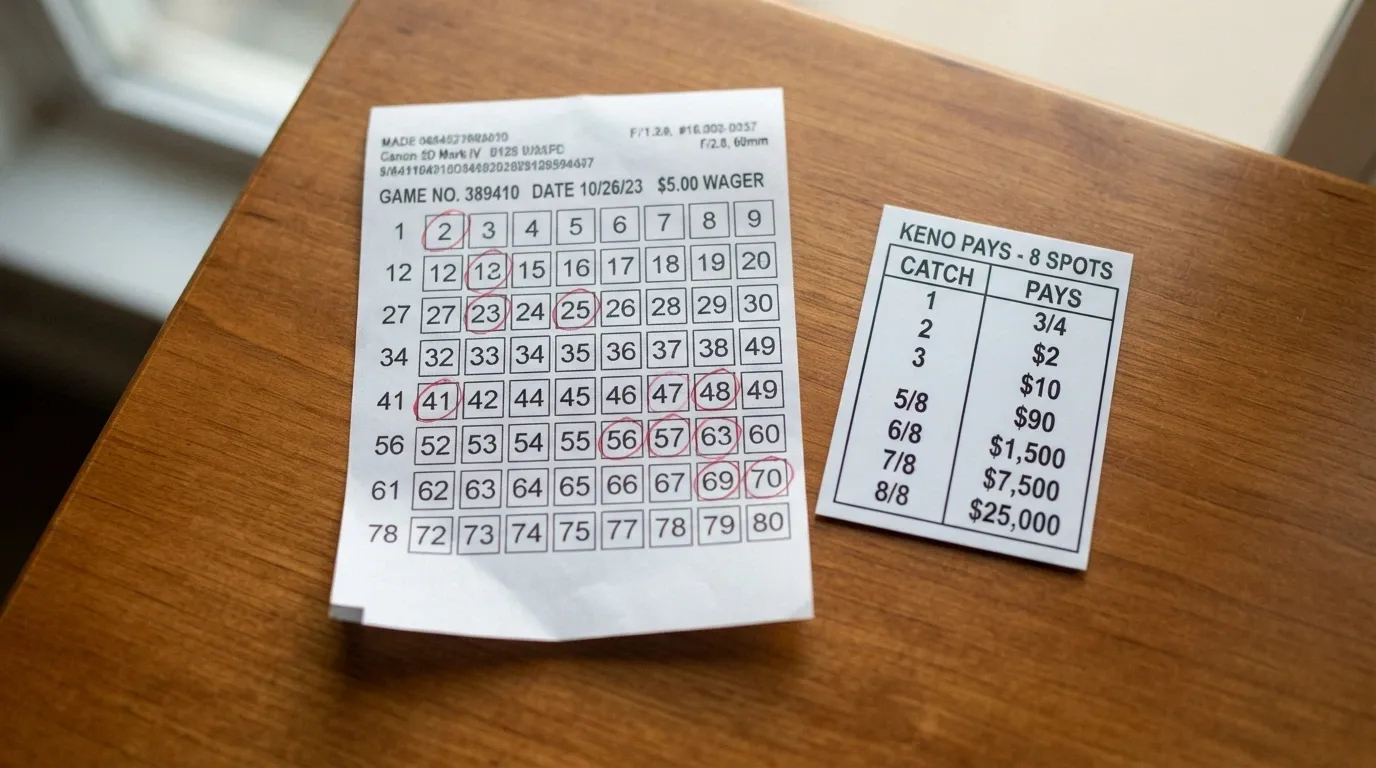
There is no strategy that changes the math. The draw is random, every number has the same probability of coming up, and the paytable is fixed. A punter who picks the same numbers every round and a punter who picks different numbers every round face the same expected return. The “strategy” pages on affiliate sites — the ones that suggest hot numbers, cold numbers, or a particular spot count for the best return — are selling superstition. The math does not move.
What the punter can control is the stake size, the spot count and the variant. A punter who picks two spots faces a higher hit frequency but a smaller payout when the catch lands. A punter who picks eight spots faces a much rarer catch but a payout that can move the bankroll. The choice between them is a choice between a steadier losing pace and a faster losing pace with occasional larger payouts. Both end in the same average return over the long run.
The house edge for standard online keno sits between 5% and 30% depending on the spot count and the paytable. A spot count of one or two is the tightest band; a spot count of eight to ten is the loosest. The punter who treats keno as a casual session entertainment has picked a tolerable edge. The punter who treats keno as a way to win has picked the wrong game — and that is the plainest version of the rules.
Free Keno Won’t Cost You a Cent — But It Won’t Pay You One Either
Free keno comes in two forms: demo-mode RNG keno, which most offshore casinos offer on their keno games without requiring a deposit, and keno-themed slot games, which look like keno but pay like a pokie. Both are useful in different ways. Neither is a substitute for understanding what a real-money keno session costs.
Demo mode lets a punter run as many rounds of a keno game as they like without staking a cent. The draw is the same RNG, the paytable is the same, the round timing is the same. What demo mode does not simulate is the real-money decision pressure. A punter staking pretend money will press the max-spot button, try the turbo mode, and run a thousand rounds in an hour without feeling anything. The punter staking real money will pause, hedge, and adjust the stake based on how the session is going. The psychological gap is real, and no demo mode closes it.
Keno-themed slot games are pokies dressed in keno graphics. The reels spin, the paylines trigger on keno-style number combinations, and the bonus features use keno imagery. The RTP and volatility profile belong to the slot, not to draw keno. A punter who plays a keno-themed slot expecting keno odds is reading the wrong paytable. The game is a pokie with a keno skin.
Keno-Style Slot Games: When a Pokie Looks Like Keno
Keno-themed slot games have proliferated in offshore casino lobbies over the last few years. The mechanics are slot mechanics: spinning reels, fixed paylines, scatter pays, free-spin rounds. The skin is keno: number grids, draw-style visuals, paytable graphics that mimic a keno payout schedule. The punter who lands on one of these games from a search for “online keno” has found a pokie, not a keno draw.
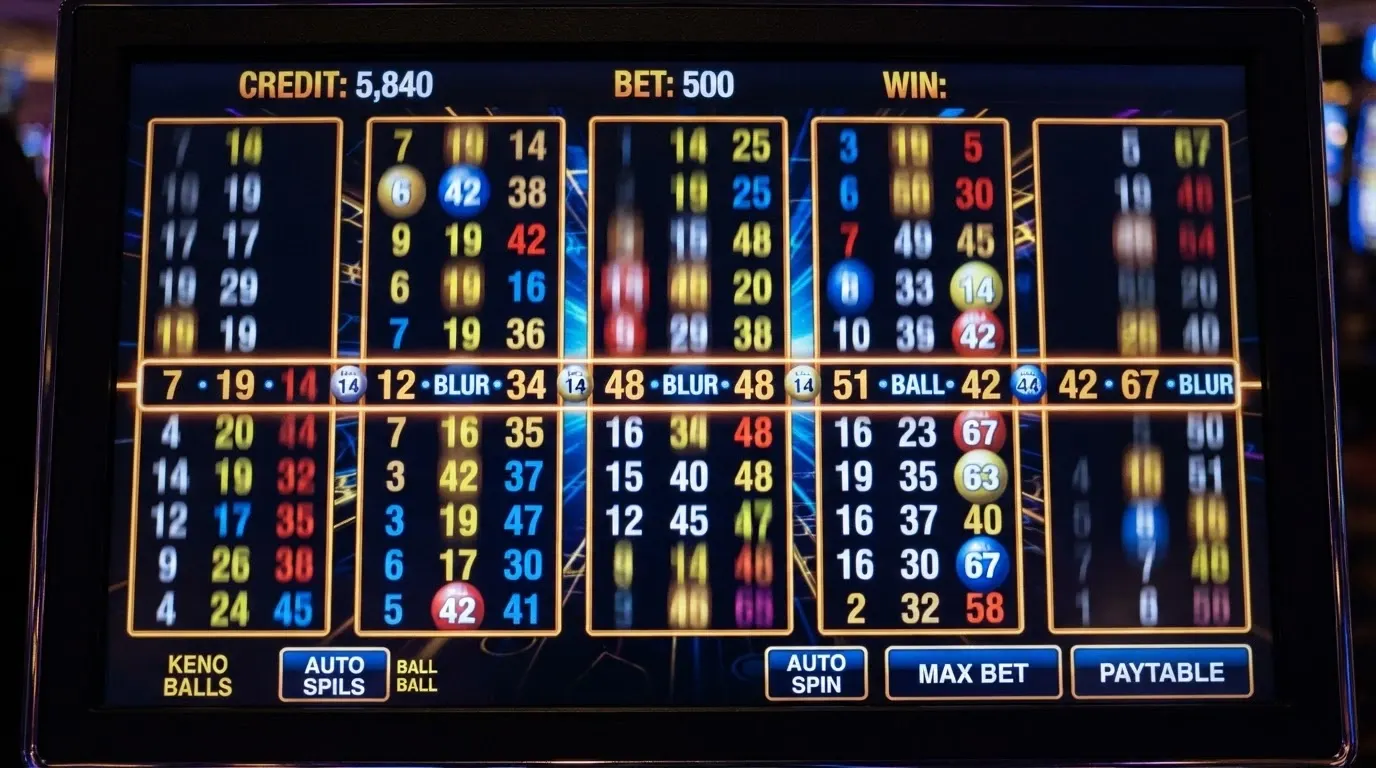
The legal distinction is sharper than the visual one. Keno is a permitted and licensable product in Australia under the IGA framework — but only when it is offered through a state or territory licensed operator on land. Online casino games, including keno-themed slots, fall under the IGA’s prohibition when offered to Australian customers. The offshore operator that hosts a keno-themed slot has not licensed that slot under Australian law; it has licensed it under whatever jurisdiction its licence sits in. The punter playing it is in the same legal position as the punter playing a standard pokie at the same casino: offshore, unregulated, with no BetStop binding.
The RTP difference is the practical distinction. A standard online keno game has a house edge of 5–30%. A keno-themed slot typically has a house edge of 3–6%. The keno-themed slot is the cheaper game to play, in the long run, despite the keno skin. A punter who enjoys the keno visual but wants a tighter house edge is better served by the slot than by draw keno — and that is an honest inversion of the marketing.
Why Demo Mode Is the Smartest Way to Learn Keno
Demo mode is the right place to start for a punter who has never played keno before. It costs nothing, it runs the same RNG the real-money game uses, and it lets the punter learn the pace, the paytable and the spot count options without risking a bankroll. The hour a punter spends in demo mode is the hour that should precede the first real-money deposit.
The intuition demo mode builds is real, and it transfers to the real-money game. The punter who has played two hundred demo rounds knows how often a four-spot catch lands, how often a five-spot catch lands, and what a zero-catch looks like. That knowledge makes the first real-money session less disorienting. The punter who has never played before and jumps straight to a real-money deposit is the punter who is most likely to misread a zero-catch as a sign that the game is rigged. The reality is that zero-catch rounds are normal at most spot counts, and demo mode is where that becomes obvious.
The gap demo mode cannot close is the bonus wagering context. An offshore casino that offers a deposit bonus with a turnover requirement is asking the punter to wager the bonus amount a number of times before any payout can be withdrawn. The wagering contribution of keno is often lower than pokies’ — sometimes 100%, sometimes 50%, sometimes zero. The punter who has played two hundred demo rounds has not experienced what it is like to grind through a turnover requirement with a 50%-weighted keno contribution. That experience only comes with real money, and it is where the bonus headline meets the bonus reality.
Why Your Keno Casino Bonus Looks Bigger Than It Really Is
A welcome bonus at an offshore keno casino typically arrives as a percentage match on the first deposit — 100% up to a cap is common, with 50% and 200% offers appearing less often. The marketing headline is the match percentage and the cap. The reality is the wagering requirement, the game weighting, and the validity window.
The wagering requirement — sometimes called the turnover requirement or the playthrough multiplier — is the number of times the bonus amount must be staked before any winnings can be withdrawn. A $100 bonus with a 40x wagering requirement means the punter must stake $4,000 in total before the bonus converts to withdrawable cash. The wagering requirement is the single most important number on the bonus terms page, and it is the one most often buried under the match percentage in marketing copy.
The game weighting is where keno punts are caught out. A wagering contribution of 100% means every dollar staked on keno counts as one dollar toward the wagering requirement. A contribution of 50% means every dollar staked counts as fifty cents. A contribution of 0% means keno does not count toward wagering at all. The offshore casinos that publish their weighting tables typically put keno at 50% or lower; the ones that do not publish a table are giving the punter no way to plan the bonus clearance.
The validity window is the time limit on meeting the wagering requirement. A 30-day window is common, with shorter and longer windows appearing at different operators. A punter who cannot meet the requirement inside the window forfeits the bonus and any winnings tied to it. The validity window is the third leg of the bonus reality, and it is where the math of the offer either works for the punter or fails to.
Welcome Bonuses and Keno: What the Fine Print Really Says
A percentage match welcome bonus is a common offer at offshore keno casinos, with the match cap ranging from a few hundred to a few thousand AUD. The headline is the cap, but the punter must wager the bonus amount a number of times before any of it can be withdrawn, and the wagering contribution of keno is usually lower than pokies’.
The turnover requirement, the game weighting and the validity window together determine whether the bonus is worth claiming. A punter who plans to play keno exclusively, who sees a 100% match with a 40x turnover and a 50% keno weighting, is looking at an effective wagering requirement of $100 × 40 ÷ 0.5 = $8,000 in keno stakes before the bonus converts. A punter who plans to play pokies at 100% weighting is looking at $4,000 in pokie stakes for the same bonus.
The choice for a keno-focused punter is whether to claim the bonus at all. A bonus that costs more in expected loss than the bonus itself is worth is a bonus that punishes the punter for taking it. The math is the math, and the house edge on keno multiplied by the effective wagering requirement is the cost of clearing the bonus. A punter who skips the bonus and plays with their own cash is not making a mistake.
The minimum-odds restriction is a fourth term that catches punters. Some bonuses restrict play to games with odds of 1.50 or higher, or to specific bet types, and exclude everything else. A keno player whose favourite variant sits below the minimum odds is excluded from the wagering requirement entirely. The punter who reads the terms before claiming avoids this trap; the punter who claims first and reads later discovers it the hard way.
Keno on Your Phone: What Mobile Play Gets Right (and Wrong)
Mobile keno at an offshore casino runs in a mobile browser. The casino’s HTML5 site adapts to the phone screen, the keno games load in portrait or landscape, and the punter can stake a round with a thumb tap. The mobile experience at most offshore casinos is competent. The dedicated app is rarer — and the App Store / Google Play path is closed by the same IGA framework that closes the rest of the online casino market in Australia.

The Australian app stores do not carry licensed online casino apps, because no licensed online casino exists in Australia. An app that advertises real-money keno to an Australian customer is an app that is, by definition, outside the Australian regulatory framework. The major app store policies reinforce this: Apple and Google both restrict real-money gambling apps to licensed operators in licensed jurisdictions, and Australia is not on that list for online casino. An Australian punter searching the App Store for a keno casino app will not find a licensed one, because there is none.
The offshore casino that wants an app on Australian phones goes through a direct download path — an APK from the operator’s site, an iOS profile install, or a mobile web app that lives in the browser. Each path has its own friction. The APK install requires the punter to adjust phone security settings. The iOS profile install requires trust verification. The mobile web app has no install at all but also no home-screen presence.
Keno Casino Apps vs Browser Play: What Actually Works on Your Phone
Browser-based mobile keno is the path of least resistance for most Australian punters. The punter opens a mobile browser, navigates to the offshore casino site, logs in, and plays. No install, no permission adjustment, no home screen clutter. The HTML5 build at a reputable offshore casino is comparable to the desktop build in terms of game range and responsiveness.
The dedicated app has advantages in some areas and disadvantages in others. A native app can load faster on subsequent visits, can use phone notifications for promotional messaging, and can feel smoother on older phones with limited browser memory. The disadvantages are the install friction, the security concerns around an APK from an offshore source, and the fact that any app sitting outside the official app stores is one update away from a compatibility break with a new phone OS version.
The mobile network question is a real one for Australian punters. The 4G and 5G coverage in the major population centres supports HTML5 keno without lag. In regional areas, the latency can push the round time out, and a turbo-mode keno game on a flaky connection is a frustrating experience. The punter in regional Australia is better served by a slower draw interval than by chasing the fastest variant.
Bitcoin Keno and the Crypto Trap for Australian Players
The Interactive Gambling Amendment (Credit and Other Measures) Act 2023 banned credit cards, credit-related products and digital currency as payment for online wagering in Australia. The ban commenced on 11 June 2024. The penalty for an operator failing to enforce the ban is up to A$247,500 per breach. From 1 January 2027, banks and payment providers gain express authority to block transactions to illegal gambling operators.

A keno casino that asks an Australian customer for Bitcoin, Ethereum or any other cryptocurrency is, by definition, an operator that is operating outside the Australian payment rules. The site’s willingness to accept crypto is a clear signal that the rest of the Australian framework — the ACMA’s enforcement, the BetStop binding, the Australian Consumer Law protections — is not in play either. A punter who funds an account with Bitcoin at an offshore casino is a punter who has stepped fully outside the Australian regulatory perimeter.
The risks of crypto for an Australian punter are concrete. The transaction is irreversible: once the Bitcoin has left the wallet, no chargeback mechanism exists. The exchange rate between deposit and withdrawal can move against the punter by enough to wipe a withdrawal’s value. The operator that refuses a withdrawal has the punter’s money in a currency that the punter cannot recover through any Australian channel. The site that is blocked by the ACMA leaves the punter’s balance in a wallet the punter cannot reach.
Why Paying for Keno With Crypto Is a Red Flag in Australia
The crypto payment ban is the clearest single signal that an offshore keno site is operating outside Australian rules. An Australian-licensed operator cannot legally accept crypto for online wagering. An offshore operator can, and does. The choice to fund a keno account with Bitcoin is, in practice, the choice to step outside every Australian consumer protection that would otherwise apply.
The irreversibility problem is the immediate cost. A credit card chargeback can recover funds within weeks. A crypto transfer cannot be reversed at all. The punter who deposits 0.1 Bitcoin at an offshore keno casino, plays for a session, requests a withdrawal of 0.08 Bitcoin, and receives nothing has no recourse. The wallet-to-wallet transfer happened in seconds; recovering those funds does not happen at all.
The exchange-rate risk compounds the irreversibility. Bitcoin’s price against the Australian dollar moves hour by hour. A punter who deposits at one rate and withdraws at a lower rate sees the AUD value of their balance shrink before the casino even processes the withdrawal. The punter who wins and withdraws in crypto is exposed to that volatility twice — once on the deposit, once on the withdrawal. The punter who funds in AUD through a bank transfer or PayID does not face this risk.
The 1 January 2027 bank-blocking powers are the future risk. From that date, banks and payment providers in Australia gain express authority to block transactions to illegal gambling operators. The punter who tries to fund an offshore keno account through a domestic bank transfer may find the transfer blocked at the bank’s discretion. The punter who already used crypto will not face the block, because the transfer happened outside the banking system — but the punter will have no path back through the banking system either if a dispute needs resolution.
Online Keno and Australian Law: What the IGA Actually Says
The Interactive Gambling Act 2001 — the IGA — is the federal law that shapes every online gambling decision in Australia. It was amended in 2017 to close the loopholes offshore operators had used, and again in 2026 to add a layer of advertising and inducement restrictions that commence on 1 January 2027. The structure is simple at the top and complicated at the edges: the IGA prohibits the provision of online casino games to a person in Australia, and it does so by targeting the provider, not the player.

The table below compares the protections an Australian punter has at a licensed land-based keno venue against the protections at an offshore online keno casino. The gap is the practical cost of choosing the offshore path.
| Protection | Licensed AU Keno (Pubs/Clubs) | Offshore Online Keno Casino |
|---|---|---|
| Australian Consumer Law applies | Yes | No |
| BetStop self-exclusion binding | Yes | No |
| ACMA complaint route | Yes | No |
| Guarantee of withdrawal | Yes (state-licensed operator) | No |
| Site can be blocked mid-session | No | Yes |
| Responsible Gambling Code | Mandatory | Operator’s discretion |
| KYC enforcement | Mandatory | Variable |
| Player funds protection | Required | None guaranteed |
The right-hand column is mostly empty, and that emptiness is the point. Every protection in the left column that does not appear in the right column is a protection the punter gives up when they choose the offshore path. None of those protections is theoretical; each one corresponds to a real mechanism that has, at some point, been tested at an Australian-licensed venue and resolved in the punter’s favour.
The Interactive Gambling Act 2001: What It Bans and What It Permits
The IGA’s structure is straightforward. It targets providers — the offshore operators that offer online casino games to Australians — and the penalty for a provider offering a prohibited service is civil, not criminal. The individual player is not prosecuted. The ACMA enforces the law by investigating complaints, issuing formal warnings, referring operators for civil penalty proceedings, and directing ISPs to block illegal sites.
What the IGA prohibits is online casino games, online pokies and in-play sports betting. Online casino games is the category that catches online keno — because keno played as a casino game is one. The licensed alternatives — sports and race wagering placed before the event, lotteries, and keno offered through state and territory licensed operators on land — sit outside the prohibition.
The 2017 amendment closed the loopholes that offshore operators had used to argue their services were legal. Before 2017, an operator could offer games to Australians by claiming the customer had initiated the service from outside the country. The amendment shifted the test to whether the service was provided to a person in Australia, regardless of where the customer initiated the play. The 2026 reform — the Interactive Gambling Amendment (Gambling Reform) Bill 2026, which passed Parliament on 19 August 2026 — adds advertising and inducement restrictions that commence on 1 January 2027. From that date, no more than three wagering ads per hour between 6:00 am and 8:30 pm, no wagering advertising in the 20-minute window around live sport, no broadcasting of sporting odds, no radio ads during school pick-up and drop-off, no promotion by athletes or influencers, and a 14-day cooling-off period on inducement marketing after sign-up.
The IGA’s targeting of the provider rather than the player is the most important practical detail. An Australian punter who plays at an offshore casino is not breaking the law. The offshore operator offering the games to that punter is breaking the law. The punter forfeits Australian consumer protections, but is not personally at risk of prosecution. The practical implication is that the law’s bite is on the operator’s ability to keep the site reachable from Australia — not on the punter’s ability to use it.
Offshore Keno Casinos: The Protections You Forfeit When You Play Outside the Rules
Australian Consumer Law applies to every business that sells goods or services to Australian consumers, including gambling operators licensed in Australia. An Australian punter who is refused a legitimate withdrawal at a licensed venue can lodge a complaint with the state regulator, the Australian Financial Complaints Authority, or the relevant consumer protection body. The complaint has a defined escalation path, a defined timeline for resolution, and a defined mechanism for binding the operator.
None of that applies to an offshore keno casino. The punter who is refused a withdrawal at an offshore site has whatever dispute resolution the operator’s terms page describes — typically a complaint to the operator’s customer service team, then an escalation to the operator’s licensing jurisdiction, then a process in whatever court that jurisdiction recognises. None of those mechanisms is Australian. None of them are guaranteed to produce a result. None of them have the same binding authority as an Australian regulator’s intervention.
BetStop is the second protection the punter forfeits, and it is the one most relevant to keno’s harm profile. BetStop — the National Self-Exclusion Register, live since August 2023 — binds every Australian-licensed wagering operator to a single registration. A punter who signs up to BetStop is excluded from every licensed online and phone wagering service in the country. As at 31 July 2026, 67,480 Australians had registered with BetStop, and 41,290 of those registrations were still active. 78% of registrants were under 40, and 38% chose a lifetime exclusion. The registration takes effect in one step, across every licensed operator.
An offshore keno casino is not connected to BetStop. A punter who has registered with BetStop, who has recognised that they have a gambling problem, who has made the decision to exclude themselves — that punter can still deposit at an offshore keno casino, still play, and still lose. The offshore operator will accept the deposit without question, because the operator is outside the Australian framework. The punter has not stopped gambling; they have stopped gambling at licensed operators only. The gap is concrete, and it is the gap the offshore path opens widest.
The site-blocking risk is the third protection the punter forfeits. An Australian-licensed keno venue is not going to be blocked at the ISP level. The ACMA does not block licensed operators. An offshore keno site can be blocked at any time, on any ACMA direction, with no notice to the punter who has a balance on it. The 1,564 sites blocked since November 2019 include brands that were running yesterday and are unreachable today. A punter who holds a balance on a blocked site cannot reach the site, cannot contact customer service, and cannot request a withdrawal through the operator’s own channels. The balance is, in practice, gone.
Where You CAN Play Keno Legally in Australia Right Now
The licensed keno path in Australia runs through pubs, clubs and licensed wagering operators that hold state or territory authorisation to offer keno. The draw happens on a venue terminal or through a licensed wagering platform that integrates with a state-licensed keno product. Tabcorp and Keno (the brand) are the dominant operators in this space, with Keno operating in venues across multiple states. The stake is set by the venue or the licensed operator, the payout is settled at the venue or credited to the account, and the whole transaction is wrapped in Australian Consumer Law, BetStop coverage, and the state-level Responsible Gambling Code.
The licensed wagering operators offer keno within the permitted framework. A punter with an account at a licensed wagering operator can place a keno bet through the operator’s app or website, the bet is processed under the state or territory licence, and the payout is settled in the punter’s account. The product is keno, the operator is licensed, and the framework is the one the IGA permits.
The distinction between licensed land-based keno and prohibited online casino keno is the legal line a punter crosses the moment they sign up at an offshore casino. The game looks the same. The paytable looks similar. The mechanics are identical. The regulatory framework is not. The licensed keno product sits inside Australian law; the offshore keno product sits outside it. A punter who wants to play keno with Australian protections has the land-based path. A punter who wants to play keno online from an Australian phone does not have a licensed option, and that absence is the shape of the market.
Playing Keno Without Losing Yourself: Limits, Help and the BetStop Gap
The Australian harm-prevention infrastructure is real and well-resourced. The National Gambling Helpline — 1800 858 858 — is free, confidential, and staffed around the clock. Gambling Help Online offers chat and counselling at gamblinghelponline.org.au. BetStop, the National Self-Exclusion Register, binds every Australian-licensed wagering operator in one step. The Australian Institute of Health and Welfare puts problem gambling at about 2.1% of Australian adults — roughly 430,000 people — with high-risk gambling at 1.8% as of 2022.
Keno’s harm profile is shaped by the format. The pub keno draw runs every few minutes; the online keno draw at an offshore casino can run every few seconds. The pace of a fast-loop keno game is closer to a pokie spin rate than to a lottery draw. The 2.1% prevalence figure for problem gambling includes keno players, and the rapid-draw digital version of the game is a known accelerant for harm. The combination of a low-cost-per-round stake, a fast draw cycle, and a simple bet structure is the format that gets a punter from “casual session” to “out of control” faster than most casino games.
The practical money-awareness habits that matter for keno players are the standard ones — a deposit limit before the session starts, a time limit before the session starts, a clear plan for what to do with any winnings, and a hard stop on losses. None of these is unique to keno, and all of them are easier to apply in advance than in the moment. The licensed operator can enforce deposit limits at the platform level. The offshore operator can offer them as optional tools, but the punter who has chosen the offshore path is the punter who has to enforce the limits on themselves.
BetStop, Offshore Casinos and the Self-Exclusion Gap Every Player Should Know
BetStop’s coverage is Australian-licensed wagering. A registration excludes the punter from every licensed online and phone wagering service in the country. As at 31 July 2026, 67,480 Australians had registered with BetStop, and 41,290 of those registrations were still active. The split between active and lapsed registrations reflects the registration terms — a punter can choose a minimum exclusion period, and the minimum period can be as short as three months or as long as lifetime.
The demographics of BetStop registrants tell their own story. 78% of registrants are under 40. 38% chose lifetime exclusion. The skew toward younger registrants reflects the digital-first nature of the problem — the punter who signs up to BetStop is, in most cases, a punter who has been gambling online, has decided to stop, and has used the national register to do it. The 38% lifetime exclusion rate is the share of registrants who have decided that the minimum period is not enough.
The offshore gap is the part BetStop cannot close. BetStop binds Australian-licensed wagering services. An offshore casino is not licensed here, is not connected to the register, and will keep taking a self-excluded person’s money. A punter who has registered with BetStop, who has made the decision to stop gambling, who has used the national register as the single mechanism to enforce that decision — that punter can still open an account at an offshore keno casino and deposit. The register’s effect stops at the Australian border. The offshore operator’s deposit page is unaffected.
The reason this gap matters more for keno players than for most other casino players is the format. A keno session at an offshore casino can be a fast, low-stakes, high-volume activity. The punter who has self-excluded from Australian wagering but is still playing keno at an offshore casino is the punter who has left themselves exactly one channel open, and that channel is one the national register does not touch. The combination of a fast draw cycle, a low minimum stake, and no enforced deposit limit is the combination that produces harm fastest, and BetStop cannot intervene in it.
How We Selected and Ranked These Keno Casinos
The data behind this ranking comes from the BLASK BRANDS dataset, as carried by industry tracking for the Australian market. AU market share is the primary criterion; the operator with the larger share of Australian traffic is ranked above the operator with the smaller share. The criterion is revealed preference — what Australian punters actually choose — not a regulatory endorsement, because no regulatory endorsement exists for any of these operators.
The licensing benchmark against which every operator was checked is the ACMA register and the Interactive Gambling Act 2001 framework. The IGA prohibits the provision of online casino games to a person in Australia; no licence for online casino exists anywhere in the country, not federally, not in any state or territory. Every operator in the featured set was checked against this baseline, and every operator was confirmed offshore and unlicensed in Australia. There is no operator in the ranking that holds an Australian licence.
Keno game availability was treated as a qualitative criterion rather than a quantitative one. The data behind the ranking does not include per-operator keno game counts, and the published operator lobbies were not audited individually for this guide. A punter who wants a specific keno variant — multi-card, live dealer, video keno — should check the operator’s lobby directly. The ranking reflects where Australian players go, not which operator has the deepest keno library.
The offshore-status caveat applies to every operator in the table and to every claim made about them. The market share figure describes where Australian punters play; it does not describe where Australian punters should play. The recommendations the rest of this guide makes — about the legal status of offshore play, the protections that drop away, and the help available to anyone whose gambling has become a problem — apply to all ten operators in the table equally.
What You Should Actually Do About Online Keno in Australia
The licensed-AU keno path is the only path that keeps an Australian punter inside the regulatory framework. Pub keno, club keno, and keno offered by a licensed wagering operator through a state or territory authorisation — those are the venues where the draw happens under Australian law. The stake is set by the venue or the licensed operator, the payout is settled in AUD, the operator is answerable to a state regulator, and the punter has Australian Consumer Law, BetStop coverage, and a Responsible Gambling Code on their side.
The offshore path is the path most Australian keno players actually take, and it is a path with concrete costs. The casino is outside Australian law. The BetStop registration does not bind the operator. The Australian Consumer Law does not apply. The operator can be blocked at the ISP level at any time, and the punter’s balance on the blocked site is, in practice, gone. The 1,564 sites ACMA has had blocked since November 2019 include brands that were running yesterday and are unreachable today. A punter who treats an offshore keno casino as a stable venue for their bankroll is treating a venue that has no obligation to remain reachable.
The payment rules are the cleanest signal. A keno casino that asks for credit card payment is asking in violation of the ban that commenced on 11 June 2024. A keno casino that asks for cryptocurrency is asking in violation of the same ban. A keno casino that asks for PayID or a direct bank transfer may or may not be operating within the Australian payment perimeter; the punter should treat the request as a yellow flag and check the operator’s position against the ACMA register before depositing.
The bottom line is honest. If a punter chooses to play offshore keno, they should do it with money they can afford to lose on a site that could disappear tomorrow. The market share figures in this guide describe where Australian players actually go; they do not describe where Australian players should go. The legal framework does not endorse any of the ten operators in this ranking. The punter’s decision is the punter’s, and the costs of that decision are theirs to bear.
Frequently Asked Questions About Online Keno in Australia
What is the RTP of online keno and how does it compare to pokies?
Online keno typically returns between 65% and 75% to the player, which means a house edge of 25–35%. Online pokies return between 94% and 97% on most titles, a house edge of 3–6%. Keno is structurally a more expensive game to play than a standard pokie, and the difference reflects the format — keno’s larger top payouts are paid for by a lower average return. A punter who plays keno for entertainment is paying a higher per-stake cost than a punter who plays pokies at the same casino.
What are the odds of winning at keno?
The odds depend on the spot count. A two-spot catch on two spots drawn has roughly a 6% probability per draw; a ten-spot catch on ten spots drawn has a probability so low it is rarely listed on the paytable. The paytable publishes the payout per catch, and the punter can compute the expected return by multiplying the probability of each catch by the payout for that catch. The expected return is the long-run average; no individual session matches it. There is no skill that changes the odds, and no number selection method that improves them.
How does BetStop self-exclusion work and does it cover keno sites?
BetStop is the National Self-Exclusion Register. A single registration excludes a punter from every Australian-licensed online and phone wagering service in the country. The minimum exclusion period is three months; the maximum is lifetime. BetStop does not cover offshore casinos, because offshore casinos are not licensed in Australia and are not connected to the register. A self-excluded punter who tries to deposit at an offshore keno casino will find the site accepts the deposit without question.
Can I get a bonus for playing keno at an online casino?
Yes, most offshore keno casinos offer a welcome bonus on the first deposit, typically a percentage match with a cap. The bonus headline is rarely the full story: a wagering requirement (often 30x–50x), a game-weighting table that puts keno at 50% or lower, and a validity window of 30 days or less all apply. A punter who plans to play keno exclusively is often better off skipping the bonus and playing with their own cash, because the effective wagering requirement on a keno-weighted bonus can exceed the bonus value itself.
Is keno available on mobile casinos in Australia?
Keno is available on the mobile versions of offshore casino sites, which run in a mobile browser. The mobile experience is competent at most reputable operators, with HTML5 builds that adapt to phone screens and touch-friendly interfaces. Dedicated keno apps are rare, and the major app stores do not carry real-money gambling apps for Australian customers because no Australian online casino licence exists. A punter who searches the Australian App Store for a keno casino app will not find a licensed one.
How do you play keno and what are the rules?
A punter marks between two and ten numbers from one to eighty on a keno card. The draw selects twenty numbers. The punter is paid according to how many of their numbers came up — the “catch.” The paytable maps catches to payouts, and the house edge sits between 5% and 30% depending on the spot count and the paytable. There is no strategy that changes the math; the draw is random, every number has the same probability, and the punter’s only meaningful choices are the stake size and the spot count.
Written by the editors at Min Deposit 5 Casinos AU.