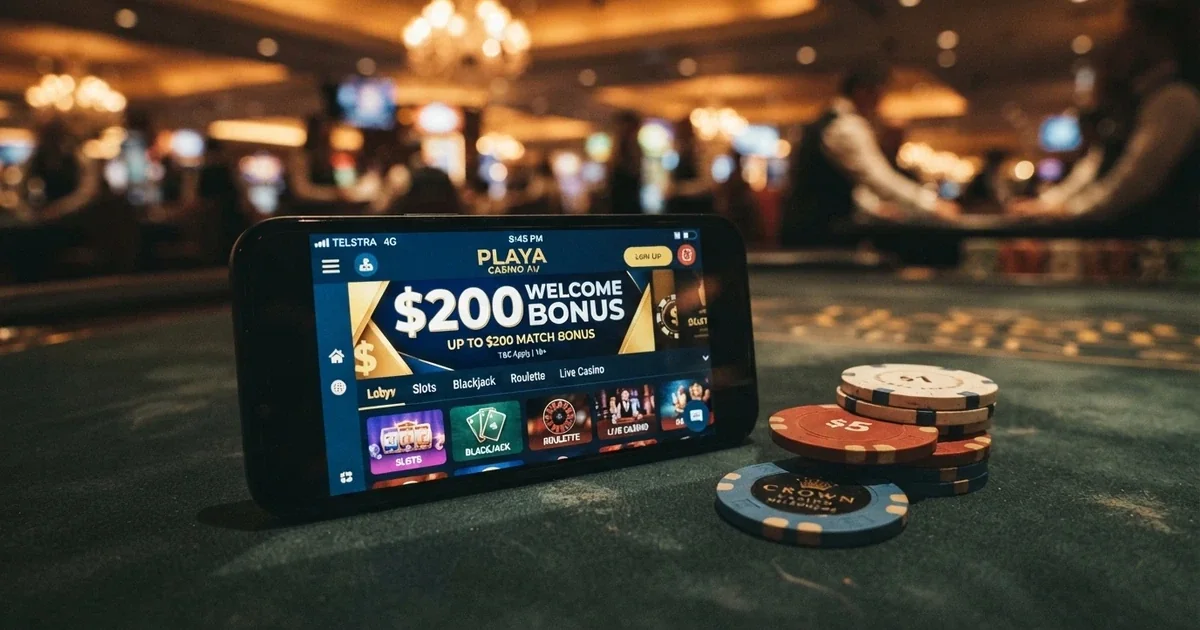
What a $300 No-Deposit Bonus Actually Looks Like for an Australian Player
 Available in AU
Data current as of 18 October 2026. Operator licences and Australian regulatory claims verified against the ACMA register of licensed Australian wagering services; harm and self-exclusion figures drawn from ACMA, Roy Morgan Research and the ANU Centre for Social Research and Methods.

Search for a $300 no deposit bonus casino in Australia and you will find pages that promise the offer like it is sitting on a shelf waiting for you to grab it. The phrasing carries an air of certainty — “$300 Free Chip”, “Claim Your $300 Bonus Now”, “Top $300 No-Deposit Casinos for Aussie Players” — and every one of those affiliate pages points offshore, every one of them describes a product that Australia has banned, and not one of them leads with what the headline figure actually means in the player’s pocket. A $300 bonus in the search results is almost never a $300 withdrawal. It is a playing balance, capped, tied to wagering conditions, and most often attached to an operator that has no Australian licence at all.
This page is the gap between that promise and the reality. The Interactive Gambling Act 2001 makes online casino an offence for any operator to provide to a person physically in Australia. No licence exists federally or in any state or territory. The ten brands Australians actually play at are offshore — Curaçao-licensed where the jurisdiction can be verified, unknown where it cannot — and only one of them runs any kind of no-deposit bonus at all. That offer is A$10 after phone verification, not A$300, and it clears to almost nothing once the wagering and the cashout cap are done with it. The $300 figure that anchors this whole search sits in the head terms as a marketing relic, not as a price a player can pay.
What follows maps what does exist: how a no-deposit bonus actually works, the four structural terms that decide whether you see a cent, the ten offshore operators Australians actually reach, the payments rails that move money across a legal border, the law that makes every casino on this page illegal in Australia, the 2026 reform that tightens the net from January next year, and the harm data that places every offer in its proper context. The verdict at the end is editorial: this is the analysis of what an Australian player actually faces when the offer sounds too good.
Table of Contents
- Why Your 2026 $300 No Deposit Bonus Is Nothing Like the Advertised Number
- How a No-Deposit Bonus Really Works — The Four Terms That Shrink a $300 Headline
- 10 Offshore Casinos Australians Actually Play At in 2026 — and None Has a $300 No-Deposit Bonus
- Paying and Getting Paid When There’s No Australian Licence in the Picture
- The Law That Makes Every Casino on This Page Illegal in Australia
- When a Free Bonus Costs More Than a Deposit — Gambling Harm and Where to Get Help
- How We Reviewed These Casinos
- Is a No-Deposit Bonus Worth the Risk in 2026?
- Frequently Asked Questions
Why Your 2026 $300 No Deposit Bonus Is Nothing Like the Advertised Number
The core tension on this page is a contradiction dressed up as a search result. This search term describes an offer that, on the AU-facing offshore market, barely exists in the shape the search promises. The head term is “$300”, the modifier is “no deposit”, the qualifier is “Australia”, and each of those three pieces pulls in a different direction.
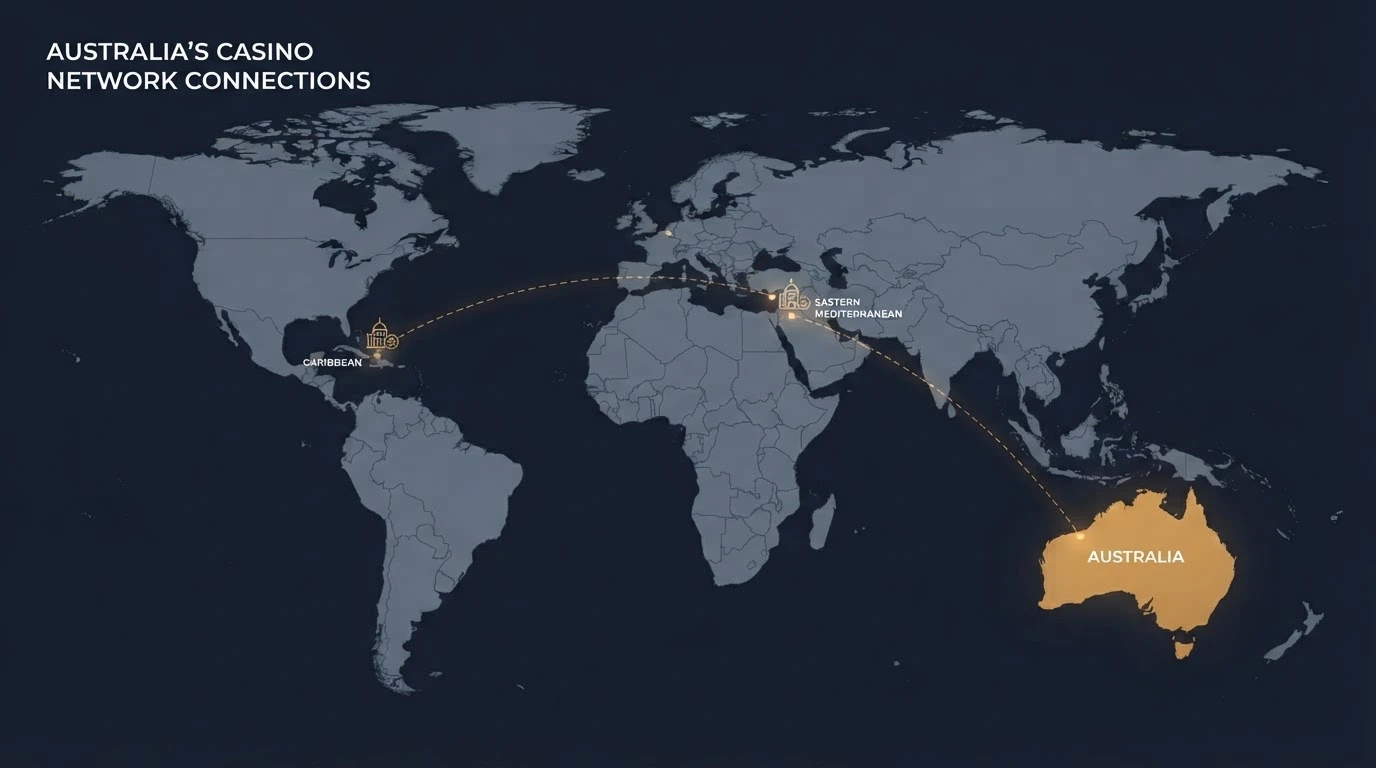
A no-deposit bonus is the casino’s most expensive acquisition tool. Free credit handed to a player who has not deposited — no risk to the player’s wallet, all risk to the operator’s promotional budget — and the industry uses it as a hook. The $300 figure sits at the upper end of the range. Most no-deposit offers in the offshore market cluster between A$10 and A$100 in actual credit value, with the A$300 headline reserved for the marketing material on affiliate pages. The gap between the advertised number and the credit the operator actually posts is the first structural term to know about, and the one no one flags on a listicle. A “claim your $300 bonus” page may credit A$30 to a new account, then route the bonus through wagering conditions that leave the player with a cashout capped well below the headline.
The legal reality is the part the affiliate pages skip. The Interactive Gambling Act 2001 prohibits any operator from providing online casino games, online pokies or in-play sports betting to a person in Australia. There is no licence for online casino anywhere in the country — federally or in any state or territory. The ACMA, the federal regulator, has had more than 1,564 illegal gambling and affiliate websites blocked by Australian ISPs since November 2019, and more than 225 illegal services have withdrawn from the Australian market since enforcement was strengthened in 2017. The individual player is not prosecuted — the law targets the provider, not the punter — but the moment you deposit, claim a bonus or play a pokie at an offshore casino, you step outside every Australian consumer protection that exists.
That leaves one operator in the featured set carrying any no-deposit bonus at all. Royal Reels offers A$10 in credit after phone verification, with 30x wagering on the bonus amount. It is the only such offer in the table further down this page. Other featured brands run deposit-gated welcome packages — such as Rocket Play and SkyCrown — but none of these match the “$300 no deposit” search. The honest version of the search is closer to: “what can an Australian player actually claim at an offshore casino without depositing first, and what does it cost them in wagering and in legal exposure?”
What a “$300 No Deposit Bonus” Actually Promises
A no-deposit bonus is free credit on a new account, with no deposit required to claim. The mechanics are simple enough to be mechanical: register, verify the account (email, sometimes phone), claim the offer — with or without a bonus code — and the operator credits the bonus to the balance. The player then plays with house money, not their own. The promise is the part that needs the most scepticism.
The bonus is an acquisition tool, and the operator’s marketing budget is what funds it. That money has to come back, and the mechanism it uses is the wagering requirement — a multiplier that converts the bonus amount into a turnover the player must generate before any winnings become withdrawable. A 30x wagering multiplier on a A$300 bonus means A$9,000 in bets before a cent of the winnings is yours. A 40x multiplier means A$12,000. A 60x multiplier, which exists in the upper end of the market, means A$18,000. None of these are trivial sums, and the player’s expected loss over the course of clearing them is not trivial either — the calculation section later in this page does the arithmetic on that.
The difference between free credit and free spins matters, and the affiliate pages often blur the two. A free-spin no-deposit bonus credits a fixed number of spins on a named pokie — typically 20 to 50 spins at a fixed stake, with the resulting winnings either paid as bonus money or as a small cash amount. A free-credit no-deposit bonus credits a dollar amount — typically A$5 to A$100 in practice, with the A$300 figure reserved for marketing. Both are routed through the same wagering and cashout conditions; both carry the same structural terms. The “free” in free bonus is a play on words the marketing copy never explains.
The headline figure is almost never the amount a player can withdraw. The cashout cap is the term that determines the actual ceiling — the operator’s own ceiling on what the bonus can pay out, regardless of how high the balance runs during play. The cap is the second structural term, and it is the one that turns the A$300 headline into the A$100 to A$300 withdrawal ceiling the industry actually permits. The bonus is a playing balance with a ceiling, not a payout.
The Australian Online Casino Reality Check
Australia is not a grey market for online casino. It is a prohibited one. The Interactive Gambling Act 2001 makes the offering an offence, and the ACMA has spent seven years enforcing that prohibition through ISP blocking, civil penalties and operator referrals. The shape of the enforcement has shifted from warnings to sustained blocking: since November 2019, the ACMA has had more than 1,564 illegal gambling and affiliate websites blocked; since the 2017 Amendment Act strengthened enforcement, more than 225 illegal services have withdrawn from the Australian market entirely.
What that means in practice is that every casino a $300 no-deposit search surfaces is offshore, unlicensed in Australia, and operates at the sufferance of an enforcement regime that has the power to make the site disappear. The ACMA does not need to prosecute the player — the IGA targets the provider, and the individual punter is not on the receiving end of the law. But the player forfeits every Australian consumer protection the moment they create an account at one of these operators. There is no Australian Consumer Law recourse if the operator refuses a withdrawal. There is no ACMA fund recovery if the balance is held. There is no AFCA complaint pathway. The site can be blocked mid-dispute with money still on it.
The right way to read a $300 no-deposit bonus page is not as a list of offers to claim. It is as a list of offshore operators offering an unlicensed product, with promotional terms that favour the house, in a market where the regulator has been blocking sites since 2019. The offers described on the next sections exist; the framework they exist inside is the one this section has just laid out.
How a No-Deposit Bonus Really Works — The Four Terms That Shrink a $300 Headline
A no-deposit bonus is a loan with conditions. The headline figure is the loan amount; the conditions are the four structural terms that decide whether the loan ever converts into money the player can take home. Every no-deposit offer in the offshore market carries all four. They stack, they interact, and they shrink the headline figure in ways the marketing copy does not bother to explain.
Wagering requirements are the first term, and the most important. The wagering multiplier is the number of times the bonus amount must be turned over in bets before any winnings become withdrawable. Typical wagering in the offshore market sits at 30x to 40x the bonus amount; the upper end runs at 50x to 70x, demanding A$15,000 to A$21,000 in turnover before withdrawal on a A$300 bonus. The player clears the multiplier by betting on eligible games; pokies contribute 100% of each bet to the turnover, table games typically contribute 10% or less, and some games are excluded entirely. The expected loss during clearing is real money out of the bonus balance, not house generosity.
Cashout caps are the second term, and the one that decides the actual ceiling. Most no-deposit bonuses cap withdrawals at A$100 to A$300 regardless of the balance the player accumulates during play. The cap applies after wagering is met. The headline figure is the balance, not the payout; the cap is the payout. A A$300 bonus with a A$200 cashout cap means the player is playing for up to A$200 in real money, no matter how high the bonus balance runs in the meantime.
Time limits and game restrictions are the third term. No-deposit bonuses typically expire within 3 to 7 days if wagering is not met; some operators run 14 to 30 day validity windows, particularly on larger bonus amounts. The maximum bet per spin is commonly capped at A$5 or less while a bonus is active, and the eligible-games list is typically restricted to pokies — table games either excluded or weighted at 10% against the wagering turnover. The cumulative effect of these is to compress the player’s clearing time into a narrow window of pokies-only play at capped stakes, with the expiry timer running from the moment the bonus is claimed.
Bonus codes are the fourth term, and the most variable. Some no-deposit bonuses are automatic — credit applied on registration. Others require a code at the cashier or on the claim page. The code may be public on the operator’s promo page, distributed through affiliate partners, or sent by email after account verification. Where a code is required and not entered, the bonus does not credit. Where a code has expired or is affiliate-only, the player may not realise until the bonus has been claimed in a degraded form or not at all.
These four terms do not sit alongside each other in the bonus terms — they multiply against each other. A A$300 bonus at 40x wagering demands A$12,000 in turnover; the cashout cap holds the withdrawal to A$200; the 7-day expiry makes that turnover volume possible only with sustained play at the A$5 maximum bet; the pokies-only restriction removes the player’s ability to mix in any lower-house-edge game. The structural terms together convert a A$300 headline into a constrained, capped, time-limited offer that is much smaller than the marketing describes.
Wagering Requirements — The Multiplier That Eats Your Winnings
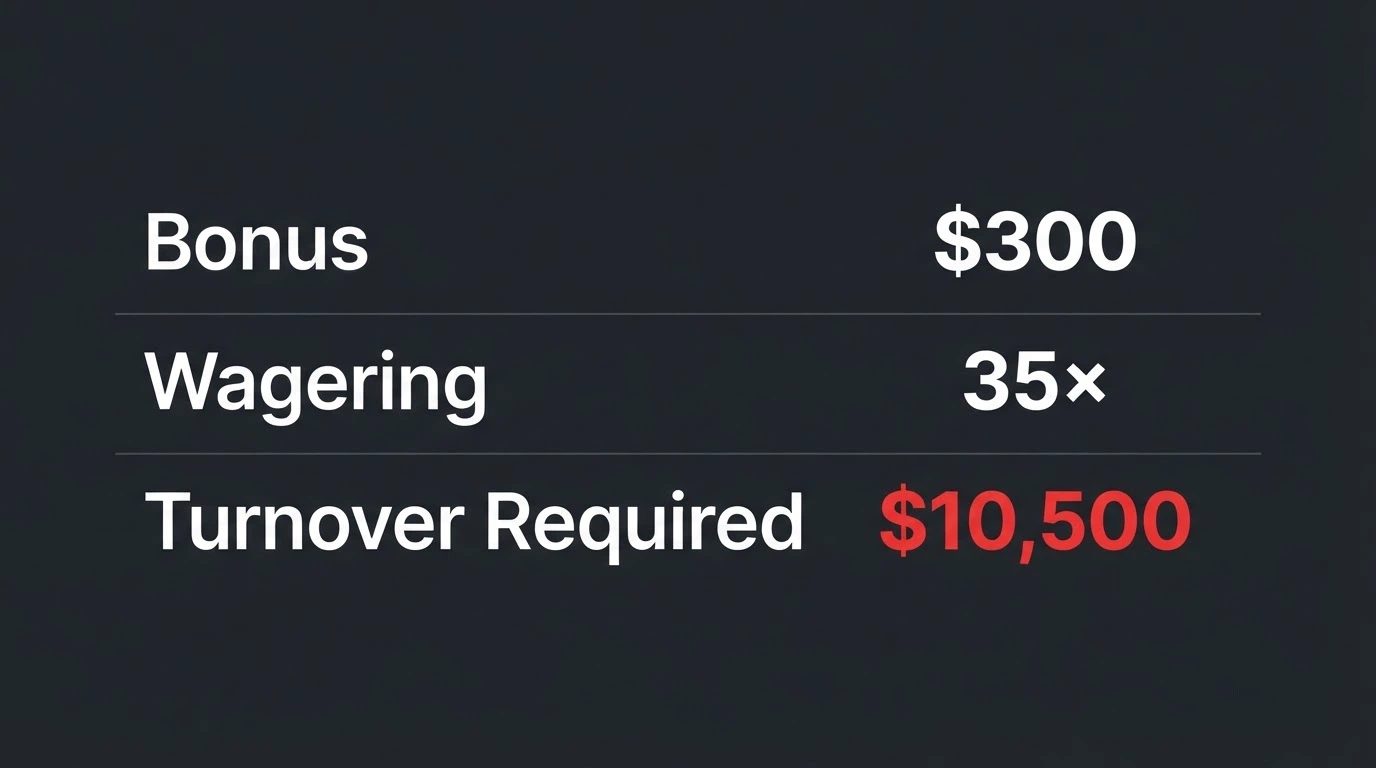
Wagering is the single term that decides whether a bonus is worth claiming, and the maths is straightforward. The multiplier applies to the bonus amount, not the deposit. A A$300 bonus at 35x wagering requires A$10,500 in qualifying bets before any winnings become withdrawable. At 30x the same bonus demands A$9,000. At 40x, A$12,000. At 60x, which exists at the top of the market, A$18,000.
The contribution rules narrow the path. Pokies contribute 100% of each bet to the turnover — a A$1 spin on a pokie is a A$1 wagering credit. Table games typically contribute 10% or are excluded entirely — a A$1 bet on blackjack or roulette may credit only A$0.10 against the wagering requirement, or nothing at all. Live dealer games sit in the same restricted category as table games. The result is that pokies are not just the dominant game type at offshore casinos; they are the only game type through which a no-deposit bonus can realistically be cleared.
Slot RTP — return to player — is the next layer. Published slot RTP defaults across the major studios cluster between 95.0% and 96.7%, with some titles running higher. A pokie with a 96% RTP returns A$0.96 for every A$1 wagered, on average, over a long session. That 4% is the house edge, and it is the rate at which the bonus balance erodes during wagering. Across A$10,500 in turnover at 96% RTP, the expected loss is A$420. That is the bonus’s real cost — not the wagering requirement, which is the volume of bets, but the expected loss the player carries while clearing it.
To put that in plain terms: assume only the bonus amount is wagered and the slot returns its published RTP. A A$300 no-deposit bonus at 35x wagering and a 96% RTP costs the player an expected A$420 over the clearing period. The cashout cap then holds the withdrawal to A$100 to A$300 — the bonus’s nominal ceiling. The offer’s net economics for the player, in expectation, is a loss of A$120 to A$320 against a chance of capturing up to A$300 in real money. The marketing describes the upside; the arithmetic describes the rest.
| Pokie Title | RTP | Provider | Volatility |
|---|---|---|---|
| Book of 99 | 99% | Relax Gaming | High |
| Mega Joker | 99% | NetEnt | High |
| Jackpot 6000 | 98.90% | NetEnt | High |
| Blood Suckers | 98% | NetEnt | Low |
| White Rabbit Megaways | 97.77% | Big Time Gaming | High |
These are the highest-RTP pokies across the catalogues research covers, and they are the titles that minimise the bonus’s real cost during clearing. Blood Suckers at 98% RTP and low volatility is the practical pick for grinding — the high hit frequency keeps the balance moving through wagering without long dry stretches. Book of 99 and Mega Joker at 99% RTP carry higher volatility, which means longer dry stretches punctuated by larger hits. White Rabbit Megaways at 97.77% sits between the two. The catalogue averages — NetEnt at 97.1%, Playtech at 96.8%, Thunderkick at 96.5%, Pragmatic Play at 96.2% — confirm that the high-RTP titles are at the top of their providers’ ranges rather than typical of them. A player who clears a A$10,500 wagering requirement on a 95% pokie is paying A$525 in expected loss. On a 99% pokie, A$105. The same offer, the same volume, the same cap — a fourfold difference in cost, driven entirely by the game the player chooses to clear it on.
Maximum Cashout Caps — The Real Ceiling on a “$300” Bonus
Even if a player clears wagering, a cashout cap typically limits the withdrawal to A$100 to A$300 regardless of how high the bonus balance runs during play. The cap is the structural term that turns the A$300 headline from a promise into a ceiling, and it is the term that decides whether the bonus is worth the effort of clearing the wagering in the first place.
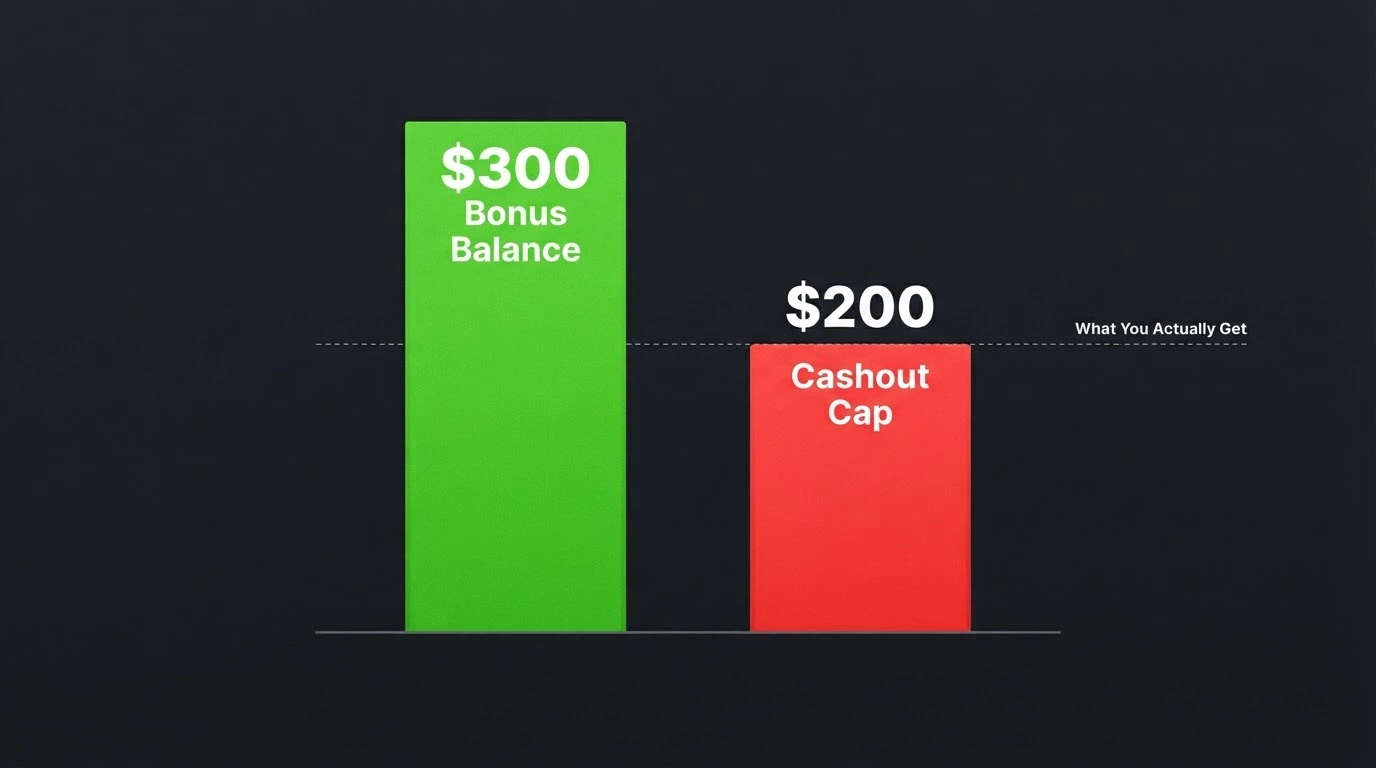
The mechanics are simple and unforgiving. The player claims the A$300 bonus, plays through the wagering requirement, accumulates a balance — say A$1,200 from a lucky streak on a high-volatility pokie — and then attempts to withdraw. The cashier applies the cap. A$100 to A$300 leaves the account, depending on the operator’s published terms, and the rest of the balance is removed. The player receives the cap, not the balance. The cap is the offer’s real value, and the marketing figure is the credit that produced it.
The cap is the single most important fine-print term to read before claiming any no-deposit bonus. A A$300 bonus with a A$200 cap is a different offer from a A$300 bonus with no cap — and the absence of a cap is rare enough in the offshore market that its presence or absence should be the first thing a player checks. Among the featured operators in this article, no no-deposit bonus without a cashout cap is documented. The cap is the rule, not the exception.
The cap interacts with wagering to make the bonus structurally unprofitable for most players. The expected loss over A$10,500 in turnover at 96% RTP is A$420. The maximum withdrawal is A$200 on a typical cap. The player is paying A$420 in expectation to win a chance at A$200 — a negative expected value before the volatility of any single session is even factored in. The arithmetic does not work in the player’s favour, and the cap is the term that closes the gap between expectation and outcome.
Time Limits, Game Restrictions, and the Fine Print Most Players Skip
Three secondary terms kill a bonus just as dead as the wagering requirement, and they stack with the multiplier and the cap.
Expiry windows, per-spin bet caps, and restricted games are the three secondary terms that can invalidate a bonus. No-deposit bonuses typically expire within 3 to 7 days if wagering is not met, though some operators run 14 to 30 day windows for larger bonuses. The clock starts at claim, and delays reduce clearing time. A 7-day expiry on a A$300 bonus at 35x wagering requires A$10,500 in turnover, or 2,100 spins at a A$5 stake, which is manageable within the 7-day window with sustained play. The maximum bet per spin is typically capped at A$5 or less during bonus play, and table games are often excluded or weighted at only 10% against the wagering requirements.
The cumulative effect of the four terms — wagering, cashout cap, expiry, game restrictions — is to compress the bonus into a narrow corridor of play. Pokies only, capped stakes, capped time, capped payout. The corridor is the offer; the A$300 headline is the marketing.
Bonus Codes — What They Are and Whether You Actually Need One
A bonus code is a short string — letters, numbers, or a mix — that gates access to a specific offer. Codes appear on affiliate sites, in promotional emails after registration, on the operator’s own promo page, or in banner ads linked from search results. The code is entered at the cashier or on the claim page; without it, the bonus does not credit, or a default alternative offer is applied.
Whether a code is required depends on the operator and the offer. Royal Reels’ A$10 no-deposit bonus, the only one in the featured set, requires phone verification rather than a code — the operator calls the registered phone number, confirms identity, and credits the bonus. For the remaining operators in the table, whether a code is required to access any specific offer was not confirmed in the research. Bonus terms, where they exist, are published on each operator’s promotions page, and the player should check that page directly before claiming.
The risks attached to codes are practical ones. An expired code does not credit. An affiliate-only code may not work for a player arriving from a different affiliate link. A code intended for a different country’s promotion may apply the wrong currency or fail at the cashier. None of these are theoretical — they are the failure modes that show up in player forums when an offer does not credit, and the player usually discovers the problem only after the bonus has been declined.
The cleanest path is to register through the operator’s own site rather than through an affiliate link, claim any bonus that is automatic on registration, and check the promo page for the code required to claim anything else. The bonus terms attached to the code are the same terms that govern the automatic offer; the code is the gate, not the offer.
10 Offshore Casinos Australians Actually Play At in 2026 — and None Has a $300 No-Deposit Bonus
No featured operator carries a $300 no-deposit bonus. Royal Reels offers A$10 after phone verification with 30x wagering. Every other featured brand runs a deposit-gated welcome package, and none of those match the head term. This section ranks the ten by AU-tracked market share — Rocket Play at 9.4% down to Rocket Casino at 0.57% — and compares them on the terms that matter for an Australian player deciding where to put money.
| Casino | Market Share (AU-tracked) | No-Deposit Bonus Offered |
|---|---|---|
| Rocket Play | 9.4% | — |
| SkyCrown | 8.55% | — |
| Royal Reels | 2.51% | A$10 after phone verification, 30x wagering |
| WinSpirit | 1.55% | — |
| Stake | 1.28% | — |
| Rainbet | 1.28% | — |
| Scream Casino | 0.99% | — |
| FairGO | 0.80% | — |
| Bizzo Casino | 0.57% | — |
| Rocket Casino | 0.57% | — |
The market-share figures come from tracked AU traffic and revenue data. They are not an endorsement, and they are not a proxy for safety. They reflect the brands Australians in fact reach, in the order they reach them. The criteria that separate a usable offer from a promotional decoy are the same four structural terms covered in the previous section — wagering, cashout cap, validity, game eligibility — and the criteria that separate a usable operator from a poor one are licence transparency, payout speed, withdrawal limits, and the absence of stalled withdrawals. The comparison table above does not rank by those criteria because, for seven of the ten operators, those figures are not documented. Where the data is missing, the table shows it as missing. That is the honest version of the comparison.
What Separates a Usable No-Deposit Bonus from a Worthless One
The ranking criteria for any no-deposit bonus, in the order they matter: wagering multiplier, cashout cap, validity window, game eligibility. Lower wagering is better — 30x clears faster than 60x, and the expected loss over the clearing period scales linearly with the multiplier. A higher cashout cap is better — A$300 ceiling is more useful than A$100, and no cap is better still. A longer validity window gives the player time to clear without compressing the session into a tight schedule. Broad game eligibility — pokies contributing 100%, table games at least weighted rather than excluded — gives the player flexibility in how they clear the bonus.
The market’s wagering range runs from 30x at the lower end to 70x at the upper end. A 30x bonus on A$300 demands A$9,000 in turnover; a 70x bonus demands A$21,000. The expected loss at 96% RTP is A$360 in the first case and A$840 in the second. The headline is identical. The cost to the player is more than double. That is the spread the wagering multiplier opens, and it is the spread the cashout cap does not close.
Cashout caps in the market cluster at A$100 to A$300. The cap is the operator’s ceiling on withdrawal regardless of balance. Validity windows cluster at 3 to 7 days for the tightest offers, with 14 to 30 days on some larger bonuses. The per-spin cap during bonus play is commonly A$5. These four terms together describe the bonus’s economic shape, and they are the shape to read before claiming.
The AU-Facing Offshore Mix — Who Runs Where
All ten operators are offshore casinos targeting Australian players. None holds an Australian casino licence — none can, because the IGA prohibits the offering outright. The licence jurisdictions where they sit are Curaçao, where verification is possible, and unknown, where it is not. Royal Reels, SkyCrown, Rocket Play and Stake show Curaçao as their licence jurisdiction in the operator-sweep data, with the unverified caveat attached; WinSpirit, Rainbet, Scream Casino, FairGO, Bizzo Casino and Rocket Casino do not have licence-jurisdiction data documented in the research and the player should verify that directly with the operator before depositing.
Curaçao is the de facto offshore licence hub for the brands Australians reach. It is a lighter regulatory regime than the UK Gambling Commission or the Malta Gaming Authority, with less rigorous player-fund protection and a complaint pathway that is slow to resolve in practice. The Curaçao licence is not worthless — it imposes some KYC, AML and game-testing obligations on the operator — but it is a thinner layer of protection than a player at a UK-licensed casino would have, and the offshore status compounds that thinness by removing every Australian consumer protection in the same move.
Market share in this set ranges from Rocket Play at 9.4% down to Rocket Casino at 0.57%, a sixteenfold spread. Market share is a rough proxy for AU player trust — a brand with more Australian traffic is one more Australian has chosen to register with and deposit at — but it is not a proxy for safety. A high-share offshore casino is a high-traffic unlicensed operator; the traffic does not create the licence that does not exist. The market-share ordering here is descriptive, not normative.
Rocket Play
Rocket Play holds 9.4% of AU-tracked market share — the largest in the featured set. The brand runs a Curaçao licence (unverified at the operator level — verify on the site) and a welcome package of up to A$2,000 plus 100 free spins across the first two deposits, with a minimum deposit of A$30 and typical wagering of 30x to 40x the bonus amount. The 30x to 40x range sits above the A$35 norm for the market, which means a heavier clearing cost on a per-dollar basis than a tighter-wagering competitor.
The game library runs to 3,000-plus slots from leading studios — a competitive depth, and a reason the brand captures a share of AU traffic at the level it does. There is no no-deposit bonus in the offer set; Rocket Play is deposit-gated only. A player who deposits A$30 to claim the first tier of the welcome package takes on the wagering requirement at the same 30x to 40x rate, and the cashout terms that govern the bonus apply at the standard rate for the market.
Rocket Play is the volume leader in the featured set and the brand most Australian players in this market reach first. That reach is not a safety endorsement. The brand is offshore, the licence verification is on the player to confirm, and the wagering terms on the welcome package are heavier than the median. Approach with caution, and read the bonus terms in full before claiming.
SkyCrown
SkyCrown holds 8.55% of AU-tracked market share and runs the deepest welcome package in the featured set — up to A$8,000 plus 400 free spins across a four-tier structure, with 40x wagering on bonus money and free spins. The Curaçao licence is the operator-jurisdiction figure; verify directly with the brand. The minimum deposit varies by tier (A$30 to A$50 across the four stages), and the wagering multiplier is consistent at 40x.
The standout figure on SkyCrown is payout speed. Average payout processing time runs at approximately 10 minutes, occasionally up to 24 hours; bank-transfer withdrawals sit at around 3 days. Minimum withdrawal is A$20 via MiFinity and A$100 via bank transfer; maximum daily withdrawal is A$7,500 with a monthly cap of A$45,000. These are workable thresholds, and the 10-minute processing time on e-wallet withdrawals is the only fast-payout data point in the featured set.
There is no no-deposit bonus at SkyCrown. The welcome package is deposit-gated only, and the 40x wagering on a four-tier structure is the clearing cost the player takes on across all four deposits. The depth of the package is generous by the offshore market’s standards; the wagering is at the higher end of the typical range. If your priority is payout speed and library depth rather than a no-deposit credit, SkyCrown warrants consideration.
Royal Reels
Royal Reels holds 2.51% of AU-tracked market share and is the only operator in the featured set that runs any no-deposit bonus. The offer is A$10 in credit after phone verification, with 30x wagering on the bonus amount. The bonus is small relative to the head term — A$10, not A$300, and the A$300 wagering turnover that a 30x multiplier demands on the advertised figure does not apply here because the credit posted is A$10, not A$300. At A$10 credit and 30x wagering, the clearing volume is A$300, not A$10,500.
The deposit welcome package is three tiers: 100% up to A$500 on the first deposit, 75% up to A$750 on the second, 100% up to A$1,250 on the third — all at 35x wagering on bonus only, with an A$5 per-spin cap during clear-down. The Curaçao licence is the operator-jurisdiction figure; verify directly with the brand. The pokie library runs to 5,400-plus titles from 40-plus premium software providers — the deepest in the featured set. The VIP programme is a 10-tier structure with cashback and exclusive rewards.
Royal Reels is the closest match in the featured set for a player whose search is for a no-deposit bonus, because Royal Reels is the only one that runs one. The A$10 credit is small, the wagering is on the bonus amount only, the verification gate is a phone call rather than a code, and the cashout terms that govern the offer apply at the standard market rate. This operator is a primary candidate for a player wanting to test an offshore casino with house money; ensure you understand the cashout cap before you play.
WinSpirit
WinSpirit holds 1.55% of AU-tracked market share — fourth in the featured set. Licence jurisdiction is unknown in the research data, and bonus terms were not documented this run. The player should verify the licence on the operator’s site directly and check the promotions page for the current welcome offer before depositing. No claim about terms can be made on the basis of the data available.
Stake
Stake holds 1.28% of AU-tracked market share and runs a Curaçao licence (unverified at the operator level — confirm on the site). The platform model differs from traditional bonus-led casinos. Stake is built around a crypto-forward wagering product, and the welcome offer shape that characterises the deposit-gated welcome packages at Rocket Play, SkyCrown and Royal Reels does not apply in the same form. Bonus details for Stake were not confirmed this run.
Stake is a known name in the offshore market and the platform has a different offer architecture to the rest of the featured set. A player interested in Stake should look at the operator’s own promotions page and weigh the crypto-native payment rails, the wagering product, and the licence jurisdiction against the credit-card and crypto ban that applies to licensed Australian wagering services (and that does not bind an offshore Curaçao-licensed operator the same way). The platform sits inside the same IGA prohibition regardless.
Rainbet
Rainbet holds 1.28% of AU-tracked market share — tied with Stake at the fifth position. Licence jurisdiction is unknown in the research data. Welcome bonus terms, free-spin allocations, wagering multipliers and validity windows were not documented this run. The player should verify the operator’s licence and current bonus terms on the site before depositing. No figure from the available data is solid enough to repeat as a written claim.
Scream Casino
Scream Casino holds 0.99% of AU-tracked market share. Licence jurisdiction is unknown, and all bonus terms were not confirmed in this research. The player should check the licence and the promotions page directly before committing a deposit. There is no claim about terms that the available data supports.
FairGO
FairGO holds 0.80% of AU-tracked market share. Licence jurisdiction is unknown, and all bonus terms were not confirmed in this research. The brand name has Australian-coded positioning, but the operator is offshore and the licence jurisdiction is not documented in the data available. The player should verify the licence on the operator’s site and check the current welcome terms before depositing.
Bizzo Casino
Bizzo Casino holds 0.57% of AU-tracked market share — tied with Rocket Casino at the bottom of the featured set. Licence jurisdiction is unknown in the research data, and bonus terms were not documented this run. The player should verify the licence and check the promotions page for current welcome terms before depositing.
Rocket Casino
Rocket Casino holds 0.57% of AU-tracked market share. Licence jurisdiction is unknown, and all bonus terms were not confirmed this run. The brand shares a name with Rocket Play at the top of the table but is a separate operator with a separate licence and a separate bonus architecture. The player should verify each before assuming the two are related. There is no claim about terms that the available data supports.
Paying and Getting Paid When There’s No Australian Licence in the Picture
Payment rails for the AU player who claims a no-deposit bonus and then deposits follow a different map than the licensed Australian wagering market. The legal routes inside Australia — debit card, bank transfer, PayID/Osko, BPAY — were redefined when the Interactive Gambling Amendment (Credit and Other Measures) Act 2023 came into force on 11 June 2024. Credit cards, credit-related products and cryptocurrency are banned as payment for online wagering under that amendment. An operator that fails to enforce the ban faces penalties of up to A$247,500. The ban binds licensed Australian wagering operators. An offshore casino is not bound by the ban in the same way, but the player’s deposit still has to clear an Australian bank, and the bank applies its own policy on transactions to known illegal gambling operators.
That is the squeeze that closes from January 2027. The Interactive Gambling Amendment (Gambling Reform) Bill 2026 passed Parliament on 19 August 2026 and its measures commence 1 January 2027. From that date, banks and payment providers gain express authority to block transactions to illegal gambling operators. The bank can refuse the deposit, return the funds, and report the transaction. A player who can deposit today may not be able to deposit in three months, and the operator has no recourse to compel the bank to reverse the block.
Depositing with PayID — Australia’s Home-Grown Rail
PayID is the New Payments Platform address that links a mobile number, email or ABN to a bank account, with instant settlement through Osko. For Australian players, PayID is the fastest widely available deposit rail — transfers settle in seconds, the player does not enter BSB and account details at the cashier, and the funds move through the regular banking system rather than through a card network or a crypto on-ramp. The legal deposit routes for licensed Australian wagering are debit card, bank transfer, PayID/Osko and BPAY. PayID sits inside that list.

Whether each featured operator accepts PayID directly was not confirmed in this research — the cashier pages were not verified for the full operator set. PayID availability varies by operator, and the player should check the deposit-methods list on the cashier page before registering. What is universal is the credit-card and crypto ban. A player cannot legally fund a licensed Australian wagering account with a credit card or with cryptocurrency, and the same logic — though not the same binding force — applies at an offshore casino, because the bank processing the payment applies the policy whether the merchant is licensed or not. Deposits at offshore casinos that rely on PayID, debit card or direct bank transfer are the practical channels for an Australian player today.
The tighter version of this section comes from the 2027 reform. From 1 January next year, banks and payment providers gain the authority to block transactions to illegal gambling operators. A PayID deposit to an offshore casino is one of the transaction types that becomes blockable. The rail that works today is the rail that is most exposed when the new rules take effect, because PayID is the most easily identified as a gambling transaction by the bank processing it.
What a $300 Deposit Gets You vs What a Bonus Promises
A A$300 deposit at an offshore casino unlocks matched funds and free spins through the deposit-gated welcome packages. Rocket Play’s first-tier deposit unlocks the first part of the A$2,000 plus 100 free spins welcome at a A$30 minimum deposit. SkyCrown’s four-tier structure steps up from A$30 to A$50 minimum deposits across the four tiers, with the full A$8,000 plus 400 free spins available only across all four deposits. Royal Reels’ three-tier structure runs 100% up to A$500, 75% up to A$750, and 100% up to A$1,250, all at 35x wagering on bonus only with an A$5 per-spin cap.
The structural advantage of a deposit-gated bonus is the higher cashout ceiling and the longer validity window. The A$300 no-deposit headline is capped at A$100 to A$300 in withdrawals regardless of balance; the A$300 deposit-gated bonus at Royal Reels unlocks matched funds that can pay out at multiples of the deposit, with cashout terms that scale with the matched amount rather than capping at a flat rate. The wagering requirement is heavier in absolute terms — A$10,500 in turnover on a A$300 35x bonus — but the ceiling is higher and the path to a real withdrawal is shorter.
The realistic offer for an AU player is the deposit-gated welcome package, not the no-deposit bonus the search promises. The deposit unlocks matched funds that are usable, with cashout terms that give the player a real chance of converting bonus money into withdrawable balance. The no-deposit bonus is the headline; the deposit-gated package is the substance.
How Fast (and Whether) You Actually Get Your Money Back
Payout speed at offshore casinos is the structural test of whether the operator is actually paying customers or just advertising that it does. The only data point in the featured set is SkyCrown’s average payout processing time of approximately 10 minutes, occasionally up to 24 hours; bank-transfer withdrawals at SkyCrown sit at around 3 days. Minimum withdrawal is A$20 via MiFinity and A$100 via bank transfer; maximum daily withdrawal is A$7,500 with a monthly cap of A$45,000. The MiFinity rail is fast; the bank-transfer rail is slow but workable.
The structural problem is the absence of Australian recourse when an offshore operator stalls. The ACMA has blocking powers, but it has no power to compel an offshore operator to release player funds. The Australian Consumer Law does not apply to an offshore merchant in the same way it applies to a domestic one. AFCA complaints do not bind an unlicensed offshore casino. The player’s only practical recourse is the operator’s own internal dispute process and the Curaçao licence complaint pathway — neither of which is fast, and neither of which has the weight of an Australian regulator behind it.
The worst-case scenario is the site being blocked mid-dispute with a balance still on it. The ACMA has blocked more than 1,564 illegal gambling and affiliate websites since November 2019. The operator’s site becomes unreachable in Australia, the player’s account becomes inaccessible, and the balance sits in an account at an offshore entity that the player cannot contact through any Australian channel. This is not a hypothetical risk; it is the documented pattern of the offshore market in Australia over the last seven years. Withdrawal thresholds — A$20 to A$100 minimums, A$7,500 daily caps — are practical constraints on the upside; the absence of an Australian licence is the structural risk on the downside.
The Law That Makes Every Casino on This Page Illegal in Australia
Every casino on this page operates from outside Australia, beyond the reach of Australian consumer law, and in violation of the Interactive Gambling Act 2001. The IGA makes it an offence for any operator to provide online casino games, online pokies or in-play sports betting to a person physically in Australia. There is no licence for online casino anywhere in the country — not federally, not in any state or territory. The 2017 Amendment Act closed offshore loopholes and gave the ACMA its enforcement and blocking powers. The 2026 Reform Bill, passed 19 August this year and commencing 1 January next year, tightens the net further with advertising caps, inducement bans, and bank authority to block transactions to illegal operators.
The IGA targets the provider, not the player. The individual punter is not prosecuted for using an offshore casino, and the ACMA does not pursue individual players. But the player who creates an account, claims a bonus, deposits, plays, and tries to withdraw at one of these operators is operating outside every Australian consumer protection that exists. There is no ACMA fund recovery if the operator refuses a withdrawal. There is no BetStop coverage to enforce a self-exclusion. There is no Australian Consumer Law recourse. The site can be blocked mid-dispute with the player’s balance still on it.
The Interactive Gambling Act 2001 — What It Prohibits and What It Doesn’t
The IGA prohibits three product categories outright. Online casino games — all forms, table games and pokies. Online pokies specifically. In-play sports betting — betting once a sporting event has started. Each of these is an offence for an operator to provide to a person in Australia. There is no licence for any of them, federally or in any state or territory, and the ACMA’s enforcement record since 2017 is the proof that the prohibition is operational rather than nominal.
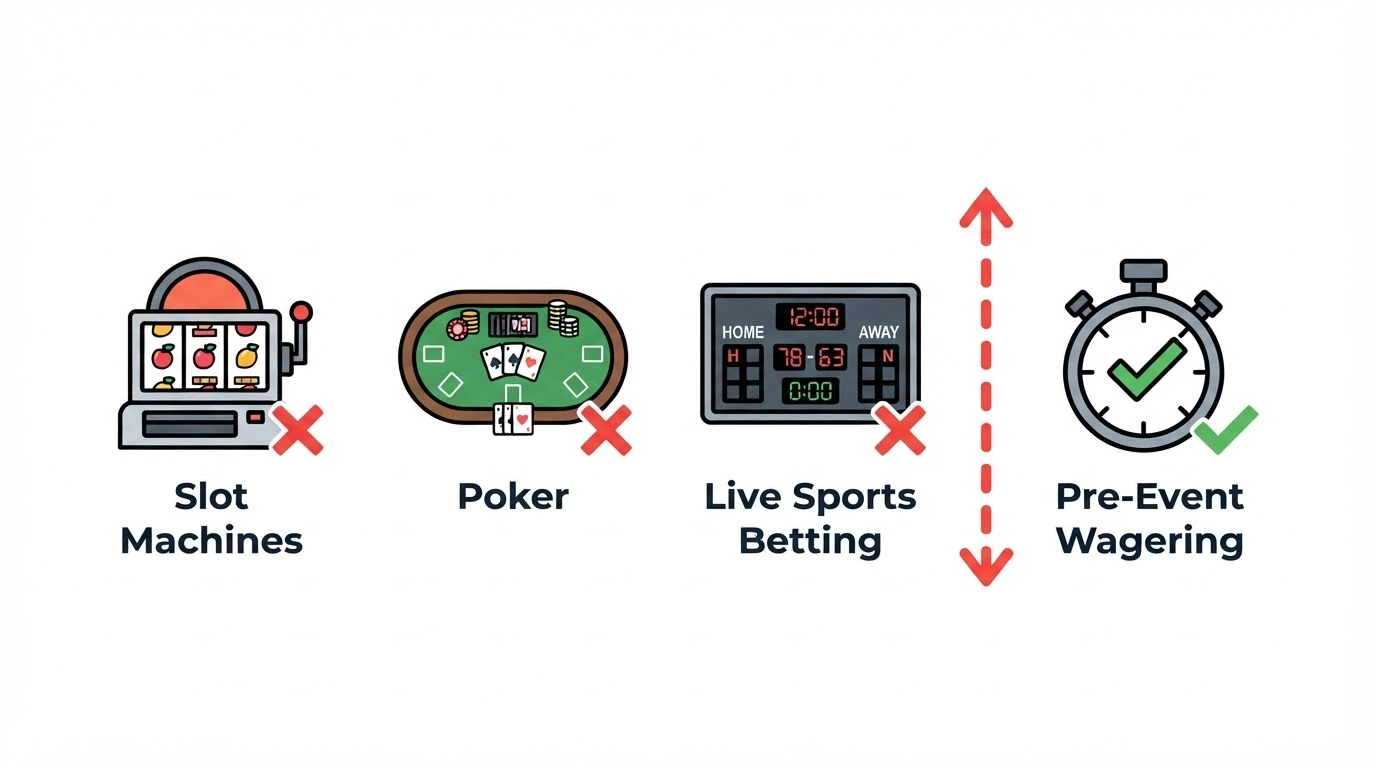
What is permitted and licensable is wagering on races and sport placed before the event begins, lotteries and keno. Operators offering those products hold state or territory licences — primarily through the Northern Territory Racing and Wagering Commission and Licensing NT, with the NT functioning as the de facto national wagering licensor for online bookmakers. The licensed reference point for an Australian player is a wagering operator such as Sportsbet, Bet365, Ladbrokes or the TAB, and the reference is to wagering, not to casino games. Online casino sits on the prohibited side of the line.
The IGA targets the provider. The individual player is not prosecuted for using an offshore casino, and the ACMA’s enforcement is directed at operators, not punters. The distinction is important and it is the reason an Australian player can access these sites without legal risk to themselves — but the same distinction removes every Australian consumer protection that would normally apply to a domestic gambling transaction. The player is not the target of the law; the player is also not the beneficiary of the protections that exist for licensed operators.
The Offshore Trap — What You Lose When a Casino Has No Australian Licence
The offshore trap involves several key losses for the player. There is no BetStop coverage, meaning self-exclusion has no effect. There is no ACMA recourse for withheld funds, and no Australian consumer-law protection applies. Furthermore, the site can be blocked mid-dispute, and there is no local protection framework to rely upon. These factors combine to make offshore gambling a high-risk activity compared to the licensed market.
No local protection framework applies to offshore casinos. The harms described later in this page — gambling-harm prevalence, the rise in problem-gambling rates, the self-exclusion register, the responsible-gambling code — apply to licensed Australian operators through BetStop, customer-set deposit limits, activity statements, and the National Gambling Helpline. An offshore casino is outside that framework.
The contrast with a licensed Australian wagering operator is the frame that makes this list readable. Sportsbet, Bet365, Ladbrokes, the TAB and other licensed bookmakers hold state or territory wagering licences, contribute to BetStop, accept ACMA enforcement, and operate inside Australian consumer law. None of them offer online casino games — that product is prohibited — but the protections that attach to a licensed wagering account do not extend to an offshore casino, and the player gives those protections up the moment they register at one.
The 2026 Reform That Changes the Rules From January Next Year
The Interactive Gambling Amendment (Gambling Reform) Bill 2026 passed Parliament on 19 August this year and its measures commence 1 January 2027. The Bill does not change the IGA’s underlying prohibition on online casino — that has been in force since 2001 and is not affected by the reform — but it adds a layer of operational restrictions that reshape the offshore bonus market’s access to Australian players.
The advertising measures are the most visible. From 1 January next year, no more than three wagering ads per hour can run between 6:00 am and 8:30 pm. Wagering advertising is banned from 15 minutes before until 5 minutes after a live sporting event. Athletes, celebrities and influencers are barred from promoting wagering products. Online wagering ads are restricted to logged-in, age-verified users who have not opted out. Each of these binds licensed Australian wagering operators and the Australian media that carry their ads; the offshore operators are not directly bound but lose access to the channels the restrictions cover.
The inducement-marketing bans are the measures that target the bonus model. From 1 January next year, direct marketing of inducements is prohibited for 14 days after a customer signs up, for three months after a person deregisters from BetStop, and indefinitely for customers identified as at risk of gambling-related harm. The shape of these bans is the licensed-operator shape, but the framework they fit into is the broader tightening of access to Australian players that the reform represents.
The most consequential measure for the offshore bonus market is the bank-blocking authority. From 1 January next year, banks and payment providers gain express authority to block transactions to illegal gambling operators. A deposit from an Australian bank account to an offshore casino becomes a transaction the bank can refuse, return, or report. PayID is the rail most exposed because the bank can identify it instantly; debit card transactions can be blocked at the card network; BPAY transactions can be refused at the receiving bank. The credit-card and crypto ban has been in force since June 2024; the bank-blocking authority extends the same logic to every payment rail.
The net is tightening. The IGA prohibited the offering; the 2017 Amendment gave ACMA the blocking tools; the 2024 credit-card and crypto ban closed off two funding channels; the 2026 reform, commencing 1 January next year, closes the rest. The offshore bonus market does not become legal in 2027 — it was never legal — but it becomes harder to reach from inside Australia.
When a Free Bonus Costs More Than a Deposit — Gambling Harm and Where to Get Help
A no-deposit bonus is designed to turn a non-depositor into a depositor. The bonus is the hook, the wagering is the conversion mechanism, and the deposit is the revenue event the operator is buying. The harm data on this page is the context for that conversion. An estimated 3.32 million Australians — 15.1% of the adult population — are experiencing some level of gambling harm. Approximately 622,000 are classified as problem gamblers under the PGSI, up from 1.9% in 2022–23. Risky gambling among Australian adults increased from 13.7% in 2024 to 19.4% in 2025. A free bonus lands in a market where harm is rising, and the offer the search promises is designed to draw the player who is most at risk.
The responsible-gambling point this page makes is not that offshore casinos are uniquely harmful — the licensed Australian wagering market carries its own documented harms, and the AIHW’s 1.8% high-risk estimate from 2022 is the cross-reference that gambling harm is not confined to the offshore market. The point is that offshore casinos are outside the protection framework the licensed market is required to offer, and the offshore bonus specifically is the offer most likely to land with the player who needs the framework the most.
The Numbers: How Many Australians Are Harmed by Gambling Right Now
The headline figures come from Roy Morgan Research, published in July this year. An estimated 3.32 million Australians — 15.1% of the adult population — are experiencing some level of gambling harm: 13.0% (2,857,000 people) from their own gambling and 5.4% (1,177,000) from other people’s gambling. The same survey’s classification of problem gambling under the PGSI puts 622,000 Australians — 2.9% of the adult population — at the most severe end of the spectrum. The PGSI figure has climbed from 1.9% in 2022–23 to 2.4% in 2023–24 to 2.9% in the most recent reading. The trend is in the wrong direction.
The ANU Centre for Social Research and Methods provides a parallel dataset for 2025. Risky gambling among Australian adults increased from 13.7% in 2024 to 19.4% in 2025 — a 5.7 percentage-point rise in a single year. More than half (56.1%) of individuals who gambled in the past 12 months mainly participated online. The shift to online gambling is structural and it is the channel through which offshore bonuses reach Australian players. The AIHW’s 2022 estimate put high-risk gambling at 1.8% of Australian adults — a lower figure from an earlier year that confirms the trend rather than contradicting it. The numbers from different surveys and different years point in the same direction: more Australians are being harmed by gambling, and more of that harm is happening online.
The market context for these figures is the offer this page describes. A no-deposit bonus is free credit on a new account. The credit is small in dollar terms — Royal Reels’ A$10 is the only one in the featured set — but the offer’s design is to convert the player from a non-depositor to a depositor. The deposit is where the operator’s revenue starts; the bonus is the loss-leader. The 15.1% of adults experiencing harm, and the 2.9% classified as problem gamblers, are the population the loss-leader is designed to reach. The bonus is the marketing hook; the harm data is the population the hook is cast into.
Self-Exclusion in Australia — BetStop and Its Offshore Blind Spot
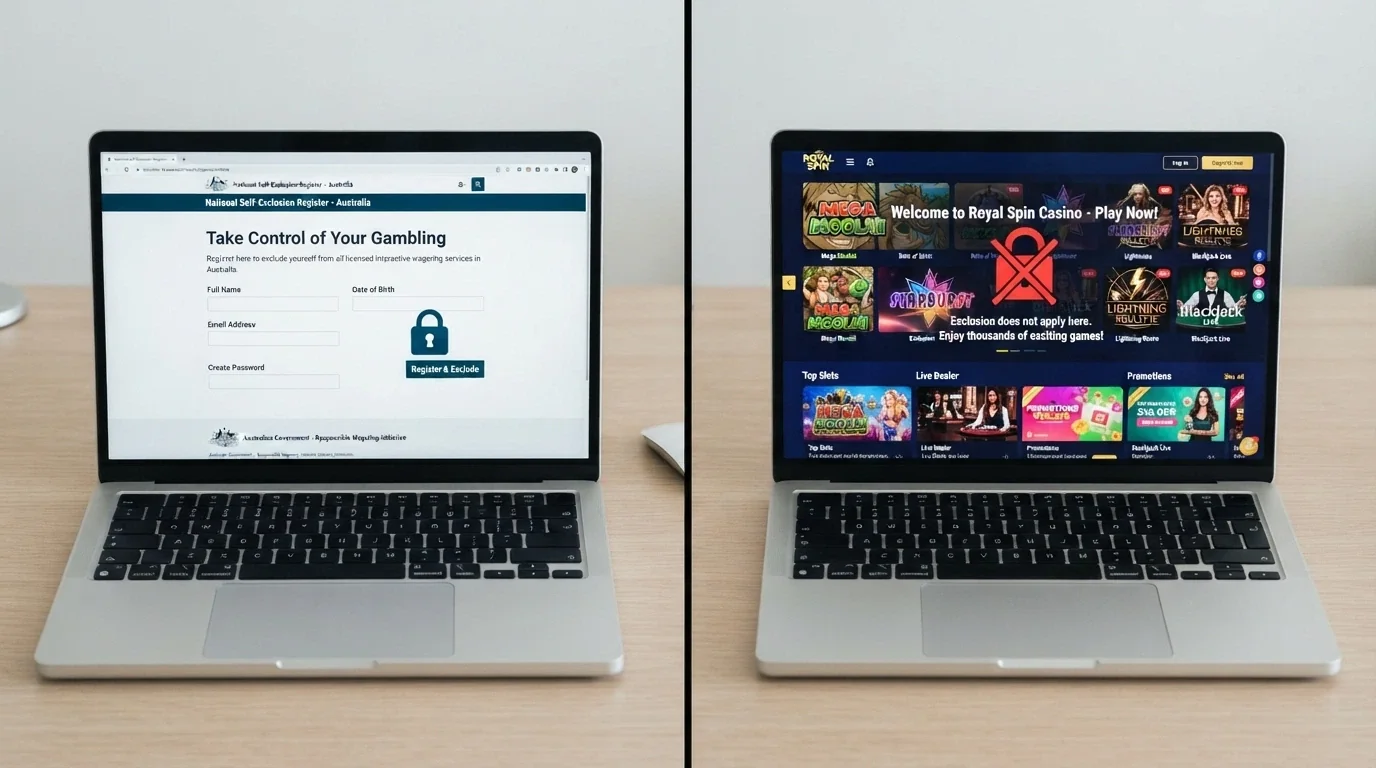
BetStop is Australia’s National Self-Exclusion Register. It launched on 21 August 2023 and excludes a person from every Australian-licensed online and phone wagering service in a single step. One registration, every licensed operator, no exceptions within the licensed framework. As of 31 March this year, 59,830 people had registered with BetStop, of whom 37,247 had active exclusions and 22,583 had completed or cancelled early. As of 31 July this year, the figures had risen to 67,480 registrations and 41,290 active exclusions — more than 60% of everyone who ever registered still has an active exclusion in place. The trend is upward.
The demographic profile is consistent. 78% of BetStop registrants were under 40 at registration; 38% chose lifetime exclusion. The under-40 skew is the same cohort the offshore bonus markets target through search ads, affiliate pages and crypto-friendly platforms. A self-exclusion that runs to lifetime is the strongest commitment a person can make within the licensed framework, and 38% of registrants have made it.
The offshore blind spot is the most important responsible-gambling point on this page. BetStop binds Australian-licensed wagering services only. An offshore casino is not connected to the register and will keep accepting a self-excluded person’s money. The single registration that excludes a person from every Australian-licensed operator does nothing at the offshore brands on this page. A player who has registered with BetStop, who has chosen lifetime exclusion, who has taken the strongest step the licensed framework offers — that player can still create an account at Royal Reels, Stake or any other offshore brand on the table, deposit, claim a bonus, play, and lose money the framework was supposed to keep them from losing. The framework is not breached; the framework simply does not reach.
The data point that makes this concrete is the 41,290 active BetStop exclusions as of 31 July this year. That is 41,290 people who have told the licensed Australian wagering market to keep them out. The licensed market honours that exclusion. The offshore market does not see it. The gap is structural, and it is the gap that the 2026 reform’s bank-blocking authority and inducement-marketing bans are designed to narrow without closing.
Help Resources — Who to Call and What They Offer
The National Gambling Helpline — 1800 858 858 — is free, confidential, and staffed 24 hours a day, 7 days a week. The line routes callers to counselling, support, and referral services across Australia, regardless of which state or territory the caller is in. Online chat and self-help tools are available through Gambling Help Online, a national service funded by the Australian government and delivered through the state and territory gambling-help networks.
Face-to-face and financial counselling is available through the state services. Gambler’s Help in Victoria provides face-to-face counselling, financial counselling, and group programs across the state; the equivalent services operate in New South Wales, Queensland, Western Australia, South Australia, Tasmania, the ACT and the Northern Territory under their own brands. Self-assessment tools are available through Gambling Help Online for players who want to understand their own gambling patterns before they reach out by phone.
The help services cover all gambling harm, not only harm from licensed-operator play. A player who has lost money at an offshore casino, who is concerned about their own gambling, who is gambling more than they can afford — the helpline does not ask which operator the harm is attached to. The service is for the person, not for the platform.
BetStop is the self-exclusion register for licensed Australian wagering services. Registration is at the BetStop site, and a single registration excludes a person from every Australian-licensed online and phone wagering service for the period chosen. The register does not cover offshore casinos; that gap is covered in the previous subsection, and it is the reason the helpline is the more useful first call for someone whose gambling has crossed a line at an offshore brand. The helpline does not require the caller to identify which operator they have been playing with, and it does not refuse support on the basis of where the gambling has happened.
The help is free, the help is confidential, and the help is staffed around the clock. The phone number to remember is 1800 858 858.
How We Reviewed These Casinos
The evaluation basis for the operator table in this article is AU-tracked market-share data. The operators are ranked by the share of AU traffic and revenue each captures in tracked data, highest first. The ranking is descriptive, not normative — a higher market share is a measure of how many Australians the brand reaches, not a measure of how safe or fair the operator is.
Each operator has been checked against the ACMA register of licensed Australian wagering services. None of them holds an Australian casino licence; none can, because the IGA prohibits the offering of online casino games to Australians and there is no licence for online casino anywhere in the country. The licence jurisdictions where they do operate are Curaçao (where documented and verified) or unknown (where research did not document the jurisdiction). The player should verify the licence on the operator’s site before depositing.
Bonus terms were sourced from operator websites and affiliate trackers where live data was available. Where research could not confirm a field — wagering multiplier, cashout cap, validity window, eligible games — the table shows it as missing rather than as a guess. The three operators with documented welcome-package data are Rocket Play, SkyCrown and Royal Reels. The remaining seven operators do not have bonus terms documented in the available data; the player should verify current terms on the operator’s site before claiming.
The evaluation criteria that would rank these operators by quality of offer rather than by market share are: wagering multiplier (lower is better — 30x vs 60x), cashout cap (higher is better — no cap best), validity window (longer is better), game eligibility (broader is better), and licence transparency (documented and verifiable jurisdiction). No invented weightings have been applied; no bonus terms have been inferred where the data is missing. The table is what the data supports, and the gaps in the table are the gaps in the data.
Is a No-Deposit Bonus Worth the Risk in 2026?
The search promise and the market reality do not match. No featured operator carries a $300 no-deposit bonus. Royal Reels’ A$10 no-deposit is the closest offer in the set, and the arithmetic on that offer — A$10 credit, 30x wagering, A$300 in turnover, expected loss of approximately A$12 at a 96% RTP, capped at A$10 to A$30 in withdrawals at typical cap rates — does not produce a meaningful payout for most players. The deposit-gated welcome packages at Rocket Play, SkyCrown and Royal Reels are the substantive offers, and they carry the same offshore risk the no-deposit bonus carries, with higher cashout ceilings and longer validity in exchange.
The legal reality does not soften. Every operator on this page operates offshore without an Australian casino licence. The IGA prohibits the offering. The ACMA blocks sites, more than 1,564 since November 2019. The player forfeits every Australian consumer protection the moment they create an account, and the offshore gap in player protection is structural. The 2026 reform, commencing 1 January next year, gives banks and payment providers authority to block transactions to illegal operators — the deposit that works today may not work in three months.
The harm data is the context for the decision. 3.32 million Australians are experiencing gambling harm. 622,000 are classified as problem gamblers, and that figure is climbing. A no-deposit bonus is the marketing hook that lands in this population, and the wagering conditions are designed to convert the hook into a deposit. The bonus is the offer the operator wants the player to claim; the player’s interest is not what the offer is designed around.
The reader’s course of action, on the basis of this page’s analysis, is to read the bonus terms before claiming any offer — wagering multiplier, cashout cap, validity window, eligible games — and to understand that no Australian consumer protection backs any operator on this page. If gambling has crossed a line, the National Gambling Helpline is 1800 858 858, free and confidential and staffed 24 hours a day. The page does not recommend claiming or avoiding any offer; it sets out what each offer is worth on the terms the operator publishes, and what the legal and consumer-protection framework around each offer is.
Frequently Asked Questions
How many times do I have to play through a no-deposit bonus before I can withdraw?
The wagering multiplier is the number of times the bonus amount must be turned over in bets before winnings become withdrawable. Typical wagering runs at 30x to 40x the bonus amount; high-end offers reach 50x to 70x. A A$300 bonus at 35x demands A$10,500 in turnover; the same bonus at 60x demands A$18,000. Pokies contribute 100% to the wagering requirement; table games and live dealer contribute 10% or are excluded entirely. Pokies are the only viable clearing route. The wagering-requirements section earlier in this page does the arithmetic on the expected loss during clearing.
Is there a limit on how much I can withdraw from a no-deposit bonus win?
Yes. Most no-deposit bonuses cap withdrawals at A$100 to A$300 regardless of the balance shown on the account during play. The cap applies after wagering is met. The headline bonus figure is the playing balance, not the withdrawable amount, and the cap is the offer’s actual ceiling. The maximum-cashout-caps section earlier in this page covers the mechanics and the interaction between the cap and the wagering requirement.
What happens if an offshore casino refuses to pay my winnings?
The structural answer is that no Australian regulator can recover the funds. The ACMA has blocking and civil-penalty powers but no power to compel an offshore operator to release player money. Australian consumer law does not apply to an offshore merchant the same way it applies to a domestic one. AFCA complaints do not bind an unlicensed offshore casino. The operator’s Curaçao licence offers a complaint pathway, but the pathway is slow and the outcome is not certain. The site can be blocked mid-dispute with a balance still on it. The offshore-trap section earlier in this page covers the protections that are forfeited when a casino has no Australian licence.
Which online pokies give me the best chance of beating the playthrough?
High-RTP pokies reduce the expected loss during wagering. Book of 99 (Relax Gaming) at 99% RTP and high volatility is the top of the published-RTP table. Mega Joker (NetEnt) at 99% RTP and Jackpot 6000 (NetEnt) at 98.90% RTP sit just below it. Blood Suckers (NetEnt) at 98% RTP and low volatility is the practical pick for grinding — the high hit frequency keeps the balance moving through wagering without long dry stretches. White Rabbit Megaways (Big Time Gaming) at 97.77% RTP sits between the high-RTP and the high-volatility ends. The wagering-requirements section earlier in this page compares the expected loss at different RTP levels.
Who do I call if I cannot stop gambling in Australia?
The National Gambling Helpline is 1800 858 858 — free, confidential, and staffed 24 hours a day, 7 days a week. Online chat, counselling and self-help tools are available through Gambling Help Online. Face-to-face and financial counselling is available through the state services — Gambler’s Help in Victoria, and the equivalent services in New South Wales, Queensland, Western Australia, South Australia, Tasmania, the ACT and the Northern Territory. BetStop, the National Self-Exclusion Register, covers licensed Australian wagering services but does not reach offshore casinos. The help-resources section earlier in this page covers each of these services in more detail.
Prepared by the Min Deposit 5 Casinos AU editorial staff.