
What “No Minimum Deposit Casino” Means at Australian Casinos in 2026
The phrase “no minimum deposit casino” gets typed into Australian search bars thousands of times a day, and the thing being searched for does not exist in the literal sense. There is no online casino that lets an Australian player fund an account with literally zero dollars, and no Australian licence for online casinos anywhere in the country. What does exist is a layer of offshore brands that set their deposit floors at A$5, A$10 or A$20 — and a marketing habit of calling anything below the competitor’s number “no minimum”. That habit makes the search result feel like a lie the moment a player reaches the cashier.
Data current as of 22 November 2026 · verified against ACMA, Curacao and Anjouan licensing registers.
This page works through what those floors really are, the bonus maths that sits behind them, the legal position an Australian player is in when they fund an offshore account, and the help that is available when the session stops being entertainment. Every operator named here is offshore. None holds an Australian licence for casino games. None can.
Table of Contents
- Why a $0 deposit casino does not exist — the marketing promise meets the payment rails
- The operator tiers — what A$5, A$10 and A$20 each unlock
- Payment methods and their real-world minimums
- The withdrawal gap — getting your money out costs more than getting in
- Pokies and real-money play on a micro budget
- Try before you pay — demo mode as the real $0 way to play
- Low-Deposit Online Casinos for Australian Players — Ranked by Access, Bonus Value and Real Cost
- Why Every Online Casino Australians Can Join Sits Outside Australian Law
- Staying in Control — Safer Play When the Deposit Barrier Is This Low
- How We Reviewed and Ranked These Low-Deposit Casinos
- What to Actually Do With This Information — Making Low-Deposit Play Work for You
- Frequently Asked Questions
Why a $0 deposit casino does not exist — the marketing promise meets the payment rails
“No minimum deposit” reads as a number. The casino’s own headline says it. The reality is that the number is set not by the casino but by the payment rail underneath — and every rail an Australian player can realistically use carries a floor of its own. PayID, the most common deposit method at offshore brands serving Australian players, is fee-free on the bank side but bottoms out at roughly A$10 at the casino end. USDT TRC-20 on a crypto-friendly site can dip to A$2 in theory, but only because the network’s smallest unit is fractions of a cent; in practice the floor is the network fee plus enough value to be worth moving. A genuine $1 deposit only exists in marketing language. The brand that lists $1 has either hidden a higher minimum behind a banner, or quietly excluded PayID and cards and funnelled the player toward a specific rail.
The phrase “no minimum” is doing one job — ranking on a search results page. It tells the player the casino is willing to accept the lowest plausible deposit from an Australian player, which is somewhere between A$2 and A$10 depending on the rail. It is not promising $0, and it is not promising that the offer attached to the deposit is free. Anyone treating the headline as a contract reads the small print and finds the floor.
This is not unique to Australia. Globally, payment processors set minimums that vary by currency and rail, and casino brands work around them rather than beneath them. But in Australia the gap is wider because the licensed wagering market sits adjacent and uses different rails entirely. PayID deposits into an AU-licensed sports book go through with no casino-style minimum at all because the bookmaker’s deposit rules are set by the platform, not the rail. A site accepting PayID from an Australian player is, almost by definition, not one of those.
The operator tiers — what A$5, A$10 and A$20 each unlock
The Australian low-deposit market sits in three bands, and the band a player picks shapes everything that follows.
Tier 1 covers the A$5 minimum — and it is a narrow band. A$5 deposits with 25–35x wagering and over 3,000 pokies on the lobby are the floor of what is offered. The wagering multiple is the lowest seen at offshore brands, the games count is the largest, and the player pays for that combination with the smallest possible bankroll. There is one Tier 1 brand in the list further down, and it earns the slot because the combination actually exists.
Tier 2 sits at A$10 with 35–45x wagering and 1,500–3,000 pokies. This is where the majority of offshore brands serving Australians price their entry point — PayID clears at A$10, the wagering multiple climbs a step, and the game library drops by a third or more. A$10 is the de facto entry point of the Australian low-deposit market, not because it is the lowest number on offer, but because it is the number every payment rail can reach.
Tier 3 starts at A$20 with 45x and over wagering and fewer than 1,500 pokies. Some sites price the welcome bonus at A$30 or higher still. The bonus gets larger; the maths gets worse. A 200% match at 40x on deposit and bonus is one of the better combinations in this band; at 45x it stops being competitive.
There are edge cases. USDT TRC-20 at SkyCrown drops to A$2 — the only entry point in the list below the A$5 band — but that edge is payment-rail-dependent and does not extend to PayID or cards. Crypto players can find themselves playing a different site to the same brand everyone else reaches.
Payment methods and their real-world minimums
PayID, crypto and cards each shape the floor differently.
PayID is the everyday rail for Australian players, and it is fee-free at both the bank and the casino end. The casino’s minimum is the variable — A$10 at entry-level sites, A$30 at premium platforms, with most brands clustering around A$20. Deposits are instant. Withdrawals back to PayID, when the casino offers the rail in both directions, settle in one to two hours at the brands that publish the figure.
Crypto sits lower in theory and higher in practice. The on-chain minimum is fractions of a cent. The network fee, in dollar terms, is the floor that actually bites — and the fee moves with the chain. USDT TRC-20 is the cheapest reasonable option for an Australian player and clears at A$2 in the best case, but the floor is the fee plus enough to make the transaction worth moving. Bitcoin sits higher — A$30 minimum at one of the listed brands and 10–30 minutes processing. USDT TRC-20 withdrawals settle inside five minutes at the brands that publish the time. The 24-hour volatility of the AUD-crypto pair is its own cost.
Cards sit at A$10–A$30 depending on the brand, and credit cards are the rail that signals offshore status most clearly — credit-card deposits are banned for AU-licensed wagering, so a card deposit screen means the site is offshore. Visa and Mastercard minimums at the brands below are typically A$20.
The cheapest route to a real-money spin is whichever rail clears at the lowest number the player can fund. For an Australian with a debit card and a bank account, that is almost always PayID at A$10. For a player already holding USDT on a TRC-20 wallet, the same site can be A$2. The deposit screen tells the player which site they are at.
The withdrawal gap — getting your money out costs more than getting in
A A$10 deposit is a small commitment. A A$50 withdrawal floor is a different kind of commitment. The asymmetry is one of the worst-kept secrets in the offshore market — minimum deposits sit at A$5, A$10 or A$20, and minimum withdrawals sit at A$25–A$100, with A$50 the most common figure across the brands below. The gap exists because the casino expects the player to play through several deposits before cashing out, and the floor is set high enough to make that the path of least resistance.
For a low-stakes player, this is the line that decides whether the session is entertainment or a sunk cost. A A$10 deposit at a A$50 floor requires a 5× return before any money leaves the account. A A$5 deposit at a A$25 floor requires a 5× return. A A$20 deposit at a A$100 floor is the same ratio. The wagering requirements on any bonus attached to the deposit multiply the requirement further — 30x on a deposit bonus means a A$500 bonus has to turnover fifteen thousand dollars in bets before withdrawal opens.
The deposit-withdrawal asymmetry is the single biggest practical cost of low-deposit play. Crypto softens it. The brands that publish a crypto withdrawal floor put it lower — A$30 in one published case against A$50 fiat — and the speed is faster. The licence and the consumer protection do not change, but the cashout math does.
Pokies and real-money play on a micro budget
A A$10 deposit is roughly 100 spins at A$0.10, the most common minimum bet on Australian-facing pokies. A A$5 deposit is roughly 50. A A$20 deposit is 200. The micro-budget session is short by definition, and what the player picks to spin decides whether the session stretches into an hour or evaporates in ten minutes.

RTP and volatility are the levers. A 99.00% RTP title — Mega Joker from NetEnt is the cleanest example — returns a dollar for every dollar wagered over a long horizon, with the rest eaten by the house edge. A 96.51% RTP title like Sweet Bonanza returns a little less but offers a 21,100x max win on a high-volatility frame. The micro-budget player who picks Mega Joker is buying time; the player who picks Sweet Bonanza is buying variance. Both are honest choices, but they describe different sessions.
The same title can carry different RTPs at different brands. Starburst is published at 92%, 94%, 96.09% and 99% RTP, and the operator decides which version to licence — a fact the lobby rarely surfaces. Book of Dead’s 96.21% standard RTP falls to 95%, 92%, 91.2%, 87.2% and 84.2% on lower-RTP variants at some brands. The version matters. The lobby usually does not say.
Big Bass Splash, at 96.71% RTP and high volatility with a 5,000x max win, is the kind of title that punishes a short bankroll — the variance eats the session before the bonus round shows up. Gates of Olympus, at 96.50% with high volatility and 5,000x max win, sits in the same slot. Both are honest titles at a long horizon, both are punishing on a 100-spin session. The micro-budget player picking one is paying for the chance, not the expectation.
Try before you pay — demo mode as the real $0 way to play
The only genuine $0 way to play Australian pokies is demo mode, and it costs nothing, requires no account, and works on every major title the offshore brands run. A pokies lobby at an offshore casino typically lets the player open any game in a play-money version without registering. The play-money balance refills when it runs out. The volatility, the bonus round, the RTP — they all behave the same as the real-money version, because they are the same code.

Demo mode is the test bench a low-deposit player should use before funding the account. Spin a high-volatility title at A$0.10 in demo for 200 spins and the session arc becomes obvious — the long dry stretches, the bonus trigger rate, what a “near miss” actually feels like. Whether the session arc is what the player wants is a question only the player can answer. The deposit only funds the same answer, with real money attached.
The offshore brands all run demo mode. Some hide it behind a login wall; most do not. A player who wants to compare two pokies at two different brands can do it in an afternoon without funding either account. That is the test an Australian player can run for free, and it is the only test where the result costs nothing.
Low-Deposit Online Casinos for Australian Players — Ranked by Access, Bonus Value and Real Cost
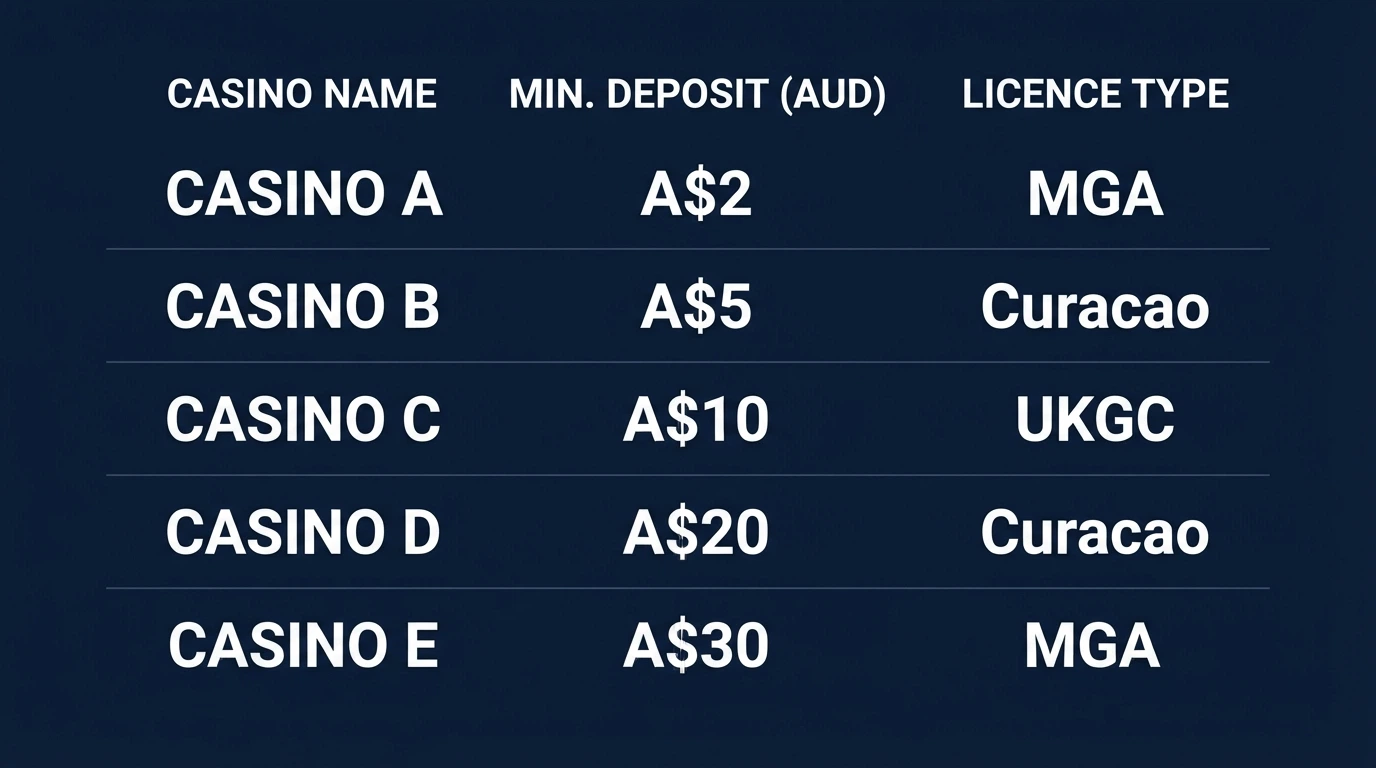
Every brand below is offshore. None holds an Australian licence for casino games. Each one is ranked by what an Australian low-deposit player actually meets at the cashier — deposit access first, bonus cost second, withdrawal floor third — and each one comes with the warning that no offshore brand can offer what an AU-licensed wagering operator can: Australian consumer law, ACMA complaint recourse, or BetStop coverage. The table below is the short version of the list.
| Operator | Legal Status | Min Deposit (AUD) | Lowest Deposit Route |
|---|---|---|---|
| SkyCrown | Curacao (offshore) | A$2 | USDT TRC-20 |
| Bizzo Casino | Curacao (offshore) | A$5 | — |
| FairGO | Curacao (offshore) | A$10 | PayID |
| Royal Reels | Curacao (offshore) | A$10 | PayID |
| NeoSpin | Curacao (offshore) | A$10 | PayID |
| King Billy | Curacao (offshore) | A$10–A$20 | PayID |
| WinSpirit | Curacao (offshore, likely) | A$30 | PayID |
| Rainbet | Anjouan (offshore) | A$30 | Crypto |
| Rocket Play | Curacao (offshore, likely) | — | — |
| Stake | Curacao No. 8048/JAZ (offshore) | A$50 (bonus trigger) | Crypto |
The column that matters is the second one. Every operator on this page is offshore. Some are Curacao-licensed, some are Anjouan, and none can offer the protections an AU-licensed wagering operator can — but the price of those protections is a product the law does not let Australian players buy.
Bonus cost is the column the welcome offer never quite shows. The 200% match at Stake is the largest headline number in the list, and it costs the player the largest expected loss too — roughly A$6,282 in expected value over the bonus’s wagering life at 96.51% RTP, assuming the A$3,000 bonus and the A$1,500 matching deposit are both wagered through at 40x. That is the bonus’s real cost in statistical terms — an average over many spins, not a guaranteed outcome for any single session. The 100% match at Royal Reels at 30x carries roughly A$523 in expected loss over its wagering life at the same RTP, and the WinSpirit welcome package at A$1,000 maximum lands in between. A welcome bonus is, in plain language, an advance on the player’s own money that the player pays back in expected value before the bonus is theirs.
Royal Reels
Royal Reels is the entry point that does the most with the smallest deposit, and it does so by tying the bonus to a deposit that is twice the floor. A$10 via PayID opens the account, but the 100% up to A$500 welcome match triggers at A$20 — meaning a player who deposits the minimum and does not top up to A$20 forfeits the bonus. The 30x wagering on the deposit bonus is the lowest multiple on the list, and 50 free spins tag along. A A$10 no-deposit bonus is available with 40x wagering, which is the standard rate for no-deposit offers and roughly four times as expensive per dollar as the deposit bonus. Withdrawal is A$50 fiat or A$30 crypto, which is the gap the section on withdrawal floors describes.
The most economical deposit bonus on the list for a player willing to deposit A$20 to claim it. The no-deposit bonus exists, but the maths on it is worse than the deposit bonus at four times the wagering.
WinSpirit
WinSpirit prices its welcome package at A$30 minimum deposit, which sits in Tier 3 of the deposit bands. The 100% up to A$1,000 plus 100 free spins (20 a day for five days) is generous on the surface. The 40x wagering is industry standard, not industry-lowest, and the A$3,000 win limit on free spins winnings — published in the Wednesday reload terms — caps the upside on the spins side. The bonus validity window was not confirmed in this review; a 30-day window is typical for this product type and worth checking before the first deposit.
Worth the A$30 entry for a player chasing free-spin volume, not a player chasing value per spin. The bonus ceiling is the highest in the list, and the floor moves with it.
NeoSpin
NeoSpin sets the bonus trigger at the deposit floor — A$10 via PayID opens the account and the welcome offer at the same price. The minimum withdrawal is A$50. Welcome bonus specifics were not confirmed in this review; bonus terms should be checked at the cashier before the first deposit because the wagering multiplier and validity window determine whether the A$10 entry is worth the cashout gap.
A clean A$10 entry — bonus and deposit at the same price, cashout floor at the same 5× gap as the rest of the list.
SkyCrown
SkyCrown is the lowest deposit in the list at A$2 via USDT TRC-20, which is a real number rather than a marketing number. The PayID floor at the same brand is A$10. The bonus triggers at A$30, which means the lowest deposit on the page does not unlock the welcome offer — a player funding at A$2 is paying for the games, not the bonus. The minimum withdrawal is A$50. Welcome package specifics were not confirmed in this review.
The cheapest real-money spin available, but the bonus lives at A$30, not A$2. The player who deposits A$2 is playing the lobby, not the offer.
Stake
Stake is the largest brand on the list by game count, and the most expensive to trigger the bonus at. The 200% match up to A$3,000 at 40x wagering on deposit and bonus is the best headline on the page — it is also the one that costs the most in expected loss. A A$50 deposit unlocks the offer; below that, the player gets the games without the bonus. The 30-day clearing window is the longest in the list. Stake runs a Curacao licence through Antillephone (No. 8048/JAZ), the most established licence on this page, and the games library includes Stake Originals alongside the major third-party providers. There is no published crypto minimum — the floor is the network fee, which makes anything under roughly A$10 impractical to move.
Built for a player who plays high volume and wants the largest bonus ceiling. At the maximum match the expected loss is roughly A$6,282 over the wagering life at 96.51% RTP — that is the price of the headline number, and the player should know it before depositing.
FairGO
FairGO is the RTG specialist — RealTime Gaming pokies only, no Pragmatic Play or NetEnt, no major third-party studios. The deposit floor is A$10 via PayID, with some promotions triggering at A$5. The Curacao licence is in place. Welcome bonus specifics and the wagering multiplier were not confirmed in this review.
Suits a player who specifically wants the RTG catalogue and is comfortable with a smaller games library. A lobby without the major studios is a deliberate trade.
Bizzo Casino
Bizzo sets the lowest fiat deposit in the list at A$5, and runs a large game library across multiple providers. The Curacao licence is in place. Welcome bonus specifics, wagering multiplier, validity window and minimum withdrawal were not confirmed in this review.
Worth a look for a player who wants the lowest fiat entry point and a multi-provider lobby. Bonus and withdrawal specifics should be verified at the cashier before the first deposit.
Rocket Play
Rocket Play’s deposit and bonus specifics were not confirmed in this review — the data was not available at the time of the checks. The brand is on the Curacao licence list, and the offshore status is the same as the rest of the page.
A brand worth verifying directly before funding an account. Deposit minimum, welcome bonus terms, wagering multiplier and withdrawal floor should be confirmed with the operator’s own cashier and terms page before the first A$10 moves.
King Billy
King Billy sits at the A$10–A$20 deposit band, mid-range for the list, and holds a Curacao licence. Welcome bonus, wagering multiplier, validity window and withdrawal specifics were not confirmed in this review.
A reasonable mid-range option for a player who wants to confirm the bonus and withdrawal specifics at the cashier before committing.
Rainbet
Rainbet is the only Anjouan-licensed brand on the list, and the only one with explicit game exclusions. The minimum deposit is A$30 for the Wager Lock promotional balance, the wagering multiplier is 40x on first-deposit bonus and free spins winnings, and the minimum withdrawal is A$15 — the lowest in the list. Hacksaw and Nolimit titles are excluded from bonus play, and games with RTP above 97.4% are excluded — the same titles a bonus-hunter would normally chase. The exclusions are written into the promotion.
The lowest withdrawal floor in the list, with a bonus that excludes the very titles a bonus-hunter would chase. The exclusion list costs the player the games where the bonus math actually works.
Why Every Online Casino Australians Can Join Sits Outside Australian Law
Online casino games are prohibited in Australia. The Interactive Gambling Act 2001 makes it an offence to provide online casino games, online pokies or in-play betting on a sport to a person in Australia. There is no licence for online casino anywhere in the country — there never has been. Every brand on this page is offshore, and the offshore route is the only route that exists for an Australian player who wants to play online pokies for real money. This section is the legal backdrop against which every deposit, bonus and withdrawal above should be read.
| Regulatory Framework | Applies To | AU Consumer Protection | Payment Safeguards | Self-Exclusion Coverage |
|---|---|---|---|---|
| AU-licensed wagering (NT and state/territory) | Pre-event sports/racing betting, lotteries, keno | Australian Consumer Law applies; AFCA dispute path | Credit cards and crypto banned since 11 June 2024; debit, PayID, BPAY allowed | BetStop — 67,480 registrations, binds all AU-licensed wagering |
| Curacao offshore | Online casino games, online pokies | None | — | None — not connected to BetStop |
| Anjouan offshore | Online casino games, online pokies | None | — | None — not connected to BetStop |
The table lays out the contrast the rest of this section makes in prose. The first row is the AU framework that exists; the next two are the two offshore frameworks every brand on this page operates under. The same row is missing from the offshore columns because there is nothing there to write.
Why no online casino can hold an Australian licence
The Interactive Gambling Act 2001 prohibits the supply of online casino games and online pokies to Australians. What is licensable, under state and territory law administered through the Northern Territory Racing and Wagering Commission — the de facto national wagering licensor — is wagering on races and sport placed before the event, plus lotteries and keno. Online casino games do not appear in the list. The minimum age for any commercial gambling in Australia is 18.
The Northern Territory Racing and Wagering Commission administers online wagering licences through Licensing NT, with terms up to 20 years. The product those licences cover is sports and racing betting, not casino games. No application can be made for an Australian online casino licence, because the activity is not one Australia regulates.
ACMA enforcement — blocking, warnings and the numbers
The Australian Communications and Media Authority is the federal regulator that enforces the prohibition. Its powers include investigating complaints, issuing formal warnings, referring operators for civil penalty proceedings and directing Australian ISPs to block illegal sites at DNS level. Since the first blocking request in November 2019, the ACMA has had 1,564 illegal gambling and affiliate websites blocked. More than 225 illegal services have withdrawn from the Australian market since enforcement was strengthened in 2017.
The quarterly cadence of enforcement is steady. In Q2 2025 (April–June), the ACMA investigated 24 gambling sites, found 30 breaches of the IGA, issued 10 formal warnings and referred 73 websites for ISP blocking. In Q4 2025 (October–December), the figures rose to 45 sites investigated, 69 breaches, 10 formal warnings and 133 URLs referred. The enforcement does not end the supply — the offshore market replaces blocked sites with new ones — but it does keep the pressure on.
On 16 January 2026, the ACMA issued 8 infringement notices to Tabcorp, each for A$19,800, totalling A$158,400, for providing a prohibited in-play betting service. The fine was against a licensed operator. Offshore operators face the same statute with no Australian address to serve.
No BetStop, no complaints body, no consumer law — the three protections that vanish offshore
The moment an Australian player deposits at an offshore casino, three layers of Australian protection disappear — and none of them can be recovered.
BetStop — the National Self-Exclusion Register — does not reach offshore casinos. The register binds Australian-licensed wagering services only; an offshore casino is not connected. A player who has self-excluded through BetStop remains fully exposed at any offshore site, because the operator has no way to check the register and no obligation to honour it. The 67,480 BetStop registrations as at 31 July 2026, with 41,290 active exclusions, are protected at AU-licensed bookmakers and unprotected at offshore casinos.
Australian Consumer Law does not apply. An offshore operator refusing a withdrawal, voiding a win on a technicality, or closing an account with a balance on it is operating outside the reach of the ACCC and the Australian Financial Complaints Authority. The dispute has no Australian venue.
ACMA has no complaints body for offshore disputes. The regulator blocks sites and pursues providers; it does not arbitrate player complaints. A player whose offshore casino refuses a withdrawal has, in practice, only the operator’s own support team to escalate to — and the leverage that comes from threatening to leave a site they could be blocked from accessing the next morning.
Even licensed operators have breached the rules. Entain Group was found by the ACMA to have opened four accounts for BetStop-registered individuals and provided wagering services on 59 occasions to registered individuals. The breach was by a licensed operator, with the regulator’s tools and the register’s reach behind it. An offshore operator faces none of those constraints.
The payment-method tell — when the deposit screen shows you are outside the rules
A site asking an Australian player for a credit card or crypto deposit is advertising its offshore status. The payment method is the regulatory boundary.
Credit cards, credit-related products and digital currency (crypto) are banned as payment for licensed online wagering in Australia, with the ban commencing 11 June 2024 under the Interactive Gambling Amendment (Credit and Other Measures) Act 2023. An operator failing to enforce the ban faces penalties of up to A$247,500. The legal deposit routes for licensed wagering are debit card, bank transfer, PayID/Osko and BPAY — and every one of them requires identity verification.
A site accepting credit card or crypto deposits from an Australian is, by definition, operating outside the AU-licensed wagering regime. That is not a regulatory grey area; it is the regulatory boundary. Every brand on this page accepts one or both. Every brand on this page is offshore.
The gambling reform bill and what it changes for players
The Interactive Gambling Amendment (Gambling Reform) Bill 2026 passed Parliament on 19 August 2026. Its measures commence 1 January 2027 — law passed, start date set, not yet binding, not speculative.
What changes: wagering advertising on television is capped at no more than three ads per hour between 5am and 8.30pm, with a blackout from 15 minutes before until 5 minutes after live sporting events. Direct marketing of wagering inducements is prohibited for 14 days after sign-up, three months after BetStop deregistration, and indefinitely for customers identified as at risk. Banks and payment providers gain express authority to block transactions to illegal gambling operators from the same date.
What the bill does not change for offshore casino players: the offshore casino is not subject to Australian advertising law, and the player funding an offshore account is not the target of the bill’s inducement bans. The reform tightens the AU-licensed wagering market; it does not open a legal route for online casinos. The AdStop opt-out register is not expected to be operational by 1 January 2027, so the advertising restrictions begin without the register to enforce them at the consumer end.
For an Australian player funding an offshore casino account, the reform matters at the bank rail — a bank exercising the new power to block transactions to illegal gambling operators can decline a deposit the player has already approved. The deposit screen does not warn the player when this happens. The transaction simply fails.
The black market the bill leaves untouched is, by government estimate, projected to reach A$5 billion by 2029. The reform is built for the licensed market; the offshore market is the part of Australian gambling the bill cannot reach.
Staying in Control — Safer Play When the Deposit Barrier Is This Low
A A$5 deposit floor removes the financial friction, but it does not remove the behavioural risk. Low-deposit play sits inside the same harm landscape as every other form of gambling, and Australian harm data is among the worst per capita in the world. This section is the part of the page a low-deposit player should read before funding the account, not after.
The harm behind the headline — what the numbers say about small-stakes gambling
Australians lost approximately A$32.2 billion on legal forms of gambling in 2023-24, the highest per-capita losses globally at roughly A$1,521. Wagering accounted for A$8.4 billion of that — 26% of the total — up from A$3 billion and 16% in 2010-11. The growth has been in wagering, and the wagering growth has been online. 65% of Australian adults had gambled at least once in the past 12 months as of 2024-25, up from 57% in 2019 — the participation rate is climbing with the deposit-floor race.
The concentration of harm is sharper than the headline suggests. 34% of the total dollars spent on sports betting in Australia comes from persons experiencing gambling harm, despite them representing only 10% of the player base. 10% of Australians who bet on sports are classified as problem gamblers, with a further 17% at moderate risk. Among Australian adults who regularly bet online on sports or races — at least monthly — more than 70% are experiencing or at risk of experiencing gambling harm.
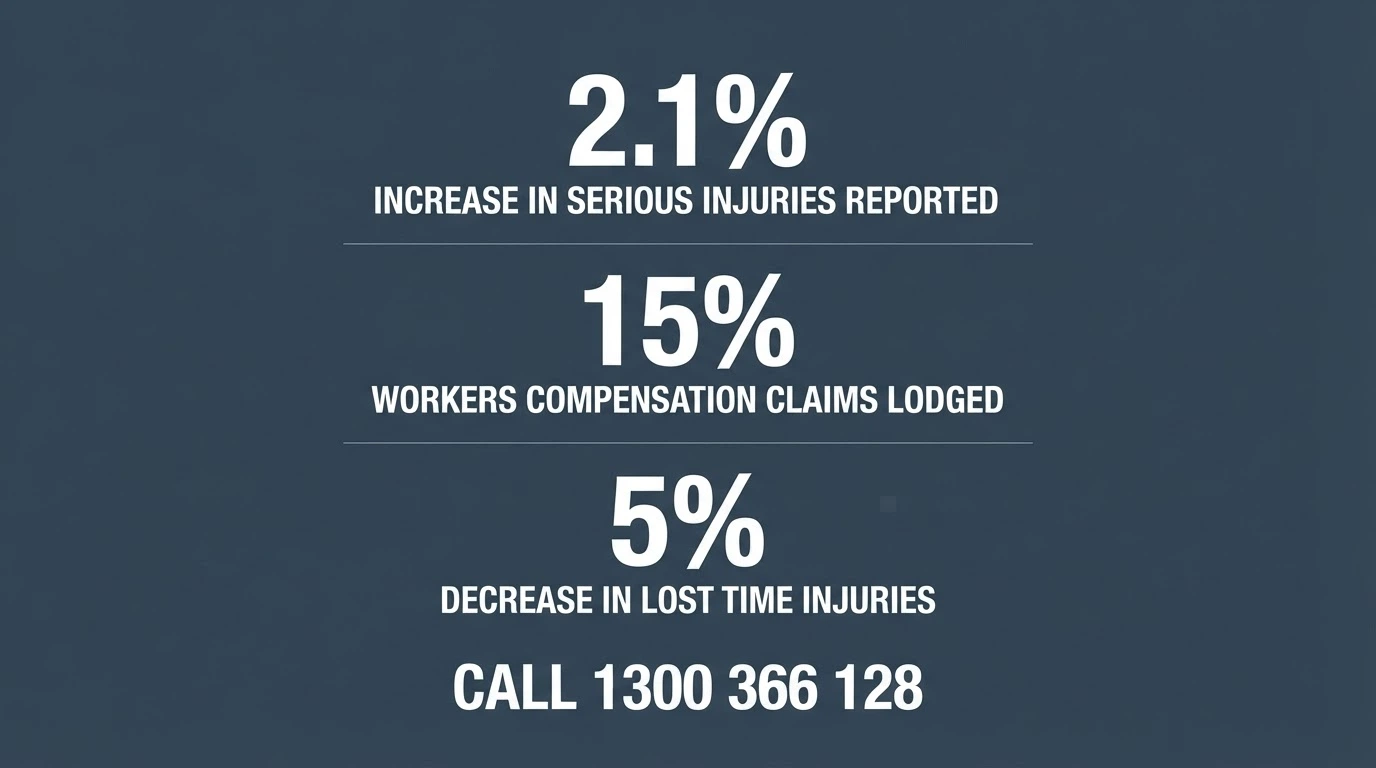
The at-risk share of the population is rising. Those at risk of gambling harm increased from 11% to 15% of Australians between 2019 and 2024. About 2.1% of Australian adults — roughly 430,000 people — experience problem gambling; the Australian Institute of Health and Welfare put high-risk gambling at 1.8% in 2022. And only 5% of the at-risk online gambling group sought help for gambling in the past 12 months — the rest carried the harm without contacting the helpline, the counsellor or the GP.
A micro-deposit session is not, statistically, a lower-harm session. The same population drives the loss concentration. The same help-gap applies. The A$5 floor changes the bankroll management; it does not change the population the operator is selling to.
BetStop and self-exclusion — where the safety net does and doesn’t catch
BetStop — the National Self-Exclusion Register — is the closest thing Australia has to a single-step exclusion from online gambling. One registration excludes a person from every Australian-licensed online and phone wagering service. 67,480 Australians had registered as at 31 July 2026, with 41,290 exclusions still active. 78% of registrants were under 40, and 38% chose lifetime exclusion — the heaviest exclusion period available.
BetStop binds Australian-licensed wagering services only. An offshore casino is not connected. A self-excluded Australian player can fund an offshore account at any brand on this page, on any rail, at any deposit floor. The exclusion the player took to protect themselves stops at the AU-licensed border. The offshore route does not pick up where the register leaves off; it sits in the gap the register does not reach.
This is the single most concrete harm of the offshore route. The BetStop registration protected the player against the AU-licensed wagering market. The same player funding an offshore casino account has undone the protection, and the casino is under no obligation to honour the exclusion. Self-exclusion at an offshore brand depends on the brand’s own policy and the player’s own discipline. The register does the work; the offshore site does not.
Practical help — helplines, tools and what to do next
The National Gambling Helpline is 1800 858 858 — free, confidential, staffed 24 hours a day, seven days a week. Online chat and counselling are available through Gambling Help Online. BetStop registration is through the National Self-Exclusion Register for licensed wagering only. AU-licensed wagering operators also offer deposit limits and activity statements under state and territory conditions, which differ between jurisdictions.
The helpline is the first call for an Australian player whose session has stopped being entertainment. The 5% of at-risk online gamblers who sought help in the past 12 months are the 5% who made the call; the 95% who did not are the players this section is written for.
How We Reviewed and Ranked These Low-Deposit Casinos
The ranking above is built on what an Australian player meets at the cashier, in the terms and conditions, and in the licence registry. The criteria are stated below, and what the ranking does not claim is stated below too.
The checks we ran — sources, registers and the ACMA blocking list
Every operator on this page was checked against the ACMA register and the ACMA blocking list as the regulatory benchmark — the same list that has removed 1,564 sites since November 2019. Operator terms pages were the primary source for deposit minimums, bonus terms, wagering multipliers, validity windows and withdrawal floors; the figures on this page come from those pages as published at the time of review. Curacao and Anjouan licence registries were checked for legal-status verification. Player-complaint forums were read for withdrawal-delay and KYC patterns — recurring complaints inform the verdict on each operator without being cited as a figure.
No operator was excluded from the list on a complaint basis alone. The list is built on what the operators publish, not on forum anecdotes. Forums are a check on the published terms, not a substitute for them.
The criteria that ordered the list — and what this ranking does not claim
The list is ordered by deposit accessibility first. A A$2 crypto deposit sorts above a A$5 fiat deposit; a A$10 PayID deposit sorts above a A$30 one. Bonus cost is the secondary sort — wagering multiplier, validity window, max-cashout cap on free spins winnings. Withdrawal floor and licence transparency are the tertiary filters. No percentages or weightings are invented; the ordering is qualitative within each tier.
What this ranking does not claim: it is not exhaustive. Operators not covered exist at every tier. It is not an endorsement of any operator on the list. It is not a recommendation that an Australian player should fund an account at any operator on the list. Every brand above is offshore. Every brand is unregulated in Australia. No operator on the list is AU-licensed for casino games, and no operator on the list can offer the protections an AU-licensed wagering operator can. The ranking is a description of what an Australian player will meet, not a verdict that they should meet it.
What to Actually Do With This Information — Making Low-Deposit Play Work for You
The deposit floors are real, the bonus maths is real, the legal position is real. This section is what an Australian player should do with all three before funding an account.

The deposit-floor reality — what a A$10 deposit actually buys and what it costs to cash out
A A$10 deposit at a A$50 withdrawal floor means the player needs a 5× return before any money leaves the account. A A$5 deposit at a A$25 floor is the same ratio. The deposit is cheap; the cashout is not. The maths should be run before funding the account, not after.
The welcome bonus extends the cashout path. A A$500 deposit bonus at 30x wagering carries roughly A$523 in expected loss over its wagering life at 96.51% RTP. The maximum bonus on the list is A$3,000 at 40x on deposit and bonus, with expected loss of roughly A$6,282 over the wagering life at 96.51% RTP. The headline is the upside; the expected loss is the cost of clearing it. Both numbers are statistical estimates over many spins under the stated assumptions — neither is a guaranteed outcome for any single session.
Treating the deposit as the cost of entertainment — not as an investment — is the honest framing. The session is the product. The bonus is a coupon the operator offers to keep the session going. The cashout is the player keeping what is left.
Your pre-deposit checklist — three things to check before you fund an account
Three checks take two minutes and prevent the most common low-deposit regrets.
- Check the withdrawal minimum before depositing. A A$10 deposit at a A$50 floor is a 5× return requirement. The floor lives in the cashier or the terms page, not on the welcome banner.
- Verify the operator is not on the ACMA blocking list today, and understand it could be tomorrow. The block is DNS-level and can land without notice. A balance on the account at the moment of blocking is not recoverable.
- Confirm the bonus wagering multiplier and validity window. 40x on deposit and bonus with a 30-day window changes the session’s cost materially. 30x with the same window is roughly two-thirds the cost at the same RTP.
When the session stops being entertainment — and where to get help
The moment play stops feeling like a choice, free 24/7 help exists — and low-deposit play does not make problem gambling less real.
The National Gambling Helpline is 1800 858 858. Free, confidential, 24 hours a day, with online chat and counselling through Gambling Help Online. BetStop registration is through the National Self-Exclusion Register for licensed wagering only, with the offshore blind spot noted earlier. About 2.1% of Australian adults — roughly 430,000 people — experience problem gambling. The at-risk share of the population is 15%, and only 5% of the at-risk online gambling group sought help in the past 12 months. Low-deposit play sits inside the same harm landscape as every other form of gambling. The help is the same help.
Frequently Asked Questions
Can I deposit $1 at an online casino in Australia?
A genuine A$1 deposit does not exist at AU-facing brands. The realistic floor is A$5–A$10 via PayID or cards; USDT TRC-20 drops to A$2 in theory because the network’s smallest unit is fractions of a cent. “No minimum deposit” is marketing shorthand; the rail sets the floor, not the casino.
Is PayID accepted at minimum deposit casinos in Australia?
PayID is the standard deposit rail at offshore brands serving Australian players, and it is fee-free at both ends. The casino’s minimum is the variable — A$10 at entry-level sites, A$30 at premium platforms. Deposits are instant; withdrawals back to PayID, when offered, settle in one to two hours.
Can I use Bitcoin to deposit at a no minimum deposit casino in Australia?
Bitcoin is accepted at several offshore brands, with A$30 minimums and 10–30 minute processing. USDT TRC-20 is cheaper, clearing at A$2 in the best case. Credit cards and crypto are banned for AU-licensed wagering since 11 June 2024, so a crypto deposit screen signals an offshore operator. AUD-crypto volatility is its own cost.
Do I need to verify my identity at a low-deposit casino?
Yes. Every operator on this page runs KYC checks before processing a withdrawal, even at A$30. The licence requires it, the payment rail usually requires it, and the casino’s own fraud policy requires it. Verification typically means a government photo ID and proof of address; the timeline varies by operator and document.
Are no deposit bonuses the same as no minimum deposit casinos?
No. A no-deposit bonus is a small credit (Royal Reels offers A$10 at 40x wagering) for opening an account without funding it. A no-minimum-deposit casino accepts the lowest plausible deposit, typically A$5–A$10. No-deposit bonuses look free but cost roughly four times the per-dollar rate of deposit bonuses at standard wagering; withdrawal caps run A$50–A$180.