
Inside the Best-Paying Online Pokies in Australia — RTP, Casinos, and What the Number Doesn’t Tell You
In 2026, three online pokies advertise a 99.00% return to the player — one of them only in a Supermeter mode most players never reach, the other two in ordinary play. Every one of them sits behind the same wall: the casino serving them is offshore, unlicensed in Australia, and outside the local safety net. A 99% return means one thing on a marketing line, and something quite different when the operator loading it has no regulator to answer to and no Australian complaints body to take a complaint. That is the gap most pages on this subject do not draw for you, and it is the one this page exists to draw.
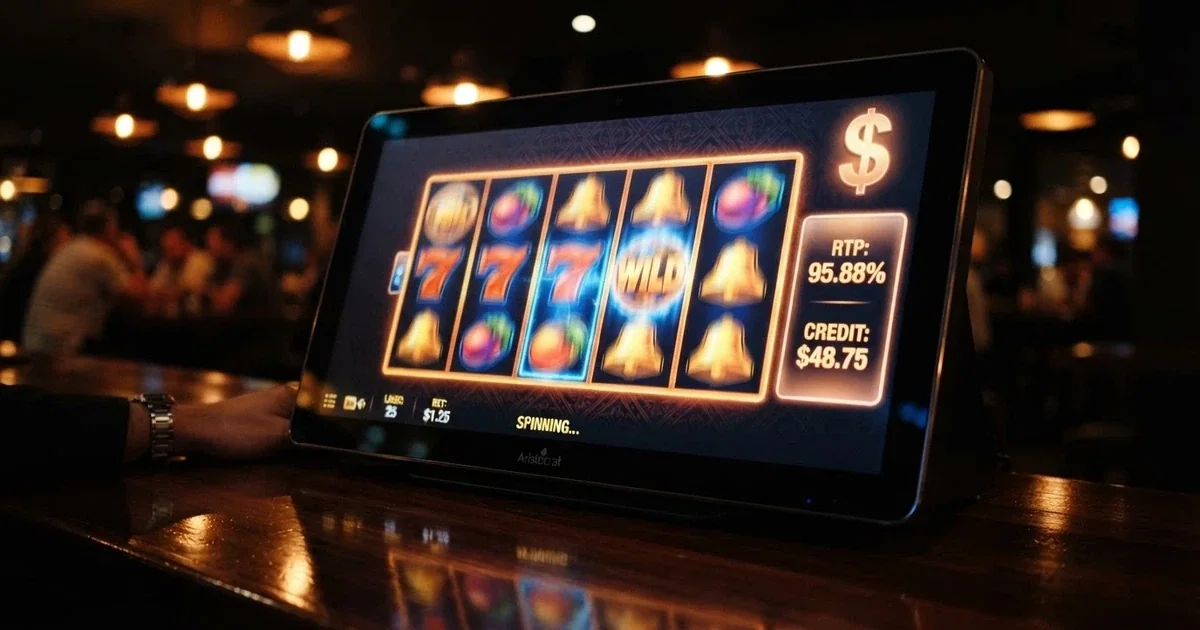
Current as of 22 November 2026, against the ACMA’s Interactive Gambling Act register and the AU-facing operator market-share trackers.
Table of Contents
- What “best paying” really means — and what it doesn’t
- 2026’s highest-RTP pokies — and the RTP tier trap most players miss
- Why every online casino an Australian plays at sits offshore
- 10 AU-facing casinos for high-RTP pokies, compared
- How fast your winnings actually reach you
- Playing safely when the house answers to nobody
- How we chose and ranked these casinos
- Is chasing the highest RTP worth the offshore trade-off?
- Frequently asked questions
What “best paying” really means — and what it doesn’t
The search term “best paying online pokies Australia” asks one question on its surface — which pokie returns the most — and hides two more that decide the answer. The first is what “best” measures: return to player (RTP) is a long-run statistical average, not a per-session guarantee. The second is where the pokie can be played, and in Australia that answer is the same for every operator an Australian player can reach: offshore, unlicensed, and outside the framework the term “best” implies. This section works through the numbers that decide a session’s real cost and the ones the marketing skips.
RTP explained: the number behind every spin
Return to player is the share of all money wagered on a pokie that the game returns, on average, across millions of spins. A 96% RTP means the pokie keeps four cents in every dollar over a long enough window to smooth out the variance. The window matters: Queensland’s gaming machines return between 85% and 92% over the life of the machine — three to four years, tens of millions of spins, the regulator’s lifetime measure. Online pokies publish RTP figures inside that same statistical frame, with the best of them clustering between 96% and 98%, and the genuinely high outliers reaching 99.00%. The numbers are real. What they do not describe is what your session will return. A 96.53% RTP across ten thousand spins averages out to A$96.53 returned per A$100 wagered. Across five hundred spins, the standard deviation is wide enough that the same machine can pay out A$120 or A$80 to the same player. The RTP is the destination; the session is the journey, and the two rarely match.

A 99.00% pokie is not a 99% return on your deposit. It is a 99% return across a mathematical lifetime, on the assumption you are one of millions of spins. For a player with a finite bankroll and a finite session, the RTP is the long-run expectation and not a per-spin promise. The single most common error in pokie marketing is treating the percentage as if it described the next session.
Why two pokies with the same name can pay differently
Most of the high-RTP pokies in the offshore-AU catalogue come from a handful of providers who license titles with operator-selectable RTP configurations. Pragmatic Play ships Sugar Rush 1000 in four tiers: 97.50% (their premium configuration), 96.53% (the default), 95.50%, and 94.50%. The casino picks which tier to load. The player generally does not know which one is loaded until the pokie is open and the info screen is checked.
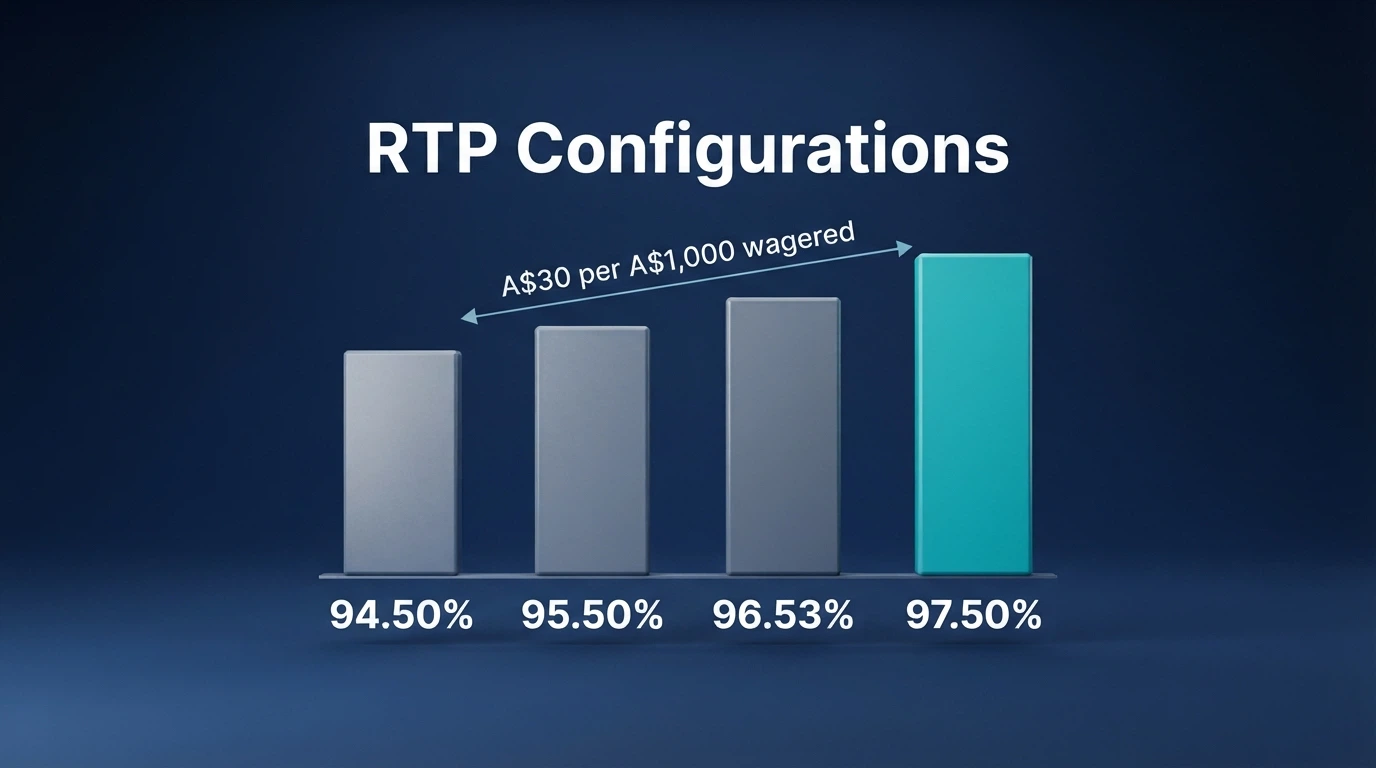
The real-dollar difference between tiers is sharper than the percentage gap suggests. The gap from 97.50% to 94.50% is three percentage points of return — an extra 3% of every wager retained by the house. On a session of A$1,000 wagered at A$1 a spin, the expected loss at 97.50% RTP is A$25; at 94.50%, it is A$55. That is A$30 of expected value the title’s headline number implies exists, and a lower tier silently confiscates. The same mechanism applies to Sweet Bonanza 1000, Gates of Olympus 1000, Big Bass Bonanza, Sleeping Dragon Ultra Dark and most of the Pragmatic Play catalogue an Australian player will see at an offshore casino. Sleeping Dragon Ultra Dark, launched 23 July 2026, ships in three configurations including a 94.50% variant. The published RTP is the ceiling; the operator’s selection is the floor you actually play under.
Volatility and hit frequency: the other half of the story
Two pokies at the same RTP can pay in completely different shapes. Volatility describes how that return is distributed across spins — high volatility means long dry stretches punctuated by occasional large wins, low volatility means frequent small wins with limited upside. Hit frequency is the related number: how often any spin produces a paying combination, expressed as a percentage of spins.
Sugar Rush 1000 publishes a 26.40% hit frequency at very high volatility (5/5 on the provider’s scale) and a 25,000x max win. Sleeping Dragon Ultra Dark publishes a 33.78% hit frequency at high volatility with a 20,000x max win. A player who wants to see wins on the screen — even small ones — gets a different experience at 33.78% than at 26.40%, and the bankroll profile each demands is different. Low-volatility pokies like Blood Suckers (98.00% RTP, 900x max win) and 1429 Uncharted Seas (98.60%, 670x max win) trade the headline RTP and the modest max wins for a steadier payout cadence.
For a player with a small bankroll, the trade-off is concrete. A high-volatility pokie stretches a session of A$100 over fewer, larger bets — and most sessions end without triggering the bonus features that pay the headline prizes. A low-volatility pokie of the same RTP runs a longer session with more frequent but smaller returns. The “best paying” pokie for a given player is not the one with the highest published percentage; it is the one whose volatility matches the bankroll and the patience the player brings to the session.
Real-money play vs demo mode: what you can test without risking a cent
Every pokie on this page can be opened in demo mode at the provider’s own site and at most casino lobbies, with virtual credits replacing real money. Demo mode is the cleanest way to learn a title’s mechanics — bonus buy pricing, the timing of tumbling reels, how a cluster-pays grid resolves, the rhythm of a megaways spin. None of the dollars are real, and none of the marketing claims are yet load-bearing on your wallet.
What demo mode does not teach is the discipline real-money play demands. Loss tolerance, tilt, the decision to chase a near-miss feature trigger — none of those states can be reproduced in a session where nothing is at stake. The transition from demo to real-money play is also where the configurable RTP tier the casino loaded becomes the one the player is playing under, regardless of the figure the provider publishes. Demo mode is a mechanics tutorial. It is not a payout preview.
The cost of a 500-spin session at 96.53% RTP — worked through
A representative real-money session: 500 spins of Sugar Rush 1000 at A$1 per spin, with the game’s default 96.53% RTP loaded. Total wagered is A$500. The expected return is A$500 × 0.9653 = A$482.65. The expected loss — the average the house keeps across many such sessions — is A$17.35.
That figure is an average, not a prediction. A player running the same 500 spins will land somewhere inside a wide distribution; some sessions return A$600, others A$300, with most sitting close to A$482.65. The arithmetic answers how much the bonus costs the player on average across many sessions. It does not answer how much any individual session pays, and it does not promise any specific outcome. Read it as the price of admission over the long run, and treat the per-session number you actually see as variance talking.
The same A$1 × 500-spin shape, loaded at Sugar Rush 1000’s 94.50% tier instead of the default, gives A$27.50 expected loss. A$1 × 500 of Mega Joker at 99.00% gives A$5. The headline RTP on a marketing page is not a flat discount on the cost of the session. It is a long-run figure that compounds across thousands of spins. The first 500 of them rarely show it.
2026’s highest-RTP pokies — and the RTP tier trap most players miss
A leaderboard of the fifteen highest-RTP pokies available to Australian players at offshore casinos shows the shape of the ceiling clearly. Three titles publish 99.00%. Five more sit between 98% and 99%. The rest cluster in the 96% range that the broader online catalogue considers strong. Reading the table as a flat ranking misses the same point the rest of the marketing does: a pokie’s published RTP is the figure its provider has authorised the casino to use, and the casino may have loaded a different one.
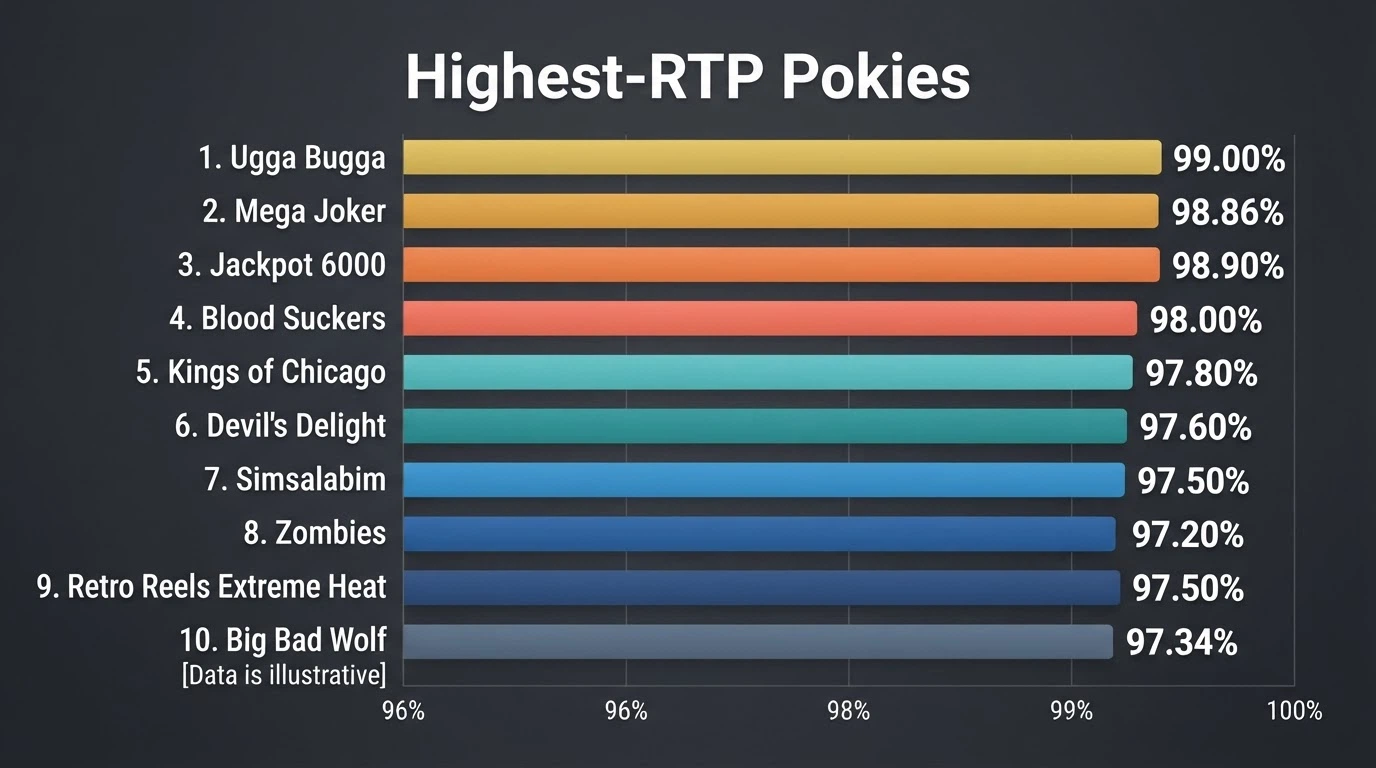
The table below ranks the titles by published RTP and flags the configurable-tier titles in the column where it applies. The Supermeter caveat applies to two NetEnt classics whose 99.00% number is reachable only inside a specific game mode most players do not play. The progressive-jackpot caveat applies to Mega Moolah, whose headline RTP is suppressed by the jackpot contribution and whose ceiling is reached through the jackpot itself, not through base play. Every Pragmatic Play title on the list is shipped in multiple RTP tiers and may be loaded at a lower configuration than the table shows.
The 2026 high-RTP pokie leaderboard
| Pokie | Provider | RTP | Volatility | Max Win |
|---|---|---|---|---|
| Mega Joker | NetEnt | 99.00% (Supermeter) | — | — |
| Book of 99 | Relax Gaming | 99.00% | High | 12,075x |
| Jackpot 6000 | NetEnt | 98.86% (Supermeter) | Medium | 2,000x |
| 1429 Uncharted Seas | Thunderkick | 98.60% | Low | 670x |
| Blood Suckers | NetEnt | 98.00% | Low | 900x |
| White Rabbit Megaways | Big Time Gaming | 97.72% | Very High | 13,029x |
| Dead or Alive 2 | NetEnt | 96.82% | Very High | 111,111x |
| Big Bass Bonanza | Pragmatic Play / Reel Kingdom | 96.71% | High | 2,100x |
| Razor Shark | Push Gaming | 96.70% | Very High | 25,000x |
| Sugar Rush 1000 | Pragmatic Play | 96.53% | Very High | 25,000x |
| Sweet Bonanza 1000 | Pragmatic Play | 96.53% | High | 25,000x |
| Gates of Olympus 1000 | Pragmatic Play | 96.50% | High | 15,000x |
| Sleeping Dragon Ultra Dark | Pragmatic Play | 96.50% | High | 20,000x |
| Money Train 3 | Relax Gaming | 96.40% | Extreme | 100,000x |
| Mega Moolah | Microgaming | 88.12% | — | Mega Jackpot seeds at A$1,000,000 |
Two notes on reading the table. The two NetEnt titles at the top (Mega Joker and Jackpot 6000) only reach the listed RTP inside Supermeter mode, a separate betting tier that sits above the base reels and is not where most players play. Base-play RTP for Mega Joker sits between 76.9% and 85.1% — a meaningful gap from the headline. The Pragmatic Play titles (Sugar Rush 1000, Sweet Bonanza 1000, Gates of Olympus 1000, Sleeping Dragon Ultra Dark, Big Bass Bonanza) all ship in multiple RTP configurations; the table shows the default, and a lower tier may be the one loaded at any given casino. Mega Moolah’s 88.12% RTP reflects the progressive jackpot contribution — most of that figure returns through the Mega Jackpot rather than through base play, which is why the slot’s max-win line on the table is “Mega Jackpot seeds at A$1,000,000” and not a multiplier.
What the RTP number alone will never tell you
Mega Joker’s 99.00% RTP and Money Train 3’s 96.40% RTP sit four and a half percentage points apart, yet a serious player will tell you the latter is the more interesting title. Money Train 3 carries a 100,000x max win on a very-high-volatility profile; Mega Joker’s 99.00% returns through the Supermeter mode at a multiplier that does not approach that scale. The two pokies address different sessions and different bankrolls, and the gap between them is not the four-and-a-half points but the volatility profile, the max-win ceiling, and the player’s appetite for both.
A similar pattern runs through Mega Moolah. Its 88.12% RTP is the lowest on the table and the most-misunderstood title on it. The figure is suppressed by the contribution every wager makes to the Mega Jackpot — a pooled progressive that seeds at A$1,000,000 and has paid out eight-figure sums in real payouts. Mega Moolah is not a “low RTP” pokie in the sense that the rest of the table describes; it is a different product entirely, one whose expected return runs through the jackpot rather than through the reels. A punter evaluating it on RTP alone is reading the wrong column.
Independent auditors verify the RTPs the table shows — eCOGRA publishes monthly payout reports, iTech Labs certifies RNGs out of Australia, GLI and BMM Testlabs round out the field — but those verifications are of the configuration the provider ships, not of the configuration the operator loaded. A Pragmatic Play title at 96.53% is a different game from the same title at 94.50%, and the audit trail covers one of them.
Why every online casino an Australian plays at sits offshore
Online casino games and online pokies are prohibited under Australia’s Interactive Gambling Act 2001. No Australian licence exists for the product — not federally, not in any state or territory. The Australian market is structurally closed for online casinos the way the French market is: every site an Australian player can actually reach operates outside the regime, with no Australian licence and no Australian regulator to answer to. This section explains what the law actually prohibits, what changes on 1 January 2027, and the specific protections an Australian loses the moment a deposit crosses to an offshore site.

What the Interactive Gambling Act actually bans — and why the player isn’t the target
The IGA criminalises the provision of online casino games — “roulette, poker, craps, online ‘pokies’ and blackjack” — to a person in Australia. The Department of Infrastructure is explicit: “It’s illegal to provide some interactive gambling activities, such as ‘online casinos’, to someone in Australia.” The penalties are aimed at the provider, not the player. Individuals face up to A$360,000 per day; bodies corporate face up to A$1.8 million per day. The individual player is not prosecuted under the Act — the targets are the operators, the platforms and the affiliates routing Australian traffic to them.
The Australian Communications and Media Authority (ACMA) is the regulator that enforces the prohibition. It investigates complaints, issues formal warnings, refers operators for civil penalty proceedings, and directs Australian ISPs to block illegal sites. Since its first blocking request in November 2019, the ACMA has had 1,564 illegal gambling and affiliate websites blocked, with more than 225 illegal services withdrawing from the Australian market since 2017. A blocked site can still hold player balances; the block stops new AU traffic but does not return funds to existing customers.
What the IGA does not prohibit is wagering on races and sport placed before the event begins, lotteries and keno — products licensed through state and territory regulators and concentrated in practice in the Northern Territory Racing and Wagering Commission. Online casino is the gap. Every operator on the comparison table that follows is offshore, unlicensed in Australia, and exists in the gap the IGA draws.
The 2026 gambling reform: what changes on 1 January 2027
The Interactive Gambling Amendment (Gambling Reform) Bill 2026 passed Parliament on 19 August 2026 — the most significant Australian gambling-law reform in a generation. Its measures commence on 1 January 2027, and the most consequential change for an offshore operator reaching Australian players is the bank-and-payment-provider power to block transactions to illegal gambling operators. From the commencement date, an Australian bank can decline a transaction it identifies as going to an unlicensed operator, with no notice to the player.
The reform also tightens advertising rules. Wagering ads are banned during live sporting coverage from 15 minutes before until 5 minutes after events scheduled between 5am and 8:30pm. Television wagering ads are capped at three per hour between 5am and 8:30pm. Athletes, celebrities and influencers cannot promote wagering services. In-stadia and uniform advertising is banned. The new AdStop register, administered by the ACMA, lets Australians opt out of wagering advertising across digital platforms.
Inducement marketing — the bonus emails and pop-ups that follow sign-up — is restricted to a 14-day cooling-off period after registration, a three-month ban after a person deregisters from BetStop, and an indefinite ban for customers identified as at-risk. Online keno “pocket pokies” and foreign-matched lotteries are banned outright. None of these measures binds an offshore casino serving Australians from Curaçao or another unlicensed jurisdiction, but the bank-blocking power does reach them — it sits on the Australian side of the transaction.
Six protections you lose the moment you play at an offshore casino
- No Australian consumer protection and no Australian complaints body — the ACMA cannot recover funds or compel action when an offshore operator fails.
- No BetStop coverage — the National Self-Exclusion Register binds only Australian-licensed wagering services, and an offshore casino will keep accepting deposits from a self-excluded person.
- No recourse if the operator refuses a withdrawal, voids a win or closes the account — Australian dispute resolution does not reach an offshore entity.
- The site can be ACMA-blocked at any time with a balance still on it — a block stops new AU traffic but does not return existing funds to customers.
- A credit-card or cryptocurrency deposit request is itself a signal the operator is outside Australian rules — both have been banned as payment for licensed online wagering since 11 June 2024, with non-compliance penalties of up to A$247,500.
- No responsible-lending or deposit-limit obligation on the operator — the offshore operator has no legal duty to enforce a spending limit, a session cap or a self-exclusion request.
10 AU-facing casinos for high-RTP pokies, compared
The ten operators below hold measurable AU-facing market share and were the brands confirmed as carrying the high-RTP pokies in this article’s catalogue. Every one of them is offshore, unlicensed in Australia, and outside the Australian regulatory framework. The comparison table that follows is a market-share snapshot, not a licence endorsement — no Australian licence exists for any operator on it. Individual write-ups name what was confirmed for each brand and what was not, so the reader can decide what to verify before depositing.

Operator comparison at a glance
| Operator | AU Market Share | Holds an Australian Licence |
|---|---|---|
| Rocket Play | 9.4% | No |
| Skycrown | 8.55% | No |
| Royal Reels | 2.51% | No |
| WinSpirit | 1.55% | No |
| Stake | 1.28% | No |
| Rainbet | 1.28% | No |
| Scream Casino | 0.99% | No |
| FairGO | 0.80% | No |
| Bizzo Casino | 0.57% | No |
| Rocket Casino | 0.57% | No |
The licence column is uniform for a reason: no Australian licence exists for online casino games. What is stated below for each operator is what was independently confirmed; always verify current bonus terms, wagering multiples and licence numbers directly at the operator’s site.
Rocket Play
Rocket Play holds the largest AU-facing market share in the featured set, at 9.4% — third among all AU-facing brands and the largest of the operators centred on pokie play. The brand carries the depth of catalogue and the promotional cadence a player expects at the top of the offshore-AU rankings. Visit the operator’s home page for its latest bonus terms and game selection. Treat the licence as offshore-by-construction.
Against the other nine operators in this set, Rocket Play is the closest comparison point for an Australian player who wants scale. Verify current bonus and payout terms on the operator’s site before depositing.
Skycrown
Skycrown is the only featured operator with independently confirmed high-RTP pokie coverage. The brand carries both Mega Joker (NetEnt, 99.00% RTP in Supermeter mode) and Book of 99 (Relax Gaming, 99.00% RTP in ordinary play) — the two 99.00% titles the leaderboard in this article surfaces. At 8.55% AU market share, Skycrown ranks fourth among AU-facing brands, just behind Rocket Play. The bonus terms and the rest of the game-provider list are available on the operator’s site.
For a player who came to this page to play the highest-RTP pokies, Skycrown is the only operator on this set where the answer is on the page rather than at the bottom of an unconfirmed search. The 99.00% number is real, the titles are real, and the operator’s licence is offshore by construction. The verdict is the rest of the page’s: the pokie is on offer, the casino behind it is not.
Royal Reels
Royal Reels ranks ninth in AU-facing market share, at 2.51% — well inside the top ten and meaningfully ahead of the smaller brands on the table. Check the operator’s site for current welcome offers, wagering multiples and licence details.
What can be said is that Royal Reels sits at the upper end of the AU-facing market on raw traffic, which generally correlates with the range of pokies the brand carries. Whether it carries the specific 99.00% titles at the top of the leaderboard is the question the sweep did not answer.
WinSpirit
WinSpirit holds 1.55% AU-facing market share — eleventh among AU-facing brands and inside the page’s featured set on the strength of that traffic. Check the operator’s site for current bonus terms, game providers and licence details.
The brand sits at the boundary of the AU-facing market on traffic alone. That makes it a reasonable candidate for comparison with the brands above it and a less likely place to find the high-RTP pokies the rest of the page is built around.
Stake
Stake is a globally recognised crypto-first brand with a measurable AU-facing presence — 1.28% market share, twelfth among AU-facing operators. The brand’s reputation is built on its sportsbook and its original-stake model rather than on a pokie catalogue of its own, which makes it a different shape of offering from the operators above it on the table. Verify the operator’s game library and current bonus offers directly on their site.
For a punter who came to this page for high-RTP pokies specifically, Stake is the brand to verify the catalogue against before assuming the page’s ranking applies. The global reputation does not translate directly into the specific pokie coverage the leaderboard ranks by.
Rainbet
Rainbet sits at 1.28% AU-facing market share — tied with Stake for twelfth/thirteenth on the broader AU-facing list. Check the operator’s site for catalogue depth and bonus details.
The market-share position is informative only insofar as it tells a player Rainbet is not a fly-by-night brand reaching for AU traffic. It does not tell a player that the brand carries the high-RTP titles in this article’s catalogue. Verify before you assume.
Scream Casino
Scream Casino holds 0.99% AU-facing market share — fourteenth among AU-facing brands and the smallest operator above the 0.80% threshold in this set. Check the operator’s site for bonus and game-provider details. The brand is smaller than the operators above it on the table, and that smaller scale generally means a narrower pokie catalogue — not a certainty, but the working assumption until the sweep fills the gap.
For a player who values the high-RTP titles in this article’s leaderboard over the brand’s recognisability, Scream Casino is a name to check the catalogue of before depositing.
FairGO
FairGO’s brand identity — the name, the AU-focused language on the operator’s own site — reads as AU-targeted, but the operator is offshore and unlicensed in Australia. Market share is 0.80%, sixteenth among AU-facing brands. Check the operator’s site for current bonus terms, game-provider lists and licence details.
The brand naming is a useful reminder that the offshore-AU market is not defined by its licence status but by the operators that have chosen to take Australian deposits. The Australian flag in the name does not move the licence. Verify the offer, the wagering terms and the in-game RTP tiers before depositing.
Bizzo Casino
Bizzo Casino holds 0.57% AU-facing market share — nineteenth among AU-facing brands and tied with Rocket Casino at the bottom of the featured set. Check the operator’s site for the current catalogue and bonus structure. The brand is smaller than the operators above it on the table, which generally corresponds to a narrower catalogue rather than a different one.
The comparison the table invites on market share does not tell a player what Bizzo Casino carries in the way of high-RTP pokies. The catalogue, the bonus and the licence are the things to verify at the operator’s own page before assuming the position on the leaderboard translates.
Rocket Casino
Rocket Casino rounds out the featured set at 0.57% AU-facing market share — twentieth among AU-facing brands, tied with Bizzo Casino on the share itself. The brand is the second of the two operators on this page with an independently confirmed high-RTP title: 1429 Uncharted Seas (Thunderkick, 98.60% RTP). Check the operator’s site for current bonus terms and catalogue details.
For a player who came to this page for the highest-RTP pokies, Rocket Casino is one of two operators in the featured set where the answer is confirmed rather than inferred. The 98.60% figure is the second-highest RTP in the table — behind only the 99.00% titles at Skycrown — and the only confirmed high-RTP coverage at an operator under 1% AU market share.
How fast your winnings actually reach you
Payment method matters more than the casino brand. Two players at the same offshore casino, playing the same pokie, can see wildly different payout times depending on whether they used PayID, USDT on TRC20, or a BECS bank transfer. This section walks through the realistic settlement windows the AU-facing market actually delivers, the withdrawal limits that cap how much can leave the casino per day, and the verification step that is the real bottleneck on a first payout.
PayID: under a minute to your bank account
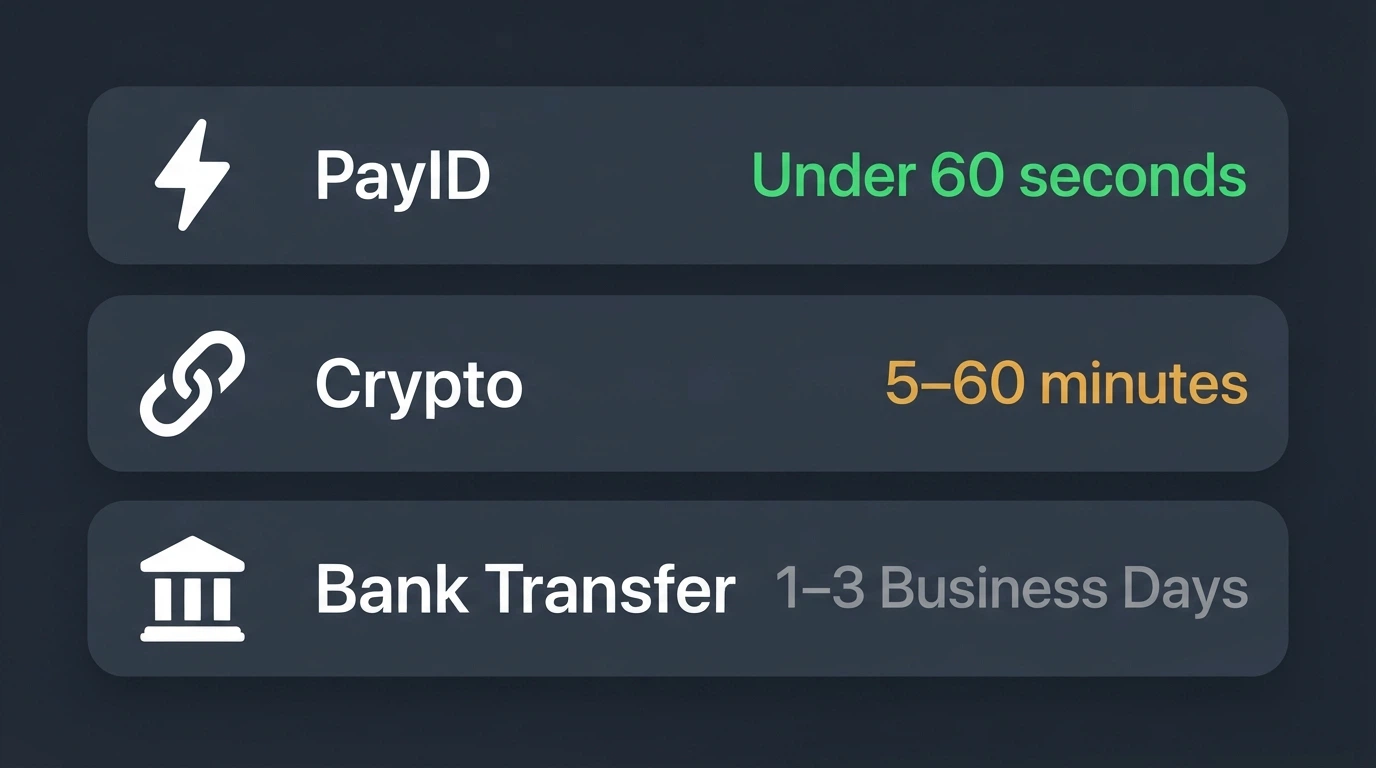
PayID transfers settle through Australia’s New Payments Platform in under 60 seconds — the fastest route from a casino balance to an Australian bank account. POLi, the previous AU instant-deposit standard, was decommissioned on 30 September 2023. PayID is now the default AU instant route, supported by most major AU banks and most AU-facing offshore casinos.
In the Q2 2026 speed test published by the AU-facing operator trackers, the fastest verified PayID casino payout was processed in under 10 minutes from request to funds cleared. The slowest took just over 11 hours — the gap is KYC verification, not PayID itself. Minimum withdrawal limits on PayID at the tested casinos ranged from A$10 to A$30; maximum daily caps ranged from A$2,000 to A$10,000. PayID is the route to use unless there is a specific reason to use crypto or a bank transfer.
Crypto and bank transfer speeds compared
Crypto is faster than a bank transfer but the spread within crypto is wide. USDT on TRC20 and Solana settled in under five minutes in testing. Ethereum and Litecoin took five to thirty minutes. Bitcoin was the slowest crypto at thirty to sixty-plus minutes — ten to sixty minutes is the broader consensus window for Bitcoin confirmations across the AU-facing market. The spread is driven by network congestion and the number of confirmations the casino requires.
Bank transfers via BECS take one to three business days — meaningfully slower than any crypto option and an order of magnitude slower than PayID. Bank transfer is the route for withdrawals that exceed a casino’s daily PayID cap, and the trade-off is the time cost. For a player clearing a big progressive-jackpot win, the difference between PayID under 60 seconds and a BECS transfer at three business days is the difference between a clean payout and a three-day wait with the operator’s compliance team in the loop.
Withdrawal limits and what can slow a payout
Even the fastest payment method is throttled by the casino’s per-day cap. Daily maximums at the tested AU-facing offshore brands range from A$2,000 to A$10,000; minimums sit between A$10 and A$30. A player with a five-figure payout has two options — withdraw over several days inside the daily cap, or use a slower method (bank transfer or Bitcoin) for the bulk.
The real bottleneck on a first withdrawal is KYC verification. A casino’s stated “instant payout” assumes a fully verified account — photo ID, proof of address, sometimes a screenshot of the deposit method. A first-time withdrawal that triggers the verification flow can take hours or days, not minutes. PayID under 60 seconds applies to a verified account, and an unverified account does not get the instant route. Factor verification into the time estimate for any first payout.
Playing safely when the house answers to nobody
Australian-licensed wagering operators carry harm-minimisation obligations the offshore casinos on this page do not. BetStop coverage, customer-set deposit limits, activity statements, account pauses — these are requirements under state and territory wagering licences, and the offshore operators serving Australians are not subject to any of them. The player has to build the controls the regulator would otherwise have enforced. This section covers what the player can set themselves, why BetStop does not reach the sites on this page, and the help resources that work regardless of where the gambling happens.
Bankroll and session controls you set yourself
The clearest sign an Australian is gambling at an offshore casino is the absence of a deposit-limit prompt at the cashier — the licensed operators are required to offer one, the offshore operators are not. A punter who wants a session cap has to set it before depositing, ideally as a hard rule: a fixed bankroll for the session, a fixed number of spins, a fixed stop-loss at which the session ends. The offshore casino will not enforce any of these.
Bank-level tools add a layer the casino cannot see. Most Australian banks allow scheduled payment blocks, daily transfer limits, and gambling-Transaction blocks through their card networks. Setting a card-level gambling block before depositing is the cleanest single move a player can make — it caps the offshore casino’s deposit flow regardless of what the operator’s cashier offers. Time-based session caps are harder to enforce on the casino side, but a phone alarm at the session length is the rough equivalent.
Why BetStop doesn’t cover offshore casinos — and what does
BetStop — the National Self-Exclusion Register — is the strongest harm-minimisation tool in the Australian system. A single registration excludes a person from every Australian-licensed online and phone wagering service, simultaneously. As at 31 July 2026, the register had 67,480 lifetime registrations, with 41,290 exclusions still active. The demographic skew is sharp: 78% of registrants were under 40, and 38% chose a lifetime exclusion.
BetStop binds only Australian-licensed services. An offshore casino is not connected to the register and will continue accepting deposits from a self-excluded person — the registration does not cross the licensing boundary the casino sits outside of. For a person who has registered with BetStop and is still being served by an offshore brand, the registration is a strong signal that the next step is to block the deposit path itself — the bank-level gambling block or a card cancellation — rather than to assume the offshore operator will honour the self-exclusion.
Where to get help in Australia
- National Gambling Helpline — 1800 858 858 — free, confidential, staffed 24 hours a day, 7 days a week. The phone line is the front door of the Australian harm-minimisation system.
- Gambling Help Online — gamblinghelponline.org.au — online chat and counselling, the web equivalent of the helpline, useful outside phone hours or for a player who prefers text.
- Financial Counselling — 1800 007 007 — free, independent, confidential financial counselling for people facing gambling-related financial difficulty, available Monday to Friday 8:30am to 4:30pm.
These services are free, confidential and available regardless of where the gambling happened. The minimum gambling age in Australia is 18. Around 2.1% of Australian adults — roughly 430,000 people — experience problem gambling, with high-risk gambling measured at 1.8% by the Australian Institute of Health and Welfare in 2022. The help infrastructure is built for that scale and answers on every channel.
How we chose and ranked these casinos
The featured operators were selected from a market-share tracker of AU-facing offshore brands, ordered by AU traffic share within the top 20. The high-RTP pokies ranked in the leaderboard were drawn from Payoutverdict’s published AU pokie RTP ranking, cross-checked against provider specs at Slot Expanse, Casino Review AU and CrazyVegas AU. Independent confirmation of game availability at specific operators came from BetterChoiceCompany’s audit (Skycrown carrying Mega Joker and Book of 99) and Payoutverdict’s audit (Rocket Casino carrying 1429 Uncharted Seas). Regulatory claims were verified against the ACMA’s Interactive Gambling Act enforcement register, the Department of Infrastructure’s IGA documentation, and the AIHW prevalence figures. eCOGRA’s monthly payout reports and iTech Labs’ RNG certifications were used as the audit-trail references for provider-side RTP claims.
The operator sweep intended to confirm bonus terms, licence numbers and game-provider lists for each of the ten featured brands returned no usable results this run — two planned queries errored at the HTTP layer. The data points printed for each operator are the ones independently confirmed; bonus terms, wagering multiples, withdrawal caps and licence numbers are not stated where they could not be confirmed against the operator’s own terms page. No proprietary scoring or weighted ranking was applied to the featured set. The page’s verdict on each operator — including the comparison and caveat shapes in the individual write-ups — is the page’s own, drawn from the figures it carries.
Is chasing the highest RTP worth the offshore trade-off?
The numbers in this article say three things at once. First, the highest-RTP pokies are real and available — 99.00% titles exist and are confirmed carried by at least two operators in the featured set. Second, every one of them sits behind an unlicensed operator, and the configurable RTP tier means the player cannot assume the casino loaded the headline number. Third, the casino serving them offers none of the protections an Australian regulatory framework would otherwise enforce — no BetStop coverage, no Australian complaints body, no deposit-limit obligation, no recourse when a withdrawal is refused or an account closed.
The payment reality is the one place the player has leverage. PayID through the NPP settles in under a minute; crypto clears in five to sixty minutes; bank transfers take one to three business days. The daily withdrawal cap is the constraint, not the payment rail. KYC verification is the real delay on a first payout, and the casino’s “instant” marketing assumes a verified account. PayID is the default recommendation for an Australian player; bank transfer is the route for payouts that exceed the daily cap.
The harm-minimisation reality is the part of the page most players will read once and not act on. About 430,000 Australian adults experience problem gambling. BetStop has 67,480 registrations; 41,290 are still active. The register does not reach the offshore sites on this page, and a self-excluded person is not protected at them. The National Gambling Helpline (1800 858 858) and Gambling Help Online (gamblinghelponline.org.au) work regardless of where the gambling happened. The financial counselling line (1800 007 007) covers the financial half of the problem on weekdays. The help infrastructure is built and reachable. Whether it gets called is the variable.
If the choice is to play, the four checks to run before depositing a dollar are concrete. Open the pokie’s info screen and read the RTP it displays — that is the configuration the casino loaded, not the provider’s headline figure. Verify the casino is currently accessible from an Australian IP, because ACMA blocking is ongoing and a blocked site is an inaccessible balance. Set a hard session limit — a fixed bankroll, a fixed spin count, a fixed stop-loss — and stop when the limit is hit. Save the helpline number in the phone before the first deposit, so the call has no friction if it is needed. The page’s verdict is not that the highest RTP is unreachable. It is that reaching it costs more than the marketing shows, and the player has to count that cost before the first spin.
Frequently asked questions
Which Australian-facing online casino pays out the fastest?
PayID through Australia’s New Payments Platform is the fastest route available, settling in under 60 seconds. In Q2 2026 testing, the fastest verified PayID casino payout was processed in under 10 minutes from request to funds cleared, and the slowest took just over 11 hours. Crypto via USDT on TRC20 or Solana settles in under five minutes and is the next-fastest option. Bitcoin, Ethereum and bank transfers via BECS are meaningfully slower — see the section on payout speeds for the full comparison and the daily withdrawal caps that apply.
Can I use PayID to deposit and withdraw at online pokies sites in Australia?
Yes — most AU-facing offshore casinos now support PayID for both deposits and withdrawals. PayID replaced POLi as the standard AU instant-payment method after POLi was decommissioned on 30 September 2023. Deposits settle in under a minute via the NPP; withdrawals follow the same rail with the casino’s verification step in front. Minimum withdrawals typically run A$10 to A$30, and maximum daily caps sit between A$2,000 and A$10,000 depending on the operator.
Are offshore online casinos safe for Australian players?
Offshore casinos are not subject to Australian consumer law, the ACMA’s complaints process or BetStop’s self-exclusion register. The IGA 2001 prohibits the provision of online casino games to Australians, and no licence for the product exists in any Australian jurisdiction — the operators on this page all hold offshore licences and answer to offshore regulators only. The player has no Australian recourse if a withdrawal is refused, an account closed or a balance left stranded after an ACMA block. Credit-card and crypto deposit requests are themselves a signal the operator is outside Australian rules, since both have been banned for licensed wagering since 11 June 2024. See the section on offshore protections for the full list of what is forfeited.
How do I check the real RTP of a pokie game at my casino?
Open the pokie and look for the information or paytable screen — usually a small “i” or menu icon. The RTP the game displays is the configuration the casino loaded, not necessarily the provider’s published maximum. For Pragmatic Play titles — Sugar Rush 1000, Sweet Bonanza 1000, Gates of Olympus 1000, Sleeping Dragon Ultra Dark, Big Bass Bonanza — the game ships in multiple tiers (typically 94.50%, 95.50%, 96.53% and 97.50%); the in-game figure tells you which one your session is playing under. For NetEnt’s Mega Joker and Jackpot 6000, the 99.00% RTP is reachable only in Supermeter mode; the base reels return a lower figure.
What happens if an offshore casino blocks Australian users — do I lose my money?
An ACMA blocking order stops new Australian traffic to the site but does not return funds to existing customers. The site can be blocked at any time with a balance still on it, and the offshore operator has no Australian regulator to compel a payout. The ACMA’s enforcement record shows 1,564 sites blocked since November 2019 and 225+ services withdrawn since 2017, and the 2026 reform gives Australian banks express authority to block transactions to illegal operators from 1 January 2027. A player whose account is blocked mid-session has no Australian complaints body to escalate to and no automatic refund mechanism. The balance is at the offshore operator’s discretion, which is the practical risk an unlicensed site carries.