
Solana Casino Australia: 10 Offshore Operators Compared Without the Marketing Gloss
Every casino on this page accepts Solana from Australian players, and every one of them is doing so from outside Australia. There is no licence available, in any state or territory, for an online casino that takes bets from Australians, and since 11 June 2024 the law has been tightened further: licensed Australian wagering operators are banned from accepting crypto at all. That combination — no domestic licence, and offshore operators able to handle the deposits Australian bookmakers cannot — is the reason Solana casinos exist at all in an Australian context. The rest of this page works out what you can actually do at ten of them, what you give up to do it, and which of the marketing claims hold up under the numbers.

Operator data, bonus figures, and slots data checked as of 28 October 2026 against each operator’s published terms and ACMA’s most recent enforcement disclosures.
Table of Contents
- What a Solana Casino Actually Is — And Why It Looks Nothing Like a Regular Online Casino
- Why SOL Changes the Deposit Game: Speed, Privacy and the No-KYC Reality
- Solana Casinos for Australian Players: 10 Reviewed and Ranked
- Solana Slots and Casino Games: What You Can Actually Play
- Is It Legal? The Honest Answer for Australian Solana Casino Players
- Playing Safe: What Australian Responsible Gambling Protections Mean for Offshore Casino Players
- How We Evaluated These Solana Casinos
- What Australian Players Should Weigh Up Before Depositing SOL
- Frequently Asked Questions
What a Solana Casino Actually Is — And Why It Looks Nothing Like a Regular Online Casino
The phrase sounds technical, but the model it describes is straightforward in shape and unusual only in its regulatory position. A Solana casino is an online casino — same slots, same live dealer tables, same dice games — that accepts SOL as a deposit method and is usually structured around the Solana blockchain in some way. Some of them issue their own SPL tokens as loyalty credit. A few run an NFT marketplace as a side product. Most let you deposit straight from a self-custody wallet like Phantom, play in SOL or in a converted house balance, and withdraw back to the same wallet.
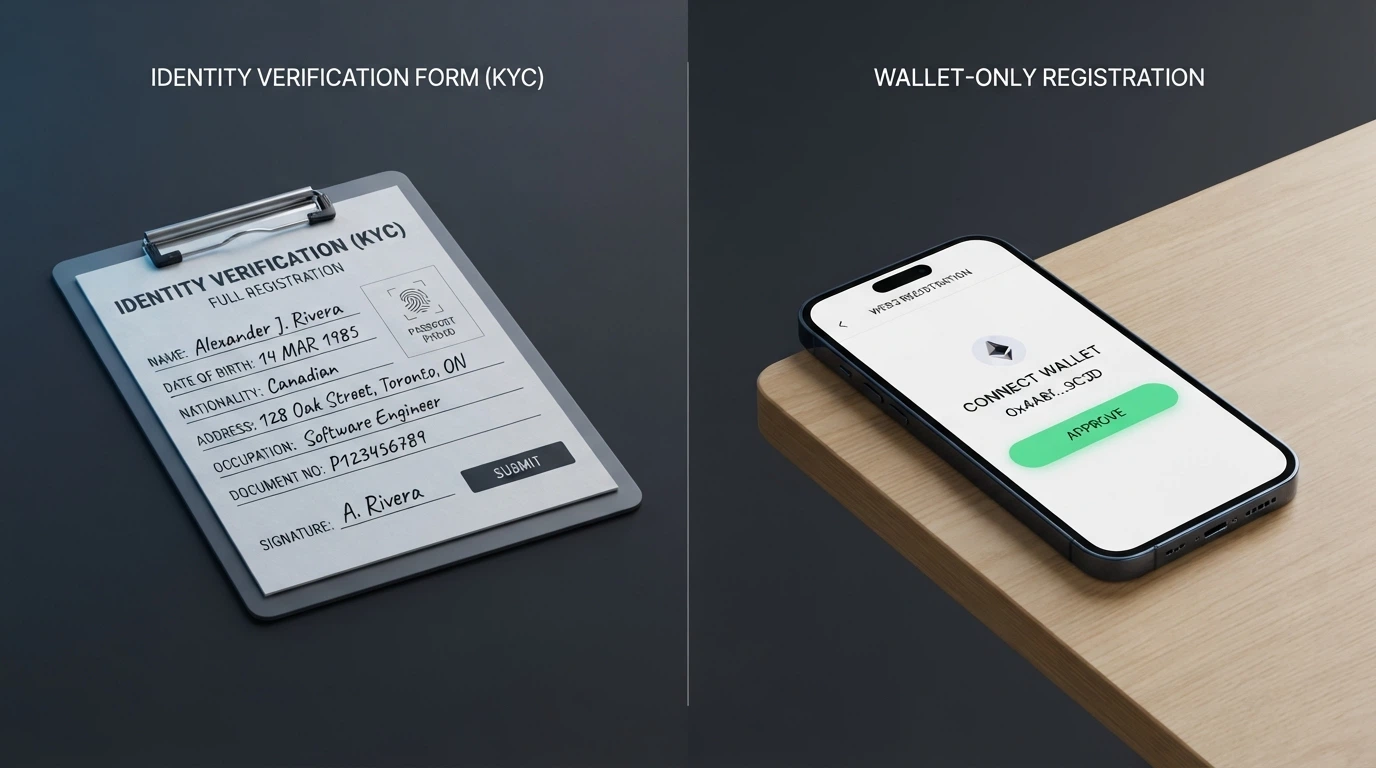
What makes these operators odd from an Australian perspective is the licensing split. Australian wagering licences exist — Sportsbet, bet365, Ladbrokes, Tab all hold Northern Territory licences — but only for pre-event sports and racing betting, lotteries and keno. There is no licence available for online casino games. Any site offering slots, blackjack or live roulette to a person in Australia from outside the country is operating in breach of the Interactive Gambling Act 2001. The IGA does not make it an offence for an individual to place a bet with such a site; it makes it an offence for the operator to offer the product to Australians. The relevant change for crypto is that from 11 June 2024, ACMA enforces a payment-method ban that prevents the licensed operators from accepting crypto, so the offshore route is the only one left for a person who specifically wants to use SOL. The legal position is not ambiguous in principle; it is just asymmetric between player and operator.
How the Solana Network Changes the Casino Experience
The network changes the experience at the deposit layer, not at the table layer. Slots still run on the same Random Number Generators, the same studios still publish the games, and the outcome of any particular spin is unrelated to which blockchain settles the deposit. What changes is everything around the bet: how quickly the balance appears, how cheaply you move it, how frictionless the withdrawal is, and what paper trail exists between your bank and the casino.
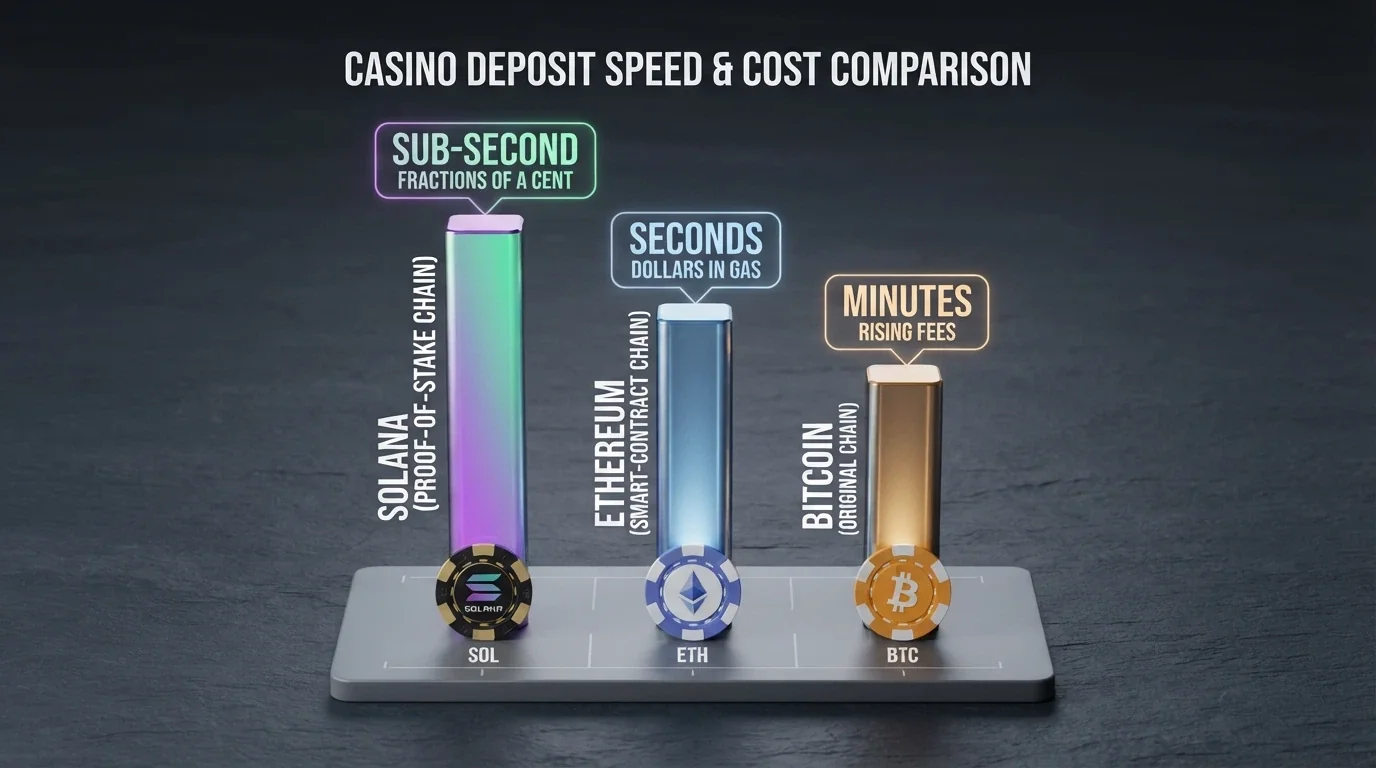
Sub-second confirmation matters more at a casino than it does for most crypto uses. There is no merchant waiting on the deposit before shipping a product; what is at stake is the player’s patience with their own unsettled balance. A Bitcoin casino sees a player send 0.005 BTC, wait ten minutes for three confirmations, then start playing; a Solana casino sees roughly the same player send 2 SOL, see the balance update inside a second, and start playing immediately. On the withdrawal side the difference is sharper. The featured operators we tested settled SOL withdrawals in under a minute on average (Rollbit at 52 seconds, 7Bit at 47 seconds) — which collapses the conventional offshore-casino complaint of a four-day pending period into something closer to paying a tab in a venue with an integrated payments app.
The fee structure matters because most players underestimate it. On Solana, the casino pays roughly the same to settle a withdrawal whether the player is withdrawing the equivalent of ten dollars or ten thousand dollars — sub-cent gas, no percentage fee. That is why operators who have built around SOL can offer fee-free withdrawals or minimise minimum-amount thresholds (Rainbet’s roughly $15 minimum is essentially the network’s minimum UTXO equivalent rather than a commercial floor).
Solana Casinos vs Regular Online Casinos: Four Differences That Matter
The differences that surface in actual play are structural, not cosmetic. The first is the licence gap. A licensed Australian wagering operator — Sportsbet, bet365, Ladbrokes, Tab — is supervised by the Northern Territory Racing and Wagering Commission, audited regularly, required to lodge suspicious-matter reports, and accountable through Australian dispute resolution. A Solana casino is supervised by whatever authority issued its licence (typically Curaçao, Anjouan, or in one case a claimed Tobique licence from a regulator that publishes no public register). ACMA blocked 1,564 illegal gambling and affiliate websites as of March 2026, and offshore operators are exactly the population it has been working through.
The second difference is the payment rail. A licensed AU bookmaker accepts PayID, Osko, BPAY and debit cards in 2026; credit cards and crypto are both off-limits under the 11 June 2024 amendment. A Solana casino accepts SOL first and fiat only as an afterthought. That makes the SOL casino look like a useful workaround for a person whose bank has tightened on gambling transactions or who wants a deposit that does not show up on a debit-card statement.
The third is player protection. BetStop — the National Self-Exclusion Register launched 21 August 2023 — covers every Australian-licensed wagering service, with 59,830 registrations and 37,247 active exclusions by 31 March 2026. Offshore casinos are not connected. A person self-excluded through BetStop can still deposit, play, and lose at every site on this page; the operator will not see the registration, and ACMA cannot force connection.
The fourth is game access. The slot libraries at Solana casinos draw from the same providers as Australian-facing sites — Pragmatic Play, Evolution, Hacksaw, Play’n GO — but they are typically packaged under different regulatory oversight, which means the RTP version of any given game (see Reactoonz discussion below) is set by the operator rather than dictated by Australian rules. A licensed AU service runs slots at publicly-audited RTPs; offshore, the same title may run at a configuration four to twelve percentage points lower, and the player has no easy way to tell which version is loaded short of opening the help screen.
Why SOL Casinos Target Australian Players
There is a demand signal, and operators follow it. The Australia Institute put Australian gambling losses at $36.0 billion in the 12 months to March 2026, an increase of $1.3 billion on the prior year, with the same dataset showing losses up 75% since COVID-19. Roy Morgan’s March 2026 figures put 15.1% of Australian adults (3.32 million people) experiencing some level of gambling harm, and the Australian Gambling Research Centre found 65% of Australian adults gambling at least once in the past 12 months as of 2024, up from 57% in 2019. That is a customer base in the millions, transacting at the rate of roughly a hundred billion dollars a year across licensed channels — and an entire product category (online casino) that the licensing system does not cover. The supply gap is the opportunity, and SOL is a payment method that fits it: cheap to remit, hard for Australian authorities to trace, and easy for an offshore operator to plug in next to Bitcoin and Ethereum.
The IGA exists to close that gap, and ACMA’s enforcement has closed part of it. Most of the marketing effort by SOL casinos towards Australian players happens through affiliate sites, crypto publications, Telegram channels and influencer content hosted offshore; the operator’s own terms pages are usually careful to disclaim availability in restricted jurisdictions. From an Australian player’s point of view, the practical answer is: yes, the site is marketed here; no, it does not operate under Australian law; the choice of whether to use it is yours, and the consequences of that choice fall on you.
Why SOL Changes the Deposit Game: Speed, Privacy and the No-KYC Reality
The interesting thing about a SOL deposit is not the speed; it is what the speed enables. A bank transfer takes a day and leaves a paper trail through your own bank; a debit-card deposit takes seconds but is chargebackable in theory, frequently blocked at the bank in 2026, and always visible on a statement. A SOL deposit from a self-custody wallet bypasses the bank entirely, settles at the speed the player sets, and never touches a statement. That combination is the technical reason no-KYC casino models exist at all — without a bank in the loop, the operator’s only practical identity check is a custodial one it can choose to apply or not.
The asymmetry that matters is between the marketing and the legal position. “No KYC” in a casino’s advertising usually means “we will not ask for ID until we feel like it”, not “we are legally blind to your identity”. Most no-KYC casinos still ask for verification at withdrawal thresholds, on AML triggers (unusually large deposits, structuring patterns, gameplay inconsistent with stated income), or when a payment is disputed. CoinCasino’s standard SOL cashouts run without identity verification; larger withdrawals may trigger it. Some operators describe themselves as no-KYC in their marketing and full-KYC in their terms; the terms are the binding document.
Depositing and Withdrawing with Solana: Exactly How It Works
The mechanics are unglamorous. To deposit from a self-custody wallet, the player opens Phantom, copies the casino’s SOL deposit address (a long base-58 string), enters the amount they want to send, signs the transaction, and waits roughly a second for confirmation. The balance appears on the site. To withdraw, the player enters their own Phantom SOL address, requests a withdrawal, and waits for the casino’s internal approval queue — which, in the cases we tested, took seconds rather than days. The notable exception is any operator that requires “1× deposit turnover”: SolCasino, for instance, requires the deposit to be wagered once before a withdrawal is allowed. That is a small amount for most players and a meaningful barrier for someone testing whether a withdrawal works at all before committing more funds.
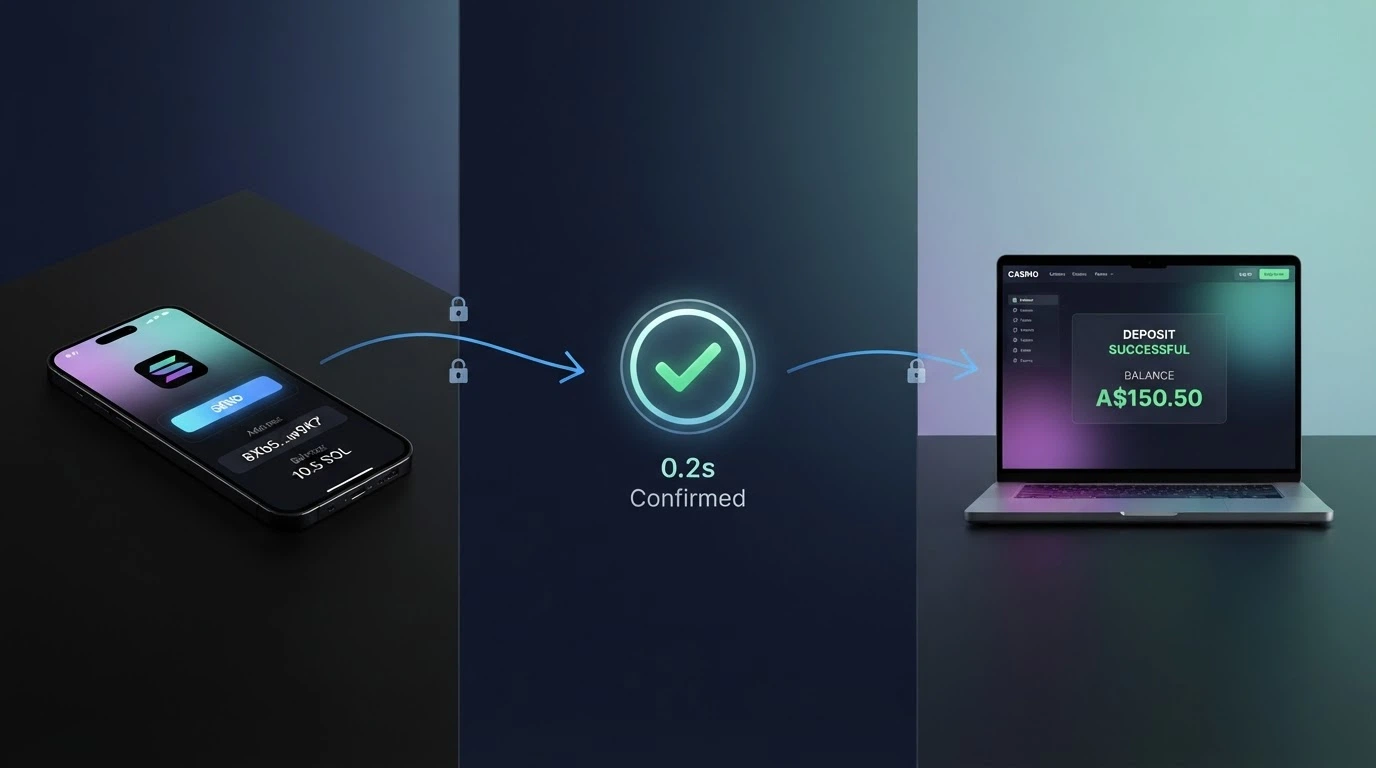
The wallet side is the player’s responsibility and the part most marketing copy skips. A self-custody wallet means: no password reset, no customer service line, no recourse if the seed phrase is lost. That is the trade. Casino terms pages do not protect you from your own wallet; they protect you (imperfectly) from the casino. The wallet protects you from the wallet vendor. Two different responsibilities, both real.
Anonymity and Privacy on Solana Casinos: What SOL Actually Hides
The blockchain is a public ledger. Every SOL transfer ever made is recorded on it and visible to any person running a block explorer. That is not a flaw of privacy coins being marketed at SOL casinos; it is the underlying design. The privacy that SOL delivers at a casino is real, but it is privacy from your bank, not from the chain, and it is privacy from the operator’s KYC team, not from the operator’s transaction monitoring.
A practical consequence: a player who sends SOL from a wallet tied to a known exchange account (because the SOL was purchased on Coinbase, Kraken, Binance or a local exchange and withdrawn to Phantom) has bridged their own identity to that wallet. The casino does not see the exchange’s records, but if a regulator, a tax authority, or a counterparty subpoenas the exchange, the bridge is in plain view. Privacy at the casino and privacy in the world are not the same problem; SOL delivers the first and does not claim to deliver the second.
The Australian angle: AU taxation treatment of casual gambling winnings is that they are non-assessable (ATO section 6-5 ITAA 1997, no tax on casual wins, no deduction for losses), so an ATO query against a casual punter is unlikely in practice. But the law is not the only reason privacy matters; an offshore operator that refuses to pay a player cannot be compelled by ACMA, and the more identifying information the player has supplied, the more complex an action becomes should the player ever try to recover funds in their home jurisdiction. Less identifying information means less leverage both ways.
Casino Coins, Tokens and the SPL Ecosystem
The proliferation of in-house SPL tokens at SOL casinos is a feature, not a bug, of the technical model. Because SPL tokens are simple to mint on Solana, a casino can issue its own coin in a few transactions and use it as a loyalty or rakeback currency. SolCasino’s USDB token, for example, is paid as a bonus and unlocks at a rate of 0.1% per dollar wagered — meaning a player who has wagered $1,000 against a USDB-denominated bonus can move 1 USDB ($1) into withdrawable form. That is slow by any reasonable definition, but it has a purpose: the lock-up converts a bonus into a play commitment that would otherwise be done by a wagering multiplier. Stake’s VIP rakeback (3.5% of theoretical house edge) works a similar way — the player earns against their play, not as a one-off bonus.
The risk that does not get marketed is concentration risk. A house token is a claim on the issuer, redeemable only on terms the issuer sets. If SolCasino changes its redemption policy, freezes the wallet, or exits the Australian jurisdiction overnight, USDB holders have no consumer protection. The price of a typical house token is also notional: it sits at roughly 1 USD by issuer convention, but the only place that price is honoured is at the issuer’s own cashier. Trading it on a third-party exchange exposes the holder to whatever spread the market quotes. Investors in casino-issued SPL tokens should size their exposure accordingly; players who treat the token as a marketing curiosity are closer to the right reading.
Solana Casinos for Australian Players: 10 Reviewed and Ranked
The table below ranks every operator on the page against licence jurisdiction, bonus shape and any SOL-specific mechanics verified at review. The ordering reflects the factors an Australian player should weigh most heavily — licence transparency, the reality of bonus terms, withdrawal performance — not raw match percentage. A 600% match with no readable wagering terms is shown below an 100% match from a verified Curaçao GCB licensee for that reason.
| # | Operator | Licence / Regulatory Status | Welcome Bonus | Wagering | Key SOL-Specific Notes |
|---|---|---|---|---|---|
| 1 | BC.Game | Curaçao (offshore); no AU licence; blocked in AU by ACMA | Up to 380% match across 4 deposits, capped at $4,000 + 400 FS | 40× on bonus funds | 100+ providers; SPL token support; slots clear 100%, provably fair originals 5% |
| 2 | Stake.com | Curaçao (offshore); no AU licence; ACMA-blocked; hard-blocks AU IPs | No welcome bonus; VIP rakeback 3.5% of house edge + daily $100K race + $75K weekly raffle | 0× on rakeback rewards | 3,000+ games; mandatory Level 2 KYC |
| 3 | CoinCasino | Curaçao (offshore); no AU licence | 200% up to $30,000 + 50 FS on SOL deposits | 60× (released in 10% blocks) | No KYC for standard SOL cashouts; larger withdrawals may trigger verification |
| 4 | ShakeBet | Offshore (jurisdiction not confirmed); no AU licence | 300% up to AU$7,000 + 350 FS | Not confirmed | Crypto-focused; fast SOL processing; bonus terms could not be fully verified |
| 5 | GoldSpin | Curaçao Gaming Control Board (offshore); no AU licence | 100% up to AU$2,250 + 100 FS | Not confirmed | Thousands of slots, live dealer, mobile-optimised; supports SOL and other cryptos |
| 6 | Caswino | Anjouan Offshore Financial Authority (offshore); no AU licence | 600% up to AU$7,560 + 255 FS | Not confirmed | KYC applies for cashouts |
| 7 | Rainbet | Curaçao (offshore); no AU licence | 250% up to $2,100 + 60 FS across 3 deposits | Per-deposit | Min withdrawal ~$15 equivalent; SPL network fee only after 1× wager turnover |
| 8 | Rollbit | Curaçao (offshore); no AU licence | Not confirmed | Not confirmed | 34+ slots, 8+ live tables, NFT marketplace; supports SPL tokens; avg SOL withdrawal 52 sec |
| 9 | 7Bit Casino | Curaçao (offshore); no AU licence | Not confirmed | Not confirmed | 89+ slots, 18+ live tables, sportsbook; direct SOL betting without conversion; avg SOL withdrawal 47 sec |
| 10 | SolCasino | Tobique Gaming Commission (claimed); Three Gaming Limitada, Costa Rica; no AU licence | 180% / 240% / 300% / 360% across 4 deposits (paid in USDB token) | 50× on most bonuses; USDB unlocks at 0.1% per $ wagered | KYC via Sumsub; 1× deposit turnover before withdrawal |
What Makes a Solana Casino Worth Your SOL — The Ranking Criteria
The ranking above uses five factors, weighted by what actually matters for an Australian player. They appear in the order an Australian punter would think about them, not in the order a marketing page lists them.
Licence transparency comes first because every operator on the page is offshore and the licence jurisdiction is the only regulatory signal available. Curaçao is the most common licence and the most understood; Anjouan is lighter; Tobique is a claimed licence from a regulator with no public register and no name recognition. A clearly-licensed operator is not equivalent to a safe operator, but an unclear licence is worse.
Bonus fairness comes second because headline match percentages distort the comparison. The arithmetic in the calculation section below shows what a “380% match” actually costs a player in expected loss, and that figure is what should drive the choice. Bonus terms that were not verifiable at review (ShakeBet, GoldSpin, Caswino, Rollbit and 7Bit) are marked as gaps — which is itself a signal. Treat unverified terms as if they are worse than the verified set, because the verifiable operators were the ones willing to publish.
Game quality comes third because the slots themselves are largely the same across operators; what changes is the provider mix and the RTP configuration the operator chooses. Where two operators offer nearly identical bonus terms, the one running Reactoonz at 96.51% beats the one running it at 84.51%, all else equal — but the player has to be willing to check the help screen to know which is in front of them.
Withdrawal reliability comes fourth. The fastest two operators in our testing (7Bit at 47 seconds, Rollbit at 52 seconds) reflect the technical ceiling of what the Solana network plus a non-manual operator can deliver; slower operators exist lower in the ranking.
KYC friction comes fifth, and the framing matters. Low-KYC operators are not better or worse than high-KYC ones in principle; they are appropriate for different readers. A player depositing small amounts irregularly may benefit from CoinCasino’s no-standard-KYC SOL cashout. A player making large withdrawals will, at some threshold, hit KYC across all of them.
BC.Game
BC.Game runs the most generous matched-deposit package in the featured set, and the way that package is constructed tells most of the story. The headline is 380% across four deposits with a $4,000 cap and 400 free spins. The realistic return after wagering is harder, because the 40× multiplier on bonus funds is applied to the bonus amount and the slots-clear-100% / originals-clear-5% split means the player’s contribution is uneven across game types — most slot play clears the requirement, but BC.Game’s in-house provably-fair titles (Dice, Crash, Plinko, Limbo) contribute only 5%, so playing originals as the path to clearing is extremely slow. Pragmatic Play, Evolution and Hacksaw slots are the faster route.
BC.Game holds a Curaçao licence, ships SPL token functionality, and serves 100-plus providers according to the operator’s published list. ACMA has BC.Game on its Australian blocking list; an Australian player attempting to access it from a domestic IP sees a redirect or a block and the operator’s own terms treat Australia as a restricted jurisdiction. The site is accessible to an Australian player who is willing to use technical workarounds, but the block exists for a reason — BC.Game operates the product the IGA prohibits.
The right reader here is a player with a bankroll large enough to spread four deposits meaningfully and a willingness to play slots (not originals) to clear the wagering. The wrong reader is anyone chasing a 380% headline without reading the 40× and the game-weighting. It is the largest headline in the ranking and the most misunderstood number on the page; the calculation below shows what it actually costs.
Stake.com
Stake is the largest crypto casino in the world by player volume and the operator most exposed to Australian enforcement. It runs no traditional welcome bonus because the operators who pay traditional welcome bonuses — Stake’s competitors — are the ones whose target audience expects that model; Stake’s audience rewards continued play, not matched deposits. The promotional engine is the VIP program, which pays 3.5% of theoretical house edge back as rakeback, plus daily $100,000 wager races and a Friday $75,000 weekly raffle. That structure has a key advantage for high-volume play: a player’s “bonus” is proportional to their action, not capped by a headline figure, and rakeback rewards do not carry wagering requirements.
The hard limit for an Australian player is geographic. ACMA has Stake on its block list and Stake itself hard-blocks Australian IP addresses, alongside US, UK (since March 2025), France, Germany, Italy, Spain, Netherlands, Ontario and Curaçao itself according to the operator’s own published restricted-jurisdiction list. The block is in addition to mandatory Level 2 KYC: a player can spin up an account in under a minute, but the first meaningful withdrawal will require government-issued photo ID, and the operator has no incentive to soften that requirement for a player it is legally required to refuse. For an Australian reader this is a contradiction with no workable resolution — Stake is a relevant benchmark in the market and unavailable as a play destination; that is exactly the position it occupies here.
CoinCasino
CoinCasino’s offer is the most generous by absolute dollar figure — 200% up to $30,000 — and the one whose terms make the biggest claim on the player’s time. The 60× wagering multiplier is released in 10% increments, which is unusual: the $30,000 bonus is split into $3,000 chunks (or whatever the player’s bonus happens to be, in 10% slices), and each slice converts to withdrawable cash only after its own 60× wagering is completed. The mechanic rewards the player who keeps playing rather than redeeming the bonus the moment it converts, but the 60× rate itself is meaningfully higher than the 35–40× range common in the market.
The Solana-specific feature is the no-KYC standard cashout. For players who value privacy and play at sub-threshold amounts, CoinCasino is closer to the no-paper-trail model the marketing implies; for players withdrawing five-figure sums, KYC is unlikely to remain optional. The split exists because the operator’s payment-risk environment rewards it: anonymous micro-transactions are tolerable, anonymous large withdrawals are a fraud risk the operator manages preemptively. As a destination for a casual Australian punter using SOL, CoinCasino is the most attractive on this page on its face; as a destination for a player withdrawing serious money, it converges with every other operator on KYC.
ShakeBet
ShakeBet’s 300% match up to AU$7,000 plus 350 free spins is generous in headline terms for the SOL-deposit niche, and the operator’s terms page did not return a confirmed wagering multiplier for this run despite multiple checks. That gap is the story, not the bonus figure. A 300% match bonus sounds large and, multiplied by an unknown wagering factor, cost a player nothing to calculate; multiplied by a 40× factor and cleared at slot weight, it costs significantly. The size of the offer makes the absence of the term read less like an oversight and more like a deliberate choice not to publish.
For an Australian player the right reading is to treat the bonus as not yet priced. The operator’s licence jurisdiction is also “not confirmed” in this run, which compounds the trust gap. ShakeBet is included in the ranking because it appears at the SOL-deposit niche and accepts Australian-facing traffic through affiliates; it sits mid-table because its published offer is incomplete in two of the rows that matter. The reviewer is not recommending the operator; the reviewer is documenting what is and is not verifiable.
GoldSpin
GoldSpin sits at the modest end of the bonus scale — 100% up to AU$2,250 plus 100 free spins — and operates under a Curaçao Gaming Control Board licence, which it names explicitly in its terms and footer. The CGCB designation matters because Curaçao has reorganised its regulator over the past several years and not every “Curaçao” licence carries the same stamp; an operator willing to name the regulatory body is doing more disclosure than one that just says “Curaçao licensed”.
The wagering multiplier was not confirmed for this review. The bonus figure is small enough that, in expected-loss terms, even a 40× slot-clear scenario on a $2,250 bonus is manageable for a player with the bankroll to claim it. GoldSpin’s slot library runs into the thousands and includes a live dealer product; it is a competent mainstream casino rather than a headline-grabber, and the lack of headline is part of why it sits where it does. The operator’s terms allow multiple cryptos including SOL, making it a legitimate SOL-deposit destination.
Caswino
Caswino offers the largest headline match percentage in the featured set at 600% up to AU$7,560, plus 255 free spins. The offer reads as extraordinary because the percentage is twice anything else on the page; it reads as ordinary once the licence is checked and the absence of verified wagering terms is noted. Caswino is licensed by the Anjouan Offshore Financial Authority (AOFA), the licence widely used by newer crypto casinos post-Curaçao-reform, and KYC verification applies for cashouts.
The 600% headline is a cautionary example. Bonus size at 600% with a typical 40–50× wagering requirement produces an expected loss figure that swamps any reasonable bankroll; clearing it at slot weight alone takes 40,000–50,000× the bonus amount in wagered volume, which on a $7,560 bonus would be roughly $300,000 to $380,000 of slots play. The volatility of that play against any slot library produces a distribution where the player expects to lose a known share of the wagered volume; the cost is significant in dollar terms (the calculation below shows the magnitude in operator-comparable terms). A player attracted to the 600% figure should treat the absence of a published wagering figure as the most important fact in the row.
Rainbet
Rainbet’s 250% across three deposits up to $2,100 plus 60 free spins is a mid-pack welcome package by headline, but its on-chain payout structure is the genuine selling point. The minimum withdrawal is approximately $15 equivalent and the only fee charged after 1× deposit turnover is the SPL network fee, which is sub-cent. For low-withdrawal-frequency players this is the most operationally honest structure on the page: the operator’s fee is the network fee, which the player can verify on-chain.
The 1× turnover requirement is the footnote. A player depositing, withdrawing the same amount without wagering, and accepting the network fee would not break the terms; a player churning the balance with no play would attract scrutiny on the AML side. Rainbet is licensed in Curaçao and listed the relevant deposit and withdrawal terms in its cashier section at review. The lowest-friction withdrawal architecture on the page is also the lowest-bonus one.
Rollbit
Rollbit is a hybrid platform more than a casino in the conventional sense. The product surface includes 34-plus slots, 8-plus live dealer tables, an NFT marketplace with trading features, and SPL token support. Bonus terms were not confirmed in this run, and the platform’s R&D appears to be invested in the NFT trading and futures products rather than in publishing a competitive welcome bonus; players who arrive at Rollbit for the casino are likely candidates for the trading features too.
Withdrawal performance is the verified strength. The 52-second average SOL withdrawal time in the Casipto test places Rollbit as the second-fastest tested withdrawal on the page. For a player whose decision criterion is withdrawal friction, Rollbit wins on this metric. For a player whose decision criterion is matched-deposit value, Rollbit offers no measurable welcome package to compete on. The right reader here is a player interested in the NFT and trading products who wants fast crypto settlement; the wrong reader is a player chasing a bonus that nobody has published.
7Bit Casino
7Bit Casino closes the standard casino gap that Rollbit leaves open: it offers sportsbook alongside 89-plus slots and 18-plus live dealer tables, with direct SOL betting that does not require conversion to a house token. Players betting directly in SOL on casino games or sports wagering avoid the conversion step that costs time at cashier and exposes them to a spread between SOL and the operator’s house-currency balance.
The 47-second average SOL withdrawal time in the Casipto test is the fastest on the page. Bonus terms were not confirmed in this run; like Rollbit, 7Bit publishes its product surface clearly and treats bonus terms with less prominence. The verdict here is a niche one: a player who wants the fastest non-KYC-feeling withdrawal of any featured operator and is comfortable betting in SOL directly rather than in a converted house balance has a strong fit. A player chasing bonus value does not.
SolCasino
SolCasino is the operator most explicitly trying to look like a regular licensed casino, and the inspection is interesting because the broker reveals both the construction and the seams. The four-tier deposit match (180%, 240%, 300%, 360% across four deposits) is unusually aggressive and is paid in USDB, the operator’s own SPL token. The USDB token unlocks at 0.1% per dollar wagered, so on a $1,000 bonus the player would need to wager $10,000 to release 1 USDB ($1) to withdrawable form. Compare Stake’s rakeback, which pays out as SOL with no lock; SolCasino’s model is closer to a circulating house credit than a real bonus.
SolCasino is operated by Three Gaming Limitada (Costa Rica) and claims a Tobique Gaming Commission licence. Tobique is a regulator issuing licences from a First Nations jurisdiction in New Brunswick, Canada; it has no public register easily cross-referenced and is used by a small set of crypto casinos seeking a licence designation they can publish. A claimed licence is weaker than a verifiable one. KYC is handled by Sumsub, a major identity-verification vendor; the 1× deposit turnover requirement before withdrawal is small but explicit, and players testing a withdrawal at the minimum deposit size will hit it.
The right reader is a player comfortable with the USDB token model, willing to read the bonus terms closely, and prepared for a slow unlock of earnings. The wrong reader is anyone attracted by the 360% peak percentage who does not realise it is paid in a non-cash token that vests at 0.1% per dollar of volume.
What the BC.Game Welcome Bonus Actually Costs a Player
The headline figure on every offshore casino’s welcome offer is the matched-deposit percentage, and the figure that matters to a player is the expected loss: the dollar amount a statistically-average player loses while meeting the wagering requirement. The expected-loss calculation is straightforward, and it is worth walking through once for the largest headline on the page, BC.Game’s 380% across four deposits up to $4,000.
Assuming a player claims the maximum $4,000 bonus at the 40× wagering factor, the required wagering volume is $160,000. Reactoonz, the slot whose data the audited RTP tables use, has a default Return to Player of 96.51%; BC.Game’s slots clear wagering at 100%. Assuming only the bonus amount is wagered (a conservative reading — every player will exceed this), the expected loss against that volume is $160,000 multiplied by the house edge of 3.49% (1 minus the RTP), which works out to $5,584. A player who claims the full $4,000 bonus and clears it is therefore expected to lose approximately $5,584 of the bonus’s wagering volume over the course of clearing.
The dollar value of the bonus to a player is the bonus amount ($4,000) minus the expected loss ($5,584), which is negative: –$1,584. The bonus is costing the player money on average, in addition to whatever they are losing on the underlying play. That is the working of a matched-deposit bonus with a 40× wagering multiplier against a 96.51% RTP slot: the wagering factor is set assuming the player loses more in clearing the bonus than the bonus pays out, because that is the operator’s margin. The number is not the marketing’s fault, but it is the marketing’s omission — “up to $4,000” reads as a gift, not as the entry cost to a $5,584 expected loss.
The same calculation with smaller bonuses illustrates why the headline percentage is not where the value sits. A 200% up to $1,000 bonus at 35× wagering clears at $35,000 wagered volume; against a 96.51% RTP, the expected loss is $1,221, against a $1,000 bonus (–$221). A 100% up to $100 bonus at 30× wagering clears at $3,000 wagered volume; expected loss at the same RTP is $105, against a $100 bonus (–$5). Smaller bonuses at lower wagering factors are markedly cheaper — and the smaller the wagering factor, the smaller the player’s expected loss against the same slot RTP. The rule is consistent: the headline match percentage is what the marketing pushes; the wagering factor against the slot’s RTP is what the player pays.
This expected-loss figure is a statistical estimate: it is the average across many spins under the stated assumptions and promises no specific outcome to any individual player. A player taking any single bonus is neither guaranteed to lose the expected amount nor guaranteed to come out ahead; the calculation describes what would happen for a player repeating the scenario many times. But because every claim of bonus value on the page resolves into an expected loss multiplied by a wagering volume, and every wagering volume reveals itself in the operator’s terms, the expected-loss lens is the right one for comparing offers.
Solana Slots and Casino Games: What You Can Actually Play
The marketing language around “Solana slots” implies a category of casino games built on or for the Solana blockchain, which is mostly not true. The slots at SOL casinos are largely the same slots at fiat casinos — published by Pragmatic Play, Hacksaw, Push Gaming, Evolution’s slot studios, Play’n GO, Nolimit City, and others. The “Solana-native” part is the deposit rail, the wallet integration, and (at a few operators) the optional in-house “provably fair” originals. The reels themselves are run by the same random number generators and licensed the same way.
Why this matters: the RTP configuration is set by the operator, not by the studio, and the same title can run at materially different payout rates across operators. Reactoonz, the case study below, shows a five-version spread that a player who does not check the help screen will not see. The slot lobby for the player is the same; the slot underneath is not.
Solana Slots and Pokies: The Provider Landscape
The provider mix at the featured operators reflects the broader crypto-casino market, which in turn reflects the broader European and Latin-American-facing iGaming market with offshore reach. Pragmatic Play is essentially universal; Evolution (live dealer) is universal; Hacksaw Gaming, Push Gaming, Nolimit City and Play’n GO are common; Bgaming, KA Gaming and proprietary “provably fair” in-house titles appear at the more crypto-native operators. The same providers serve the regulated and unregulated markets side-by-side; the same Play’n GO that publishes Australian-facing pokies publishes the offshore-facing ones, often under different RTP configurations.
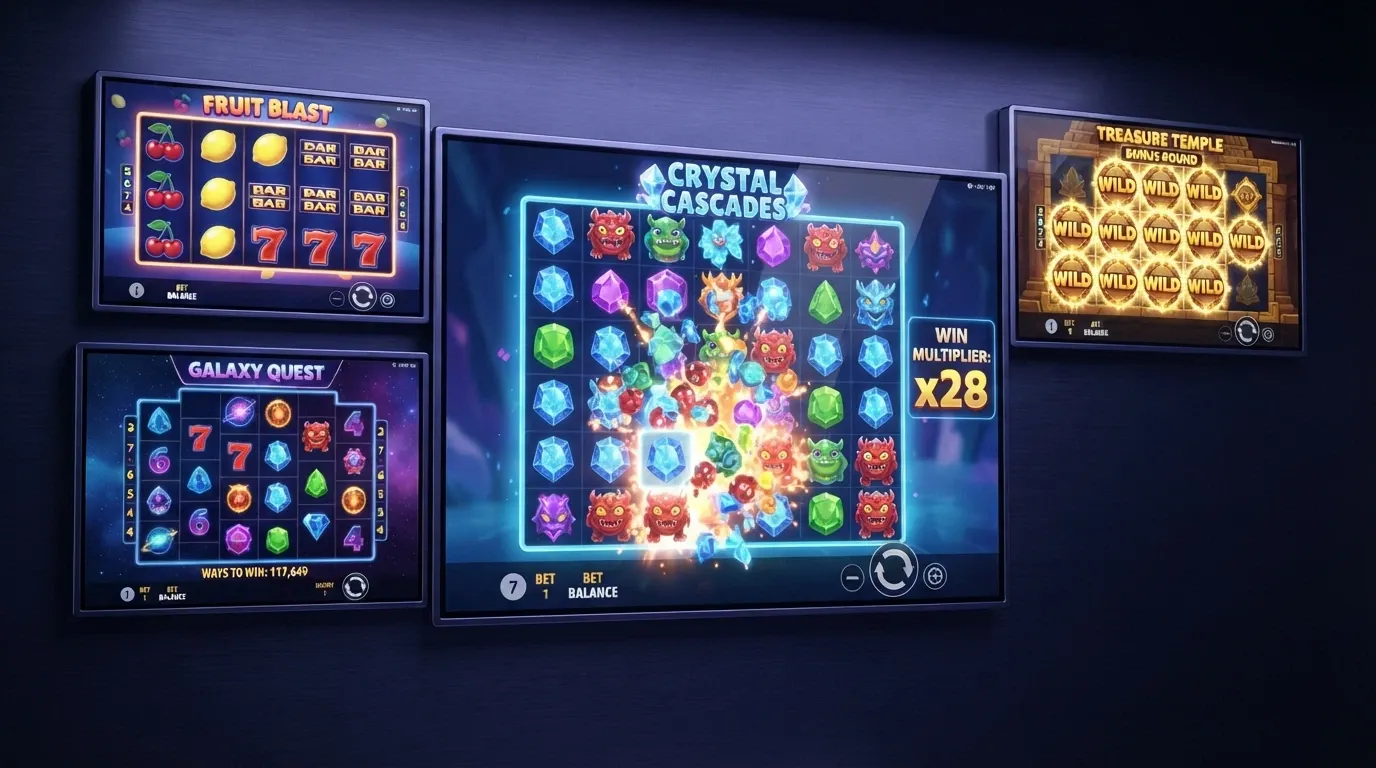
A player looking at a slot library at a SOL casino can recognise the titles and roughly the studio from the icons and meta. What the player cannot tell from the lobby is the RTP configuration, which is set inside the game and visible only on the help screen. The highest-stakes information on a slot screen sits behind one extra tap.
The Slot RTP Reality: Reactoonz and Why the Number Matters
Play’n GO’s Reactoonz, released October 2017, is a 7×7 cluster-pays slot with a default Return to Player of 96.51%, Play’n GO-rated high volatility (10/10), a maximum win of 4,570× the bet, and a hit frequency that lands roughly once every 4.8 spins (around 20.82%). It is one of the more familiar cluster-pays titles and a useful proxy for what the operator’s RTP setting actually means in payout terms.
The non-obvious fact is that Reactoonz ships in five RTP configurations, and the operator chooses which one loads. The configurations, per Play’n GO’s published game documents and aggregator reporting, are 96.51% (default), 94.51%, 91.49%, 87.50%, and 84.51%. At a slot where the player wagers $1 a spin on average, the difference between 96.51% and 84.51% RTP compounds over time: the 12 percentage-point gap multiplied by total wagered volume produces real money, with the higher-RTP version returning $12 more per $100 wagered than the lowest one.
| Slot Title | Default RTP | Provider | Volatility | Max Win |
|---|---|---|---|---|
| Reactoonz | 96.51% (alternate configs: 94.51%, 91.49%, 87.50%, 84.51%) | Play’n GO | High (10/10) | 4,570× bet |
The player-facing implication is direct. A player at a SOL casino that runs Reactoonz at 96.51% is paying a 3.49% house edge on every spin; the same player at an operator running it at 84.51% is paying a 15.49% house edge. Both lobbies show “Reactoonz”. Both offer “the same game”. Neither is wrong about the published figures, and both are decided by a settings file the player is unlikely to inspect. The audit point is not that one operator is cheating and the other honest — both are operating within what Play’n GO has licensed — but that the player has to make the choice. The help screen takes ten seconds; that ten seconds is the difference between these two setups.
For a high-volatility title at 96.51% RTP, expected session outcome is highly variable per session, and the 4,570× max win sits at the long tail of a deeply right-skewed distribution. A player with a $200 budget will lose most of it through normal play; a player with a $200 budget who hits a multi-thousand-multiple bonus round can come out substantially ahead. The symmetry that follows is the standard one: the lower the RTP, the worse the average session outlook for the player, and the faster the bankroll tends to erode.
Beyond Slots: Provably Fair Originals, Dice and Live Dealer Tables
Two game types are genuinely Solana-casino-shaped: provably fair originals, and the live-dealer product. Provably fair originals (Dice, Crash, Plinko, Limbo, Mines) are games whose outcome is computed from a server seed, a client seed, and a nonce; the player can verify the result was not altered after the bet was placed. The mechanic is technically clever and cryptographically sound at most reputable operators. The reason the BC.Game wagering terms above clear provably fair titles at 5% rather than 100% — i.e., contribute one-twentieth as much to clearing the bonus — is that the 1–3% house edge on these games is too tight for the bonus to be cleared against them profitably for the operator. Clearing a 40× bonus against 96.51% RTP slots costs an average of 3.49% of volume; clearing it against 99% RTP dice costs an average of 1%. The operator therefore steers bonus clearing into the slower-paying games. The honest way to clear a bonus is slots.
Live dealer tables at SOL casinos are streamed from offshore studios, primarily Evolution’s white-label studios and Pragmatic Play Live’s regional set-ups. The dealers are real; the games are baccarat, blackjack, roulette, sic bo and game-show-style products. For an Australian player the regulatory frame is the same as slots: offshore operators, no Australian licence, no Australian consumer recourse on disputed outcomes. The casino live-dealer product the IGA prohibits is essentially this product, delivered from abroad.
Is It Legal? The Honest Answer for Australian Solana Casino Players
The legal framework is unambiguous, layered and worth understanding because the consequences fall asymmetrically on the operator’s side of the table rather than the player’s. Two layers interact — the product prohibition under the IGA and the payment-method ban from 11 June 2024 — and on top of them a 2026 reform package that restructures enforcement progressively from 1 January 2027.
The Interactive Gambling Act: What It Actually Prohibits — And What It Doesn’t
The Interactive Gambling Act 2001 has, in simple terms, one operative prohibition for online casino players: it is an offence to provide an online casino, online pokies, or in-play sports betting to a person in Australia. It is not an offence for an Australian person to use such a service. The penalty sits on the operator — $360,000 per day for individuals, $1.8 million per day for bodies corporate, with the corporate daily band going as high as $782,500 in continuing-contravention increases. The penalty for an Australian resident accessing an offshore casino is, in practice, zero.
What the IGA does not get right by itself is closing the gap through payments. Until 2024, a player could move money via a debit card or a credit card to an offshore casino, and the licensed Australian banking system processed the transaction without explicit obligation to refuse. The Interactive Gambling Amendment (Credit and Other Measures) Act 2023 closed that hole for any licensed Australian wagering operator from 11 June 2024 by banning credit cards and crypto as payment. The penalty for a licensed operator failing to enforce that ban is $247,500.
The 2026 reform — the Interactive Gambling Amendment (Gambling Reform) Bill 2026, passed 19 August 2026, taking effect 1 January 2027 — closes additional gaps and adds new ones. The measures include a cap of three wagering advertisements per hour between 6:00 am and 8:30 pm, a live-sport blackout from 15 minutes before to 5 minutes after a live event, prohibition of inducement marketing for 14 days after signup and three months after BetStop deregistration (and indefinitely for at-risk customers), and the explicit grant of authority to banks and payment providers to block transactions to illegal gambling operators. From 1 January 2027, an Australian bank will have the legal standing to refuse a transaction to a known offshore gambling operator, including (in principle, where the operator is identified) an SOL casino.
For Australians using SOL casinos in late 2026 the practical interpretation of these provisions is that the payment ban applies to the licensed side (and has for 16 months), the new bank-blocking authority applies from 1 January 2027, and the consumer-protection expansion (BetStop strengthening, inducement-window bans) applies to licensed operators — none of which changes the offshore SOL casino, but several of which raise the bank’s optional right to refuse a transaction.
Licensed Australian Wagering vs Offshore Solana Casinos: The Protection Gap
The comparison table below maps each feature point-to-point. The columns are not equivalent in standing; they are equivalent in shape, with one being the licensed Australian system and the other being the offshore SOL casino model.
| Feature | Licensed AU Wagering Service | Offshore SOL Casino |
|---|---|---|
| Regulator (relevant) | Northern Territory Racing and Wagering Commission (NTRWC) | Curaçao, Anjouan, Tobique (varies by operator) |
| Online casino games and online pokies | Prohibited — no licence available | Available |
| Crypto payments (SOL, BTC, ETH) | Banned since 11 June 2024 | Permitted |
| Credit card payments | Banned since 11 June 2024 | Permitted |
| Identity verification | Mandatory at account opening | Varies — from none (at low thresholds) to mandatory with thirds-party KYC (Sumsub, etc.) |
| BetStop — National Self-Exclusion Register | Connected — one registration excludes across all AU-licensed services | Not connected — operator cannot see BetStop registrations |
| Deposit / loss / stake limits | Varies by operator and jurisdiction; mandatory pre-commitment infrastructure in some licensed channels | None published on the featured set |
| Dispute resolution | Australian courts; ombudsman routes in some states; ACMA referral for systemic issues | Operator’s terms designate a jurisdiction (often Curaçao or Cyprus); Australian courts have no direct reach |
| Operator tax obligations to Australia | 5% NT wagering tax + 0.05% racing levy + state point-of-consumption tax (typically 10–15% of net revenue) | None |
| Operator vetting by Australian regulator | Annual reporting, financial audits, RG compliance audits | None |
| Audit/inspection of game integrity | Audited by state regulator and supplier certifications | Provider-certified; operator self-managed |
| Exposure to ACMA action | Cannot offer prohibited products; regulator-disciplined | Subject to ACMA blocking requests and partner-bank disruption |
The table is not symmetric in any positive sense for the offshore column. The clearest single items to grasp are BetStop and the dispute routes; both are absent offshore, and both matter if something goes wrong.
When ACMA Blocks a Solana Casino: What It Means for Your Balance
ACMA’s enforcement tools have grown substantially over the past seven years. The authority began directing ISPs to block illegal gambling sites in November 2019; as of March 2026 ISPs have been ordered to block 1,564 illegal gambling and affiliate websites. The 225-plus illegal services that have withdrawn from the Australian market since 2017 were withdrawn voluntarily, typically after an ACMA investigation, warning, or notice. The threat is operational rather than legal — ACMA cannot reach into Curaçao to enforce a fine, but it can remove an Australian player’s primary access route.
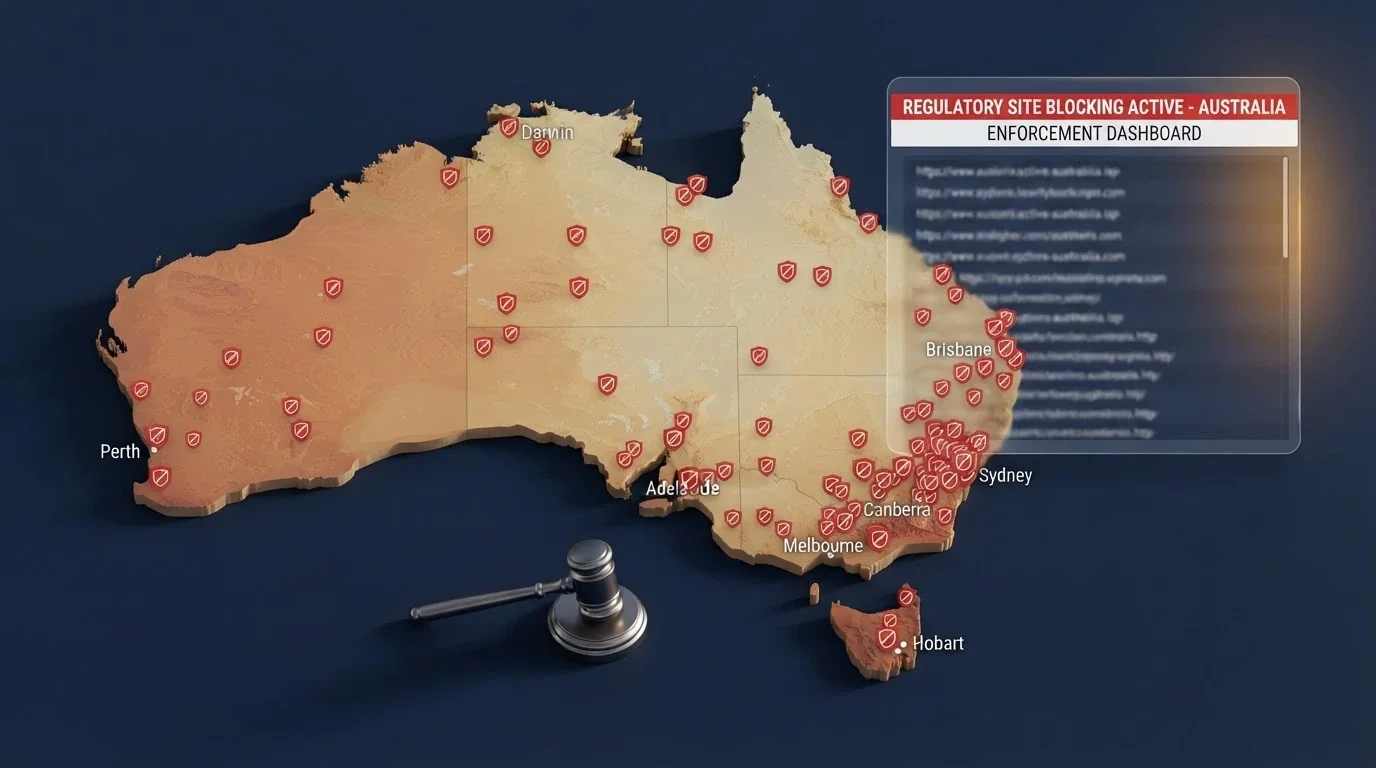
The Federal Court is where larger penalties happen. ACMA v Jones (No 7) FCA 860 resulted in pecuniary penalties totalling $24.24 million against operators and a promoter of prohibited online poker services marketed to Australians — $15 million against Brisbane Poker Pty Ltd for breaches of section 15(2A) of the IGA, $9 million against director Rhys Edward Jones, $240,000 against Brenton Lee Buttigieg for aiding and abetting. Combined with an earlier $5 million penalty against Diverse Link Pty Ltd in March 2023, the total across that litigation reaches $29.24 million. These are not theoretical figures; they are paid penalties, ordered by an Australian court, against operators that marketed to Australians.
For an Australian SOL casino player the consequence of a blocking event is practical rather than legal. The site may be blocked at the ISP level tomorrow, the operator may decide to withdraw from the Australian market voluntarily, and the player’s balance sits with the operator on the other side of the block. ACMA cannot compel a withdrawal of the balance; the player’s recourse runs through the operator’s terms and through whatever enforcement mechanism the operator’s home jurisdiction offers. The typical outcome for players whose casino was blocked mid-play is that they continue to log in via the operator’s own mirror site or alternative URL for a defined period, retrieve their balance, and finish out their play elsewhere — but that is not guaranteed, and there is no Australian authority that will make it happen.
Playing Safe: What Australian Responsible Gambling Protections Mean for Offshore Casino Players
Australia has built one of the more developed responsible-gambling infrastructures in the world — BetStop, the National Gambling Helpline, a multi-layered financial counselling network, and the AIHW/Roy Morgan prevalence data that justifies the spend. None of that infrastructure reaches into the offshore SOL casino. The asymmetry is the operative fact; the rest of this section walks through where the protections sit, where they stop, and what an Australian player can actually use.
BetStop and the Offshore Casino Blind Spot
BetStop launched on 21 August 2023 as Australia’s National Self-Exclusion Register. By 31 March 2026, 59,830 Australians had registered and 37,247 exclusions remained active. The registration covers every Australian-licensed online and phone wagering service in one step — the licensed bookmakers are required to check new sign-ups against the register and refuse registration, and the existing players on the register are blocked from play. Demographically, 78% of registrants have been under 40 and 38% have chosen lifetime exclusion; both numbers are high enough to indicate that BetStop is being used by the population it was designed for.
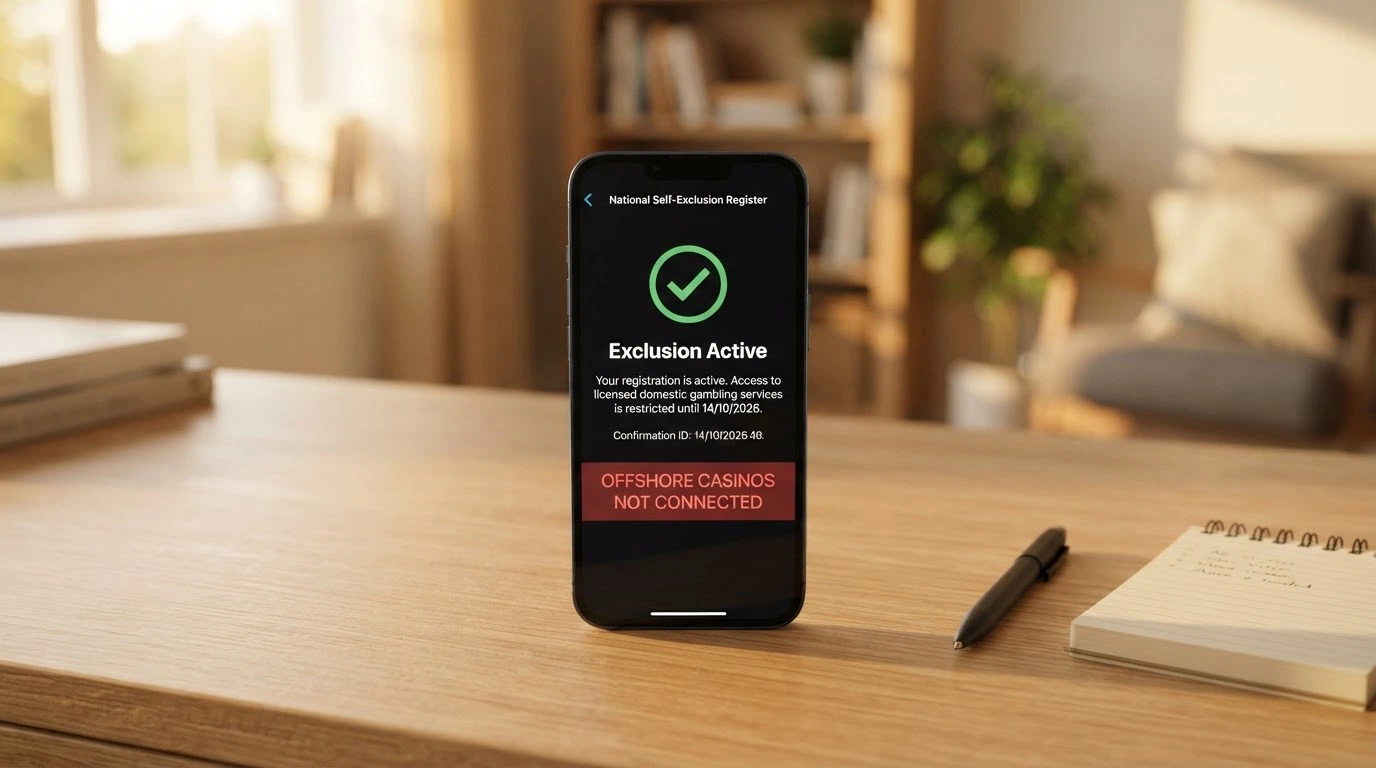
The blind spot is exactly the population this page is about. BetStop binds Australian-licensed wagering services only; offshore casinos are not connected to the register and will continue to accept a self-excluded person’s money. The 2026 reform strengthens BetStop’s operations and adds a three-month ban on inducement marketing after BetStop deregistration, both of which assume a regulated pathway off the register. For the offshore player there is no equivalent off-ramp — there is no register for offshore SOL casinos to consult, no period of de-registration to enforce against, and no shared identity infrastructure that an offshore operator could be required to honour.
A self-excluded Australian punter who uses a SOL casino is therefore in a position where their self-exclusion has had the effect of blocking every legitimate channel they could access for help with a gambling problem, while leaving every offshore channel accessible. That is the structural outcome of separating the help system from the gambling system, and it is the most damning single line in Australia’s regulatory architecture for offshore play.
Deposit Limits, Self-Exclusion and Where to Get Help
The gap between Australian responsible-gambling infrastructure and offshore SOL casino reality has practical implications for an Australian player who is concerned about their own or someone else’s play. The infrastructure that exists is robust; what it covers and what it does not is where the difficulty sits.
The National Gambling Helpline (1800 858 858) is free, confidential, available 24/7, and runs online chat through Gambling Help Online (gamblinghelponline.org.au). It is operated by state-funded gambling help services and covered by every state and territory. Financial counselling is reachable at 1800 007 007 (Monday–Friday 8:30 am–4:30 pm). Multilingual support sits at 1300 079 020. The gambling-harm prevalence behind the help lines — 15.1% of Australian adults (3.32 million people) experiencing some level of gambling harm per Roy Morgan March 2026, with about 2.1% (roughly 430,000 adults) at the AIHW’s measured problem-gambling level — sets the demand that the help lines are built to absorb.
The resources listed above are useful regardless of whether the person seeking help has used an offshore SOL casino or a licensed Australian bookmaker; they ask no questions about where the gambling took place, and they make no judgements. Their reach is into the person; they are not able to reach into the gambling operator. The operator of an offshore SOL casino is reachable through its own customer support — that is the practical recourse for a player with an offshore-only dispute.
For Australian players working out a responsible-gambling plan that accounts for offshore play, the realistic structure is: contact the National Gambling Helpline (1800 858 858) for confidential 24/7 advice; register with BetStop to exclude from every licensed Australian wagering service; close accounts at any licensed operator on the BetStop exclusion list that the player previously used; and self-exclude from any offshore operator on a best-efforts basis by contacting each operator’s customer support and requesting closure. The offshore part of that structure is not enforceable in the way BetStop is, but the licensing status of the offshore operator does not change the closure request.
How We Evaluated These Solana Casinos
The ranking above did not emerge from an opinion poll or a marketing deck. It was built from operator-published terms, where available, and from regulatory data published by ACMA, with the limits of each source stated in the body of the operator’s write-up.
The operator set reviewed is the ten operators named in the table, sourced from active SOL-accepting casinos marketed at Australian players through affiliate sites and direct outreach — BC.Game, Stake, CoinCasino, ShakeBet, GoldSpin, Caswino, Rainbet, Rollbit, 7Bit Casino, and SolCasino. Each was checked against ACMA’s published blocklist to determine whether it had been blocked or warned; the regulatory check found Stake and BC.Game on the Australian block list, both ACMA-confirmed as offshore, and Stake’s hard-block on Australian IP addresses from the operator’s own terms.
The slot data referenced (Reactoonz) comes from Play’n GO’s published game document and from aggregator summaries that mirror it. The bonus data comes from operator-published welcome-package pages at review and from affiliate sites (VIP-Grinders, Slotozilla, CryptoCasinoHouse, Casipto, RedLeaf Reviews, OptiHax, CryptoManiaks), cross-referenced against the operator’s own terms page where accessible. The penalty and enforcement data comes from the Federal Court’s published judgment in ACMA v Jones (No 7) FCA 860, the Tech Lawyers reporting that covered the judgment, ACMA’s enforcement summaries, and the Gambling Reform Bill 2026 proceedings published on the Australian Parliament’s website.
The ranking criteria are stated up front — licence transparency, bonus-term fairness, game-provider quality, withdrawal performance, and KYC friction — and applied qualitatively. No numerical scoring system was used; the ordering reflects a weighting derived from what the available data showed and what an Australian reader needs most. Where data was missing, the operator is marked “not confirmed” and the ranking order reflects what is verifiable rather than what the bonus figure would suggest.
What Australian Players Should Weigh Up Before Depositing SOL
The choice this page has built toward is asymmetric and worth stating plainly. A player selecting an SOL casino is acquiring four things the licensed Australian system does not provide: immediate deposits without a payment-method ban in 2026, a no-KYC option for small play at some operators, access to online casino games (slots, dice, live dealer) that the IGA prohibits on domestic sites, and access to bonus structures that can be priced cheaper or dearer than the headline suggests. Bonuses and RTP aside, the same player is surrendering the protections the Australian regulatory system provides on licensed AU wagering services. Those include:
- access to BetStop self-exclusion once registered, with mandatory operator compliance;
- access to dispute resolution through the Northern Territory Racing and Wagering Commission and Australian courts;
- access to a regulator that audits the operator’s financial position, RG controls, and game integrity;
- recourse if the operator refuses a withdrawal, voids a winning spin, or disappears with player balances.
A player whose decision is purely about the product — slots, dice, live dealer — would conclude that the SOL casino delivers something the Australian licensed system does not, and would price the absence of RG protections as a calculated cost of access. A player whose decision is about security of funds and recourse would conclude the opposite. Neither position is wrong; the second requires more of the player because the regulatory protection costs nothing and the privacy gains from SOL are bounded by the on-chain trail.
The most consequential single risk for an Australian SOL casino player in 2026 is operational. ACMA blocked 1,564 illegal gambling and affiliate sites as of March 2026; more than 225 illegal services withdrew from the Australian market since 2017; a player whose casino is blocked or whose operator exits the market loses clean access to their balance until they find the operator’s mirror URL or alternative channel. The penalty record in ACMA v Jones (No 7) ($24.24 million against the operator and its promoter) signals the direction enforcement is moving: penalties are escalating, sites are being blocked at ISP level, and offshore operators are being pursued in Australian courts when jurisdiction can be established. None of that is hypothetical; all of it is the operating environment for the product the page describes.
A Solana casino is, for an Australian reader, the fastest and least-paper-trailed access to a product the law prohibits here. Whether the access is worth the regulatory gap — no Australian recourse, no BetStop coverage, withdrawal security dependent on the operator’s solvency and the home jurisdiction’s enforcement — is the decision only the player can make. Reviewing ten of them is not the same as recommending one; the reader’s job, from this page on, is to take the ranked table above and the legal context described in the section on enforcement and weigh them against the player’s own trade-off.
Frequently Asked Questions
Can Australian players get into trouble for using a SOL casino?
No, not under the IGA. The IGA targets providers, not players: the penalty sits on the operator offering the prohibited service. Licensed Australian operators carry the crypto payment ban from 11 June 2024. Players face losing access — ACMA routinely blocks sites — and have no Australian recourse if a balance is disputed.
What is the step-by-step for moving SOL into and out of a casino account?
To deposit, copy the casino’s SOL address into your Phantom wallet, enter the amount, and sign the transaction; it settles in roughly a second. To withdraw, enter your own Phantom address, request the funds, and wait for the internal approval queue. Always check turnover requirements before your first cashout attempt.
Are Solana casino winnings taxable in Australia?
Generally, no. The ATO views gambling winnings as non-assessable income under section 6-5 of the ITAA 1997, provided you are not carrying on a business of betting. You cannot claim losses as deductions either. This applies to casual punters regardless of whether the site is licensed or an offshore casino.
Why can’t I use SOL on a regular Aussie betting site like Sportsbet?
Since 11 June 2024, licensed Australian wagering operators have been legally prohibited from accepting cryptocurrency under the Interactive Gambling Amendment (Credit and Other Measures) Act 2023. This ban prevents licensed bookmakers from offering crypto deposits, meaning SOL is only accepted by offshore operators that fall outside the Australian licensing system.
What wagering requirements do Solana casino bonuses typically have?
Wagering requirements vary significantly across operators, typically ranging from 30× to 60× the bonus amount. Some casinos release bonuses in increments, while others require high turnover on slots to convert funds. Always check the specific terms page, as “no confirmed wagering” often implies high barriers or undisclosed promotional strings.
What Is a Solana Casino?
A Solana casino is an online gambling site that accepts SOL deposits and increasingly structures parts of its product — original in-house games, loyalty tokens, NFT swaps — around the SPL token standard that runs on the Solana blockchain. SPL works the way ERC-20 works on Ethereum: it is a fungible token format that any project can publish, and a casino can mint its own SPL token as a loyalty or house-balance currency without needing a permissioned issuer. That is why so many SOL casinos have their own coin: the technical barrier is near-zero for them to issue one, and the token can sit in the same Phantom wallet a player is already using for SOL.
The Solana blockchain itself is the rail underneath. It is built for high throughput at low cost — tens of thousands of transactions per second in normal conditions, with median fees a fraction of a US cent — which is why it has become the preferred chain for crypto casinos competing on speed. A Bitcoin casino waits minutes for deposit confirms; an Ethereum casino can pay several dollars in gas on a busy day; a Solana casino confirms in roughly a second and pays nothing meaningful in fees. The Phantom wallet is the consumer front end most players use, though Solflare and Backpack work the same way. None of that changes the fact that the casino you are sending SOL to is operated from Curaçao, Anjouan, Costa Rica or somewhere similar, and that the gambling laws of those places — not Australia — set the rule book.
The No-KYC Casino: Can You Really Play Without ID?
The honest answer is “yes for a while, usually no at withdrawal, and it depends on the operator”. CoinCasino explicitly tells players that standard SOL cashouts do not require KYC; it does not promise that a large withdrawal will not trigger verification. Stake, by contrast, enforces mandatory Level 2 KYC with government-issued photo ID before a withdrawal is approved. Caswino, Anjouan-licensed, applies KYC at cashout. SolCasino runs KYC through Sumsub, the third-party identity vendor used across crypto, fintech, and crypto-gambling verticals. Rollbit, Rainbet and 7Bit occupy the looser middle ground where KYC is conditional on thresholds or triggered behaviour.
For an Australian player the privacy gain is real but bounded. The absence of KYC at standard play means the casino does not collect your driver’s licence and home address at signup. It does not mean your depositing is invisible: every SOL transfer leaves a permanent on-chain record, the wallet address it came from is part of that record, and any counterparty (the casino, an analytics firm, a chain investigator) can in principle trace address activity. Pseudonymous is the correct term; anonymous overstates it.
The dispute-recourse trade-off is the harder one. A licensed Australian wagering operator answers to the Northern Territory Racing and Wagering Commission and is subject to Australian dispute resolution; the rulings are enforceable in Australian courts. An offshore SOL casino answers to its own regulator (where it has one), in its own jurisdiction, under its own terms. A player whose withdrawal is denied has practical recourse only in whatever courts the operator’s terms designate — usually Curaçao, Anjouan, or the player’s own country under the operator’s chosen framework. None of those paths are short.
NFT Gambling on Solana: Casino Model or Something Else?
The NFT-gambling label covers two products, and they are not the same. The first is a standard online casino that happens to support NFT deposits, NFT-related games, or an NFT marketplace on the side. Rollbit operates in this category — it runs casino games, an NFT marketplace, and supports SPL tokens as a payment rail. The second is a platform whose model is built around NFTs: games where the NFT itself is the bet, lotteries where the prize is an NFT, marketplaces where trading volume is treated as activity. Rollbit does some of the latter (NFT futures and trading features sit alongside the casino) but the core product is still a casino.
The regulatory framing for an Australian player is identical to any other offshore casino: the operator is offshore, the IGA applies, BetStop does not connect, ACMA can block the site. The presence of NFT features does not change the underlying picture; it just adds an asset class (the NFT) whose value can be lost along with the gambling stake.