
What “Highest Payout” Means at an Australian Online Casino
Every “top 10 highest payout online casino Australia” listicle promises the same thing: bigger returns, faster withdrawals, and a casino that pays out more than its rivals. The promise is built on a single word that means three different things at once, and the gap between them is where the rest of this page does its work.
Verified as at 22 November 2026 against the Australian Communications and Media Authority register and the Interactive Gambling Act 2001.
Table of Contents
- What “Highest Payout” Actually Means at an Online Casino
- The Highest RTP Online Pokies Australian Players Can Actually Access
- 10 Online Casinos Australian Players Trust for Payouts in 2026
- Is Online Casino Legal in Australia? What the Law Actually Says
- Staying in Control — Responsible Gambling Tools That Reach Australian Players
- How We Selected and Ranked These Casinos
- What This Means for Australian Players in 2026
- Frequently Asked Questions
What “Highest Payout” Actually Means at an Online Casino
“Highest payout” sounds like one variable. It is at least three, and an Australian player comparing casinos on the strength of the phrase alone is usually comparing apples to motorbikes.
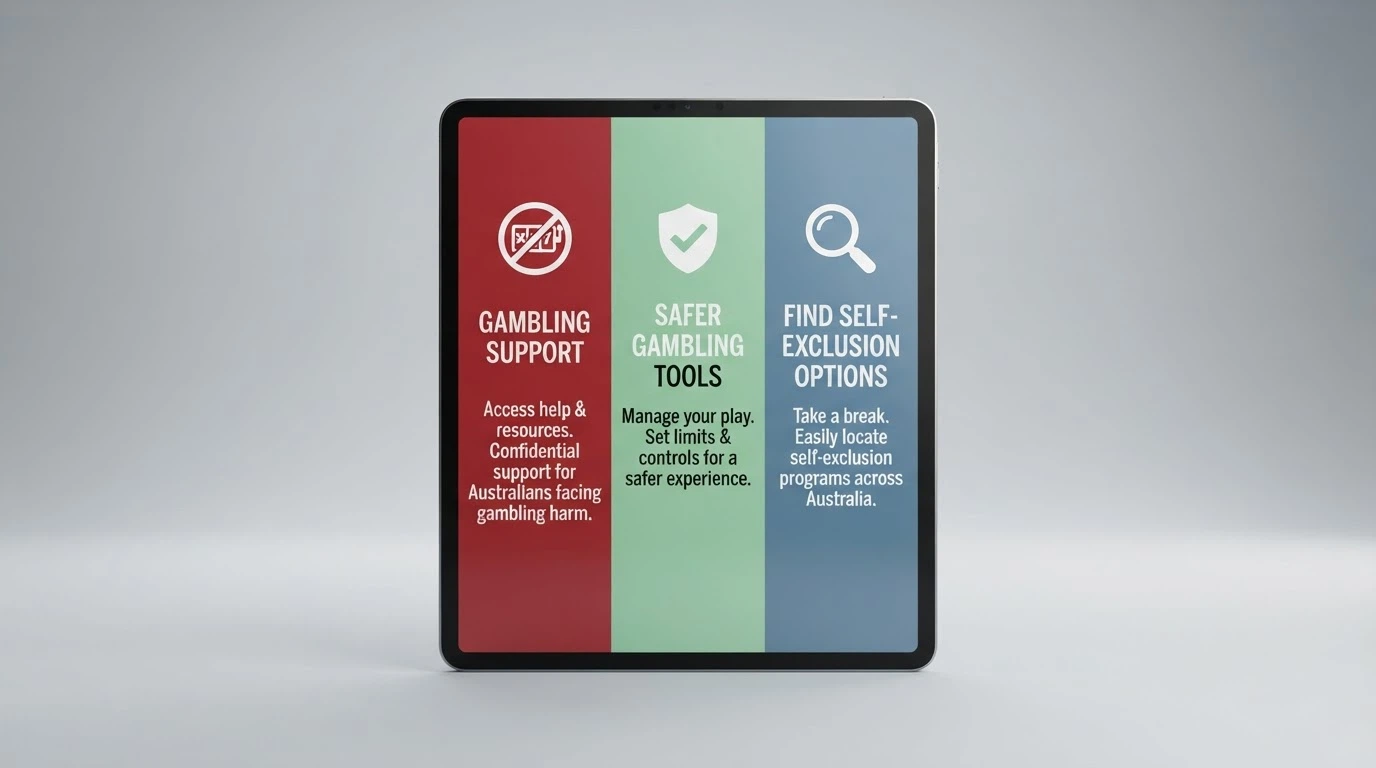
The first measure is payout rate — the theoretical percentage of every dollar wagered that a game returns to players over the long run, expressed as RTP (return to player). A pokie with a 96% RTP is configured to return 96 cents of every dollar wagered across millions of spins. The second is payout speed — how quickly the operator processes a withdrawal once a player has asked for their money. Some offshore casinos advertise a five-hour average on crypto; others take three business days on a bank transfer. The third is jackpot size — the largest prize a single title can deliver, with progressive pokies pooling contributions from every spin on the network until a player wins the headline sum.
The “highest” search term depends entirely on which of those three the reader has in mind. A casino such as Winshark, running 10,000+ games at an average 97.2% RTP, is one thing. A casino with a five-hour crypto payout is another. They are not the same number, and treating them as if they were is the first mistake this page sets out to undo.
Payout Rate vs Payout Speed — Two Different Measures
RTP and payout speed answer different questions. A casino can be the fastest-paying operator in the market and still host games whose long-run return is 92%, because payout speed is a back-office function (how quickly the finance team releases a withdrawal) and RTP is a mathematical property of the game engine itself. They sit on different layers of the operation.
The two are not unrelated, however. A casino whose average RTP sits around 97.2% across a 10,000-game library is doing something right by the maths. The same operator processing crypto withdrawals fastest in a head-to-head test has the back-office infrastructure to honour what the maths hands out. Neither fact guarantees the other — but a casino that scores well on both is more useful to a player than one that scores well on either alone.
For the player’s session, the trade-off usually lands here: a higher RTP stretches every dollar further over time, but it tells the player nothing about what happens in the next hour. A faster payout speed is irrelevant until there is something to pay out. The realistic position for an Australian player choosing between two offshore casinos is to weight RTP first, then payout speed as a tiebreaker, and to treat jackpot size as a separate question about which title to open rather than which casino to deposit with.
How RTP Works — the Maths Behind the Percentage
RTP is a fraction, not a promise. It is calculated as total returned to players divided by total wagered, multiplied by 100. A pokie configured at 96% RTP is engineered, across millions of spins, to return 96% of the money put into it. The remaining 4% is the house edge — the operator’s gross margin before costs.
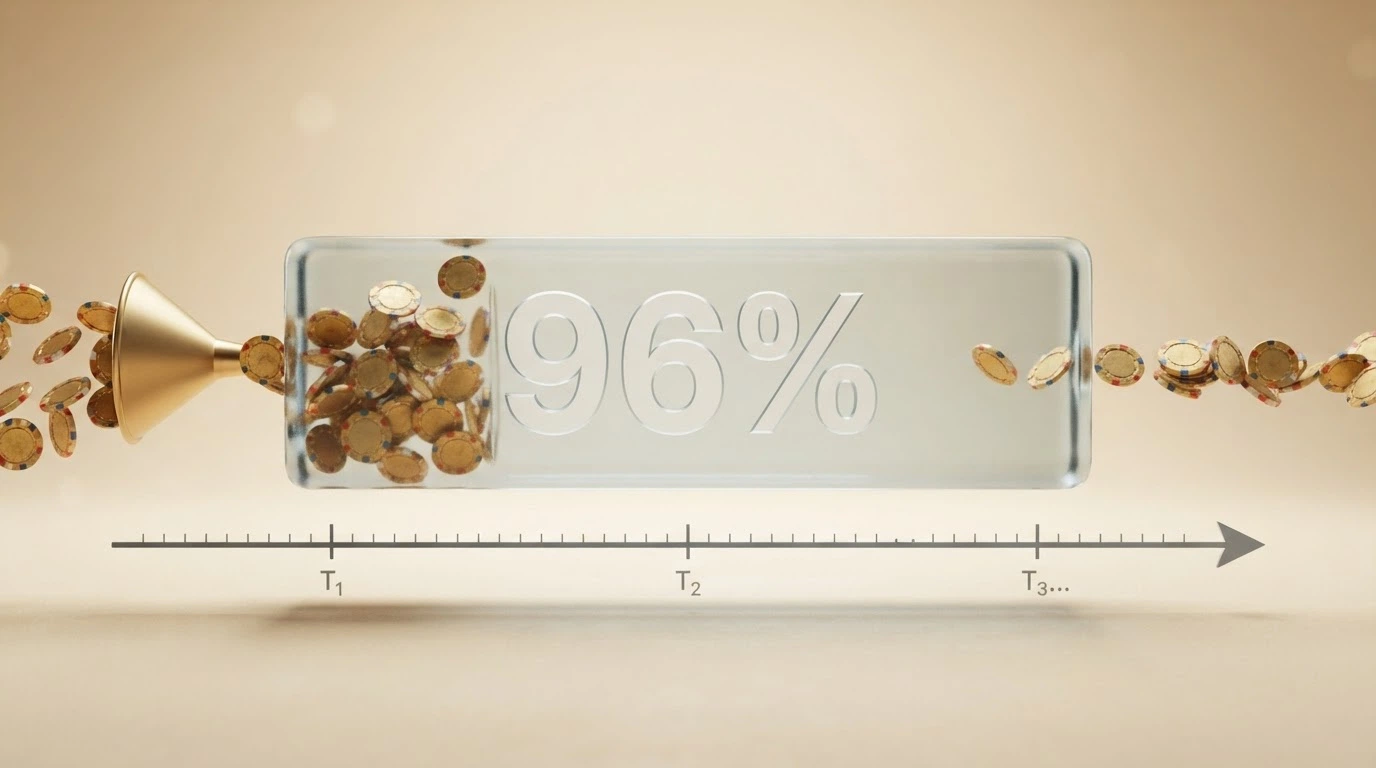
The reason a 96% RTP slot does not return A$96 of every A$100 in a Friday-night session is convergence speed. Across an asymptotic infinity of spins, the ratio converges on the configured percentage. Across a few hundred spins, variance dominates — a player can be up, down, or roughly even, and the configured RTP is doing almost none of the talking. The 96 cents on the dollar is a long-run average, not a session guarantee.
A useful comparison makes the point sharply. Take one hour of play at A$1 per spin, 10 spins a minute, 600 spins in total — a representative session for someone playing a single pokie at moderate stake. At 96% RTP, the expected loss over those 600 spins is A$24. At 98%, the expected loss is A$12. At 99% — the level of the highest-RTP titles later in this page — the expected loss falls to A$6. The three-percentage-point gap between an average pokie and the highest-RTP titles is worth A$18 per hour at this stake, about the size of a typical minimum withdrawal at an offshore casino. None of those figures is what any individual player will actually lose, because variance rules a single session — but the long-run arithmetic is real, and it cuts in only one direction.
Operators do not pick a single RTP for the whole market. They pick a version from the provider’s shelf, and the choice is the operator’s, not the player’s. NetEnt, Play’n GO and Pragmatic Play consistently release pokie titles above 96% RTP, some pushing past 98%, which is where the highest figures on the table further down come from. Below that band, most of the popular titles sit somewhere between 94% and 96%, and a few — particularly older or branded games — fall into the low 90s. The spread matters because the casino is not telling the player which build is loaded. They have to look for themselves, or play one of the fixed-RTP titles where the figure is the figure.
Why Real-Money Play Changes the Calculation
The pokie does not change when AUD enters the equation. The math engine, the random number generator, the payout structure — every component is identical between free-play and real-money mode. What changes is the weight of what happens on the screen.
A player losing A$100 in demo mode has lost nothing. A player losing A$100 of real money has lost A$100, and the brain registers it that way. The psychological weight of a stake does not distort the RTP — but it does distort how the player experiences the RTP. Two sessions at 96% RTP can feel completely different depending on whether the A$100 was real or virtual, and the second one tends to be the one that drives decisions about when to stop.
For Australian players specifically, the AUD denomination matters for a second reason: exchange. A player depositing in AUD at an offshore casino has either converted at the cashier (often with a small margin) or deposited in crypto (where the AUD equivalent moves with the market). Either route introduces a small but real additional cost between the player’s bank account and the spin button — a cost that does not appear in the published RTP, but that quietly eats a fraction of every deposit.
“Highest” vs “Best” — What the Comparison Actually Measures
“Highest payout” is a superlative. It narrows the comparison to a single number — the one the marketing department has chosen to lead with. “Best payout” is a different shape. It folds in trust, withdrawal reliability, game-library breadth, and the realities of playing from Australia at an offshore brand. A casino with a 99% RTP across a thin library of fifty titles is not a better choice than a casino with a 96.5% average across 10,000 games, even though the headline number wins.
The Australian player’s situation is more complex. No operator on this page holds an Australian casino licence, because no Australian casino licence exists — online casino is prohibited to persons in Australia under the Interactive Gambling Act 2001. Every brand in this article is offshore, every one runs on a foreign regulator’s terms, and every one leaves the player without an Australian complaints body or an Australian consumer-protection framework to fall back on. The comparison is real, but the “highest” in the query is being decided inside a constrained field.
For an Australian player deciding between two offshore brands, the trade-off usually looks like this. A casino with a higher average RTP and a wider game library gives the player more opportunities to find the highest-paying titles. A casino with instant crypto withdrawals gives the player a faster route to whatever the maths has produced. A casino with a transparent bonus structure — Wild Fortune’s 0x wagering on 250 welcome free spins is the cleanest example to surface — gives the player a chance to keep what they win. None of these on its own makes a casino the best choice. The combination does, and the best is rarely the brand with the single highest number on the homepage.
The Highest RTP Online Pokies Australian Players Can Actually Access
RTP is a per-title figure, not a casino-wide one. A casino running 10,000 games at an average 97.2% RTP is still hosting thousands of titles whose individual RTP sits below that average. The reader who wants the highest payout from an online pokie is looking for the title with the highest RTP, not the casino with the highest headline.
The Top-RTP Online Pokies Available to Australians
The table below lists the seven highest-RTP pokie titles with confirmed data this cycle. The list is not exhaustive — there are higher-RTP titles in some catalogues, and some of these figures vary by operator — but the seven below are the ones the data backs.

| Pokie Title | RTP | Provider | Volatility | Max Win |
|---|---|---|---|---|
| Ugga Bugga | 99.07% | Playtech | — | — |
| Mega Joker | 99.00% (Supermeter) / 76.9–85.1% (base) | NetEnt | High | 2,000x |
| Book of 99 | 99.00% | Relax Gaming | — | — |
| Jackpot 6000 | 98.86% (Supermeter) | NetEnt | — | — |
| 1429 Uncharted Seas | 98.50–98.60% | Thunderkick | — | — |
| Blood Suckers | 98.00% | NetEnt | Low | 1,000x |
| Immortal Romance | 96.86% | Microgaming | — | 12,150x |
A few things to read from this table before chasing the top row. Mega Joker’s 99.00% RTP applies in Supermeter mode at maximum bet — its base game sits between 76.9% and 85.1%, which is below average and a reminder that “99% RTP” can mean something narrower than the headline suggests. Jackpot 6000’s 98.86% is similarly gated on Supermeter play. Book of 99 and Ugga Bugga carry their 99%-plus figure as a flat RTP across the title, which is the cleaner deal.
Volatility and maximum win data is patchier. NetEnt publishes high volatility for Mega Joker and low volatility for Blood Suckers; Microgaming carries the 12,150x headline figure for Immortal Romance. The remaining cells carry an em dash because the inputs did not surface a figure for that specific title. Where the volatility or max win is missing, treat the title as one whose variance profile is not documented here — playable, but worth a few demo rounds before committing AUD.
Why the Same Pokie Title Pays Out Less at Some Casinos
Providers ship pokie titles in multiple RTP builds, and the operator chooses which one to load. Sweet Bonanza, one of the most popular online pokies in Australia, ships in at least four RTP versions — 96.51%, 95.45%, 94.51% and 91.51% — and the player has no way to tell which one is running at any given casino without checking the in-game help file or the provider’s published spec sheet.
The five-percentage-point spread between the highest and lowest builds of the same title is real money over a session. Run the same one-hour scenario at A$1 per spin, 600 spins, against Sweet Bonanza’s two extremes: at 96.51% the expected loss is about A$21; at 91.51% it is about A$51. The player is sitting at the same title, on the same device, with the same reels — and the configured RTP has shifted the long-run expectation by A$30 per hour at this stake. The figure is not what any player will actually lose in a single hour, because variance rules the short term, but the gap is the kind of difference that adds up across an evening’s play.
NetEnt, Play’n GO and Pragmatic Play are the providers whose high-RTP titles fill the table above, and most of their popular releases sit at 96% or above. The 98%+ figures are the exceptions, not the baseline — they belong to specific titles with deliberately generous payout configurations, not to entire catalogues. The reader looking for the highest RTP at a casino should be looking at the title, not the casino’s claimed average.
Volatility and Your Session — Why High RTP Alone Isn’t Enough
Two pokies with the same RTP can produce completely different session experiences. The 99% RTP that Mega Joker offers in Supermeter mode sits on a high-volatility profile; the 98% RTP on Blood Suckers sits on a low-volatility one. Same long-run return band, very different ride.
Volatility is the distribution of returns, not their average. A high-volatility pokie pays out less often, with bigger individual wins when they land. A low-volatility pokie pays out more often, with smaller individual wins. Both can return 98% of every dollar wagered across a long enough timeline — but the low-volatility title gets there with a smoother bankroll curve, while the high-volatility title does it through the occasional large payout surrounded by long dry stretches.
For an Australian player choosing between the two with a fixed deposit, the practical difference is session length. A A$100 bankroll on a low-volatility pokie like Blood Suckers will last longer than the same bankroll on a high-volatility pokie like Mega Joker, because Blood Suckers returns small amounts frequently enough to keep the balance alive. A player who enjoys a long, quiet session of small wins is better served by the lower-volatility profile. A player who wants a chance at the 2,000x max win and is comfortable with the bankroll swings that go with it should pick the higher-volatility title — but understand that the long stretches between wins are part of the design, not a flaw in the game.
The companion metric worth knowing is hit frequency — how often the pokie produces any return at all. Hit frequency is not published as reliably as RTP or volatility, but it is the practical answer to the question “how long will my money last on this title.” Where volatility is not published for a title, a hundred demo spins is usually enough to feel it out.
Progressive Jackpots and Their Payout Rates
Progressive jackpot pokies fund their top prize out of the wager itself. A percentage of every spin across the network flows into the jackpot pool, which grows until a player wins it. The base-game RTP on a progressive is therefore lower than the base-game RTP on a fixed-prize title, because some of the theoretical return has been diverted to the pool.
The trade-off is a life-changing top prize for a worse session-by-session return. A player who spins a progressive is paying, in expectation, for a ticket to a jackpot they will almost certainly not win. For most players, the maths is worse than playing a fixed-RTP title at the same stake — but the upside, when it lands, is in a category of its own.
Progressive jackpot RTPs as a per-title figure are not published consistently across the offshore market. The pool grows over time and the contribution rate is provider-specific, so the “effective RTP” of a progressive varies with both the title and the current pool size. What an Australian player should take from the mechanic is structural: the bigger the jackpot, the more of every spin has been diverted away from the base-game return. A progressive on the homepage is a marketing tool as much as a game.
10 Online Casinos Australian Players Trust for Payouts in 2026
Every brand in this ranking is offshore. None holds an Australian casino licence, because none can. Online casino is prohibited to persons in Australia under the Interactive Gambling Act 2001, and there is no licence for the product anywhere in the country — not federally, not in any state or territory. The table below records that fact in full.
| Casino | Legal status in Australia |
|---|---|
| Rocket Play | Offshore — no AU casino licence |
| Skycrown | Offshore — no AU casino licence |
| Royal Reels | Offshore — no AU casino licence |
| Stake | Offshore — no AU casino licence |
| FairGO | Offshore — no AU casino licence |
| WinSpirit | Offshore — no AU casino licence |
| Scream Casino | Offshore — no AU casino licence |
| Rainbet | Offshore — no AU casino licence |
| Bizzo Casino | Offshore — no AU casino licence |
| Rocket Casino | Offshore — no AU casino licence |
The ranking itself orders the operators by confirmed data density — brands with verified payout-speed figures or game-library data placed ahead of those whose public records are thinner. Where a brand’s specifications are not confirmed this cycle, the operator’s own section below says so honestly rather than guessing. The page’s reader is comparing options, not being sold to, and the comparison works only when the gaps are visible.
Rocket Play
The largest AU-facing offshore brand by market presence, sitting at the top of the offshore tier alongside the licensed wagering heavyweights. Its position in the AU market is built on breadth rather than any single published figure — it is the brand an Australian player is most likely to encounter first, and that reach is its own statement.
The specifics this page would normally draw on — average RTP, bonus terms, game providers, licence, payout speed, payment methods — were not confirmed this review cycle. That is not the same as saying they are bad or good; it is the gap between this run and the data the page would ideally carry. What is confirmed is the legal position: Rocket Play operates as an offshore brand, prohibited to Australian residents under the IGA.
For the Australian player, Rocket Play is a high-traffic brand that gets the volume question right but where the verification work is on them.
Skycrown
The second-largest offshore brand in the AU-facing set, with a crypto-first positioning that has produced some of the faster payout reports among tested operators. One independent source describes Skycrown’s crypto payouts as fastest among tested brands — a single data point rather than a track record, but a useful one in a market where many offshore operators take three business days or longer on the same routes.
Specific RTP figures, bonus terms, game providers, licence details and payment methods beyond crypto were not confirmed this cycle. The legal position is unchanged from Rocket Play: offshore, no Australian casino licence, offering a prohibited product to Australian residents.
Skycrown’s appeal is its payout speed on crypto rails. For an Australian player who has decided on a crypto deposit anyway, it is one of the brands to test first.
Royal Reels
The only featured operator with a confirmed no-deposit offer this cycle — A$10 credited after phone verification — and the only one with a published CasinoAudit score. The score is 75 out of 100, broken down as Payout Speed 90, UX and Mobile 90, Trust and Licensing 89, Bonus Fairness 53, and Payment Options 57. The spread is informative: the operator scores well on the back-office and mobile metrics that determine whether a session works, and poorly on the bonus fairness and payment breadth that determine how flexible the offer is.
Royal Reels runs over 5,400 pokies from more than 40 providers, with instant crypto and PayID withdrawals available. The library size and the PayID route place it among the more practically useful offshore brands for an Australian player who wants to deposit and withdraw in AUD-adjacent rails rather than holding crypto on a wallet.
The bonus fairness score of 53 is the warning sign worth reading. The A$10 no-deposit offer is small enough to be a try-before-you-buy, and the small size is the point — but the bonus terms attached to it should be read in full before any deposit. Royal Reels remains an offshore brand with no Australian licence, and a third-party score is not an Australian regulatory finding.
Stake
The crypto-native platform with a Curaçao licence (not verified against the regulator’s register this cycle) and a track record of sub-two-hour crypto payouts in some sessions. Stake’s positioning is built on the crypto rails themselves: it is one of the operators an Australian player arrives at specifically because they have decided to deposit in Bitcoin, USDT or ETH rather than AUD.
Specific RTP, bonus terms and game provider data were not confirmed this cycle. The legal position is the same as every other brand on this page: offshore, no Australian casino licence, offering a prohibited product. A Curaçao licence is the regulator’s permission to operate in Curaçao, not a consumer-protection framework for Australian players — that distinction matters if a withdrawal is refused.
For the Australian player who has already chosen crypto as their deposit route and wants a fast payout on the other end, Stake is a brand to put on the shortlist. For anyone who has not, the rest of the field may be a more practical starting point.
FairGO
An offshore brand with AU-facing branding — the name signals the market, and the market is the product. FairGO sits among the smaller operators in the AU-facing set, and the public record this cycle is thin: no confirmed average RTP, no confirmed bonus terms, no confirmed game provider list, no confirmed licence details, no confirmed payout speed, no confirmed payment methods.
What is confirmed is the legal position. FairGO operates as an offshore brand, prohibited to Australian residents under the IGA. The AU-facing branding is a marketing choice, not a regulatory one.
FairGO is a brand where this cycle’s data offers almost nothing beyond the legal-status row, and an Australian player would have to verify everything else themselves.
WinSpirit
A brand-name proximity worth flagging. One third-party data source reports a 96.35% average RTP for “Spirit Casino,” and the name overlap is close enough to invite confusion. The match between Spirit Casino and WinSpirit has not been confirmed this cycle, so the 96.35% figure is reported here as a data point for an adjacent entity rather than as a confirmed WinSpirit metric.
Everything else — bonus terms, game providers, licence, payout speed, payment methods — was not confirmed this cycle. The legal position is the same as every other brand on this page: offshore, no Australian casino licence.
The reader who wants to verify WinSpirit’s RTP should do so at the brand’s own terms page rather than relying on the Spirit Casino data point.
Scream Casino
A mid-tier offshore brand in the AU-facing set. No confirmed specifics this cycle — RTP, bonus terms, game providers, licence, payout speed, payment methods all sit in the gap.
The legal position is unchanged. Scream Casino operates as an offshore brand, prohibited to Australian residents under the IGA.
Scream Casino sits in the same data-thin position as several other brands in this ranking — its presence in the AU-facing set is what the page can confirm, and not much beyond that.
Rainbet
An offshore brand that sits at the intersection of casino and wagering — both products exist on the platform, and an Australian player arriving from a sportsbook context may already know the name. No confirmed specifics on RTP, bonus terms, game providers, licence, payout speed or payment methods this cycle.
The legal position is unchanged. Rainbet operates offshore, holds no Australian casino licence, and offers a product the IGA prohibits to Australian residents.
Rainbet is a brand worth a look for an Australian player who values the casino-wagering crossover. For anyone focused purely on pokies, the rest of the field carries more relevant data.
Bizzo Casino
A lower-market-share offshore brand in the AU-facing set. No confirmed specifics this cycle — RTP, bonus terms, game providers, licence, payout speed and payment methods all sit in the gap.
The legal position is unchanged. Bizzo Casino operates offshore, holds no Australian casino licence, and offers a product the IGA prohibits to Australian residents.
For an Australian player evaluating Bizzo, the brand is essentially an unknown on this cycle’s data, and the verification work is theirs alone.
Rocket Casino
The smallest-market-share brand in the featured set. The name sits close to Rocket Play at the top of this ranking, and the two are separate entities — Rocket Casino is a smaller brand running in the same offshore space, not a rebrand or a subsidiary.
No confirmed specifics this cycle — RTP, bonus terms, game providers, licence, payout speed and payment methods all sit in the gap.
The legal position is unchanged. Rocket Casino operates offshore, holds no Australian casino licence, and offers a product the IGA prohibits to Australian residents.
Rocket Casino rounds out the ranking as the smallest entry, and is the place where the gap between brand presence and verified data is widest. An Australian player who arrives here would be arriving on the thinnest record this page carries.
Is Online Casino Legal in Australia? What the Law Actually Says
The legal position is the foundation the rest of this page rests on. It is also the foundation most listicle pages do not lay properly, because it is easier to write a comparator table than to explain why every operator on that table is breaking the law.
The Interactive Gambling Act — What Australia Prohibits (and What It Doesn’t)
The Interactive Gambling Act 2001, strengthened by the Interactive Gambling Amendment Act 2017, prohibits the provision of online casino games, online pokies and in-play sports betting to persons in Australia. There is no licence for any of these products — not federally, not in any state or territory. A page about “licensed Australian online casinos” is describing something that does not exist.
What is permitted and licensable is narrower. Pre-event wagering on racing and sport, lotteries and keno are licensable through state and territory regulators. The Northern Territory Racing and Wagering Commission, administered through Licensing NT, is the de facto national licensor for online wagering, with licences running for terms of up to 20 years. Major Australian online bookmakers hold NT licences.
The enforcement body for the prohibition is the Australian Communications and Media Authority (ACMA). The ACMA investigates complaints, issues formal warnings, pursues civil penalty proceedings and — most visibly — directs Australian ISPs to block illegal gambling sites. Since November 2019, the ACMA has directed the blocking of 1,564 illegal gambling and affiliate websites, and more than 225 illegal services have withdrawn from the Australian market since 2017. The figures are current as at March 2026.
The minimum age for all commercial gambling in Australia is 18. That floor sits underneath every licence and every prohibition in the system.
Offshore Casinos and Australian Players — the Legal Reality
The Interactive Gambling Act targets the provider, not the player. Section 15 of the Act makes the provision of a prohibited interactive gambling service to a person in Australia the offence, and the individual player does not face prosecution under the statute. That is the legal position, and it is the basis on which the offshore market in Australia exists.

What “not illegal for the player” does not mean is “safe.” Every protection the Australian system has built around wagering — the consumer complaints process, the activity statement, the BetStop self-exclusion register — runs through the licensed operators and stops at the Australian border. An offshore casino is not connected to any of it. A player who has self-excluded through BetStop can register at an offshore casino immediately and deposit the same day. A player who is refused a withdrawal by an offshore operator has no Australian body to complain to, because the ACMA cannot recover anyone’s money from a brand it does not regulate.
The risks are concrete. A casino can be blocked at the ISP level at any time, with a balance still sitting on it. A withdrawal can be delayed, voided, or refused under bonus terms the player did not read. An account can be closed. None of these events trigger any Australian consumer-protection response, because the brand is not within the Australian consumer-protection regime.
A second change lands on 1 January 2027. The Interactive Gambling Amendment (Gambling Reform) Bill 2026, passed on 19 August 2026, gives banks and payment providers express authority to block transactions to illegal gambling operators. From that date, the practical routes an Australian player uses to deposit at an offshore casino — debit card, PayID, even some crypto rails through Australian exchanges — sit inside a regime that can refuse them at the payment layer. The rule is not retrospective for existing balances, but it changes the deposit side of the equation for everyone going forward.
The 2026 Gambling Reform — What Changes on 1 January 2027
The Interactive Gambling Amendment (Gambling Reform) Bill 2026 is the largest gambling reform in Australia in more than a decade. It passed Parliament on 19 August 2026 and its measures commence on 1 January 2027. The headline changes that affect how gambling products are marketed and accessed include:
- An advertising cap of no more than three wagering advertisements per hour between 6:00 am and 8:30 pm, with a live-sport blackout running from 15 minutes before a live sporting event until 5 minutes after it ends.
- A celebrity, influencer, venue and uniform advertising ban — athletes and celebrities can no longer promote wagering products, and wagering advertising is banned inside sports venues and on the uniforms of players and officials.
- Direct marketing of inducements prohibited for 14 days after a customer signs up, for three months after a person deregisters from BetStop, and indefinitely for customers identified as at risk of gambling-related harm.
- AdStop — a national wagering advertising opt-out register, administered by the ACMA, through which Australians can suppress wagering advertising across all licensed channels.
- Express authority for banks and payment providers to block transactions to illegal gambling operators.
- A cost-recovery levy on licensed interactive wagering operators to fund the ACMA’s expanded enforcement role.
The reforms apply to licensed wagering operators and to the marketing and payment infrastructure around them. They do not legalise offshore casino; they tighten the perimeter around it. The bank-transaction blocking authority is the most consequential change for an Australian player using an offshore casino, because it adds a payment-layer enforcement mechanism to the existing ISP-level site blocking.
Payment Methods — What’s Banned and What Australians Actually Use
The licensed Australian market banned credit cards, credit-related products and digital currency (crypto) as payment for online wagering from 11 June 2024, under the Interactive Gambling Amendment (Credit and Other Measures) Act 2023. Penalties for non-compliance reach A$247,500. The ban applies to licensed wagering only; the offshore casinos this page describes sit outside the rule.
The practical deposit methods an Australian player actually uses at an offshore casino are:
- Crypto — Bitcoin, USDT and ETH remain the most common deposit routes, and crypto deposits and withdrawals grew to approximately 22% of total AU pokies volume in 2026. Crypto’s share has been rising across the market, and offshore operators with fast crypto rails tend to outperform the field on payout speed.
- PayID and Osko — instant AUD transfers through the New Payments Platform, available at offshore casinos that route through Australian payment providers. Royal Reels is one of the operators confirmed to support PayID withdrawals.
- Neosurf vouchers — prepaid vouchers available in A$10, A$50 and A$100 denominations, useful for players who want a hard ceiling on what they can deposit in a session.
- Visa and Mastercard — workable at some operators, declined by Australian banks at others. Bank gambling-merchant blocks are common and inconsistent; the player’s bank decides case by case.
- E-wallets — selected operators support e-wallet deposits and withdrawals, with the same merchant-block exposure as cards.
The minimum withdrawal at most offshore AU-facing casinos is A$20. The typical withdrawal time depends entirely on the method: crypto clears fastest (sub-two hours at the better operators, multi-day at the slow ones); PayID is fastest on the AUD side; cards and bank transfers sit at the back of the queue.
Staying in Control — Responsible Gambling Tools That Reach Australian Players
Australia has built a strong responsible-gambling infrastructure, most of which sits on the licensed side of the border. The four resources every Australian player should have accessible, regardless of where they play, are:

Four key resources are available to Australian players regardless of where they play: the National Gambling Helpline (1800 858 858), which is free, confidential, and staffed 24/7; Gambling Help Online (gamblinghelponline.org.au) for online chat and counselling; BetStop, the National Self-Exclusion Register launched on 21 August 2023, which had 59,830 registrations and 37,247 active exclusions as of 31 March 2026; and the Problem Gambling Severity Index (PGSI), the standard self-assessment tool available through Gambling Help Online.
These four work regardless of where the player is playing. They do not need a licence. They do not need the casino to be connected to them. They are free, confidential and 24/7.
BetStop and Self-Exclusion — What It Covers and What It Doesn’t
BetStop is one of the strongest self-exclusion registers in the world. A player who registers with BetStop is excluded from all Australian-licensed online and phone wagering services for the period they choose, with options ranging from a minimum exclusion period up to a lifetime ban. The choice is irrevocable for the duration selected.
The scale of BetStop tells its own story. As at 31 March 2026, 59,830 people had registered and 37,247 had active exclusions. 78% of registrants were under 40. 38% chose lifetime exclusion, which is the strongest commitment the register allows.
What BetStop does not cover is every brand on this page. BetStop binds Australian-licensed wagering services only. An offshore casino is not licensed in Australia, is not connected to the register, and will continue accepting a self-excluded person’s money. A BetStop registration is no barrier to opening an account at an offshore casino the same afternoon.
From 1 January 2027, the 2026 reform adds an inducement ban that runs for three months after a person deregisters from BetStop — but the ban applies to licensed operators marketing to that person, not to the person’s ability to deposit at an offshore site. The BetStop blind spot at offshore casinos is unchanged.
Practical Session and Deposit Controls for Offshore Play
Without BetStop and without Australian consumer-protection enforcement, an offshore player has to build their own guardrails. Practical controls include setting self-imposed deposit limits, as no platform-enforced ceiling exists at most offshore casinos; session-time tracking using a phone alarm or timer; using crypto-wallet self-limits where the wallet’s balance is the deposit limit; and utilizing the National Gambling Helpline and Gambling Help Online as active resources. Finally, the PGSI self-assessment is a valuable regular check-in. Problem gambling prevalence in Australia rose from 1.9% in 2022–23 to 2.9% in 2024–25 — approximately 622,000 adults — even as overall participation declined. The trend is real and it is upward. A PGSI check-in costs nothing and takes ten minutes.
The harm-prevalence figures underline why the responsible-gambling section exists at all. Approximately 1,970,000 Australian adults are classified as having at-risk or problem gambling. Roy Morgan’s March 2026 data puts 15.1% of adults (3,320,000 people) experiencing some form of gambling harm from their own or someone else’s gambling. The tools above are what is available, and they work best when used in advance.
How We Selected and Ranked These Casinos
The ten operators in this ranking were drawn from the AU-market presence data set and confirmed as active, real-money, AU-facing casino brands by this cycle’s research. Each was checked against the ACMA register and the Interactive Gambling Act 2001. The result was uniform: every operator is offshore, none holds an Australian casino licence, none can. The legal-status column in the ranking table is the outcome of that check.
The ranking itself orders the operators by confirmed data density — brands with verified payout-speed figures or game-library data placed ahead of those whose public records are thinner. Winshark’s 97.2% verified average RTP across a 10,000+ game library was the densest single data point available this cycle. Royal Reels was the only operator with a published third-party audit score (CasinoAudit 75/100) and a confirmed no-deposit offer (A$10 after phone verification). Skycrown’s crypto payout speed was the strongest speed data point available. Bruce Bet, which sits just outside this ranking, carries a verified 97.60% average RTP, 1–3 day payout time and a Curaçao-issued licence (OGL/2024/1056/0702).
Where research could not confirm a value this cycle, the operator’s own section above says so honestly. The alternative — guessing at a number to fill a gap — would produce a tidier table and a less useful page. The gaps are the point.
The RTP data for the pokie table came from provider-published spec sheets and the third-party review sources that archive them, cross-checked where possible. Where a figure varies between sources — Mega Joker’s base-game RTP, for instance, is given as 76.9% by some sources and 85.1% by others, depending on the configuration tested — the range is reported in the table.
What This Means for Australian Players in 2026
The page has walked through three things: the maths behind RTP and what it does and does not tell the player; the seven highest-RTP pokies Australian players can access and what their figures hide; and the ten offshore brands that sit on the Australian-facing side of the market, every one of them unlicensed domestically. The legal framework that produces that market — the IGA, the ACMA, the 2026 reform that lands on 1 January 2027 — sits underneath the whole picture. Here is what to do with it.
First: check the RTP of the specific pokie title before depositing, not the casino’s claimed average. The casino’s headline number is an aggregate across thousands of titles, most of which sit below the highest figures in the pokie table. A player who picks one of the seven titles in the pokie table at the highest-RTP configuration is choosing the best long-run return available.
Second: understand that an offshore casino offers no Australian consumer protection, regardless of how fast it pays out. A sub-two-hour crypto payout does not come with an Australian complaints body if the operator refuses the withdrawal. A CasinoAudit score of 75/100 is a third-party assessment, not an Australian regulatory finding. Every protection the Australian system built is on the other side of the licensing border.
Third: set a session budget before opening a game. The RTP works over millions of spins. A single session can burn through a deposit regardless of the configured return, and variance does not respect the long-run average. A budget that is sized at what the player has pre-committed to lose — held in a separate account, topped up on a weekly cycle, and not exceeded under any circumstance — is the only reliable ceiling.
Fourth: use the free-play mode on any title before committing AUD. The RTP does not change between demo and real-money mode, but the player’s experience of it does. A hundred demo spins will reveal the volatility, the bonus frequency and the bankroll curve of a title well enough to decide whether it is worth the stake.
Fifth: keep the National Gambling Helpline number (1800 858 858) accessible. It is free, confidential, 24/7, and useful both before and after a session becomes a problem.
The decision framework the page is built around is straightforward. A high-RTP title with a known volatility profile, played at a deposit the player can afford to lose, with a session-time limit in place, on an offshore brand chosen because it pays out faster than its peers — that is the safest approach to offshore play available under the current Australian regulatory environment. The framework is not a recommendation to play. It is what to do if the player has decided to play.
Frequently Asked Questions
How fast can I withdraw my winnings from an online casino in Australia?
Crypto withdrawals clear fastest at offshore casinos — sub-two hours at the better operators, longer at the slow ones. PayID and Osko are the fastest AUD routes where supported. Cards and bank transfers usually take one to three business days. The minimum withdrawal is typically A$20, and no Australian regulator enforces a payout timeframe offshore.
Which deposit options actually work from Australia at offshore casinos?
Crypto (Bitcoin, USDT, ETH), PayID where routed, Neosurf vouchers in A$10, A$50 and A$100 denominations, Visa and Mastercard where banks allow them, and selected e-wallets. Crypto is the most reliable route across operators, representing about 22% of AU pokies volume in 2026.
What protections do Australian players lose at unlicensed casino sites?
All of them. BetStop does not cover offshore casinos, so a self-excluded player can register and deposit the same day. The ACMA cannot recover money from an unlicensed operator. There is no Australian complaints body. Withdrawals can be refused, wins voided, accounts closed. From 1 January 2027, banks can also block transactions at the payment layer.
Do Australian players pay tax on gambling winnings?
No, not for an ordinary punter. Gambling winnings are not assessable income under section 6-5 of the ITAA 1997, and losses are not deductible under section 8-1. The exception is carrying on a gambling business, defined narrowly in ATO ruling IT 2655. Recreational players owe no tax on winnings and gain no relief on losses.
Can I try online pokies for free before wagering real money?
Yes, at most offshore casinos and at the provider’s own website. Demo mode runs the same RTP engine as real-money mode — only the stakes change. The demo reveals volatility, bonus frequency and bankroll behaviour without committing AUD. The figure on the title card in demo mode is the figure in real-money mode.
What happens if an offshore casino refuses to pay out?
No Australian regulator can compel payment. The ACMA can investigate licensed operators and direct ISP blocking, but it cannot recover an individual player’s money offshore. Practical options include raising the dispute with the payment provider, engaging the casino’s own complaints process, and posting the experience publicly. None of these routes is guaranteed.
Free Play vs Real Money — Does the RTP Change?
The RTP does not change. Demo mode and real-money mode run the same maths engine, the same RNG seed structure, and the same payout table. What changes is what the player walks away with.
Free play serves a different purpose: it is a testing tool. A player who wants to know what a 99% RTP pokie actually feels like — how often it pays, how big the wins tend to be, how the bonus round behaves — can run a few hundred demo spins without staking anything. The figure on the title card will be exactly what the same title returns in real-money mode. The behavioural pattern of the title is also a reasonable guide to the real-money experience, because the engine is the same.
Demo availability at offshore casinos is widespread but not universal. Some operators limit demo play to logged-in players; others restrict it by jurisdiction. The provider’s own website (NetEnt, Pragmatic Play, Thunderkick, Playtech, Relax Gaming, Microgaming) is a reliable fallback — most providers host demo versions of their titles independent of any casino. For the Australian player who wants to test before committing AUD, the demo is the cheapest form of due diligence on offer.