
How fast can an Australian actually get paid by an online casino?
Current as of 22 November 2026 | Verified against ACMA’s interactive gambling register

The search starts from one question: which online casino pays out the fastest? The honest answer is that every casino on the shortlist Australians reach is offshore, unlicensed in this country, and using a payment method that Australia’s regulator has either banned or is preparing to block. Speed is real. So is the trade-off. This page lays out the tested payout data on every method Australians can actually use, the welcome-bonus terms that turn a 15-minute cashout into a fortnight of grinding, and the player protections that disappear the moment a deposit crosses the border.
Table of Contents
- What a “Fast Withdrawal Casino” Actually Means for Australian Players
- Why Your Payout Speed Depends on One Choice
- The Fastest-Paying Offshore Casinos Available to Australians in 2026
- SkyCrown
- RocketPlay
- Royal Reels
- WinSpirit
- Stake
- Rainbet
- Fair Go Casino
- Bizzo Casino
- Scream Casino
- Rocket Casino
- Why a Welcome Bonus Can Add Days to Your Withdrawal
- Crypto Payouts: The Fastest Rail That Comes With Its Own Risks
- Which Pokies Actually Let You Cash Out Fast
- The Offshore Trade-Off: What You Give Up When You Play Outside Australian Law
- Knowing When to Stop: Support That Actually Exists for Australian Players
- How We Evaluated These Fast-Withdrawal Casinos
- Fast Withdrawals Exist Offshore — Here Is What to Do With That Information
- Frequently Asked Questions
What a “Fast Withdrawal Casino” Actually Means for Australian Players
“Fast withdrawal” is the most over-promised phrase in the Australian-facing casino market. Most operators quote a casino-side processing window — ten minutes, an hour, “instant” — and leave the reader to assume the bank-side leg is just as quick. It isn’t.
What the tested data shows: crypto withdrawals clear in a median of 42 minutes; PayID clears in about two hours; e-wallets like Skrill, Neteller and eZeeWallet clear in roughly six hours; Visa and Mastercard take about two working days; bank transfer takes three. Those are medians across offshore operators serving Australian players, drawn from independent testers running real withdrawals in 2026.
The casino-side queue is only one slice of that. A PayID withdrawal at an operator that takes 12 to 24 hours to approve can sit in the queue for a full day before the New Payments Platform — the real-time Australian settlement layer — gets involved. A Visa withdrawal can be approved inside an hour and still take two working days to land, because the issuing bank queues the credit the same way it queues any other settlement.
Then there is identity verification. KYC is the single biggest cause of withdrawal delay at offshore casinos, and it kicks in at modest amounts — typically above around USD $2,000 in cumulative withdrawals. First-time verification adds 24 to 72 hours on top of whatever the queue already takes. Once a player is verified, subsequent withdrawals are usually faster — until the operator’s monthly cap kicks in.
That gap between marketing and tested reality is the page’s starting point.
Why Your Payout Speed Depends on One Choice
The single biggest determinant of withdrawal speed is the payment method, not the casino. Two operators using the same processor can produce wildly different end-to-end times because one routes through PayID and the other through a Visa card. The casino approves the withdrawal either way. The rail carries it.
The Gap Between “Instant” Marketing and Tested Reality
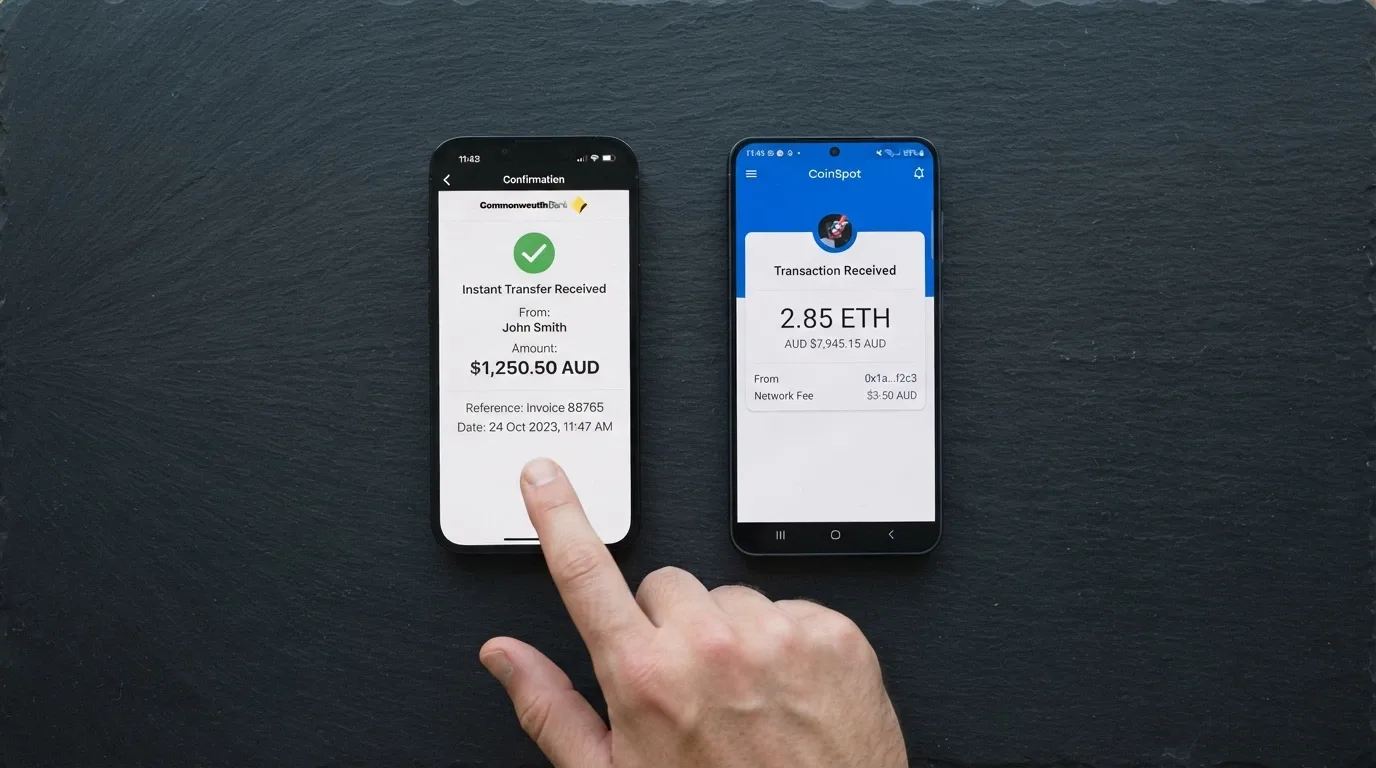
“Instant” is the word most operators reach for, and it almost always means instant at the casino’s end — the moment the cashier clicks “approve.” From there, the rail takes over, and the rail is rarely instant for AUD payouts.
Crypto is the closest to literal instant. USDT on TRC20 and Solana settle in under five minutes; Ethereum and Litecoin in five to thirty; Bitcoin in thirty to sixty-plus, gated by three to six network confirmations. PayID, by contrast, settles on the New Payments Platform in real time once the bank receives the credit — typically inside an hour after the casino releases the funds. E-wallets, cards and bank transfer run on legacy rails with one or more working days of latency built in.
Independent testing puts the medians this way: crypto 42 minutes, PayID two hours, e-wallet six hours, Visa and Mastercard two working days, bank transfer three. Operators whose marketing matches that range are being honest. The ones quoting “instant” for a bank transfer are quoting the wrong window.
PayID: Australia’s Fastest AUD Rail for Casino Payouts
PayID is the fastest AUD-native option. The NPP — Australia’s New Payments Platform — settles individual transfers in real time, which means once a casino releases a PayID withdrawal the funds usually land inside an hour. That is faster than any other AUD-denominated rail, and it avoids the card-network middleman entirely.
The catch is on the casino side. Operators that route through PayID but process withdrawals manually often take 12 to 24 hours to approve the cashout. The bank-side leg is real-time, but the door-to-door time is 36 to 72 hours once both stages are added. The fastest PayID experience comes from operators with automated approval queues; the slowest comes from operators that staff a single payments officer.
For Australians playing in AUD who do not want to touch crypto, PayID is the right rail to insist on. It also avoids the credit-card ban — debit card and bank transfer are still legal payment methods for online wagering, and PayID sits on top of the same banking infrastructure.
Crypto, E-Wallets and Cards: How Every Other Method Actually Performs
| Method | Typical Withdrawal Speed (tested median) | Key Factor Affecting Timing |
|---|---|---|
| USDT (TRC20) / Solana | Under 5 minutes | Network congestion; exchange off-ramp adds 10 min |
| Ethereum / Litecoin | 5–30 minutes | Gas fees; confirmation depth |
| Bitcoin | 30–60+ minutes | 3–6 confirmations required; network load |
| PayID (NPP) | Under 60 min after approval | Casino approval queue; bank release |
| E-wallets (Skrill, Neteller, eZeeWallet) | ~6 hours | Account verification at the wallet |
| Visa / Mastercard | 2 working days | Issuing bank settlement queue |
| Bank transfer | 3 working days | Correspondent banking chains |
Crypto is the fastest end-to-end, but the AUD conversion is its own step. An Australian player who withdraws USDT to a private wallet still has to off-ramp through a local exchange to spend it, and that off-ramp adds another ten minutes plus a KYC check at the exchange itself. PayID is the simplest rail if the casino’s approval queue is tight. E-wallets sit in the middle. Cards and bank transfer are what players fall back to when faster rails are unavailable.
How KYC Verification Adds Hours — or Days — to Your First Withdrawal
The first withdrawal is the slowest one, almost regardless of method. KYC — Know Your Customer — is the verification step every licensed and most semi-licensed operators carry out, and it triggers at modest cumulative thresholds. Above roughly USD $2,000 of withdrawals, most offshore casinos will request government ID, proof of address and sometimes a payment-method screenshot.
First-time verification adds 24 to 72 hours on top of whatever the queue takes. A PayID withdrawal that would clear in an hour after approval can take three days end-to-end if the operator decides to verify identity at the same time. The standard advice — and it is correct — is to complete verification early, before a withdrawal is even needed, so that the first cashout does not stall on paperwork.
Once verified, subsequent withdrawals usually flow through. Until they hit a monthly cap, which is the next obstacle.
Withdrawal Limits: The Fine Print That Caps Your Cashout
A fast rail does not help a player whose withdrawal exceeds the operator’s daily, weekly or monthly cap. The fine print is where the speed promise meets the size of the payout.
A representative offshore example: Instant Casino lists €4,000 per day, €10,000 per week and €20,000 per month in clause 8.1 of its terms. Neospin caps individual crypto withdrawals at A$7,500 per transaction. SkyCrown — at the other end — places no maximum on crypto deposits or withdrawals. The cap varies enormously, and it is set per operator, not per rail.
For an Australian player hitting a sizeable win on a high-volatility pokie, a €4,000 daily cap means a A$50,000 withdrawal takes nearly two weeks to clear at the daily limit alone, ignoring the operator’s processing window. The marketing material still says “fast withdrawal.” The terms page says something different. Read both before claiming any bonus.
The Fastest-Paying Offshore Casinos Available to Australians in 2026
A note before the table: every operator listed below is offshore and unlicensed in Australia. No licence for online casino exists in this country under the Interactive Gambling Act 2001. The brands below operate under a Curacao licence, with one exception (Rainbet) whose specific licence was not independently verified this round. Players using these sites give up Australian consumer protection, BetStop self-exclusion coverage, and the right to dispute a withheld withdrawal through any Australian body. That is the legal floor the comparison sits on.

| Operator | Licence | Welcome Bonus | Wagering | Free Spins |
|---|---|---|---|---|
| SkyCrown | Curacao (Hollycorn N.V.) | 120% up to A$1,200 | 40× | 125 |
| RocketPlay | Curacao | 100% up to A$500 (1st); 200% up to A$500 (2nd) | 40× | 100 |
| Royal Reels | Curacao | 100% up to A$500 | 30–40× | — |
| WinSpirit | Curacao | 200% + 25 free spins | 40× | 25 |
| Stake | Curacao | — | — | — |
| Rainbet | Offshore crypto-focused | 100% + 20 FS / 50% + 20 FS / 100% + 20 FS | 1× (crypto) / 2–3× (fiat) | 60 total |
| Fair Go Casino | Curacao | 100% up to $200 × 5 deposits (up to $1,000 total) | 30× (deposit + bonus) | — |
| Bizzo Casino | Curacao (Antillephone, 8048/JAZ2017-067) | Free spins on sign-up | — | Included |
| Scream Casino | Curacao | — | — | — |
| Rocket Casino | Curacao | — | — | — |
Three of the ten have no confirmed welcome bonus in the source data — Stake, Scream Casino and Rocket Casino. Stake’s omission is deliberate; the operator runs a no-bonus model and pays out on tested crypto times averaging around two hours door-to-door. Scream and Rocket Casino are entries whose terms were not independently verified this round, which the individual write-ups address.
SkyCrown
SkyCrown sits at the top of the speed ranking on the strength of one number: crypto withdrawals tested at under 15 minutes end-to-end, with no maximum limit on crypto deposits or withdrawals. For an Australian player whose priority is the shortest possible cashout, that is the data point that puts the operator first.
The welcome package is substantial: 120% up to A$1,200 plus 125 free spins on the first deposit, scaling to up to A$8,000 plus 400 free spins across four deposits. The minimum deposit is A$30. Wagering is 40× on bonus and free spin winnings, with a 14-day validity window on the welcome offer. The casino is licensed in Curacao via Hollycorn N.V. and runs 7,200-plus games from Evolution Gaming, Pragmatic Play Live and others.
The 40× wagering on a A$1,200 bonus means A$48,000 of turnover before any of the bonus balance becomes withdrawable — a point the section on welcome bonuses returns to in detail. The 14-day validity window makes that turnover a hard deadline rather than a suggestion.
The fastest crypto cashout in the set, on a Curacao licence, with a large but heavily conditioned welcome package. Best for an Australian player who has already decided on crypto, who values speed over bonus extraction, and who is comfortable playing outside Australian consumer-protection law.
RocketPlay
RocketPlay’s two-deposit welcome structure is the unusual part: 100% up to A$500 plus 100 free spins on the first deposit, then 200% up to A$500 on the second (minimum A$50). The 200% second-deposit match is the highest in the set after WinSpirit’s headline figure. Wagering is 40× on the bonus amount, with a maximum bet of A$7.50 during the wagering period — a rule that bites harder than it sounds, because anything above A$7.50 per spin voids the bonus and the winnings.
Crypto withdrawals are tested at one to two hours, which puts RocketPlay in the second tier behind SkyCrown but still well ahead of card and bank-transfer rails. The game library sits at 2,000-plus titles. The licence is Curacao, which is the standard backdrop for this market.
A stronger second-deposit match than most of the set, with a strict max-bet rule that requires discipline. A better fit for a player willing to deposit twice than for a one-shot bonus hunter.
Royal Reels
Royal Reels is one of the rare operators that pairs a deposit-match welcome with a no-deposit sign-up bonus: 100% up to A$500 (minimum deposit A$30) plus a A$10 no-deposit credit on registration. Wagering runs at 30 to 40×. The game library covers 2,000-plus titles from 30-plus providers, including Pragmatic Play, Evolution Gaming, Yggdrasil and Hacksaw Gaming — one of the broader supplier rosters in the set.
The no-deposit bonus deserves the scepticism its type usually earns. A$10 in bonus credit with 30 to 40× wagering means A$300 to A$400 of turnover before withdrawal, on a balance that can already be eroded by a single bad run. The maximum cashout from a no-deposit bonus is usually capped, and the validity window is short.
A useful trial of the cashier; less useful as a path to a real payout. A reasonable pick for an Australian player sampling the platform before committing a deposit.
WinSpirit
WinSpirit’s headline number is the highest match rate in the set: 200% plus 25 free spins on the welcome offer, with 40× wagering. The brand carries a 4.6 out of 5 Trustpilot score, which is unusual for offshore operators targeting Australian players — most of the set carries no public Trustpilot presence at all.
The withdrawal speed was not independently tested in this round. The operator describes its payouts as quick. The Curacao licence is standard. Provider and full game-library counts were not confirmed.
A mid-tier option, strongest for the player who values user-review signal over independent tester data. Treat the marketing speed claim as unverified until tested.
Stake
Stake is the crypto-first operator in the set, and the only one whose business model is built around no traditional welcome bonus. Tested crypto withdrawals average 1 hour 50 minutes casino-side plus around 10 minutes at the exchange, which puts Stake at just under two hours door-to-door — slower than SkyCrown’s 10–15 minutes, faster than card and bank rails by a wide margin.
The no-bonus model cuts both ways. There is no 40× wagering hurdle between a deposit and a withdrawal. There is also no bonus balance to grind through. For an Australian player who has decided not to claim deposit bonuses, Stake’s payout speed and clean terms structure make the operator one of the more honest choices in the market.
Not the fastest cashout in the set, but the cleanest terms — no bonus wagering, no max-bet rule, no validity window pressure. The pick for an Australian player who wants to skip the bonus extraction game entirely and just play.
Rainbet
Rainbet is the entry with the lowest effective wagering requirement in the set: 1× for crypto deposits, 2–3× for fiat deposits, before a withdrawal is allowed. That is meaningfully different from the 30–40× carried by most of the other operators, where the wagering is calculated against the bonus, not against the deposit.
The welcome package is structured across three deposits: 100% plus 20 free spins on the first, 50% plus 20 free spins on the second, 100% plus 20 free spins on the third. E-wallet withdrawals are quoted at next business day. Minimum withdrawal is $15. Rainbet is positioned as crypto-focused, though it accepts fiat.
The low wagering figure is the headline. A player depositing A$1,000 in crypto owes A$1,000 of turnover before withdrawal — versus A$48,000 at a 40× bonus-driven operator. For Australian players who want to deposit, play briefly and withdraw without grinding, Rainbet’s structure is materially friendlier.
The right call for an Australian player who values a short grind over a large headline match. Smaller welcome than the 100–200% matches elsewhere, but the terms make those matches achievable rather than aspirational.
Fair Go Casino
Fair Go is the pokies-focused Curacao-licensed operator in the set, and the only entry whose welcome package carries no maximum cashout on deposit bonuses. The structure is 100% up to $200 on each of the first five deposits — up to $1,000 total — at 30× wagering on deposit plus bonus. The no-max-cashout clause on the deposit bonuses is genuinely unusual.
There is also a $15 no-deposit free chip with 60× wagering and a $180 maximum cashout, which is the structure of almost every no-deposit bonus in this market: small credit, steep wagering, hard cashout cap. A player clearing $15 at 60× owes $900 of turnover before any withdrawal, and the maximum they can withdraw from the bonus itself is $180.
The no-max-cashout on deposit bonuses is the operator’s distinguishing feature. For an Australian player who plans to deposit five times and grind through a pokie-focused library, it removes one of the more common bonus traps.
Most useful for a pokies-focused player planning five deposits. Skip the no-deposit chip; the structure works against you.
Bizzo Casino
Bizzo is the entry with the cleanest licence paper trail: Curacao via Antillephone N.V., licence number 8048/JAZ2017-067, operating through TechSolutions Group N.V. The brand runs on a SoftSwiss white-label stack, which means broad game-library coverage and standard offshore cashier functionality.
Free spins are included in the welcome package, though the specific numbers were not independently confirmed this round. Withdrawal windows are quoted at one to three days, which sits in the middle of the set — slower than crypto-only operators, faster than legacy bank-transfer rails.
A verifiable Curacao licence number and a SoftSwiss infrastructure stack, with welcome bonus specifics and exact payout times not confirmed in this round. A safer mid-tier pick than the unverified names — paper trail first.
Scream Casino
Scream Casino is the entry where the data runs out. The Curacao licence is confirmed. The welcome bonus, the wagering multiplier, the bonus validity window, the withdrawal speed, the game providers and the licence date were not independently verified this round. What that means in practice is that a player choosing this operator is choosing on marketing copy alone.
Independent testing data is what separates an offshore casino claim from an offshore casino fact. Where the data does not exist, the player is the test. The absence of confirmed terms is not a verdict against the operator — it is a flag for the player to read the cashier page, the bonus terms and the responsible-gambling settings before depositing anything they are not prepared to lose.
A Curacao-licensed brand whose bonus terms, payout speeds and provider list were not independently confirmed. Approach with the standard offshore due diligence — read the terms page, complete KYC early and test with a small withdrawal before committing a larger balance.
Rocket Casino
Rocket Casino is the second of the two entries sharing the Rocket name (the other is RocketPlay). The Curacao licence is confirmed. Welcome bonus, wagering, validity, withdrawal speed, providers and game library were not independently confirmed this round. The name overlap with RocketPlay — whose bonus terms and crypto speeds are documented — creates confusion that the absence of verified data does not resolve.
A player looking at this brand should not assume the data carries over from a name-similar operator. RocketPlay’s 200% second-deposit match and 1–2 hour crypto withdrawals belong to RocketPlay. Rocket Casino is a separate brand whose terms have not been confirmed.
A Curacao-licensed brand whose terms and payout times were not independently verified. Until those terms are confirmed, do not assume the Rocket name carries RocketPlay’s data.
Why a Welcome Bonus Can Add Days to Your Withdrawal
A “fast withdrawal” promise collides with a bonus the moment a player opts in. Wagering requirements are the mechanism that turns a 15-minute crypto cashout into a multi-day grind.
A typical offshore welcome package: 40× wagering on bonus and free spin winnings, 14-day validity. Take SkyCrown’s first deposit — 120% up to A$1,200 plus 125 free spins. The A$1,200 bonus at 40× means A$48,000 of qualifying turnover before the bonus balance becomes withdrawable. That is roughly 24,000 spins at A$2 each, or about 33 hours of continuous play at a five-second spin interval.
The math on what that volume costs the player is the part the marketing never volunteers. With Book of Dead at a 96.21% return to player, A$48,000 of wagering carries an expected loss of A$48,000 multiplied by the house edge of 3.79%, which works out to about A$1,819. That is the average cost of clearing the bonus before any withdrawal is possible. A player who never clears the wagering keeps the bonus money but cannot withdraw it. A player who clears it has paid, on average, A$1,819 for the privilege of converting bonus credit into cash.
The 14-day validity window makes the calculation harder. A player who can grind eight hours a day can plausibly complete the turnover. A player playing an hour a day cannot. The clock is running regardless.
No-Deposit Bonuses: The Catch Behind “Free Money” With Fast Payouts
No-deposit bonuses sit in a different category and carry different terms. Across offshore operators serving Australians, no-deposit bonuses typically run 20× to 60× wagering, with maximum cashout caps between €50 and €200 and validity windows from 24 hours to a week.
A A$10 no-deposit credit at 30 to 40× wagering means A$300 to A$400 of turnover before any withdrawal is possible. At 60× wagering on a $15 free chip — the Fair Go structure — the player owes $900 of turnover before the $180 maximum cashout is even in play. The expected loss on a $900 turnover at a 96% RTP pokie is around $36. The maximum you can win is $180. The trade is unfavourable by design.
The reason operators offer no-deposit bonuses is that the terms make them close to unwithdrawable. A player who treats a no-deposit bonus as a free trial of the cashier is using it correctly. A player who treats it as free money has misread the small print.
Bonus-to-Cashout: Why Clearing a Bonus Takes Weeks, Not Hours
The worked example from the SkyCrown welcome makes the arithmetic concrete.
Bonus amount: A$1,200. Wagering requirement: 40× on the bonus. Required turnover: A$1,200 times 40, which is A$48,000. Book of Dead at 96.21% RTP as the benchmark: expected loss over A$48,000 of wagering is A$48,000 multiplied by (1 minus 0.9621), which equals A$48,000 multiplied by 0.0379, or about A$1,819.
That is the statistical cost of clearing the bonus, assuming a player wagers only the bonus amount and plays a 96.21% RTP pokie. In practice, variance around that figure can be large — a hot session can clear the bonus with a smaller loss, a cold session can blow past it — but the average sits at A$1,819.
The 14-day validity window at SkyCrown turns the arithmetic into a clock. A player who can sustain around A$3,500 of daily wagering finishes inside the window. A player running at A$1,500 a day runs out of time on day 13 with the bonus balance still locked. The window is short by design: operators want the bonus cycle to end before most players complete it, because an incomplete bonus is a retained house edge.
For an Australian player choosing to claim a welcome offer, the calculation is straightforward: expected loss from clearing the bonus, versus the bonus size, versus the alternative of depositing without a bonus and withdrawing at any time. The math rarely favours the bonus once the expected loss is fully counted. The reason welcome offers exist is that most players never do the arithmetic.
Crypto Payouts: The Fastest Rail That Comes With Its Own Risks
Crypto is the fastest withdrawal rail at offshore casinos serving Australians — and it is also the payment method Australia’s regulator banned as of 11 June 2024 for any online wagering, under the Interactive Gambling Amendment (Credit and Other Measures) Act 2023. Penalties for non-compliance are up to $247,500. The ban applies to operators, not to players, but it is the clearest signal the regulator sends: crypto as a payment for online gambling sits outside the Australian ruleset.

The speed case is real. USDT on TRC20 and Solana settle in under five minutes; Ethereum and Litecoin in five to thirty; Bitcoin in thirty to sixty-plus, gated by three to six network confirmations. Those are blockchain settlement times, which is what makes them fast — no bank rail, no correspondent chain, no issuing-bank queue.
The cost is friction at the AUD conversion. An Australian player withdrawing USDT to a private wallet still has to off-ramp through a local exchange — CoinSpot, Swyftx, an offshore platform — to spend the money. That off-ramp adds its own KYC, its own processing time and its own banking risk. The payout arrives in five minutes; the AUD lands in the player’s bank account ten to thirty minutes later, depending on the exchange and the deposit method.
The legal status is the harder part. The Australian regulator’s view is that any gambling site asking an Australian for a crypto deposit is operating outside the Australian rules. That does not mean the player is prosecuted — the IGA targets the provider, not the bettor — but it does mean the operator sits outside BetStop, outside Australian dispute resolution and outside any local protection when a withdrawal is refused.
Bitcoin vs USDT vs Altcoins: Which Crypto Rail Is Actually Fastest
Network choice is the difference between a five-minute cashout and a one-hour wait. USDT on TRC20 — Tether running on the Tron network — and Solana both settle in under five minutes in normal conditions. Ethereum and Litecoin sit in the five to thirty minute band, gated by block time and confirmation depth. Bitcoin is the slowest at thirty to sixty-plus minutes, because the network requires three to six confirmations before a transaction is considered final.
Confirmation count is the mechanism. A Bitcoin transaction broadcasts in seconds, but the receiving exchange or casino waits for multiple blocks to be added to the chain before crediting the balance — each block taking around ten minutes. A player wanting the fastest Bitcoin cashout should use a casino that requires only one confirmation, accepting the small reversal risk that comes with that choice.
SkyCrown’s tested crypto cashout of under 15 minutes is consistent with USDT TRC20 or Solana routing. A Bitcoin withdrawal at the same operator would take longer. The choice of network, not the casino, sets the floor on crypto speed.
What Crypto Casinos Mean by “Anonymous” — and What They Do Not
The anonymity pitch is real and partial. Crypto on its own is pseudonymous — wallet addresses do not carry a name — and a casino that takes only crypto deposits has no bank rail to share data through. What that does not mean is that the casino skips KYC. Most operators, crypto-accepting or not, trigger identity verification above roughly USD $2,000 of cumulative withdrawals. A player expecting to withdraw more than that will be asked for ID regardless of how the deposit arrived.
The exchange off-ramp is the second step that breaks anonymity. To convert USDT to AUD and land the money in an Australian bank account, the player has to use a local exchange that runs KYC under Australia’s AML/CTF regime. That exchange is connected to AUSTRAC and reports suspicious transactions. The crypto casino may know nothing about the player; the exchange knows everything.
The honest reading: crypto at an offshore casino is faster than a card, less traceable than a bank transfer, but not anonymous above the KYC trigger at either the casino or the exchange. The “anonymous” claim is a marketing line, and the maths of any sizeable withdrawal makes it inaccurate.
Which Pokies Actually Let You Cash Out Fast
The pokie does not determine withdrawal speed. Every game on an operator’s lobby routes through the same cashier, the same KYC queue, and the same withdrawal cap. What the pokie determines is whether the player reaches the withdrawal stage at all — and that question is settled by RTP and volatility, not by game brand.
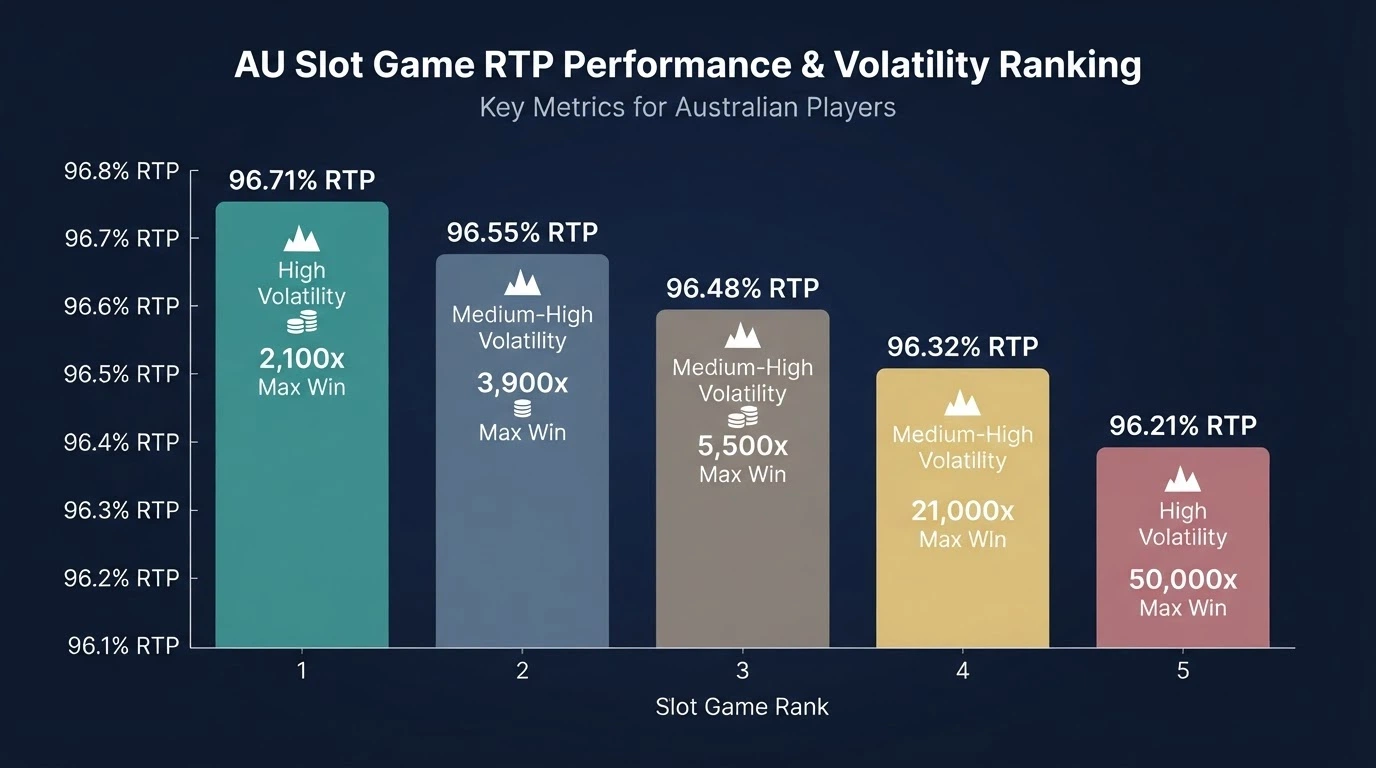
For a player grinding through a 40× wagering requirement, the RTP difference between a 92% pokie and a 96.71% pokie is the difference between losing A$3,840 and losing A$1,572 over A$48,000 of turnover. Variance is wide, but the average is what matters when the wagering requirement is fixed.
The Pokies With the Highest RTP — Your Best Shot at Reaching the Cashout
| Slot Title | Provider | RTP | Volatility | Max Win |
|---|---|---|---|---|
| Book of Dead | Play’n GO | 96.21% | High | 5,000× |
| Gates of Olympus 1000 | Pragmatic Play | 96.50% | High | 15,000× |
| Big Bass Bonanza | Pragmatic Play / Reel Kingdom | 96.71% | Medium-High | 2,100× |
| Sweet Bonanza | Pragmatic Play | 96.49% | High | 21,100× |
| The Dog House Megaways | Pragmatic Play | 96.55% | High | 12,305× |
| Temple Tumble | Relax Gaming | ~96.25% | Very High | ~9,600× |
| Big Bass Bonanza 1000 | Pragmatic Play | 96.51% | High | 21,000× |
| Buffalo King Megaways | Pragmatic Play | 96.52% | High | 5,000× |
| Aloha! Cluster Pays | NetEnt | 96.42% | Low | 700× |
| Trigger Happy | Big Time Gaming | 96.58% | High | 50,000× |
The table is ordered by the headline RTP figure. Big Bass Bonanza at 96.71% sits at the top of the high-RTP set. The original Book of Dead at 96.21% sits at the bottom of the listed figures — and that figure assumes the highest-RTP configuration; lower-RTP variants of Book of Dead exist at 95%, 92%, 91.2% and 87.2% depending on the operator.
A note on volatility: every title in the table except Aloha! Cluster Pays is rated high or very high. That means long losing runs punctuated by large wins. A player grinding through wagering on a high-volatility pokie faces more variance than one playing a low-volatility title — Aloha’s 96.42% at low volatility is the friendliest combination on the list for slow, steady turnover.
The max-win column matters less for withdrawal speed than for ceiling. Trigger Happy at 50,000× is the highest figure on the list, but a 50,000× hit on a A$2 spin is A$100,000 — and at a €4,000 daily cap, that takes weeks to withdraw.
Live Dealer Games and Withdrawal Speed: What Changes
Live dealer games pay out through the same withdrawal queue as pokies. The cashier does not differentiate by game type. What differs is the average stake size and the wagering contribution rate.
Live blackjack and roulette typically run at higher minimum bets than slots — A$5 to A$20 per hand is common. That has two effects. First, the bankroll burn per hour is faster, which means the wagering requirement finishes faster or the bankroll empties faster. Second, many live games contribute less to wagering requirements than slots — some operators count live games at 10% or exclude them entirely. A player who plans to clear wagering on live tables should check the bonus terms page before depositing.
The higher stake sizes also interact with withdrawal caps. A live-dealer player running at A$10 per hand can produce a five-figure win in a session, then hit the operator’s daily or weekly cashout limit before the win is fully withdrawn. The marketing material talks about fast payouts; the terms page talks about per-transaction, daily, weekly and monthly caps. Read both.
The Offshore Trade-Off: What You Give Up When You Play Outside Australian Law
Every fast-withdrawal casino an Australian can reach is offshore and unlicensed in Australia. Online casino and online pokies are prohibited under the Interactive Gambling Act 2001 — providing the service to a person in Australia is illegal, and no licence for it exists anywhere in the country. The Interactive Gambling Act targets the provider, not the player, but the player is the one who loses the protections.
The Australian-licensed alternative covers wagering only — sports and racing — through operators holding state or territory licences. The Northern Territory Racing and Wagering Commission, administered through Licensing NT, is the de facto national licensor for online wagering; the major bookmakers hold NT licences. None of those licences covers casino games. There is no Australian-licensed online casino to compare against.
What disappears the moment a player opens an offshore casino account: Australian consumer protection, ACMA dispute resolution, BetStop self-exclusion coverage, and any recourse if the operator decides to void a balance. The Curacao licence the offshore operator carries is real, but its enforcement is weaker than Australia’s — Curacao-licensed operators have closed, delayed or refused withdrawals on Australian players without an effective local remedy.
The trade is speed for protection. The choice is the player’s. The trade is real either way.
What “No Verification” Casinos Are Actually Trading Away
A casino that skips KYC is skipping the one check that connects it to any enforceable legal standard. KYC is the gate that prevents money laundering, that ties a player identity to a withdrawal, and that gives any regulator a hook to investigate a complaint. A “no verification” casino has removed all three.
The marketing pitch — register, deposit, play, withdraw — sounds like friction removed. The trade is the absence of an AML oversight body, the absence of a dispute resolution mechanism, and the absence of a licence with teeth. A Curacao licence with no KYC enforcement is functionally no licence for consumer protection. A player who wins on a “no verification” casino and is refused the payout has no regulator to complain to, no court with clear jurisdiction, and no escrow holding the balance.
The honest framing: KYC slows down the first withdrawal. Its absence removes the only audit trail that gives a player any leverage at all.
ACMA Enforcement: 1,564 Sites Blocked and Counting
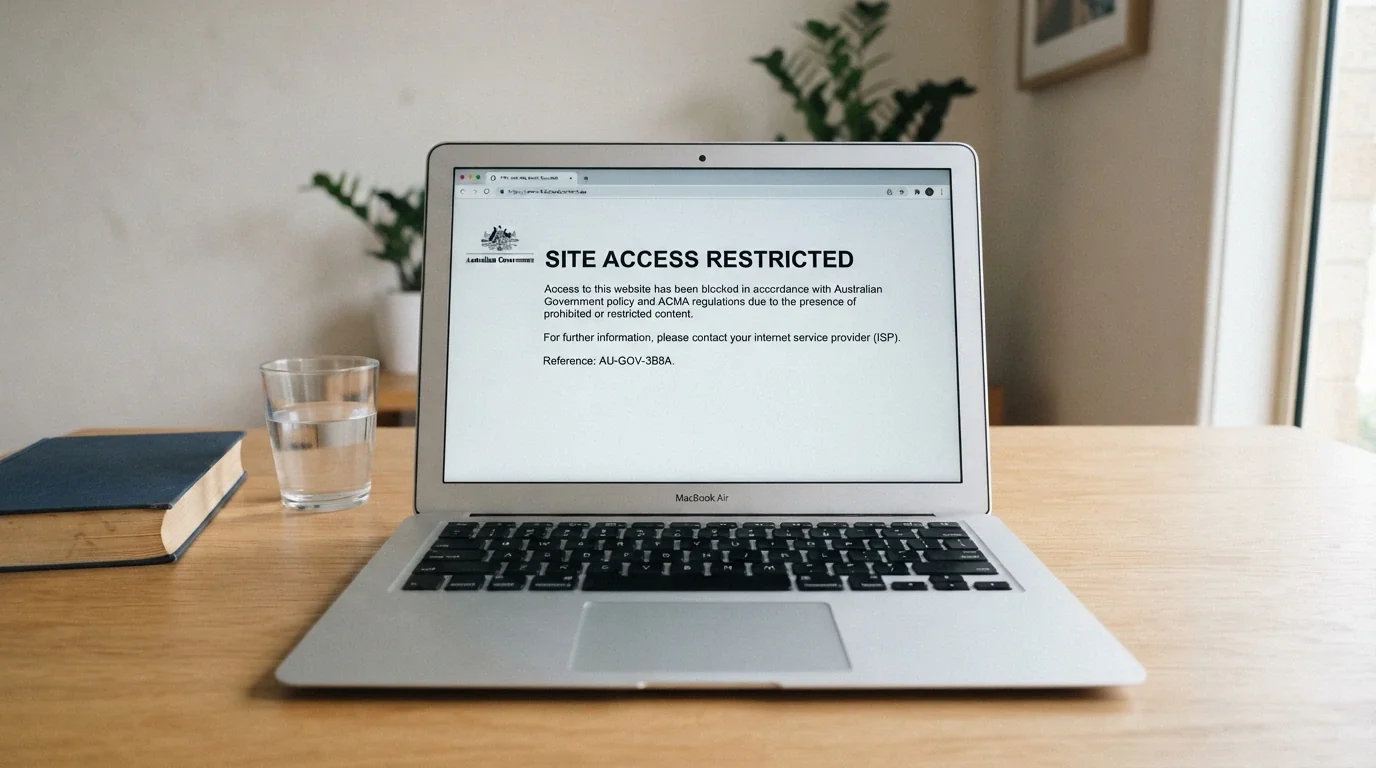
The Australian Communications and Media Authority is not passive. Since November 2019, ACMA has had 1,564 illegal gambling and affiliate websites blocked by Australian ISPs. More than 225 illegal services have voluntarily withdrawn from the Australian market since enforcement was strengthened in 2017.
The recent quarterly data is illustrative. In Q4 2025, ACMA completed 23 investigations into 45 gambling sites and found 69 breaches of the IGA — 38 for providing a prohibited interactive gambling service, 26 for providing an unlicensed regulated interactive gambling service, and 5 for advertising. ACMA referred 133 websites to ISPs for blocking and reported 133 URLs to family-friendly filter providers in the same quarter.
The enforcement regime expands further on 1 January 2027. The Interactive Gambling Amendment (Gambling Reform) Bill 2026 passed Parliament on 19 August 2026, and its measures commence on 1 January 2027. From 1 January 2027, banks and payment providers gain express authority to block transactions to illegal gambling operators. Credit cards, credit-related products and crypto are already banned as payment for online wagering since 11 June 2024, with operator penalties up to $247,500. The payment-blocking expansion closes a rail that has stayed partially open.
A player on an offshore casino today is playing on a site ACMA may block tomorrow. A player whose payment method is a credit card or crypto is using a rail the regulator has already restricted. The risk surface is real.
BetStop, Player Protections and What Offshore Casinos Are Not Connected To
BetStop — the National Self-Exclusion Register — launched on 21 August 2023 and now covers approximately 150 licensed wagering providers in Australia. To the end of Q3 FY 2025–2026, 59,830 people had registered to self-exclude from all licensed online and phone wagering in the country. As at 31 March 2026, 37,247 of those exclusions were active. The minimum exclusion period is three months; the maximum is lifetime. Of the 67,480 registrations made across the register’s first three years to 31 July 2026, more than 60% were still active — and 78% of registrants were under 40, with 38% choosing lifetime exclusion.
BetStop covers licensed wagering only. An offshore casino is not licensed, not connected to the register, and will continue accepting a self-excluded person’s money without flagging the registration. The protection the register offers applies only to operators bound by Australian licence conditions.
For a player who has self-excluded, an offshore casino is the obvious gap. The audit trail at a licensed operator ends at the cashier. The audit trail at an offshore casino does not exist.
Knowing When to Stop: Support That Actually Exists for Australian Players
The Australian help infrastructure is real and well-funded. It is also not connected to offshore casinos.
The National Gambling Helpline is 1800 858 858 — free, confidential, staffed 24/7. Online chat and counselling are available through Gambling Help Online at gamblinghelponline.org.au. Both are Australian services, run under federal and state government funding, and exist to support anyone whose gambling has stopped feeling like a choice.
The prevalence numbers put the scale in view. About 2.1% of Australian adults — roughly 430,000 people — experience problem gambling. The Australian Institute of Health and Welfare put high-risk gambling at 1.8% in 2022. In 2022, ACMA found more than one in 10 Australians had gambled online in the previous six months, up from 8% in 2020. The market is growing. The help infrastructure has grown with it.
Where people turn when they decide to seek help: a helpline (37.9% of at-risk regular online bettors), a gambling help website (35.8%), family or friends (30.5%), a doctor or psychologist (27.4%), self-exclusion (26.3%). The main reason cited was financial problems, at 60%. The pattern is consistent: the trigger is financial, the response is a mix of professional and personal support, and the help services are reachable without cost.
Deposit Caps and Self-Limits: What Offshore Casinos Actually Offer
Most reputable offshore operators carry a responsible-gambling settings page: deposit limits, session limits, take-a-break periods, and self-exclusion at the account level. The tools are real and they work — a player who sets a A$100 daily deposit limit cannot deposit more than A$100 that day at that operator.
The tools are also operator-specific. They do not connect to BetStop or to any Australian register. A player who self-excludes from an offshore casino has excluded only from that operator. The next operator is unaffected. The strength of the tools depends entirely on the operator’s own compliance — there is no Australian body enforcing the limits the way ACMA enforces blocking at licensed providers.
For a player choosing an offshore casino, the responsible-gambling page is worth a read before the first deposit. For a player who has already registered with BetStop, an offshore casino is the gap the register cannot close.
How We Evaluated These Fast-Withdrawal Casinos
The comparison rests on three categories of source: regulator data, independent tester data and operator self-reporting.
The legal backbone is the Australian Communications and Media Authority’s published enforcement record, including the 1,564 blocked-site count, the Q4 2025 investigations and breaches data, and the BetStop register statistics. The licence paper trail for Curacao operators comes from the operators’ own footer disclosures, cross-checked where possible against the Curacao Gaming Control Board.
The withdrawal-speed data comes from independent testers running real withdrawals in 2026: Betsquare’s tested payout medians across crypto, PayID, e-wallets, cards and bank transfer; PayoutVerdict’s door-to-door crypto timing; Esports.gg’s per-operator speed tests for Neospin and SkyCrown; and CardPlayer’s network-level crypto speed breakdown. Where the tester data disagreed with operator self-reporting, the tester data was used.
The bonus and term data comes from operator terms pages and from review aggregators including thepokies.net and australiangamblers.com. Where a term was not independently verified — for Scream Casino and Rocket Casino in particular — the write-up says so and ranks the operator as unverified.
What the comparison does not include: software-side payout RNG audits (which exist for some providers but were not pulled for this round), affiliate deal economics, and the per-player edge case where a withdrawal is refused for a bonus-term violation. Those would be the next layer down for a reader who wants a deeper drill.
Fast Withdrawals Exist Offshore — Here Is What to Do With That Information
Fast withdrawals are real. Crypto at SkyCrown clears in under 15 minutes in testing. PayID at a fast-approving operator clears in under an hour. E-wallets clear in six. Cards take days, bank transfers take three. The data on every rail is in the payment-method comparison table.

The legal status of every operator offering those speeds is offshore. No Australian licence covers online casino. The Interactive Gambling Act 2001 prohibits the service. ACMA blocks sites — 1,564 to date — and from 1 January 2027, banks gain authority to block the transactions. The IGA does not prosecute the player. The IGA does not protect the player either.
The choice the data points to is honest: a player who wants fast crypto payouts at an offshore casino can have them, and the trade is BetStop coverage, Australian consumer protection, ACMA dispute resolution and any recourse if the operator refuses a withdrawal. A player who wants the protections needs to use a licensed Australian wagering provider — which covers sports and racing, not casino games.
For a player who decides to proceed offshore, the practical steps are: verify the Curacao licence number on the Curacao register; complete KYC before the first withdrawal, not at it; read the bonus terms page for the wagering multiplier, the validity window, the max bet during wagering and the max cashout cap; withdraw in tranches within the operator’s daily, weekly and monthly limits; and keep the National Gambling Helpline number — 1800 858 858 — somewhere it can be reached without searching.
This page does not recommend an operator. It equips a reader to make their own decision with the data that exists. The speed is real. The trade is real.
Frequently Asked Questions
How fast do casino withdrawals actually arrive in my bank account?
Door-to-door, tested medians in 2026 run: crypto 42 minutes, PayID 2 hours, e-wallets around 6 hours, Visa and Mastercard about 2 working days, bank transfer 3. The casino’s approval queue is one part; the rail carries the rest, and the bank-side leg is rarely instant for AUD payouts.
Why do some withdrawals clear in minutes and others take days?
The payment method sets the floor. Crypto rails settle on a blockchain in minutes. PayID settles on the New Payments Platform in real time once the casino releases it. Cards and bank transfer run on legacy rails with working-day queues. First-time KYC adds 24 to 72 hours on top.
Is online casino legal in Australia?
No. Online casino, online pokies and in-play sports betting are prohibited under the Interactive Gambling Act 2001. No licence for online casino exists anywhere in Australia — federally or in any state or territory. The IGA targets the operator, not the player, but the player has no Australian consumer protection at an offshore site.
What ID documents do offshore casinos ask for before a withdrawal?
Typically government-issued photo ID (passport or driver’s licence), proof of address such as a utility bill or bank statement from the last three months, and sometimes a payment-method screenshot. KYC usually triggers at cumulative withdrawals above roughly USD $2,000, and first-time verification adds 24 to 72 hours.
Does BetStop cover offshore online casinos?
No. BetStop covers approximately 150 licensed Australian wagering providers. Offshore casinos are not licensed and not connected to the register — a BetStop registration does not stop an offshore operator from accepting deposits or wagers. For full coverage, the offshore operator’s own self-exclusion tool has to be set at each site.
What happens to my money if an offshore casino blocks my account?
There is no Australian dispute resolution body with jurisdiction over an offshore operator. A player can complain to the Curacao Gaming Control Board, but enforcement is slow and weak. The practical defence is prevention: complete KYC early, keep records, withdraw within stated limits, and avoid operators with no verifiable licence number.
Can I use a credit card to deposit at an online casino in Australia?
No — credit cards and credit-related products are banned as payment at licensed Australian wagering providers since 11 June 2024 under the Interactive Gambling Amendment Act 2023. An offshore casino may accept them, but using a credit card tells you the operator is serving the player outside the Australian rules. Debit cards, PayID and bank transfer remain the legal AUD rails.