Best 3-Reel Pokies: The Honest Australian Guide to Classic Slots in 2026
 Available in AU
The three-reel pokie is the oldest format in Australian gambling, older than the smartphone you are reading this on, older than the word “online.” It is the original. Three spinning reels, a single payline if you keep things simple, fruit and bar and seven symbols — the same icons that still glow behind glass in pubs from Parramatta to Perth. The format remains a steady part of the gambling landscape across the country, one that the average Australian barely thinks about and few outside it understand.
This page is about those games and what the offshore internet does to them. It ranks the eight best 3-reel titles an Australian player can actually find online right now, ranked by published return-to-player (RTP). It covers the ten offshore casinos Australian players use to reach them. It names the Interactive Gambling Act, ACMA’s enforcement record, and the BetStop self-exclusion register that does not reach the offshore lobby your money enters. If you came here looking for a discounted chip, stop reading. If you came here to understand the format and the cost of playing it, read on.
Current as of 18 October 2026. Operator licence claims verified against ACMA’s public register of prohibited services and Curaçao Gaming Authority published licence data.
Table of Contents
- What Is a 3-Reel Pokie — The Classic Machine, Honestly Explained
- How a Classic 3-Reel Machine Plays — Reels, Paylines and Payouts
- Why Australia Calls Them “Pokies” (and What That Says About the Game)
- 3 Reels vs 5 Reels — What More Reels Actually Cost You
- Free-Play 3-Reel Pokies — Try Before You Spend a Cent
- Real-Money 3-Reel Pokies — What Changes When Cash Hits the Reels
- Bonus Rounds on a 3-Reel Machine — Yes, They Exist
- Playing 3-Reel Pokies Online — How the Digital Version Works
- Classic Over Modern — When Simpler Pokies Are the Smarter Pick
- The Best 3-Reel Pokies Worth Your Time in 2026
- Where Australians Actually Play 3-Reel Pokies — The Offshore Casino Comparison
- The Legal Reality of Playing 3-Reel Pokies Online in Australia
- The IGA 2001 — Why Australia Banned Online Casino
- ACMA Enforcement — 1,564 Blocked Sites and What That Means for Your Session
- Licensed vs Offshore — The Protections You Actually Give Up
- Australian Payment Rules — No Credit Cards, No Crypto for Pokies
- Playing 3-Reel Pokies Without Losing Control
- BetStop — Your National Self-Exclusion Register (and the Offshore Gap)
- Deposit Limits, Session Caps and Activity Statements — The Tools That Exist
- Spot the Signs — When a Pokies Session Has Turned Harmful
- Free Help That Works — Helplines, Chat and Face-to-Face Support
- How We Picked and Ranked These 3-Reel Pokies
- The Sources We Checked and the Criteria That Ordered This List
- Your 2026 3-Reel Session — What to Actually Do Next
- Frequently Asked Questions
What Is a 3-Reel Pokie — The Classic Machine, Honestly Explained
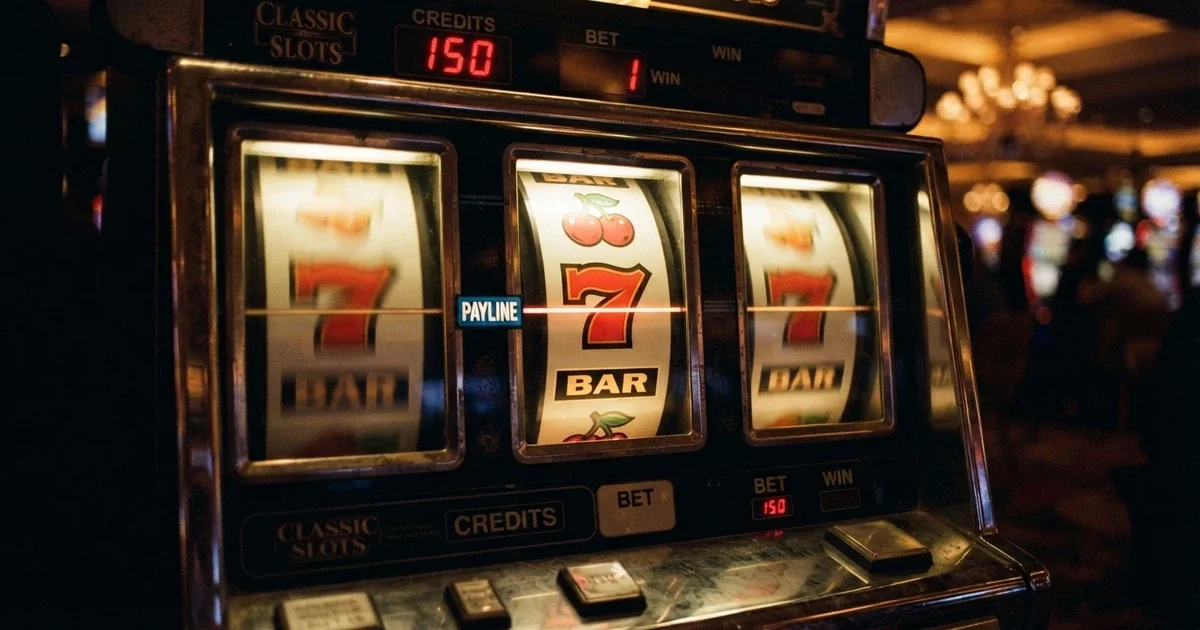
A 3-reel pokie is the original slot machine: three vertical reels spinning behind a payline, a lever or button that sets them in motion, a paytable built from a handful of icons, and a payout for lining up the right combination on the line that runs across the centre. Classic pokies are traditional slot machines built around simple mechanics: typically three reels, one to nine paylines, and iconic symbols like fruits, sevens, bars and bells. There is no scatter-pay maze, no avalanche feature, no expanding wild that triggers a free-spins round. The reel strip is a string of weighted symbols, the RNG picks which one stops on the centre line, the paytable pays out or does not, and the next spin starts. That is the game.
The reason the format survives is arithmetic, not nostalgia. Classic 3-reel slots typically land within a 94% to 96% RTP range, and that figure sits higher on the paytable than the equivalent 3-reel video slot because there is no bonus round absorbing part of the payout structure. On a 5-reel video slot with a free-spins feature and a pick-me bonus, a slice of every dollar feeds those mechanics. On a 3-reel classic, almost every dollar goes into reel-stop payouts, with a thin slice returned as the base-game hit frequency. The math is simpler, the math is in your favour, and the math is also the reason a 3-reel spin feels less spectacular. The spectacle costs payout. The payout is the point.
This format did not become a relic. It became a category. Every publisher who treats pokies seriously — NetEnt, IGT, Microgaming, Play’n GO, Pragmatic Play, Yggdrasil — keeps a classic 3-reel line in production for the audience that wants the format exactly the way it was. A modern 3-reel game is built on the same foundational logic: reel strips, a fixed RTP, a paytable the player can read before the first spin. The interface might be HTML5 instead of a lever, but the machine is the same machine.
How a Classic 3-Reel Machine Plays — Reels, Paylines and Payouts
Strip a 3-reel pokie to its parts and there are four. There is the reel strip, a virtual ribbon of weighted symbols printed on each reel, twenty or thirty stops long, with the higher-paying icons deliberately spread thin so they land less often. There is the RNG, which picks one stop per reel on every spin and produces an outcome independent of every outcome that came before it. There is the payline (or, on Modern takes, up to nine of them) that reads the combination on the centre row. And there is the paytable that turns that combination into dollars or credits, with the highest-paying line Reserved for three of the rarest symbol across all three reels.
A spin takes about three seconds of animation time, and the mathematics already happened before the rings started to slow. The random number generator picked the three reel stops the instant you pressed the button, then the screen catches up. The reels themselves are cosmetic: the player sees cherries and bars tumbling to a stop, but the result was a number a millisecond ago, and that number is what pays. There is no momentum to chase, no near-miss that means anything more than the random number that flicked past. You can build patterns from the last twenty outcomes and the next spin will ignore all of them. Outcomes are independent, RNG-driven, irreducible to anything the human eye can see coming.
The paytable hierarchy runs from the lowest-paying symbol — usually a cherry, with two-on-the-payline returning a small multiple of the line bet — up to the top icon, the seven, the bar stack or the jackpot symbol. A classic Supermeter-style game lifts the top symbol’s reward by inviting the player to wager winnings on a second-stage reel set, doubling, trebling or quadrupling whatever the base spin produced. On Mega Joker with optimal play, that second-stage feature pushes SuperMeter mode RTP up to 99%; on Jackpot 6000 the same mechanic hits 98.9%. The Ordinary Base Game sits lower — Jackpot 6000 base game returns 95%, the standard mid-market position — and that gap between the two settings is the entire decision the format offers.
Why Australia Calls Them “Pokies” (and What That Says About the Game)
Australian English uses “pokies” for what the rest of the English-speaking gambling world calls slots. The word is a diminutive of “poker machines,” the term Australians used when the first video-based card-and-spin hybrids landed in pubs and clubs in the years after the legalisation of poker machines in New South Wales clubs in 1956. The machines have nothing to do with poker; the name stuck.
The distinction matters offshore. When an Australian player lands on an offshore casino lobby and the page says “Slots,” the word still means slot machines, but the American or European origin of the page reads “one-armed bandit,” “fruit machine,” “slot machine” — three different words for the same cabinet. The Australians among them use “pokies” without thinking about it. A page that calls them “classic slots” is reaching across that gap. A page that calls them “pokies” is speaking the local language.
The regulatory split runs along the same seam. Australia bans online casino, online pokies and in-play betting under the Interactive Gambling Act 2001 — the Interactive Gambling Act did not pass to punish players, it passed to contain harm. The IGA targets the provider, not the person placing the bet. The legal product is the land-based pub and club machine, the licensed casino floor, the pre-event sports and race wager you place through an Australian-licensed bookmaker. Online is offshore and unprotected. An Australian licence for online pokie provision does not exist, because the Act prohibits it, and amendments in 2017 and 2026 have only tightened the cordon. The word “pokies” is the home-grown name for a category Australia regulates hard where it permits it at all.
3 Reels vs 5 Reels — What More Reels Actually Cost You
Five-reel video slots are where the format went in the 2010s, and the difference is not two extra reels, it is the entire structure of where the payout lives. A 5-reel video with three rows carries 15 symbol positions, dozens or hundreds of paylines or “ways to win,” scatter pays, wild substitutions, free-spin rounds, cascading reels, expanding symbols, pick-me bonuses. The screen fills with motion every spin, and the player’s eye catches something on nearly every press of the button. The maths adjusts accordingly. A modern video slot must hold back a meaningful chunk of its RTP for the bonus feature, because that feature is what the player came for and what the marketing celebrates.
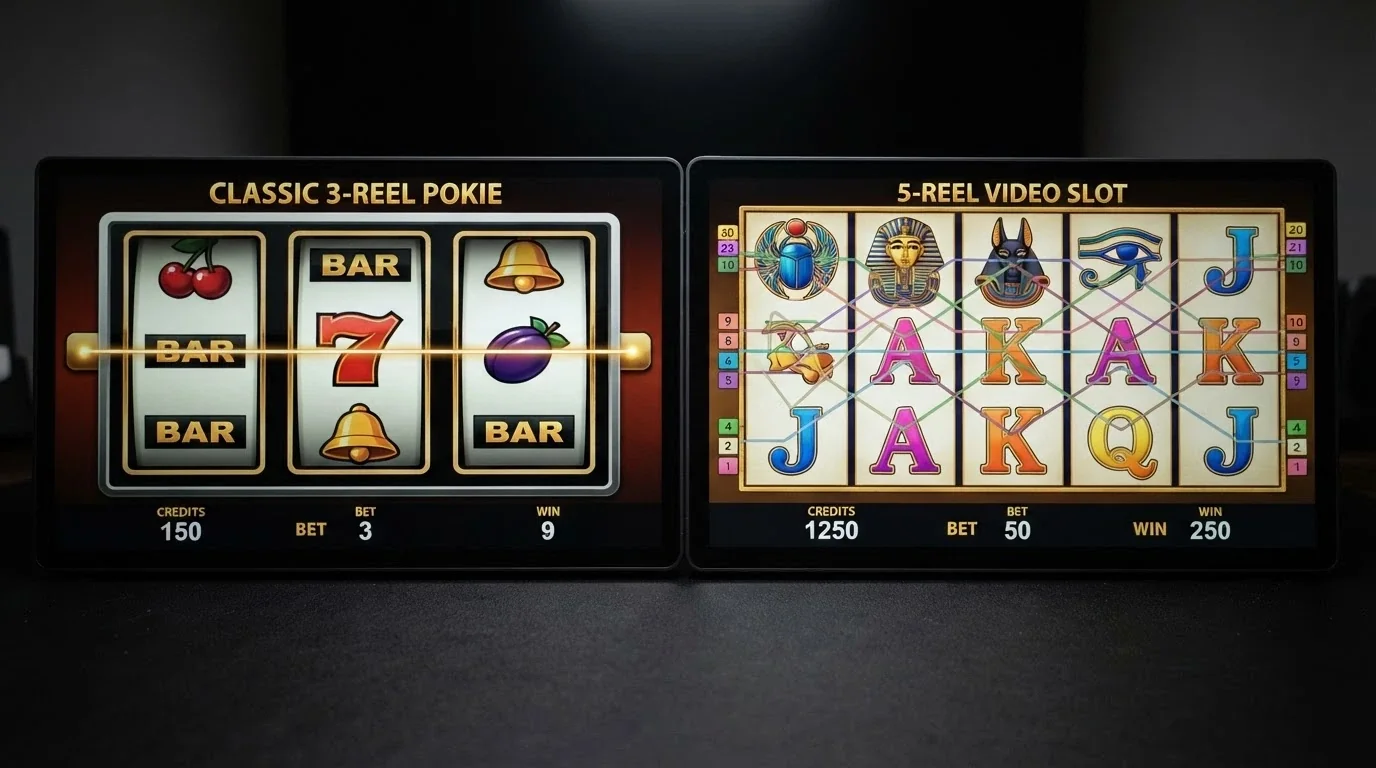
On a 3-reel classic, that bonus-feature budget collapses almost to zero. There are no free spins, no scatter pays, no pick-em bonuses to fund. The game returns almost everything through regular reel stops — line wins, the occasional wild multiplier, the rare Supermeter sequence. Classic pokies tend to have higher base-game RTP because there is no bonus round absorbing part of the payout structure; RTP is distributed more evenly across regular spins. A 3-reel spin where you line up two cherries and a bar still pays. Five of your wager comes back as small wins on roughly a third of spins in most classic structures, where a 5-reel video slot might pay out its base wins on only twenty percent of spins.
The trade reads clearly. The 5-reel game is louder, more frequent in its hit animation, and structurally dependent on a bonus feature the player must trigger to see the game’s headline RTP. The 3-reel game is quieter, shorter on animations, and closer to “what you see is what you get” on every individual spin. Multiply that out across a hundred spins: a steady drip of small wins and a clearer sense of pace. For a player who treats pokies as a session of entertainment and wants a budget to last, the 3-reel structure is the structure of bankroll discipline. For a player chasing a thousand-x hit on a bonus-trigger, the 5-reel is the format built for that.
Free-Play 3-Reel Pokies — Try Before You Spend a Cent
Every 3-reel title this page ranks is also playable without a cent, and most of them should be. Offshore casino lobbies and dedicated slot-review sites host a demo toggle on every classic pokie in their library — the same RNG, the same reel strip, the same paytable — without asking the player to register, verify identity or deposit. Sun Vegas Casino, VegasSlotsOnline, Slotsmate and the dedicated demo hubs all carry versions of Mega Joker, Jackpot 6000, Triple Diamond and the rest. The download question does not arise in 2026: modern HTML5 means the demo loads in the browser, on a phone or on a laptop, in roughly the time it takes to load this page that you are reading.
A free-play session answers questions a marketing page cannot. The published RTP is an average over millions of spins — what the session reveals is volatility: how often the game pays, how long the dry spells run, how big the rare hits land. A 96.3% RTP game with high volatility can still feel brutal over a hundred spins, the way a low-volatility 95% game can feel like a steady trickle. The demo is the only hour of clear information. Run the game for an afternoon. Watch the paytable payout ratios in practice, not at the listed theoretical level. Use that hour as the cost-free filter for which title deserves your real-money budget.
For Australian players specifically, the demo also resolves the legal-access question. Offshore casinos do not permit real-money play to Australian-registered accounts behind a credit card or crypto deposit — both have been banned since 11 June 2024 — but the free-play version lives outside the deposit flow entirely. The demo lets the player see the game; deposit and play, if it comes to that, is the step that engages the payment rules and the offshore status. Try the game with no money first. That is the right order.
Real-Money 3-Reel Pokies — What Changes When Cash Hits the Reels
The moment real money enters a session, three things change at once. The stake is no longer abstract, the RTP becomes a dollars-per-hour calculation, and the legal status of the casino becomes material. The fourth and less-obvious change: the player is now on an offshore site, because no Australian licence exists for online casino, and the protections described in every state-based wagering regulator’s brochure do not apply.
The stake side of the move is the easy end. Minimum deposits for the operators that publish them sit in the $20 to $75 range, minimum spins are typically a cent up to a dollar, and 200 spins at $1 per spin is a budget of $200, which is more than enough to test a session and to demonstrate everything the maths of the game has to show.
The expected-loss math puts a number on that session. Take a typical 3-reel RTP of 96% — the midpoint of the 94% to 96% range most classic pokies cluster in — at 200 spins of A$1 each. The formula is spins × stake × (1 − RTP) = 200 × $1 × 0.04 = $8 in expected house edge. That is the projected cost across thousands of identically-structured sessions. Any single session can land wildly above or below that line, variance is structural on a 3-reel game just as it is on a 5-reel one, but the long-run figure is what the maths says. A player who treats pokies as fifty dollars of entertainment is paying roughly $2 over fifty spins at a quarter per spin. A player spending $200 over the night has lost an average of $8 to the house edge, before any win happens to land.
What real money also delivers is the legal frame. Australia has no online casino licence for any operator, and the IGA of 2001 prohibits the offering. Real-money play at an offshore site means the player is on a platform outside Australian jurisdiction, with no recourse through ACMA if a withdrawal is held, no consumer protection from a state commission, and no automatic link to BetStop if they ever need to self-exclude. The math is the math anywhere; the consumer protection is the part that exists only on one side of the law.
Bonus Rounds on a 3-Reel Machine — Yes, They Exist
The assumption that 3-reel pokies have no features is wrong. The features exist; they are just built into a different structure than the cascading-reels, expanding-wild, free-spin-round design of a 5-reel video slot. The classic format’s “bonus” is usually the Supermeter, a second-stage reel set that turns a base-game win into the chance to multiply it, and the wild multiplier, a standard wild that doubles or quintuples the line bet on a winning combination.
Mega Joker (NetEnt) is the Supermeter prototype. The base game is a familiar three-reel layout, but every win lets the player choose between collecting the payout and entering SuperMeter mode. In SuperMeter, the reels reset to a stripped-down set where the joker symbol carries the highest multiplier. Optimal play on SuperMeter pushes the game’s RTP up to 99%, the highest published return on the classic 3-reel list. Jackpot 6000 (NetEnt) runs the same mechanic on a sister platform and reaches 98.9% RTP in SuperMeter. NetEnt built both titles because the mathematics of the SuperMeter catches the same structural edge a 5-reel bonus round catches, but without the volatility distortion.
Fire Joker (Play’n GO) carries a different mechanic: the Wheel of Multipliers. Line up three joker fire symbols to fill the grid with the same icon, and the wheel spins to multiply the line win by 2x to 10x. The base game RTP sits at 96.15%, the max win at 800x stake, and the multiplier wheel is the feature that lifts the ceiling without breaking the 3-reel grid. Break Da Bank (Microgaming) leans on wild multipliers — the Break Da Bank symbol acts as a wild and multiplies the line win by 5x when it lands on the payline, with a base RTP of 95.75% and a max win of 2,400x. Together these mechanics give the 3-reel player a reason to keep spinning beyond “wait for three sevens,” and they do it without inviting the cascading feature design of a 5-reel game.
Playing 3-Reel Pokies Online — How the Digital Version Works
The online 3-reel pokie is the same mechanical mathematics rendered in HTML5. The reel strip remains a weighted virtual ribbon, the RNG still picks one stop per reel, the paytable still pays out the line combination — only the cabinet has disappeared. Where a pub pokie has a lever and a fixed glass display, the online version has a tap or click and a responsive grid that fits a phone screen or a desktop window. No download is required. No client app is needed. The game runs in the browser the way a YouTube video runs in the browser.
For an Australian player the access point is the offshore casino lobby. RealTime Gaming, NetEnt, Pragmatic Play, Play’n GO, Nolimit City, Hacksaw Gaming and the other major studios all distribute their 3-reel catalogues through the same channels that carry 5-reel video slots — Royal Reels lists 40+ providers and 5,400+ pokies, SkyCrown lists 7,200+ games, Bizzo lists 8,000+, and most of those libraries include the classic 3-reel titles alongside everything else. The lobby view is the same lobby view a player would see anywhere in the world: categories on the left, search filter on the top, each title tile carrying the provider name, the RTP badge and a demo toggle on most sites.
The mobile experience is the desktop experience. The grid is responsive, the touchscreen tap replicates the click, the paytable swipes the same way it scrolls. The only thing mobile changes is the orientation; landscape remains the natural view for a 3-reel grid because the horizontal payline stretches across the screen the way the format expects.
Classic Over Modern — When Simpler Pokies Are the Smarter Pick
The case for the 3-reel machine is not about nostalgia. It is a measurable math case wrapped in a pace case wrapped in a clarity case. A 3-reel game stretches a bankroll per spin because base-game RTP is higher and there is no bonus-round drain to inflate the headline figure. A 3-reel game stretches a session in time because hit frequency is denser — about a third of spins return something — which means a player on a fifty-dollar budget sees more of the paytable run, rather than waiting for a single bonus trigger that may never come. And the 3-reel game is clear about its odds: a single payline, a paytable that reads like a price list, no hidden mechanics on a hidden screen — the player sees exactly what wins and what does not, on every spin.
For a player who wants their pokies as a steady, low-cost slice of entertainment bought with money they have budgeted to lose, the 3-reel classic is the smarter pick. The 5-reel video is the right format for someone who wants the long-shot bonus-trigger adrenaline — the wheel spin, the pick-em, the free-spin screen — and who treats the session as the price of admission to one of those features. The two formats are different products. The 3-reel belongs to the player who wants the small-wins-economy.
The Best 3-Reel Pokies Worth Your Time in 2026
The table below ranks the eight standout 3-reel titles by published RTP, with the volatility and max-win columns filled only where the publisher or an independent slot database confirms them. Where volatility is not confirmed by the provider, the cell carries an em dash. The eight titles are not the only 3-reel games available, but they are the ones an Australian player can find across multiple offshore lobbies with verified RTP, provider and max-win data.

| Slot Title | Provider | RTP | Volatility | Max Win |
|---|---|---|---|---|
| Mega Joker | NetEnt | Up to 99% (SuperMeter) | High | 2,000x |
| Jackpot 6000 | NetEnt | 98.9% (SuperMeter) / 95% base | Low–Medium | 6,000x |
| Money Money Money | Pragmatic Play | 97.09% | Low | ~1,000x |
| Lightning Joker | Yggdrasil | 96.3% | High | 10,000x |
| Fire Joker | Play’n GO | 96.15% | — | 800x |
| Break Da Bank | Microgaming | 95.75% | — | 2,400x |
| Triple Diamond | IGT | 95.06% | Medium | 1,199x |
| Double Diamond | IGT | 95.06% (varies by casino) | — | ~1,000x |
Reading the table the right way matters. Lightning Joker’s 96.3% RTP sits below Mega Joker’s 99% and Jackpot 6000’s 98.9%, which makes it third on paper — but its 10,000x max win is the highest in the field, and the high volatility means the game pays less often in regular spins for the chance to pay much more on the rare trigger. That is the trade every player has to weigh: a title with high RTP and tight hits, or a title with mid-RTP and the chance at the rare large payout.
Mega Joker is the picker for a player who wants the highest possible steady-state return. Money Money Money is the picker for a small-bankroll session where steady small wins are the goal. Triple Diamond and Double Diamond are the picker for someone who wants the IGT genuine fruit-machine experience without the bonus-wheel complication. Fire Joker and Lightning Joker are the pickers for somebody who likes the multiplier mechanic and can stomach the variance. Break Da Bank is the picker for the wild-multiplier mechanic, with five-x wilds powering the rare win.
Where Australians Actually Play 3-Reel Pokies — The Offshore Casino Comparison
Every offshore casino on this page accepts Australian players for real-money play. None of them holds an Australian licence for online casino, because no such licence exists. The Interactive Gambling Act 2001 prohibits the offering, and the ten operators below sit outside every protection the Australian licensed wagering system provides. The table is honest about what those operators offer and where they stand; it is not a recommendation. A player picking a brand from this list is making that call themselves.
| Operator | Offshore Licence | ACMA-Blocked? | Wagering on Bonus |
|---|---|---|---|
| SkyCrown | Curaçao | Not confirmed on ACMA list | 40x |
| RocketPlay | Curaçao | Yes | 40x |
| Royal Reels | Curaçao | Yes (uses mirror domains) | 35x (bonus only) |
| Fair Go Casino | Curaçao | Yes (first site ACMA blocked) | 30x (deposit + bonus) |
| Bizzo Casino | Curaçao (TechSolutions Group N.V.) | Yes (multiple domains) | — |
| WinSpirit | Curaçao Antillephone N.V. (No. 8048/JAZ2014-053) | Yes (“Winspirit 1”) | 40x |
| Rainbet | Curaçao eGaming (#365/JAZ) | Not confirmed on ACMA list | — |
| Stake | Curaçao | Not confirmed on ACMA list | — |
| Scream Casino | Not confirmed | Not confirmed | — |
| Rocket Casino | Not confirmed | Not confirmed | — |
The core statement is the one shared by every row: these brands sit outside Australian licensing under the Interactive Gambling Act 2001, and players are not the targets of that Act, the operators are. The wagering column is the day-one difference between the brands — Fair Go’s 30x is the lowest in the set, Royal Reels’ 35x is reasonable for an offshore bonus, SkyCrown, RocketPlay and WinSpirit sit at 40x which is on the steep side but not unusual in the offshore market. The ACMA-Blocked column reads the practical risk: a blocked site can interrupt access on a moment’s notice, with a balance on it. The Offshore Licence column reads the formal risk: most hold a Curaçao-issued licence, two of which carry an Antigua or Antillephone sub-licence number, and no licence in this list is an Australian one.
SkyCrown
The largest welcome package in the featured set, and the brand most likely to feature heavily in any Australian real-money lobby search. SkyCrown’s welcome offer is a four-tier package worth up to A$8,000 plus 400 free spins, with the first deposit carrying a 120% match up to A$1,200 and 125 free spins, and 40x wagering running across the package. Behind the bonus sits a 7,200-game lobby running on a Curaçao licence. The library covers slot machines, table games, live dealer and a rapidly expanding crash-game category, and most major 3-reel titles are stocked across the providers SkyCrown carries.
The honest framing is the one this page has applied to every operator in the set: SkyCrown is offshore, Curaçao-licensed, with no Australian licence because no such licence is possible. SkyCrown was not confirmed on ACMA’s blocked-services list at the time of writing, but Australian enforcement extends across the entire Curaçao-licensed offshore space, and the 1,564 blocked-sites figure covers brands rather than naming each one. SkyCrown’s combination of headline bonus size and library depth is genuinely the strongest in the featured set, though the consumer-protection gap is absolute: no Australian oversight, no BetStop coverage, and no statutory recourse for any withdrawal dispute.
RocketPlay
RocketPlay is the brand most clearly registered as a known offshore in the Australian regulatory record. The welcome package runs up to $2,000 plus 100 free spins — a first-deposit 100% match plus 100 free spins, then a second-deposit 200% boost — with 40x wagering attached and minimum deposits of $20 for the first tier and $75 for the second. Behind that sits a 3,000+ game library, smaller than SkyCrown’s but covering the same categories. RocketPlay is ACMA-blocked, meaning Australian ISPs have been formally directed by ACMA to prevent access to its domains, which is the precise marker of an operator ACMA considers in contravention of the IGA.
For an Australian player, the RocketPlay reality is a brand whose very presence in the local discussion is a regulatory citation. The marketing polish and bonus structure are typical of the Curaçao offshore tier; the position on ACMA’s prohibited-services list is the thing that sets it apart, and the thing an Australian player should weigh. A blocked site might still be reachable for a session today and unreachable tomorrow, and a balance on a blocked site is a balance whose access the player does not control.
Royal Reels
Royal Reels is the brand in the set with the strongest RTG/Pragmatic/Play’n GO/Nolimit City/Hacksaw Gaming depth, and the one whose payment structure most resembles the local Australian banking system. The lobby holds 5,400+ pokies across 40+ providers, and the welcome pack offers A$2,500 plus 50 free spins across three deposits with 35x wagering on the bonus only. Royal Reels also runs an A$10 no-deposit bonus after phone verification, the lowest-friction entry in the set. PayID deposits clear in under 90 seconds, and PayID withdrawals settled in 4 hours 12 minutes during weekday testing post-KYC — a faster settlement than the bank-transfer standard across the wider offshore market.
Royal Reels is ACMA-blocked but accessible via mirror domains, which means the brand has registered alternative addresses to keep Australian traffic reaching the same lobby. The mirror domain approach does not legalise the offering — it is the response to a blocked brand, not a cure for the block. A player using a Royal Reels mirror is still playing on a Curaçao-licensed site outside Australian jurisdiction. The phone-verified no-deposit bonus, the PayID clearing times and the 35x wagering are the strongest concrete terms in the set; the regulatory position remains the same. Choose Royal Reels for the catalogue depth and the local banking rail; choose it knowing the consumer-protection gap is exactly the gap it always is.
Fair Go Casino
Fair Go is the oldest entry on ACMA’s enforcement record, and the cleanest example of how a Curaçao-licensed offshore brand looks once Australia has caught up with it. Fair Go’s welcome offer is a 100% deposit match up to $200, redeemable five times for a total of $1,000 in bonus funds, with 30x wagering on deposit plus bonus, a minimum deposit of $20, and no maximum cashout on deposit bonuses — the only operator in the set that explicitly clears the player to withdraw bonus-derived winnings without an upper cap.
The library is RTG-focused, which means a narrower provider spread than SkyCrown or Royal Reels but a RealTime Gaming back catalogue that includes classic 3-reel formats alongside the studio’s video-slot output. Fair Go was the first site ACMA ever blocked, which makes its place on the table a historical anchor rather than a fresh recommendation. For an Australian player, the trade-off is sharp: low wagering requirements, no max cashout, and a long regulatory history that says the brand is on the public register of prohibited services and has been since enforcement began. The 30x wagering is the most player-friendly figure in the featured set. Verify wagering at the cashier before claiming; the rest of the brand’s reputation has been carrying the consequences of that offshore status for years.
Bizzo Casino
Bizzo operates the largest game library in the featured set — 8,000+ titles — and the cleanest interpretation of the Australian-facing Curaçao offshore template. TechSolutions Group N.V., the Curaçao-licensed operator behind Bizzo, also runs a stable of sister brands in the offshore space, and Bizzo’s catalogue benefits from that parent-company aggregation. PayID is the standout banking option, supported for both deposits and withdrawals, which lines the brand up against Royal Reels for the local-payment integration. Casino.Guru rates its Safety Index at 8.4, a figure higher than most offshore operators reviewed by the independent quality assessor.
Bizzo is ACMA-blocked across multiple domains — Bizzocasino.com, Bizzocazino.com and Bizzoocasino.com are all listed on ACMA’s prohibited-services record. Specific welcome-bonus terms were not confirmed at the time of writing, so the brand sits here on the strength of its library, its payment rail and its independent safety rating rather than on a published bonus number. With 8,000+ games in the catalogue, the brand offers the deepest library in the featured set; just remember that the platform remains an unlicensed offshore site.
WinSpirit
WinSpirit is the brand whose licence number is on the page, which by itself sets it apart from the rest of the set. WinSpirit is operated by Complete Technologies N.V. and holds a Curaçao Antillephone N.V. licence (No. 8048/JAZ2014-053). The brand publishes RTP values for its active games, uses certified RNGs from established providers, and carries 40x wagering requirements on bonuses. It is also ACMA-blocked, listed as “Winspirit 1” on the prohibited services record.
Detailed welcome-offer terms and exact game-library counts were not confirmed at the time of writing, but the licence number is the strongest proof-of-jurisdiction signal in the set — Curaçao Antillephone N.V. is one of the two principal Curaçao master-licence holders for offshore casino sub-licensees. A player using WinSpirit at least knows the master licence that issued the sub-licence, which is one verifiable hop in the regulatory chain. The trade-off is the same trade-off every offshore brand carries: an Australian player using WinSpirit is on a Curaçao-licensed, ACMA-blocked platform outside Australian jurisdiction. The transparency is closer to the surface; the legal exposure remains unchanged.
Rainbet
Rainbet operates under a Curaçao eGaming licence (#365/JAZ) and stands out for what its own marketers acknowledge rather than what they promise. The brand’s AU-facing affiliate page documents that ACMA domain blocking is a real risk for its Australian player base — a moment of directness unusual in offshore marketing, which more typically describes the same risk as a minor inconvenience. ACMA blocking status was not confirmed against the public register at the time of writing, but the brand’s own affiliate content makes the regulatory position explicit.
Rainbet’s confirmed details are thinner than the picks above it: detailed welcome-offer terms, exact game-library counts, provider mix and bonus figures were not available at the time of review. The brand ranks here because it appears in AU player-traffic data and because its own framing of the ACMA blocking risk is the kind of clarity most offshore operators decline to publish. Curaçao licence confirmed, AU traffic confirmed, ACMA blocking acknowledged by the brand itself: it is a transparently offshore operation, and any deposit terms must be verified directly at the cashier.
Stake
Stake sits in the featured set on the strength of its scale rather than on confirmed specifics about its 3-reel offering. A Curaçao-licensed offshore operator with no AU licence, Stake is one of the largest crypto-friendly casino brands globally and is widely known to Australian players who follow sports sponsorship, motorsport partnerships and the eSports betting scene. The bonus structure and game-library specifics for an Australian real-money account were not confirmed at the time of writing, so the page does not list terms it cannot verify.
For an Australian player, Stake sits at the higher-recognition end of the offshore set — its brand awareness is broader than several other brands in the table — but the structural facts are the structural facts the rest of the table carries. Crypto deposits face the credit-card/crypto ban of 11 June 2024 if processed through Australian banks; fiat deposits move through PayID and debit-card channels where supported; the site itself is offshore and unlicensed in Australia. Choose Stake for the brand recognition and the established-scale lobby. Make the choice knowing the Australian consumer protection does not exist on the platform.
Scream Casino
Scream Casino ranks in AU player traffic data but carries virtually no confirmed specifics at the time of writing. The brand is an offshore operator without an AU licence, that much holds; licence jurisdiction, bonus terms, game-library size, provider mix and ACMA blocking status were not surfaced during this review. The honest description is the honest description: AU player traffic is real, regulatory specifics were not confirmed.
For a player considering Scream Casino, the safe move is to verify current terms directly at the cashier before depositing — bonus percentages, wagering multipliers, withdrawal limits, game-provider coverage, licence jurisdiction. The page can tell you the brand ranks in local traffic data, and that is the limit of what can be told. A player landing on Scream’s lobby should treat any unverified claim as marketing copy and read the cashier page for the binding terms.
Rocket Casino
Rocket Casino rounds out the ten-operator set with the thinnest confirmed profile. Offshore operator, no AU licence, AU player traffic confirmed against independent traffic data — and nothing else confirmed at the time of writing. The pattern is the same as Scream Casino’s: the brand appears in AU player-traffic data, the regulatory specifics were not surfaced this run.
For a player weighing Rocket Casino, do not weigh on this page. The page cannot tell you the licence jurisdiction, the bonus terms, the game library or the provider mix because those figures were not available at the time of review. Verify everything directly with the brand before any deposit. The shared fact across all ten operators holds here: offshore, no AU licence, no Australian consumer protection, no recourse if a withdrawal stalls.
The Legal Reality of Playing 3-Reel Pokies Online in Australia
Australia regulates the online casino product out of existence. The Interactive Gambling Act 2001 prohibits online casino, online pokies (slots) and in-play sports betting, and that prohibition has only tightened across amendment rounds in 2017 and 2026. There is no Australian licence for online casino, no state or territory licence for online casino, no path to one. Online casino gambling is illegal to offer in Australia; casino licences cover only land-based premises, where casino games may be offered only to patrons present within the casino. That is the law, and the offshore sites Australians reach are the answer to a question the law answered by saying no.

ACMA is the regulator enforcing that answer. Since its first blocking request in November 2019, ACMA has had 1,564 illegal gambling and affiliate websites blocked by Australian ISPs. More than 225 illegal services have withdrawn from the Australian market since enforcement was strengthened in 2017. The individual player is not prosecuted under the IGA — the Act targets the provider, not the person placing the bet — but the player also does not get the protections the Australian licensed wagering system provides. That is what the prohibition means on the player’s side of the screen.
The IGA 2001 — Why Australia Banned Online Casino
The Interactive Gambling Act 2001 was not designed to punish Australian players. It was designed to contain the harm online gambling could do in a country where pokies already absorb an enormous share of household gambling spend. The original Act prohibited online casino and online pokies, and licensed pre-event wagering and lotteries through state and territory regimes. The 2017 amendment closed the loopholes offshore operators had used to take Australian customers — and it gave ACMA the explicit blocking power the regulator had previously lacked.
The 2026 reform layer took the prohibition further. The Interactive Gambling Amendment (Gambling Reform) Bill 2026 passed Parliament on 19 August 2026, and its measures commence on 1 January 2027. The reform strengthens BetStop, bans foreign matched lotteries and online keno, restricts wagering advertising on TV and live broadcasts, and gives banks and payment providers express authority to block transactions to illegal gambling operators. From 1 January 2027 the cordon closes tighter: from credit-card and crypto bans (effective 11 June 2024 at a $247,500 penalty for non-compliance) to bank-level transaction blocking in early 2027. None of these measures legalise online casino. They make the prohibition more enforceable.
The products the Australian licensed system does support are pre-event race and sports wagering through state/territory-licensed bookmakers and lotteries and keno through licensed operators. The minimum age for any commercial gambling in Australia is 18. A person betting with an Australian-licensed bookmaker is inside the regulatory cordon; a person betting at an offshore casino is not.
ACMA Enforcement — 1,564 Blocked Sites and What That Means for Your Session
ACMA has been blocking sites since November 2019. The number now sits at 1,564 illegal gambling and affiliate websites blocked by Australian ISPs, and the count keeps rising. ACMA’s enforcement moves in stages: investigations, formal warnings, civil penalty proceedings, and operator referrals, followed by formal blocking requests to ISPs that route the request into DNS-level blocking across Australian networks. Operator directors that contravene the IGA may also be referred to border protection for Movement Alert List placement, disrupting travel to Australia. That is the regulator’s full toolset.
The 225+ figure matters too. More than 225 illegal services have voluntarily withdrawn from the Australian market since 2017 — which means the enforcement record is not just about sites that get caught, but about services that assess the risk and leave before ACMA has to block them. Both paths produce the same outcome for the player: an Australian-facing service disappears, and a balance on it becomes whatever the operator decides it is worth.
For a player’s real-money session specifically, blocking means interruption. ACMA blocks at the DNS level on Australian internet providers, so an offshore site that is unblocked at 7pm can be blocked by 11pm on the same connection. The session budget has to assume that interruption is possible on any given day. Combine that with the theoretical withdrawal scenario — a casino refuses a payout, the player has no Australian complaint body — and the offshore game becomes a game with a non-zero probability of vanishing at exactly the wrong moment.
For the operators in this page’s featured set: RocketPlay, Bizzo Casino, and WinSpirit are confirmed on ACMA’s prohibited-services list; Royal Reels uses mirror domains because ACMA has blocked its primary address; Fair Go Casino was the first site ACMA ever blocked. The blocking is the regulatory attitude speaking plainly. The player should read it that way.
Licensed vs Offshore — The Protections You Actually Give Up
Australian licensed wagering operators are bound to a player-protection chain that offshore casinos do not replicate. A licensee’s account is connected to BetStop, which means one self-exclusion registration blocks that account instantly across the ~150 Australian-licensed wagering providers. The licensee is required to verify identity against Australian documents, which means an account on the licensed system is tied to a real person who lives in a state with a consumer-protection regulator backing them. The licensee publishes activity statements, offers customer-set deposit limits, sits inside state/territory complaint processes, and is regulated end-to-end by ACMA and the state/territory commissions.
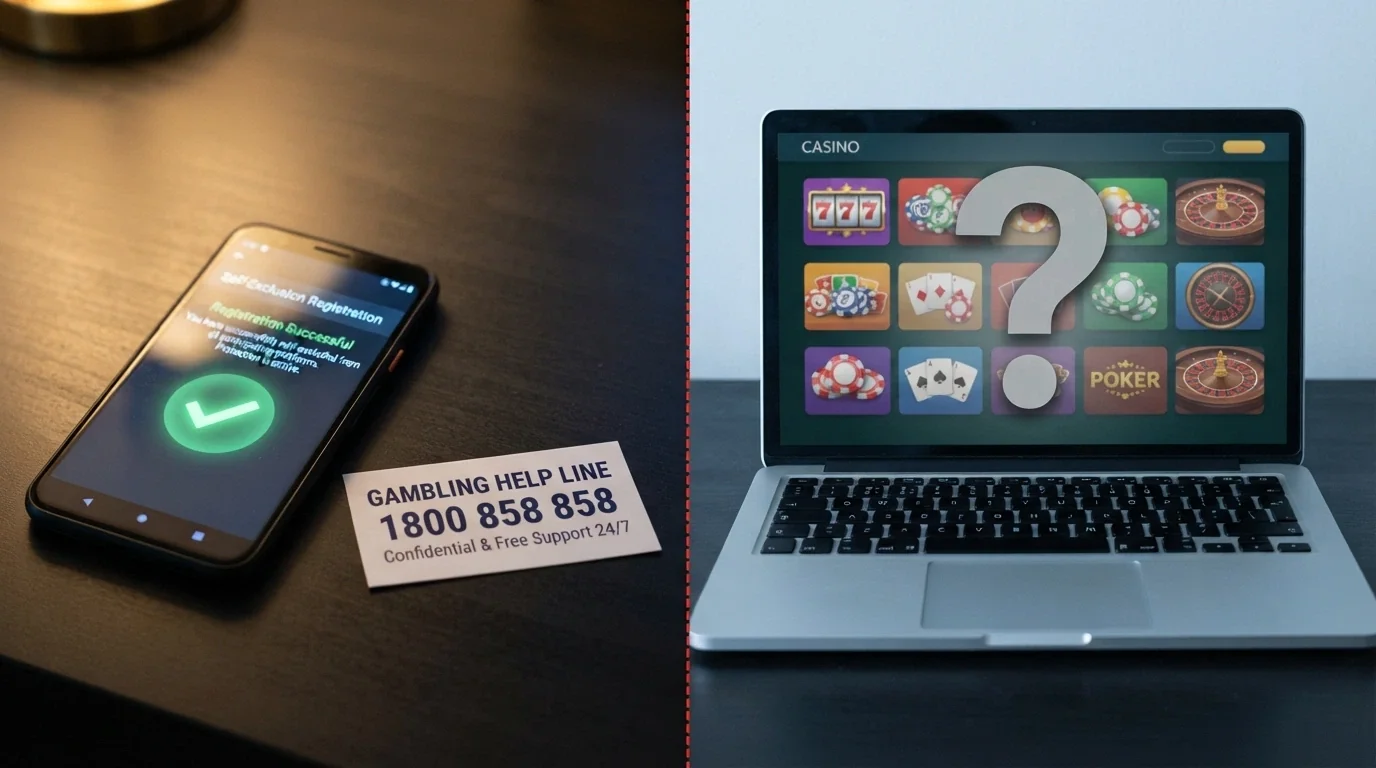
The offshore casino gives none of these. BetStop binds approximately 150 Australian-licensed wagering providers; an offshore casino is not connected to the register and will continue accepting a self-excluded person’s money. There is no Australian consumer-protection regulator to escalate a withheld withdrawal to, no ACMA complaints process to invoke, no activity statement sitting in the player’s inbox, no mandated deposit-limit tier, no statutory cooling-off period. Offshore casinos may offer some of these features as marketing practice — most publish a responsible-gaming page, several offer self-exclusion tools of their own, and a few publish RTP values prominently — but those features sit inside the operator’s terms and conditions, not inside a regulatory framework that enforces them.
The concrete difference is what the player loses when they lose. A licensed Australian operator that refuses a withdrawal has an Australian complaints body to answer to. An offshore casino that refuses a withdrawal has the offshore operator’s internal dispute process, the customer’s terms-and-conditions arbitration clause, and the regulator of Curaçao — which is the regulator of the licence that issued the licence, not the regulator of the player. A licensed Australian operator that vanishes has its licensees, premises, directors and senior management identifiable through Australian corporate registers. An offshore casino that vanishes has its parent company in Curaçao or another offshore jurisdiction, with no presence in Australia and no obligation to come back.
This is the protection gap. A 3-reel pokie is a 3-reel pokie on either side of the line; what differs is everything around the spin.
Australian Payment Rules — No Credit Cards, No Crypto for Pokies
Australia regulates the payment side of online gambling as hard as it regulates the offering side. Credit cards, credit-related products and cryptocurrency are banned as payment for online wagering, effective 11 June 2024 under the Interactive Gambling Amendment (Credit and Other Measures) Act 2023. An operator that fails to enforce the ban faces penalties of up to $247,500. The legal deposit routes at Australian-licensed wagering operators are debit card, bank transfer, PayID/Osko and BPAY — every one of them flowing through Australian banking rails and carrying the bank-side visibility that crypto deposits avoid.
The 2026 reform layer expands that visibility. From 1 January 2027, banks and payment providers gain express authority to block transactions to illegal gambling operators. The blocking is at the bank’s discretion but backed by statute, which means an offshore casino deposit that flows through an Australian bank can be declined at the point of origin rather than after the fact. A player who has been using an Australian bank card to load an offshore account today faces a future in which the bank can refuse the transaction outright, and the offshore casino has no recourse against the bank.
For an Australian player, the practical reality is a payment menu that is closing. Credit card and crypto are gone. PayID debit and bank transfer remain visible. The offshore casino that accepts the deposit through a Russian or Malaysian processing entity may still let the player in, but the bank has the legal authority to refuse the transaction. The offshore operator’s welcome bonus starts to look less like a price and more like a thin margin against the cost of being cut off mid-session.
Playing 3-Reel Pokies Without Losing Control
Australia has the strongest player-protection infrastructure in the world for a gambling-regulated jurisdiction, and most of it does not reach the offshore casino. BetStop, the harm-prevalence data, the helpline infrastructure — these are pieces of a system that licensed wagering operators sit inside. The 3-reel pokie player using an offshore casino sits outside that system. That is what this section is about.
The first thing to know is bet-stop-also: about 2.1% of Australian adults (~430,000 people) experience problem gambling. High-risk gambling was estimated at 1.8% by the Australian Institute of Health and Welfare in 2022. These are not small numbers. They are roughly one in fifty adult Australians, and a parent or partner or close friend in this magnitude changes how a reader thinks about a session they thought was casual.
BetStop — Your National Self-Exclusion Register (and the Offshore Gap)
BetStop is the national self-exclusion register for Australian online and phone wagering. Live since 21 August 2023, the register had recorded 67,480 registrations as at 31 July 2026, with 41,290 exclusions still active. Seventy-eight per cent of registrants were under 40, and thirty-eight per cent chose lifetime exclusion. One registration across one Australian-licensed wagering provider is sufficient — every licensed operator is bound to check BetStop at account creation and on a continuing basis, and a registrant’s deposit, login, and account-open attempts across ~150 Australian-licensed wagering services are refused.
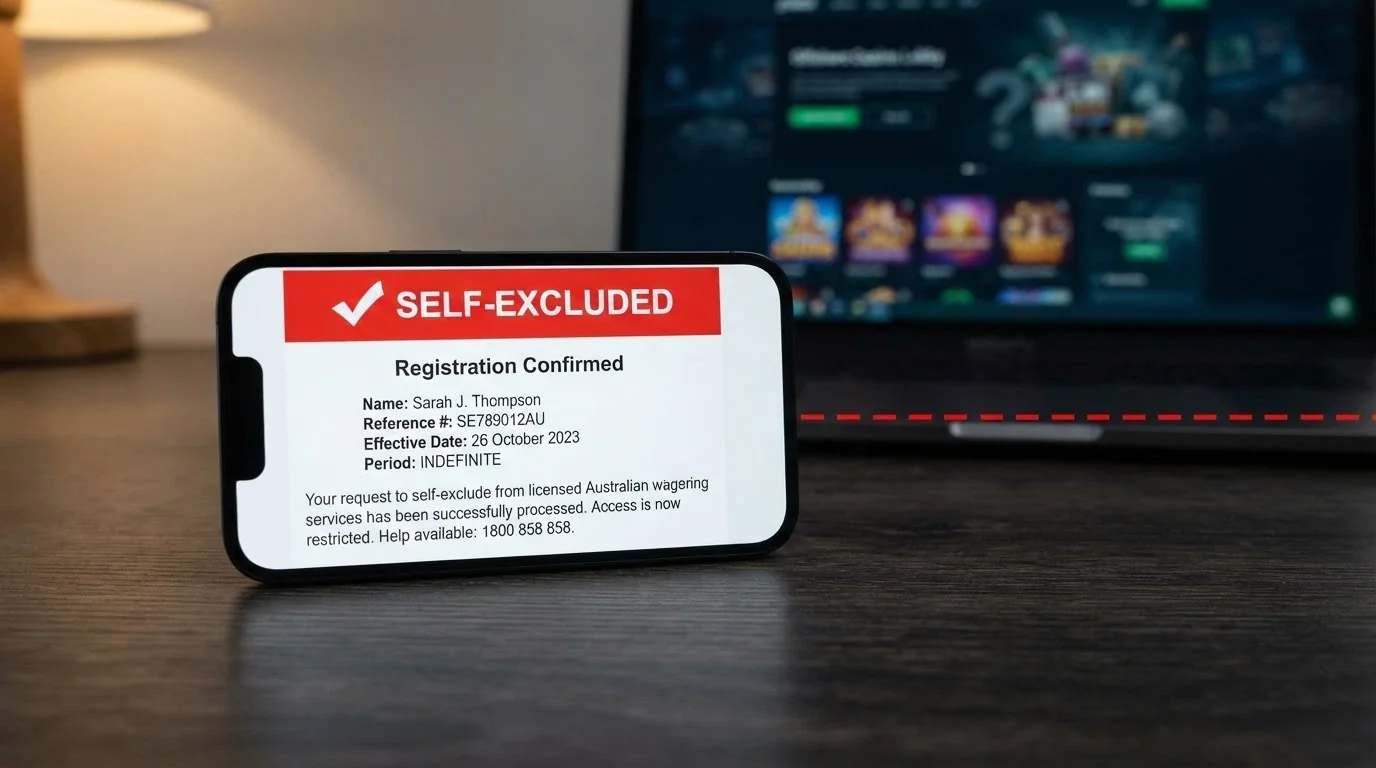
The minimum exclusion period is three months; the maximum is lifetime; the terms cannot be reduced by the player, and removal requires a statutory declaration with evidence of counselling. That structure makes BetStop meaningful: it is the one self-exclusion tool in Australia backed by statutory force and a regulatory obligation on every licensee.
The offshore gap is the limit of BetStop. The register binds ~150 Australian-licensed wagering providers; offshore casinos are not connected, and a self-excluded person can still deposit and play at one. The strongest player-protection tool Australia has does not reach the lobby the offshore 3-reel session runs in. From 1 January 2027, direct marketing of inducements is banned for three months after a person deregisters from BetStop — but that reform protects a person on the licensed side of the line, not the offshore side.
For a player who has signed up to BetStop, the offshore casino is the open door. The HVAC-level obligation the regulator places on the licensee has no counterpart on the offshore site, and the offshore operator’s terms-and-conditions self-exclusion is a marketing feature, not a statutory one.
Deposit Limits, Session Caps and Activity Statements — The Tools That Exist
Australian-licensed wagering operators are required to offer customer-set deposit limits, and the limits bind. A player can set a daily, weekly or monthly deposit ceiling, change it only downward instantly and upward only after a cooling-off window. Activity statements are mandated by state/territory regulation, meaning the player receives a regular statement of every wager placed, won and lost, with a direct line to their own play data. Some licensed operators also offer session-time caps and loss caps as additional responsible-gambling features.
All of these tools live inside the licensed system. The licensed bookmaker is required to offer them, the regulator audits the offering, and the player can escalate a refusal to the state regulator. An offshore casino may offer some of the same tools as a marketing feature — most publish a “responsible gaming” page with deposit-limit and self-exclusion options — but those features live inside the operator’s terms and conditions, not inside a regulatory obligation that can be enforced at the regulator’s discretion. A responsible-gaming page on an offshore site is a marketing commitment, not a statutory one, and an offshore operator’s “responsible gaming” page is the equivalent of a casino sticker on the way in. The licensed equivalent is the regulated feature inside a regulator-defined account.
For an Australian 3-reel player, the practical advice is this: if a deposit limit matters to a person, the deposit limit on a licensed account is the deposit limit with a regulator behind it. On an offshore casino it is whatever the offshore casino’s policy says it is this week.
Spot the Signs — When a Pokies Session Has Turned Harmful
The behavioural markers of a session that has crossed from entertainment into harm are well-established, and they read as common-sense rather than clinical. Chasing losses — increasing the stake or playing longer to recover a downturn — is the clearest early warning. Exceeding a pre-set limit that the player set for themselves at the start of a session is another. Playing longer than planned is a third. Lying about, hiding or downplaying the amount of money or time spent gambling is a fourth. Borrowing money, selling possessions, or using money budgeted for essential expenses to fund play is the fifth.
The prevalence figure gives the markers their weight. About 2.1% of Australian adults — roughly 430,000 people — experience problem gambling. High-risk gambling was estimated at 1.8% in 2022 by the Australian Institute of Health and Welfare. The numbers are large enough that nearly every Australian has one person in this band in their extended network, and small enough that the affected person is unlikely to be the person reading this. The markers are for the reader to use on themselves, on a partner, on a friend, on a parent. The strongest version of this kind of help is the version that spots a marker and acts on it.
If any of these markers have shown up in the last month, the right response is a call. It does not require certainty. The National Gambling Helpline (1800 858 858) is free, confidential and staffed 24 hours a day — a single five-minute call to confirm what is happening is the most efficient first move available.
Free Help That Works — Helplines, Chat and Face-to-Face Support
The National Gambling Helpline is 1800 858 858. Free, confidential, 24/7, with online chat and email counselling through Gambling Help Online at gamblinghelponline.org.au. The line is staffed by counsellors trained in gambling harm, and the chat service is staffed at the same level, both safe for an Australian player using an offshore casino and a player whose harm concerns are about the licensed system. There is no judgement built into the call; the counsellor is there because harm is common enough that a government-paid line has been set up to handle it. About 2.1% of Australians — 430,000 people — experience problem gambling. The line exists for them.
Gambler’s Help services are the state/territory-delivered offline arm of the same infrastructure. Each state funds face-to-face, telephone and online counselling tailored to the gambling-harm framework operating in that jurisdiction. Sessions are free, confidential and run by professionals. The National Debt Helpline is 1800 007 007, the parallel service for financial counselling related to gambling harm — settlements, debt restructuring, the conversation that has to follow when harm has produced a financial shortfall.
For the offshore casino player specifically, the help line is the help line. It does not matter whether the harm has been experienced on a licensed Australian wagering platform or an offshore casino; the counsellors handle both, and the Gambling Help Online web chat is the same service. The first call is the hardest call. After that, the call is just the call.
How We Picked and Ranked These 3-Reel Pokies
The eight titles in the ranking table were chosen on three criteria: a 3-reel format, a published RTP, and availability across multiple offshore casinos accepting Australian players. The published RTP was the first cut. A title’s RTP has to come from the publisher themselves — NetEnt’s data on Mega Joker, IGT’s data on Triple Diamond, Pragmatic Play’s data on Money Money Money — or from an independent slot database that publishes the figure against a verifiable game version. The 94% to 96% RTP range that 3-reel classics sit inside is itself a quality marker; a 3-reel classic at 92% is below market and excluded, while a 3-reel classic at 99% in SuperMeter mode stays inside the list if the figure is achievable in a real-play scenario.
The volatility column was filled only where the publisher or independent database confirms a volatility rating. Most providers publish RTP but do not publish a volatility rating — Triple Diamond is one of the few IGT classics that carries a confirmed medium volatility. Lightning Joker carries a published high volatility; Fire Joker’s volatility was not confirmed in the same form. Where the figure could not be verified, the cell carries an em dash rather than a guess. Max-win figures were taken from the same publisher data or independent databases. The eight titles are the titles that cleared all three gates.
The ten operators were selected from AU player-traffic data cross-referenced against ACMA’s public enforcement records and Curaçao Gaming Authority published licence data. A brand with AU player traffic but no confirmed licence jurisdiction sits lower on the list and gets a thinner description; a brand with a confirmed Curaçao licence and a confirmed ACMA position gets a fuller one. Stake made the list on the strength of AU player traffic and brand recognition; Scream Casino and Rocket Casino rounded out the bottom three on traffic alone and got the most sparsely-detailed write-ups.
The Sources We Checked and the Criteria That Ordered This List
Published RTP sources were SunVegas Casino and VegasSlotsOnline, two of the larger independent slot databases that publish RTP, volatility and max-win data against verifiable game versions. The provider-direct sources — NetEnt’s game information pages, IGT’s paytable publications, Microgaming’s game sheets — were checked where the database figures diverged. The Australian regulatory sources were ACMA’s online gambling investigations page, ACMA’s BetStop page, and the Parliament of Australia record of the Interactive Gambling Amendment (Gambling Reform) Bill 2026. The licensing sources were the Curaçao Gaming Authority public licence list and individual licensee registration pages, used to verify the licence numbers cited for WinSpirit (8048/JAZ2014-053), Rainbet (#365/JAZ) and the broader Curaçao-licence status of the other offshore brands.
The criterion chain ran in this order: a title had to have a 3-reel format, a published RTP from the provider or an independent slot database, a verifiable provider name, and availability across at least two offshore casinos serving AU players. An operator had to appear in AU player-traffic data and have at least one verifiable licence-jurisdiction data point. Operators that failed the licence check were kept in the set at the bottom with the qualification that specific terms were not confirmed. Titles that failed the publisher-RTP check were excluded entirely; a 3-reel game without a verifiable RTP is a 3-reel game without auditable information, and the ranking cannot carry that.
What this page does not do is invent numbers. Every RTP, volatility, max-win, licence number, ACMA-blocked status and wagering figure comes from a named source or a stated absence. The em-dash cells are em-dash cells because the source did not publish a figure, not because the source published a different figure. Where research could not confirm a detail, the cover of the operator write-up names the gap and advises the reader to verify at the cashier. The list is honest about what it knows.
Your 2026 3-Reel Session — What to Actually Do Next
Here is what every section above comes down to. You came to this page because the 3-reel format caught your eye — the simpler odds, the higher base RTP, the pace, the classics. You looked at the offshore casino set because that is the only place an Australian player can find them. You read the legal section because the prohibition and ACMA’s enforcement record and the betting rules matter when your money is on the other side of the world.
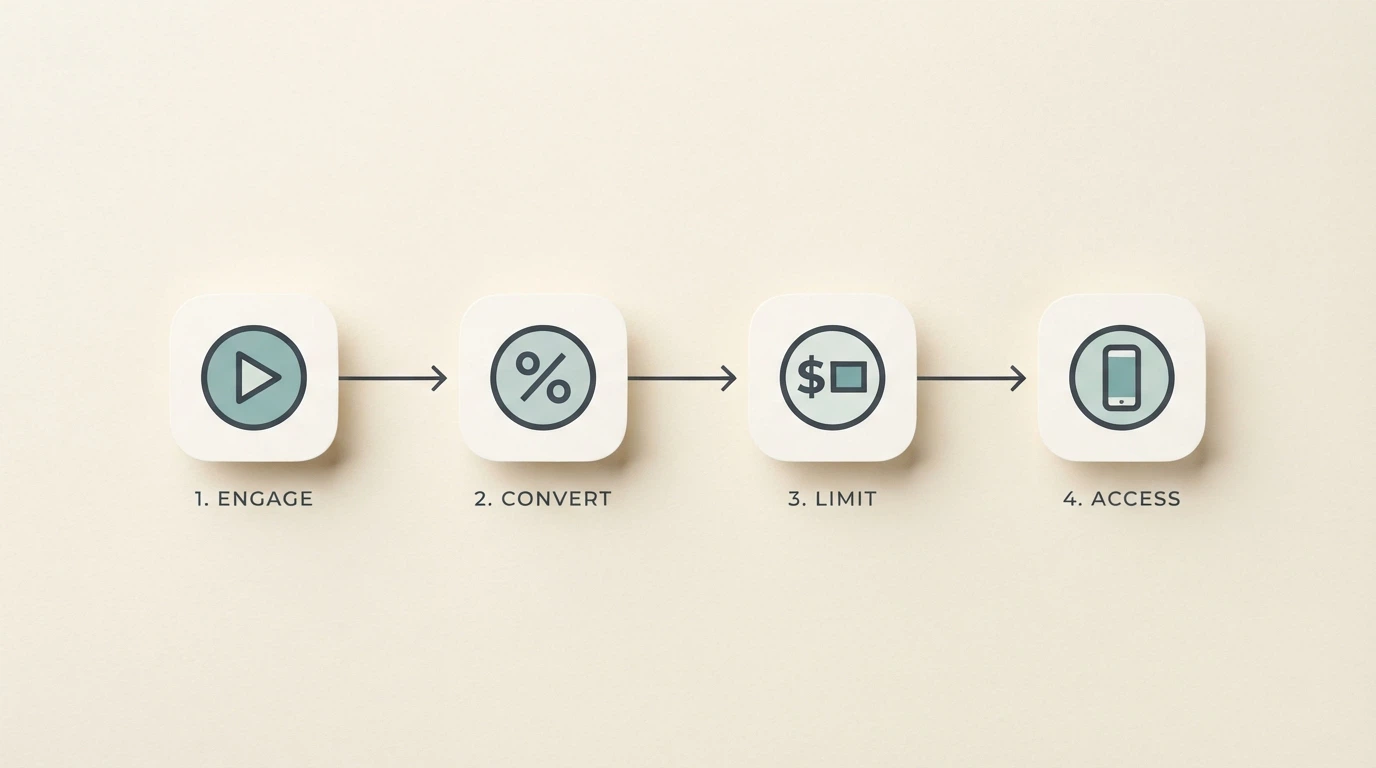
The session that follows from that sequence has six numbered steps, and the last one is optional. The sequence reads simply: try the title in demo mode first. Check the RTP of the specific game at the specific casino before depositing. Set a hard loss limit before the first spin. Know that the site is offshore and unprotected. Keep the helpline number (1800 858 858) saved. And if any of the risk factors in this page have settled uneasily in your reading — the offshore status, the ACMA block, the credit-card ban, the bank-transaction blocking coming from 1 January 2027 — the safest play is no play at all.
The discipline of the demo comes first for a reason. A free-play session costs nothing, runs the same RNG as the real-money game, and reveals what the page cannot: how often the title pays in practice, how long the dry spells run, whether the variance feels right for the session you intend to run. Most offshore casinos carrying 3-reel titles offer a demo toggle, and the same titles are playable on review platforms. The demo is the only hour of cost-free information, and an hour saved is an hour not at the table.
The RTP check is the second step because RTPs vary by casino. A title published at 96% by the provider may run at 94% at a specific casino, because operators select lower-RTP game versions for geographic markets where they think players will not check. Always check the specific game version at the casino you intend to play on, both for the fairness of the offer and for the precision of any bonus calculation.
The hard loss limit goes in before the first spin, before the welcome bonus is even thought about. A loss limit is the dollar amount the player will accept losing before stopping the session — it is not the size of the bonus, not the size of the bankroll, but the size of the spend the player has budgeted to lose. Set it. Honour it.
The offshore status confirmation means something specific. It means BetStop does not cover this session, ACMA cannot intervene on a withdrawal dispute, and the offshore casino’s responsible-gaming page is a marketing feature, not a regulated obligation. The player is the only regulator of their own session. The 1800 858 858 line is the one independent resource available regardless of where the session is happening.
And if the risk factors accumulate — the offshore status, the regulatory exposure, the unprotected balance, the upcoming 2027 reforms — the answer is to not play. A session at an offshore casino is a session the player has decided to take. A reader who has reached this paragraph with that decision still open can still make the other choice. Sometimes the best 3-reel spin is the one the player did not make.
Frequently Asked Questions
What happens inside a pokie from the moment you press spin?
The random number generator picks the three reel stops the moment the spin button is pressed, in a single CPU cycle. The reels then animate to those stops — the visual is cosmetic, the result was already decided. The payline reads the combination, the paytable computes the payout (or registers no payout), the balance updates, and the RNG picks the next outcome independently of the last. There is no momentum, no “hot” or “cold” streak, no near-miss that hints at what’s coming. A pokie is a series of independent random trials whose visual presentation is a thirds-of-a-second entertainment layer over a mathematics that has already happened.
Which 3-reel slot has the highest RTP available to Australian players?
Mega Joker by NetEnt, at up to 99% in SuperMeter mode. Jackpot 6000 sits second at 98.9% in the same mode. Both titles run higher in SuperMeter than they do in base-game mode — base-game RTPs are lower — which means the highest published figure is the figure an optimal-play session can achieve, not what every session will return. The base-game player gets a return in the 94% to 96% range that the rest of the classic 3-reel catalogue sits inside.
What does RTP mean for classic 3-reel slots and why does it matter?
RTP, return to player, is the percentage of every dollar wagered that a game is programmed to return to players across millions of spins. A 96% RTP game returns $96 for every $100 wagered, on average, over the long term. Variance — how the returns distribute spin-to-spin — is the second variable, and a 96% high-volatility game pays out as much in total as a 96% low-volatility game but does it in rare large hits rather than steady ones. For a small-bankroll session, higher RTP and lower variance both protect the bankroll. For a player chasing the rare big hit, higher volatility is the price of admission.
Are 3-reel pokies fair — what ensures random outcomes?
A certified random number generator (RNG). Reputable studios use RNGs independently tested and certified by bodies such as iTech Labs, GLI or eCOGRA, and offshore casinos licensed by Curaçao eGaming or Antillephone are contractually required to use certified RNGs. Each spin’s outcome is independent of every other spin: there is no memory in the system, and a long losing streak makes the next spin no more likely to win. The fairness of a 3-reel game sits in the certified RNG, in the published RTP, and in the licensed operator’s contractual commitment to use both. The offshore gap is that none of this is enforced by an Australian regulator.
Which developers supply the top classic 3-reel titles to Australian casinos?
NetEnt (Mega Joker, Jackpot 6000), IGT (Triple Diamond, Double Diamond), Play’n GO (Fire Joker), Microgaming (Break Da Bank), Yggdrasil (Lightning Joker) and Pragmatic Play (Money Money Money) are the studios behind the eight titles on the ranking table. Beyond those, every major provider distributes a 3-reel catalogue — Quickspin, Betsoft, Playtech — generally in the dozens of titles rather than the hundreds. Most offshore lobbies serving Australian players expose the full back-catalogue of the providers they carry, so a search on “classic” or “3-reel” in any featured lobby returns the studio list with the titles folded in.
Written by the editors at Min Deposit 5 Casinos AU.