
Best online casino payment methods for Aussies in 2026
 Available in AU
Online casino is prohibited in Australia. The Interactive Gambling Act 2001 outlaws providing the product to anyone physically in the country, which means every brand an Australian player can actually reach sits offshore, licensed somewhere else, subject to someone else’s rules. The IGA targets the provider, not the player: an Australian punter is not prosecuted for using an offshore casino, but every Australian authority is also absent when money goes missing.
What does matter is the payment method. That is the real decision an Australian player makes on day one, and it is the one most pages treat as an afterthought — a row in a comparison table, a footnote about processing times. The method decides the minimum deposit, the maximum per transaction, how fast a withdrawal lands, what the operator sees about the player, and what recourse exists if the operator decides to keep a balance. Two operators offering the same welcome bonus can move money hours or days apart; only the rail in between changes.
This page ranks the five families of payment methods an Australian player can actually use at an offshore casino in 2026 — PayID and other instant-payment rails, cards, e-wallets, prepaid vouchers, and crypto — then maps them across the ten AU-facing brands players most often reach for. The legal backdrop, the offshore gap, and the help services are at the end.
Data current as of 18 October 2026; licence status verified against the ACMA register.
Table of Contents
- Why your payment method matters more than the casino you pick
- Every way to pay at an Australian-facing online casino in 2026
- Crypto casino payments — faster money, fewer protections
- Paying from your phone — convenience that costs you nothing extra
- Fast vs slow withdrawals — where the real delay hides
- What makes a casino payment safe — and what doesn’t
- Behind the deposit button — the rails that move your money
- The 10 casino brands AU players reach for — ranked by how they handle your money
- What the law actually says about paying an online casino in Australia
- Keeping the tap on — payment limits and help that actually work
- How we evaluated every payment method and casino on this page
- The payment method you pick sets the terms — choose it before you choose the casino
- Frequently asked questions
Why your payment method matters more than the casino you pick
Pick the wrong payment method and the best welcome bonus on the planet is still slow to clear, capped at a figure you never agreed to, and routed through a system you cannot reverse. Pick the right one and a mid-tier casino with an honest cashier can out-pay a flagship brand with a six-day withdrawal queue. The method is the contract.
What an Australian player actually chooses is two contracts, not one. There is the deposit rail — how money moves from a bank account or wallet into the casino balance — and the withdrawal rail — how it moves back. These are almost never the same thing. A Neosurf voucher deposits cleanly but cannot withdraw. A debit card deposits instantly and takes three to five business days to give the money back. Crypto deposits and withdraws on the same chain, in either direction, within an hour. The two rails sit on either side of the balance, and they have to be chosen together.
Australian players also face a narrower menu than players in the UK or most of Europe, and a wider one than players in the United States. PayID, POLi, BPAY and Osko are AU-native rails that no comparable offshore market offers at scale. The credit card ban that took effect on 11 June 2024 removed a rail licensed operators used to take — credit cards are no longer a permitted deposit method for any Australian-licensed wagering service, with penalties of up to A$247,500 for the operator that accepts one. The crypto ban that arrived in the same package did the same for digital currency, at least at the licensed end. Both rails still work at offshore casinos, which is precisely why the cashier list tells you where the casino is licensed.
What the Australian payment landscape actually looks like in 2026
The cashier an Australian player meets in 2026 falls into two camps. At an Australian-licensed wagering operator, the legal deposit routes are debit card, bank transfer, PayID/Osko and BPAY. That is the whole list. Every one of those fifty licensed operators reviewed by the ACMA had scrubbed credit card and crypto references from their deposit language by 30 June 2025, a 100 per cent compliance rate that turned the payment menu into a near-monoculture.
At an offshore casino, the list is wider and noisier. PayID still works where the operator has bothered to integrate it, alongside Visa and Mastercard (credit and debit), Skrill, Neteller, MiFinity, MuchBetter, ecoPayz, Neosurf, Flexepin, CashtoCode, POLi, Apple Pay, Google Pay, and a growing stack of cryptocurrencies — Bitcoin, Ethereum, Litecoin, USDT on multiple chains, occasionally others. The presence of any of those methods, particularly crypto or a credit card, is a tell that the operator is outside Australian jurisdiction. That is not a safety signal or an unsafety signal on its own — it is a jurisdictional one.
The aggregate picture is that offshore is gaining share. H2 Gambling Capital estimated that around 36 per cent of all online wagering by Australians now goes through offshore operators, up from 26 per cent in 2021. Channelisation — the share of the market that stays inside the licensed perimeter — dropped from 74 per cent to 64 per cent across the same period. That is the population this page is written for: AU bank accounts, AUD balances, no Australian licence standing behind the cashier.
How the same payment method performs differently across brands
The name on the deposit button tells you almost nothing about how the deposit will perform. PayID at RocketPlay clears in under an hour for most Australian banks, with a daily limit around A$5,000. PayID at Bizzo is documented as instant to twenty-four hours, with a higher minimum withdrawal of A$100. PayID at Royal Reels is offered from a A$10 deposit entry point, but the published withdrawal floor is A$50 for fiat. The rail is identical; the operator’s processing queue, its KYC staging, and its payment-team approval window are the variables.
Three things change between brands using the same method. First, operator-side processing: every withdrawal goes through a fraud check, a KYC verification step (sometimes already done, sometimes triggered by the cashout itself), and a payment-team approval queue that is essentially a human inbox. The fastest operators in this set run that queue in minutes; the slowest run it across two business days. Second, the banking partner: some operators route PayID through a partner with a faster NPP integration, others through a partner with deeper card-scheme coverage. Third, the rules each operator publishes: minimum deposits, minimum withdrawals, daily and weekly caps, and excluded methods for bonuses or for KYC-cleared accounts all vary.
The result is that a method is not one thing. It is one rail, several operators, and a spread of outcomes wide enough that the rail is the smaller variable. Players who treat payment method as a single decision and operator as a fine-tuning decision tend to wait longer for the same money.
Every way to pay at an Australian-facing online casino in 2026
Five families of payment methods are available at AU-facing offshore casinos, and they sort by who holds the money between the player’s bank and the casino. At one end are rails where the player’s own bank is the custodian throughout: PayID, POLi, debit cards, bank transfer. At the other end are rails where a third party sits in the middle — e-wallets, prepaid vouchers, crypto. The difference matters because the middleman is what gets to see your bank details, set your fees, and decide whether the withdrawal lands today or next week.
The licensed AU market permits a narrower set. Debit card, bank transfer, PayID/Osko and BPAY are the four legal deposit routes. The offshore market adds e-wallets, prepaid vouchers, crypto and tokenised card wrappers (Apple Pay and Google Pay). What follows is each family, how it performs at the cashier, and what it costs the player.
E-wallets — Skrill, Neteller, MiFinity and the digital middlemen
E-wallets sit between the bank and the casino, and that gap is both their speed advantage and their friction. A deposit from Skrill, Neteller or MiFinity clears inside a few minutes once the wallet has been funded; a withdrawal back to the same wallet usually lands within twenty-four hours of operator approval, with most of the wait in the operator’s queue rather than on the rail.
The friction is that you have to fund the wallet first. Most AU players move money from a bank account or a debit card into the wallet, then from the wallet into the casino, and that introduces a second transaction with its own fee schedule. Skrill and Neteller have historically charged for currency conversion and for some withdrawal routes; MiFinity has positioned itself on lower per-transaction fees for smaller balances. None of these wallets is a permitted deposit method for Australian-licensed wagering — they are an offshore-market tool — which is also why almost no AU-facing casino surfaces them in a banner image or a deposit-bonus headline.
What an e-wallet earns you is a separation between the casino and your bank. The casino sees the e-wallet account, not the bank account; the bank sees the e-wallet provider, not the casino. That is a real privacy layer, and it is also the reason e-wallets are the rail the average AU player uses when they want to keep gambling spend off a single bank statement. The trade-off is that the wallet’s own customer support is now in the loop if anything goes wrong — another step removed from any Australian authority.
Cards and bank transfers — the familiar rails with the longest waits
Visa and Mastercard are universal at AU-facing offshore casinos. Deposits are instant, which is the entire pitch; withdrawals are not, and have never been. Card withdrawals at Australian casinos take three to five business days to land in a bank account, and a chunk of that is settlement infrastructure that the casino cannot speed up — card settlement in Australia typically runs one to three business days from the transaction to money in account. The casino’s approval queue sits on top.
Bank transfer is slower still in some configurations. Deposits via direct bank transfer clear in one to twenty-four hours; withdrawals take one to three business days at best, and RocketPlay publishes a three to seven business day window for its bank transfer withdrawals with a per-transaction maximum of A$6,000. The advantage of bank transfer is that the limits are usually higher and the rail accepts any account the player can name.
The credit card distinction is the one that catches people out. The credit card ban for Australian-licensed wagering took effect on 11 June 2024, with penalties of up to A$247,500 for any operator that accepts a credit-funded deposit. Offshore casinos accepting AU players still take credit cards, and a credit card deposit to an offshore casino is, from a debt perspective, exactly what the ban was designed to prevent at the licensed end: a cardholder running a balance on gambling spend, with no chargeback safety net once the money leaves the account. Debit cards do not have that problem. The two are processed through the same Visa or Mastercard rails, but only one of them can put a player into unarranged overdraft.
Prepaid and voucher deposits — pay cash, stay private, forget withdrawals
Prepaid vouchers are the closest thing a casino cashier offers to paying cash. Buy a Neosurf, Flexepin or CashtoCode voucher at a retail outlet or online, enter the sixteen-digit code at the cashier, and the funds appear in the casino balance within seconds. No bank account is involved; no card number crosses any operator’s server. The privacy is real, and it is also the reason withdrawals cannot route back to the same voucher: there is no account to send the money to.
RocketPlay documents CashtoCode vouchers up to A$800 as deposit-only; Neosurf and Flexepin are the same across the wider market. The deposit-only limitation is structural, not policy. A voucher is a token, not a payment instrument, and once its value has been redeemed there is nothing left to return funds to. A player who deposits via Neosurf and wins A$500 needs a second rail — typically a bank transfer, an e-wallet, or, increasingly, crypto — to actually receive the payout.
The deposit-only status also caps the practical use of vouchers. They are best understood as a way to control spend, not as a way to play a full session. A player who buys A$200 of Neosurf and runs it through has no withdrawal question to answer; a player who buys A$200 of Neosurf and wins four figures on a single spin is going to need a withdrawal method they did not start with. That gap is fine if it is anticipated; it is the kind of gap that produces complaints when it is not.
PayID, POLi and Volt — the Australian instant-payment advantage
PayID runs on the Reserve Bank’s own rails and clears in under a minute. That combination — speed to settlement, zero player-side fees, and an AU-native rail — is unmatched by anything in the e-wallet, card or crypto families, and it is the reason PayID shows up at the top of most AU payment-method comparisons. PayID/Osko deposits post in under 60 seconds with zero transfer fees; withdrawals land in one to four hours. USDT TRC-20 is faster on the casino side (under fifteen minutes for the withdrawal to clear, with network fees under A$0.50), but it asks the player to convert AUD to crypto and back, which adds a day and a counterparty.
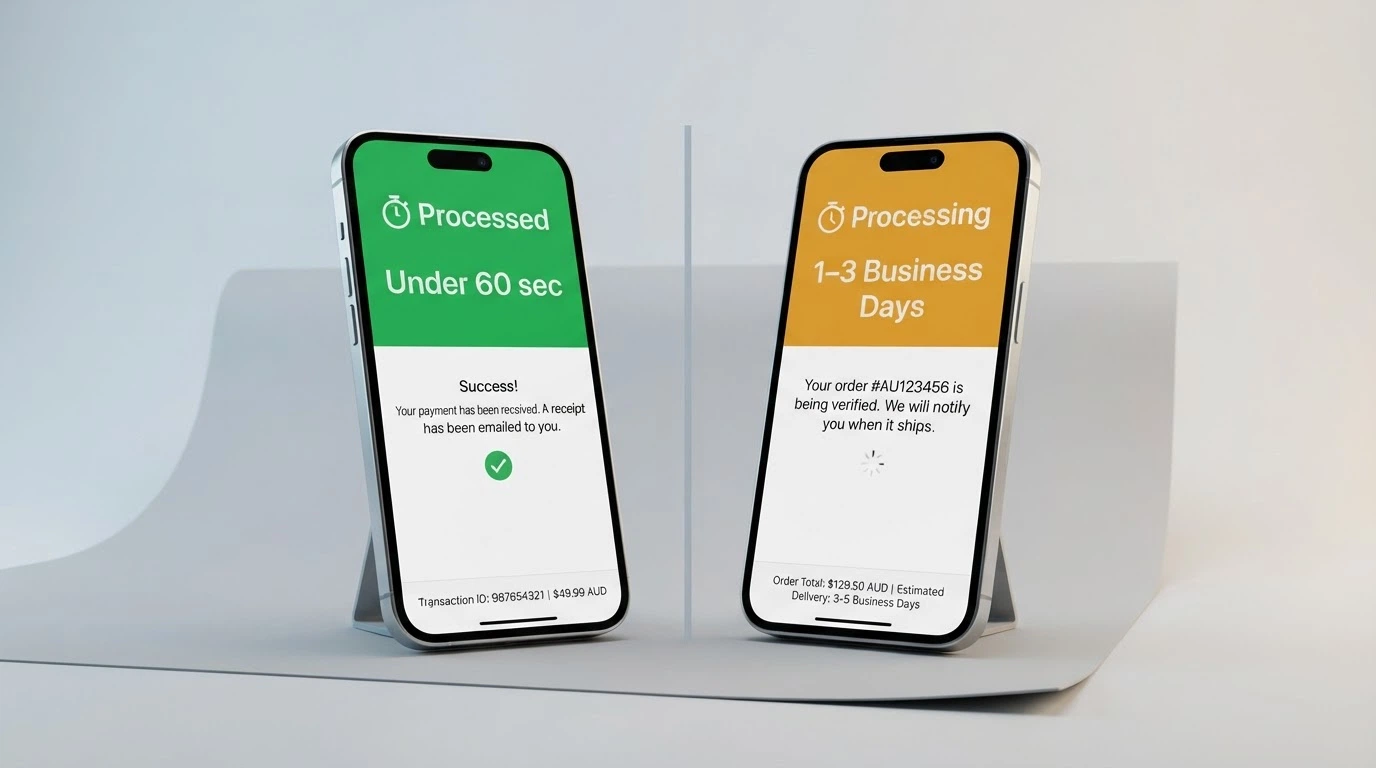
The technical backbone is the New Payments Platform, live since February 2018, with the Reserve Bank’s Fast Settlement Service settling individual transactions around the clock including weekends and public holidays. That is what makes the sub-minute deposit a system property rather than a marketing claim, and what makes the one-to-four-hour withdrawal ceiling a processing question rather than a rail question.
POLi is the older alternative that still does the job. It offers instant AUD deposits with low fees, working well for A$25–A$1,000 deposits, and is the route many AU players used before PayID was everywhere. Volt is the open-banking newcomer: bank-to-bank payments that route through PSD2-style consent flows in Europe and equivalent rails in Australia. Coverage is thinner than PayID but the fees are competitive and the speed is in the same band.
| Payment method | Deposit speed | Withdrawal speed | Fees | Accepted at (operators on this page) |
|---|---|---|---|---|
| PayID / Osko | Under 60 seconds | 1–4 hours | Zero player-side | RocketPlay, Royal Reels, Bizzo |
| POLi | Instant | Not widely offered for withdrawal | Low | Limited — verify per operator |
| Cards (Visa / Mastercard) | Instant | 3–5 business days | None at deposit; some FX at withdrawal | Skycrown, RocketPlay, Royal Reels, Bizzo, WinSpirit |
| E-wallets (Skrill / Neteller / MiFinity) | Minutes | 0–24 hours after approval | Conversion fees possible | Skycrown, RocketPlay, Bizzo, WinSpirit |
| Bank transfer | 1–24 hours | 1–5 business days | None typical | Skycrown, RocketPlay, Royal Reels, Bizzo, WinSpirit |
| Crypto (BTC / ETH / USDT / LTC) | Network-confirmed, often under 30 min | 2–60 minutes once approved | Network fees (USDT TRC-20 under A$0.50) | Skycrown, Stake, Royal Reels, Bizzo, WinSpirit, Rainbet |
| Prepaid (Neosurf / CashtoCode / Flexepin) | Instant | Not available — deposit only | Voucher purchase fee | Skycrown, RocketPlay, Royal Reels, Bizzo |
| Apple Pay / Google Pay | Instant | Not offered for withdrawal | None | Bizzo (both) |
POLi deposits are documented at A$25–A$1,000 with low fees; few operators in the ranking below route POLi withdrawals, so the rail is mostly a deposit-and-then-switch option. Apple Pay and Google Pay are tokenised card wrappers in this market — the casino never sees the player’s real card number — but neither is widely offered as a withdrawal option. Bizzo is the only operator in the ranking confirmed to accept both, with Google Pay deposits from A$17 and Apple Pay deposits from A$20.
Crypto casino payments — faster money, fewer protections
Crypto cuts out the bank and the payment processor, which is what makes it fast. The casino never sees a bank account; the bank never sees the casino. A USDT TRC-20 withdrawal can clear in under fifteen minutes once approved, with network fees under A$0.50. A Bitcoin withdrawal clears in minutes to an hour depending on congestion and the fee the player attaches. Ethereum sits in the same band, sometimes faster, sometimes slower depending on gas.
The cost of that speed is the protection layer. There is no chargeback on a blockchain transaction. There is no Australian Financial Complaints Authority to escalate to, no ACMA complaint pathway, no AU ombudsman with jurisdiction over a Curaçao-licensed casino. If the operator refuses to release a withdrawal, the player’s only recourse is the operator’s own internal dispute process and whatever licence jurisdiction the operator sits in. The 2026 reform’s bank-blocking authority, which lets Australian banks block transactions to illegal gambling operators from 1 January 2027, does not help here: the transaction is not flowing through an Australian bank.
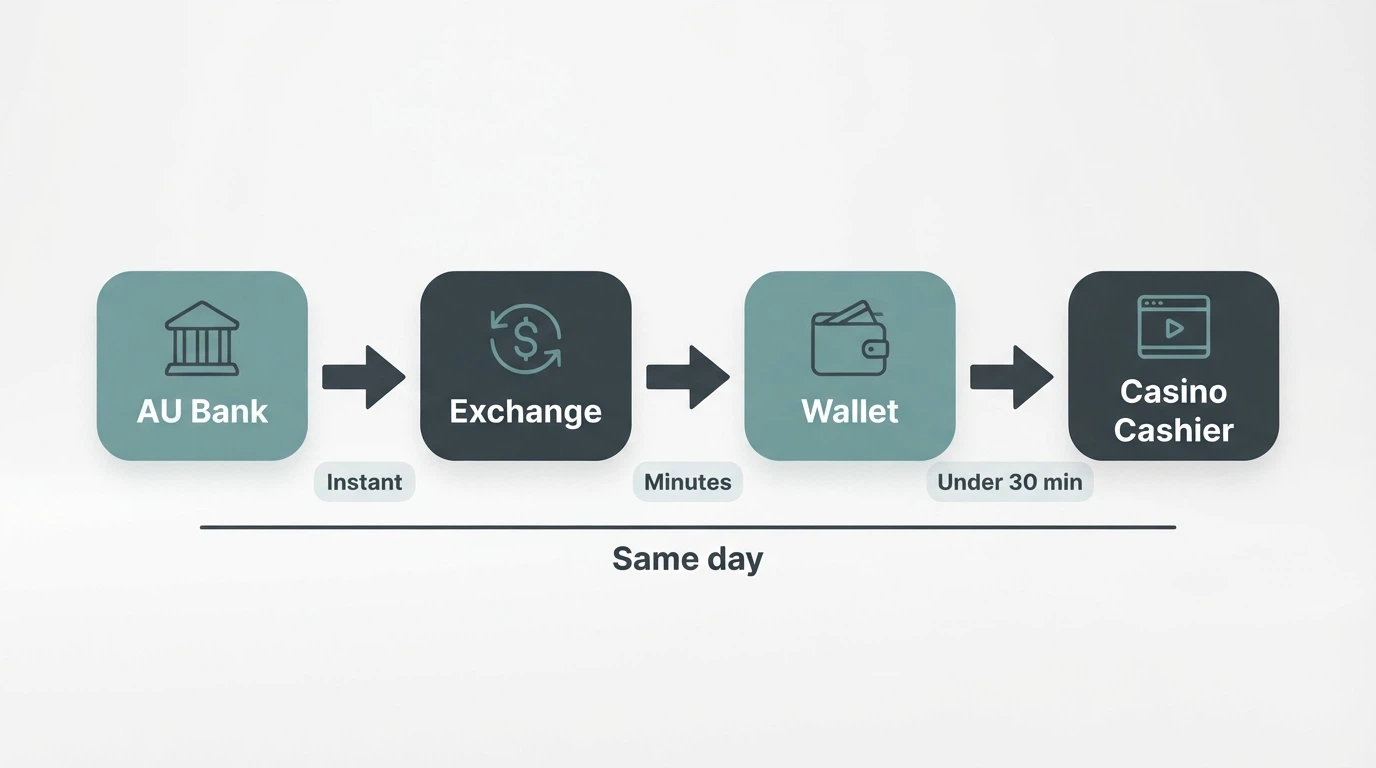
The Australian player who uses crypto at an offshore casino in 2026 is typically moving money through a four-step chain: Australian bank to a local exchange such as CoinSpot or Independent Reserve, conversion to USDT TRC-20 or BTC, transfer to the casino’s wallet address, and the reverse chain on the way out. The reverse chain — crypto to AUD on a local exchange — can take another day beyond the casino’s withdrawal confirmation, because the exchange is now the bottleneck. Converting crypto to AUD via an exchange may take another day beyond the withdrawal confirmation, which itself may take twenty-four to seventy-two hours.
AUSTRAC’s Travel Rule kicks in at A$10,000 for crypto transactions, which is the threshold at which Australian exchanges must collect and share counterparty information. Below the threshold, the player moves money through exchanges with minimal reporting; above it, the exchange files. That does not change what the casino sees, but it does change what the Australian regulator can reconstruct if a transaction is later questioned. The Travel Rule is not a casino rule; it is the exchange’s, and the exchange sits on the player’s side of the cashout, not the operator’s.
Anonymity, privacy and what you give up when you pay with crypto
Crypto promises a privacy floor that no card or e-wallet can match. The casino sees a wallet address, not a name; the bank sees an exchange, not a casino. That is genuinely useful for a player who wants gambling spend segregated from a primary bank statement, and it is the reason crypto is the rail of choice for players who have been declined by mainstream methods at licensed operators. The rail is also the reason crypto bypasses every Australian consumer protection that exists for the licensed market.
Three protections are bypassed in one move. No chargeback means the card network’s dispute process — the same process that returns a fraudulent transaction — does not exist for a blockchain transfer. No ACMA recourse means the Australian regulator’s complaint pathway, which works for licensed operators, has no reach into a Curaçao-licensed casino. No Australian financial ombudsman means the escalation route every AU consumer has through their bank or e-wallet provider ends at the wallet or the bank, both of which are downstream of the casino’s decision.
The privacy cuts both ways. A player whose withdrawal is refused has no Australian authority to appeal to. A player whose account is closed with a balance has no AU route to recover funds. A player who self-excludes through BetStop and walks to an offshore crypto casino has left the Australian protective perimeter entirely; the exchange and the wallet do not know, the bank does not know, and the casino is not connected to BetStop in the first place. That is the cost of the speed.
Paying from your phone — convenience that costs you nothing extra
Mobile casino payments are not a separate method. The cashier on a phone browser and the cashier on a desktop browser are usually the same page, and the underlying rail is the same PayID, card, e-wallet or crypto the player would have hit on a laptop. What the phone adds is a layer of tokenisation, biometric authentication and stored-credentials convenience that the desktop flow rarely matches.
Apple Pay and Google Pay are the clearest examples. Both are tokenised card wrappers: the casino receives a device token, not the player’s real card number, and the real card sits behind the device’s biometric or passcode check. A breach of the casino’s payment data does not yield the player’s card number; it yields tokens the issuer can revoke. Bizzo is the only operator in the ranking confirmed to accept both, with Apple Pay deposits from A$20 and Google Pay from A$17 — the lowest published minimum deposit in the set.
Most AU-facing offshore casinos run through the mobile browser rather than a native app. The casino’s web cashier is the cashier; the operator does not maintain a separate mobile-binary payment integration. That is part of why mobile-specific payment coverage is thin across competitor pages: the rail is the rail, and the device changes the wrapper, not the contract. SMS and carrier billing (Boku) are rare at AU-facing casinos for the same reason — they require direct carrier integration, and offshore operators rarely bother.
What the phone does add is a friction reducer. Stored card credentials, biometric approval, and one-tap deposit on PayID or Apple Pay reduce the time between “I want to play” and “money in the balance” to a few seconds. That is real convenience, and it is also worth naming as a friction reducer rather than a feature, because the friction it reduces is mostly the friction that made a player stop and think.
Fast vs slow withdrawals — where the real delay hides
The payment method gets blamed for slow cashouts, but the operator’s internal processing queue is usually the bottleneck — not the rail. A withdrawal has two stages. The operator’s team has to approve it, which means a fraud check, a KYC verification (sometimes already complete, sometimes triggered by the size of the cashout itself), and a payment-team inbox where a human clicks release. Then the rail has to move the money. The first stage is the variable; the second stage is mostly fixed.
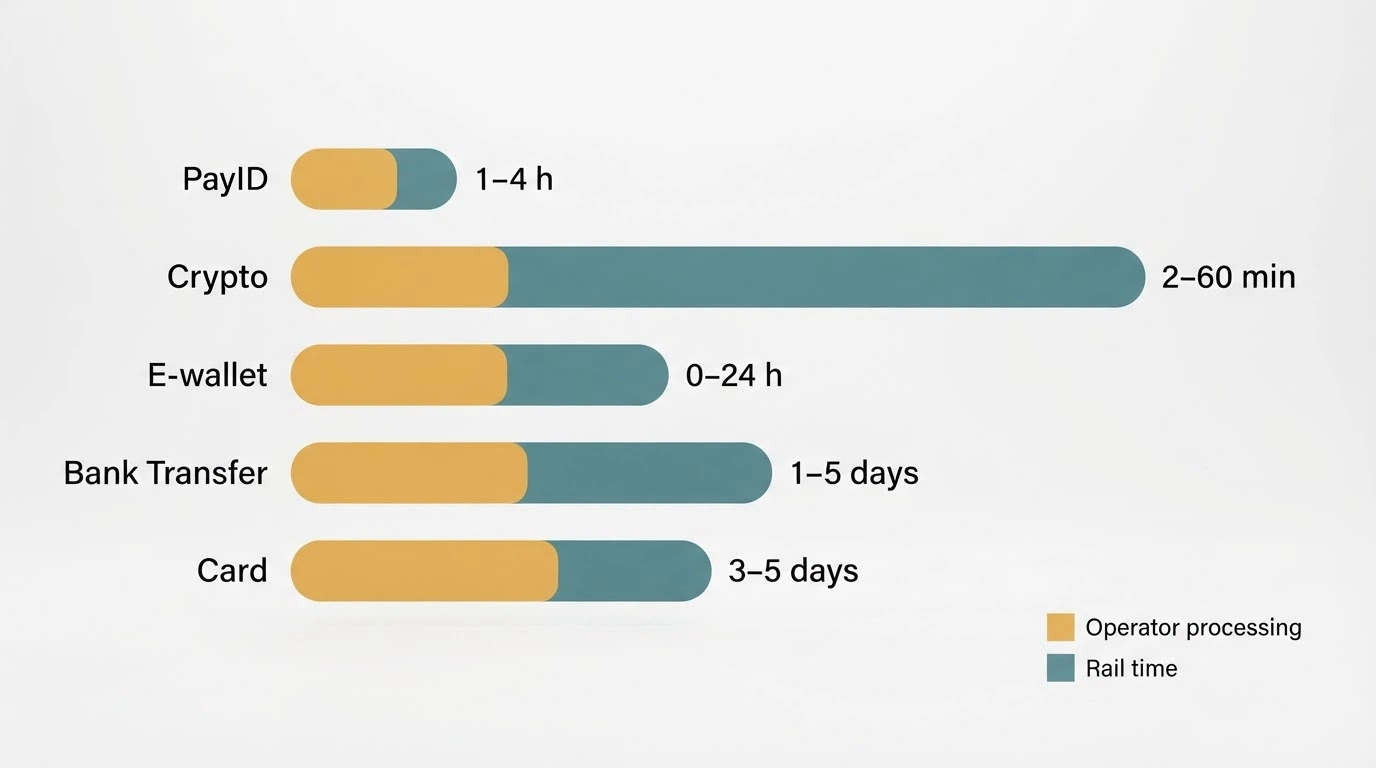
PayID, crypto and the e-wallets are all “instant to the rail” once approved. PayID withdrawals take one to four hours after the operator releases them; USDT TRC-20 clears in under fifteen minutes; MiFinity and Skrill land within twenty-four hours. Cards add three to five business days on top of operator approval; bank transfer adds one to five. A player who picks an instant-to-the-rail method at a slow operator will still wait. A player who picks a slow rail at a fast operator will still wait. The combination is what determines the cashout time.
The fastest real-world combination in this set is a sub-hour operator paired with PayID or USDT TRC-20. Skycrown publishes a ten-minute average processing time with KYC verification complete within four hours, which means a PayID or USDT withdrawal can land in the player’s account within an afternoon of the request, not within a working week. The slowest real-world combination is a 48-hour operator paired with a bank transfer, which can stretch a withdrawal across a calendar week.
Instant-payout claims — what they actually mean at an AU-facing casino
“Instant withdrawal” almost never means the money is in the player’s account the second they click. It means the operator has approved the withdrawal and released it to the rail, and the rail is fast. Stake’s debit card withdrawals can be as fast as twenty seconds, which is the closest thing in this market to genuine instant settlement, and that figure is the result of an internal pipeline that runs the approval queue, the KYC check, and the card-network tokenisation in a single automated flow. Most operators cannot match that combination because most operators do not run the queue and the rail as a single system.
PayID is the closest AU-native rail to true instant settlement on the deposit side. A PayID deposit posts in under sixty seconds with zero transfer fees, which is a system property of the NPP and the Fast Settlement Service rather than a casino optimisation. On the withdrawal side PayID takes one to four hours, because the operator still has to approve the request and the rail still has to settle, but no other AU-native rail is faster.
Crypto is faster on the rail and slower on the conversion. A USDT TRC-20 withdrawal clears in minutes, but the player has to convert USDT to AUD on an Australian exchange, and that step takes another day beyond the casino’s confirmation. The speed advantage is real for the player who already holds crypto; it is a wash for the player who has to round-trip AUD through an exchange. Net: PayID for the AUD-native player, USDT for the player who is already in crypto.
No method is genuinely instant end-to-end at an offshore casino. The realistic floor is “approved and on the rail inside the hour” for the best operators, which means PayID or USDT at Skycrown or Stake. Anything else adds either a rail delay (cards, bank transfer) or an operator delay (Fair Go’s 24–48 hours, WinSpirit’s 48 business hours, Bizzo’s PayID instant-to-24-hours window).
Where the delay actually sits — operator processing times compared
The withdrawal-approval window is where the published cashout times diverge most across the operators below. The data listed is what each operator publishes on its own cashier or payment-policy page; the actual experience depends on KYC status, the size of the cashout, and whether the request triggers any risk-management flags.
- Skycrown: average processing time approximately ten minutes; KYC verification completed within four hours. PayID and USDT clear same-session.
- RocketPlay: PayID withdrawals under one hour for most Australian banks, with a daily limit around A$5,000. Bank transfer withdrawals take three to seven business days.
- Bizzo Casino: PayID withdrawals documented as instant to twenty-four hours, with a minimum of A$100. Bank transfer withdrawals take up to five business days, minimum A$50.
- Stake: crypto cashouts one to four hours for KYC-cleared accounts; debit card withdrawals as fast as twenty seconds. Amounts above A$4,000 may trigger a source-of-funds questionnaire that stalls the withdrawal for forty-eight to seventy-two hours.
- Fair Go Casino: payouts released within twenty-four to forty-eight hours of approval; minimum withdrawal A$100, per-transaction ceiling A$2,500.
- WinSpirit: standard withdrawal processing up to forty-eight business hours from request; e-wallets instant or same-day after approval; bank transfers and cards three to seven business days.
- Royal Reels: PayID from A$10, A$30 crypto withdrawal floor and A$50 fiat withdrawal floor, A$10,000 weekly cap.
- Scream Casino, Rocket Casino: published payment-specific processing data was not surfaced at the time of review. Players should verify on the operator’s cashier page before depositing.
- Rainbet: crypto is the primary rail; fiat processing times were not surfaced.
The takeaway is that processing time, not rail time, is the dominant variable at most operators. A player who can complete KYC before requesting a withdrawal, who keeps cashouts below any source-of-funds thresholds, and who picks PayID or USDT at an operator with a sub-hour approval queue can land their money the same day. A player who waits until the cashout request to do KYC, who lets the balance climb above the questionnaire threshold, and who picks a slow rail will wait a week. The rails are interchangeable; the timing is not.
What makes a casino payment safe — and what doesn’t
“Safe” at a casino cashier means three things. The money arrives at the destination. The player’s bank details are not stolen in transit. The player can get their money back out. The first two are mostly solved by the rail: PayID runs over NPP with bank-grade authentication, Visa and Mastercard tokenise card numbers at the network layer, blockchain transactions are cryptographically signed. The third is where most of the actual risk sits, and it is the one the rail cannot solve.
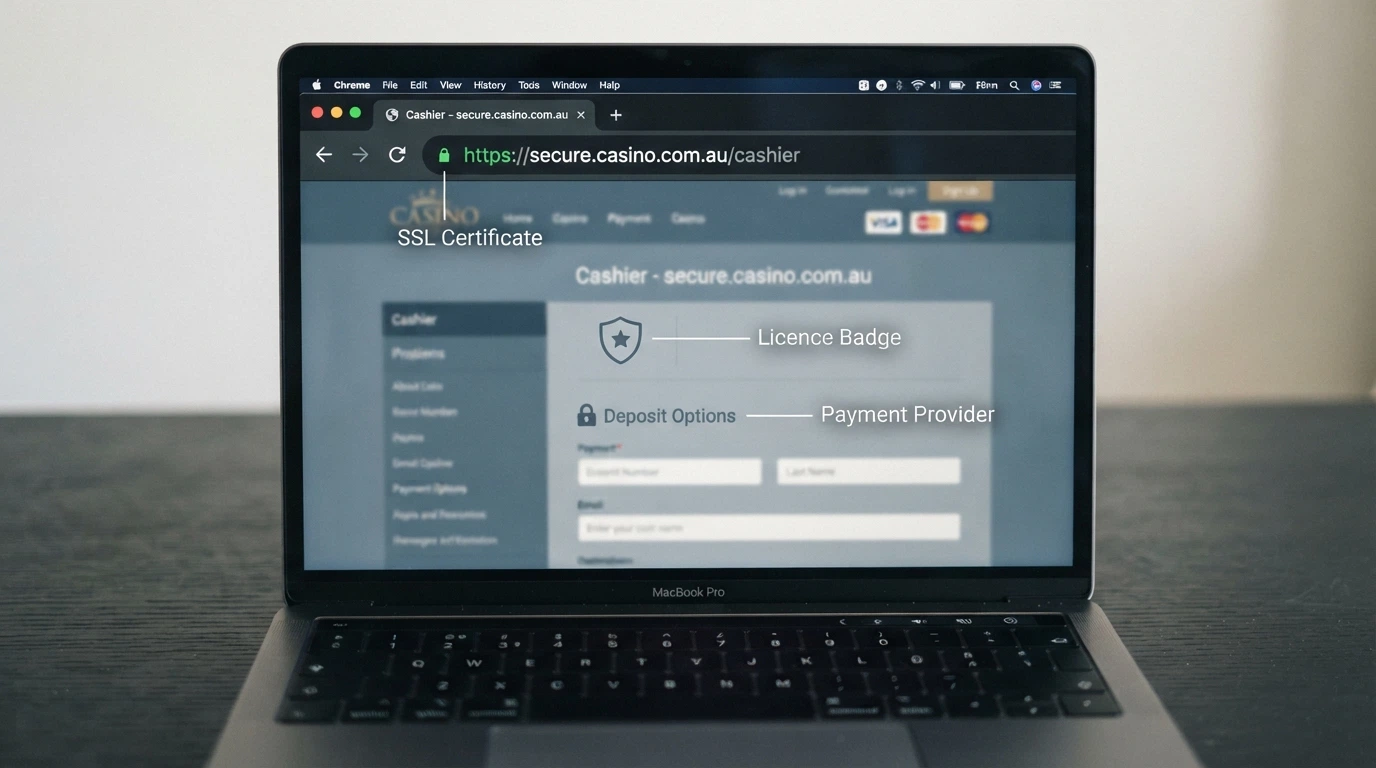
The rail is engineered for security in transit. The operator’s handling of the rail is the variable. An AU-facing casino can sit on a Curaçao licence, accept a deposit via PayID, route it through a perfectly encrypted payment gateway, and still refuse to release a withdrawal the next day. The PayID did its job; the operator is the one who decided not to. Encryption protects the data; only a published licence, transparent processing times and a track record of paying out protect the money itself.
SSL, two-factor authentication, tokenisation — the security layers are real, and most AU-facing operators implement them. The check a player can do in five seconds is the licence badge at the footer of the page and the payment-policy link in the footer or the terms-and-conditions menu. A casino with no published payment-policy page, no licence number, and no cashier-level disclosure of processing times is a casino that has decided the player does not need that information. That is its own signal.
Licensed Australian routes vs high-risk offshore payment paths
A debit card deposit at an Australian-licensed wagering operator and the same debit card deposit at an offshore casino travel through the same Visa rail. Only one of them gives the player an Australian authority to call if the money disappears. The licensed operator sits inside the ACMA’s regulatory perimeter, accepts the AU financial-services-law framework, exposes chargeback rights through the player’s bank, and is reachable through the Australian Financial Complaints Authority if the operator refuses to escalate. The offshore casino sits inside whatever jurisdiction issued its licence, with whatever complaint pathways that jurisdiction offers, and none of those pathways include ACMA, AFCA or any other Australian body.
Since the first ACMA blocking request in November 2019, 1,564 illegal gambling and affiliate websites have been blocked by Australian ISPs (as of March 2026), and more than 225 illegal services have withdrawn from the Australian market since 2017. Those figures are not the casino’s behaviour — they are the regulator’s enforcement record. A blocked site is one a player cannot reach, and a site that withdrew is one that decided AU enforcement was no longer worth the compliance cost. Neither outcome returns the player’s balance.
The 2026 reform, which commences on 1 January 2027, gives banks and payment providers express authority to block transactions to illegal gambling operators. The reform does not compel the banks to block — it permits them to. A player who uses PayID at an offshore casino in 2027 may find the deposit returned by their bank; a player who uses crypto will not, because the transaction never touches the Australian banking system. Bank-blocking changes the calculus at the fiat end and leaves the crypto end where it was.
How to recognise a trustworthy setup at an offshore operator: a published licence number and the regulator’s name, a payment-policy page with processing times and limits, a cashier that discloses minimums and maximums before the player deposits, and a track record of paying out that is checkable on independent player forums. None of those signals is a guarantee. They are a filter.
Behind the deposit button — the rails that move your money
Every deposit an Australian player makes triggers a chain of payment providers, gateways and settlement systems that the cashier page never names. Knowing the chain matters because each link in it is a possible source of delay, and the slowest link is rarely the one the player can see.
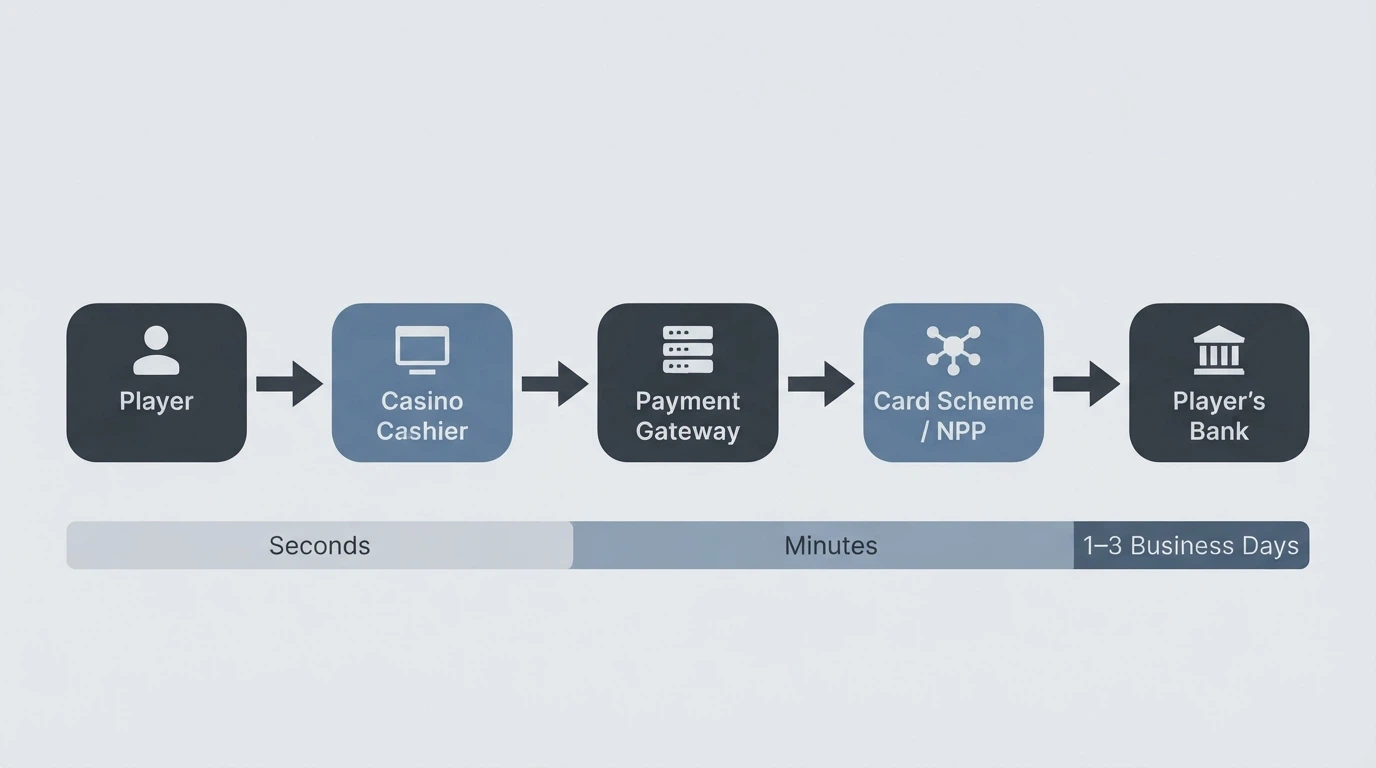
The Australian payment infrastructure for fiat is anchored by the New Payments Platform, live since February 2018, with the Reserve Bank’s Fast Settlement Service settling individual transactions around the clock including weekends and public holidays. PayID and Osko run on NPP. BPAY runs on the older direct-debit infrastructure. Cards run on the Visa and Mastercard networks, with settlement in Australia typically taking one to three business days from transaction to money in account. Crypto runs on the relevant blockchain, with settlement in minutes once network confirmations clear.
A deposit made via PayID at an AU-facing offshore casino typically travels: casino cashier → payment gateway (a third-party processor that handles the bank’s side of the transaction) → NPP/Fast Settlement Service → player’s bank. Each link is a queue. A payment gateway that has not integrated the latest NPP API will add seconds; a bank that is mid-maintenance will add minutes; an operator whose payment-team approval flow requires a manual click will add the processing window. The deposit speed published at the cashier is the sum of those queues minus whatever the operator has bothered to optimise.
The Australian Transaction Reports and Analysis Centre (AUSTRAC) sits over all of it. AUSTRAC’s Travel Rule kicks in at A$10,000 for crypto transactions, which means any Australian exchange handling a transaction above that threshold must collect and share counterparty information with the receiving exchange. Below the threshold, reporting is lighter; above it, the audit trail exists. The Travel Rule does not change the casino’s experience, but it does change what a regulator can reconstruct if a transaction is later questioned.
Casino payment systems — the software that decides whether your withdrawal is approved
The casino’s payment platform is a piece of software with rules, risk flags and queues. It scores each transaction for risk, integrates with the KYC vendor the casino has chosen, routes the deposit to the right payment provider, and queues the withdrawal for human approval. The player sees the queue as a “pending” status; the platform sees a transaction that has not yet cleared every check it wants to run.
The risk rules are where the withdrawal can stall. A large cashout triggers a source-of-funds questionnaire: at Stake, amounts above A$4,000-equivalent may trigger the questionnaire and stall the withdrawal for forty-eight to seventy-two hours while the player documents where the funds came from. A new payment method — a card the player has not used before — can trigger a re-verification step. An IP mismatch — the player logging in from a different country than the one on file — can flag the withdrawal for manual review. Each rule is a delay the cashier page does not document.
The integration layer between the casino platform and the payment provider is the link that determines whether an instant rail actually clears instantly. A casino whose payment gateway is integrated with PayID’s NPP API will land a PayID withdrawal in an hour; a casino whose gateway routes through an older processor will add a day. The same rail, the same operator brand, different speeds. There is no published list of which casinos use which gateway, and the only way to know is to test the cashier.
Payment provider mix — why casinos offer different methods and what that tells you
A casino’s payment-method list is not random. It reflects which providers agreed to onboard the operator, which is a signal about the operator’s standing with the payment industry. Visa and Mastercard are selective about which gambling merchants they work with — a casino with credit card acceptance has a relationship the casino had to earn, or has accepted the higher processing costs that come with a higher-risk MCC code. PayPal is more selective still; its presence at a cashier is a signal that the operator cleared PayPal’s gambling-vetting process.
Crypto and prepaid vouchers are easier for offshore operators to integrate, partly because no centralised payment network is making the onboarding decision. An offshore casino can stand up a Bitcoin and USDT wallet integration in a week; integrating Visa takes months and a compliance file. That is why the broader-method operators tend to be the larger brands (Skycrown publishes nine methods including cards, e-wallets, three cryptocurrencies and Neosurf), and the narrower operators tend to be the smaller or more specialised ones.
What a broad method mix tells you: the operator has had multiple providers accept its onboarding, which is a soft signal of stability. What a narrow method mix tells you: less of a signal on its own. Rainbet is crypto-only, which is a deliberate product positioning rather than a compliance flag. A two-method casino with both methods down for maintenance is a different problem; a two-method casino because it only does crypto is a crypto casino. Method count is information; it is not a verdict.
The 10 casino brands AU players reach for — ranked by how they handle your money
The operators below are the ten AU-facing casino brands that attract the most Australian player traffic, based on market-share data and player reach. None of them holds an Australian online casino licence — no such licence exists, because online casino is prohibited in Australia under the Interactive Gambling Act 2001. They are all offshore, licensed in Curaçao, Malta or other jurisdictions, and accessible from Australia because the IGA targets the provider, not the player.

What differs between them is the payment setup: how many methods they take, how low the deposit floor goes, how fast the withdrawals clear, and what limits apply when they do. The table below covers the operators where the data is published. Three operators in the ranking (Scream Casino, Rocket Casino, Rainbet’s fiat rail) carry thin published payment data at the time of review, and their entries are marked accordingly.
| Operator | Licence / Status in Australia | Deposit methods supported | Minimum deposit A$ | Fastest withdrawal |
|---|---|---|---|---|
| Skycrown | Offshore — no AU online casino licence possible | Visa, Mastercard, Skrill, Neteller, Bitcoin, Ethereum, Litecoin, Neosurf, MiFinity | A$20 | ~10 min avg processing (PayID / USDT) |
| RocketPlay | Offshore — no AU online casino licence possible | PayID, Visa / Mastercard, MiFinity, Neosurf, CashtoCode, Bank Transfer, Crypto | A$10 (PayID) | PayID under 1 hour |
| Royal Reels | Offshore — no AU online casino licence possible | PayID, Crypto, Bank Transfer, Neosurf | A$10 (PayID) | — |
| Stake | Offshore, Curaçao (widely reported) | Crypto (primary), Debit Card, Bank Transfer | — | Crypto 1–4 h; debit card as fast as 20 sec |
| FairGO | Offshore — no AU online casino licence possible | — | A$20 | 24–48 h after approval |
| Bizzo Casino | Offshore — no AU online casino licence possible | PayID, Visa, Mastercard, Neosurf, Apple Pay, Google Pay, Bank Transfer, Crypto | A$17 (Google Pay) | PayID instant–24 h |
| WinSpirit | Offshore — no AU online casino licence possible | Card, Crypto, E-wallets, Bank Transfer | — | E-wallets instant–same-day |
| Rainbet | Offshore — no AU online casino licence possible | Crypto (primary); other methods — | — | — |
| Scream Casino | Offshore — no AU online casino licence possible | — | — | — |
| Rocket Casino | Offshore — no AU online casino licence possible | — | — | — |
Method count is not the whole story. An operator with three methods and sub-hour withdrawals can beat one with nine methods and a 48-hour processing queue, and a crypto-only operator with a 20-second cashout can beat a multi-method operator whose bank transfer takes a week. The data points below are what each operator publishes on its own payment page; the ranking reflects which operators make it easiest to move AUD in and out, not which has the most methods or the largest bonus.
Skycrown: nine payment rails and a 10-minute average processing time
Skycrown has the broadest method mix in the ranking and the fastest stated processing average. Nine deposit methods span cards (Visa, Mastercard), e-wallets (Skrill, Neteller, MiFinity), three cryptocurrencies (Bitcoin, Ethereum, Litecoin) and a Neosurf voucher. The minimum deposit is A$20 and the minimum withdrawal is the same, with a weekly cap of A$7,500 (USDT 5,000) and a monthly cap of A$45,000 (USDT 30,000).
The processing speed is the headline. Skycrown publishes an average processing time of approximately ten minutes and a KYC verification turnaround of about four hours, which together mean a PayID or USDT withdrawal can land the same afternoon for a player whose KYC is already cleared. Licence details are usually found in the operator’s footer, with many in this segment publishing a Curaçao or similar offshore licence. Always confirm the licence on the operator’s official site before depositing.
Skycrown suits the AUD-native player who wants the widest method menu and the fastest stated processing. The weekly cap of A$7,500 and monthly cap of A$45,000 are tighter than Royal Reels’ A$10,000 weekly, which is the one number Skycrown does not lead on.
RocketPlay: PayID cashouts under an hour with a A$10 entry point
RocketPlay is the operator with the lowest PayID entry point in the ranking and the fastest documented PayID withdrawal among featured operators. PayID deposits start at A$10; Visa and Mastercard from A$25; MiFinity from A$30; CashtoCode vouchers up to A$800 as deposit-only; bank transfer from A$30 with a per-transaction maximum of A$6,000. The PayID withdrawal is under one hour for most Australian banks, with a daily limit around A$5,000. Bank transfer withdrawals take three to seven business days.
The welcome package is a 100 per cent match up to €1,000 plus 100 free spins, denominated in euros rather than AUD — a currency mismatch worth noting for an AU player, because the bonus value in AUD moves with the exchange rate and the wagering requirement operates on the EUR figure. The bonus structure is otherwise standard for an offshore casino welcome offer, with the value concentrated in the match component.
RocketPlay is the operator to pick if PayID at the cashier is the deciding factor. The A$10 PayID deposit floor and the under-one-hour PayID withdrawal are the two figures that make the case; the euro-denominated welcome offer and the A$6,000 bank-transfer ceiling are the trade-offs.
Bizzo Casino: PayID plus Apple Pay and Google Pay under one roof
Bizzo is the only operator in the ranking confirmed to support Apple Pay and Google Pay alongside PayID — a mobile-payment combination no other operator in the set documents. PayID withdrawals are documented as instant to twenty-four hours with a minimum of A$100. Deposits via Visa, Mastercard, Neosurf and Apple Pay start at A$20; Google Pay deposits start at A$17, the lowest published minimum deposit in the ranking. Bank transfer withdrawals take up to five business days with a minimum of A$50; crypto is also supported.
The Apple Pay and Google Pay integration is the differentiator. Both are tokenised card wrappers, which means the casino never receives the player’s real card number — the deposit is approved by the device biometric, and the card sits behind it. For a player depositing from a phone, that is a meaningful privacy and security layer the other operators do not match.
Bizzo is the only operator in the set that takes Apple Pay and Google Pay alongside PayID, and at A$17 Google Pay is the lowest deposit floor in the ranking. The PayID minimum withdrawal of A$100 is the catch, and a player cashing out smaller balances should account for it.
Royal Reels: the A$10,000 weekly cap and PayID from ten dollars
Royal Reels leads the ranking on weekly withdrawal capacity, with a published A$10,000 weekly cap — A$2,500 higher than Skycrown and the highest figure published in the set. PayID deposits start at A$10, with a A$20 welcome-bonus deposit benchmark. The withdrawal floor splits by method: A$30 for crypto, A$50 for fiat. Deposit methods include PayID, crypto, bank transfer and Neosurf.
The weekly cap is the headline. A player moving A$40,000 in a month hits Royal Reels’ ceiling faster than Skycrown’s, and a player moving A$80,000 in a month runs out of headroom at either operator. The crypto-withdrawal floor of A$30 is the lowest in the set, which matters for the player who wants to cash out smaller wins in crypto. The fiat-withdrawal floor of A$50 is mid-pack.
Royal Reels leads on the weekly withdrawal cap at A$10,000, with a A$10 PayID entry point and the lowest crypto withdrawal floor (A$30) in the set. The licence jurisdiction was not confirmed at the time of review; players should verify on the operator’s site before depositing.
Stake: crypto-first with a 20-second debit card withdrawal
Stake is the speed champion of the ranking. A tested debit card withdrawal has cleared in as fast as twenty seconds, which is the closest thing to genuine instant settlement in the AU-facing market, and crypto withdrawals land in one to four hours for KYC-cleared accounts. Crypto is the primary deposit rail — Bitcoin, Ethereum, USDT and others — with debit card and bank transfer as secondary methods; bank transfer withdrawals take up to three business days.
The speed comes with a frictional risk. Amounts above A$4,000-equivalent may trigger a source-of-funds questionnaire, and the questionnaire can stall the withdrawal for forty-eight to seventy-two hours while the player documents where the funds came from. That is a longer stall than the operator’s average processing time, and it applies to exactly the withdrawals where speed matters most. Stake’s licence jurisdiction is widely reported as Curaçao; players should verify on the operator’s site.
Stake is the speed outlier of the set: debit card withdrawals as fast as twenty seconds and crypto cashouts in one to four hours. The A$4,000 source-of-funds threshold is the friction the speed does not advertise, and it triggers precisely on the withdrawals where speed matters most.
Rainbet: crypto-only, and that is the whole payment story
Rainbet runs on a single rail. Crypto is the sole deposit and withdrawal method published; no fiat on-ramp or off-ramp is documented at the time of review. For an AU player, that means a CoinSpot or Independent Reserve round-trip on every deposit and every withdrawal, with the AUD-to-crypto conversion adding a day beyond the casino’s own processing time.
The licence jurisdiction was not confirmed at the time of review. Players should verify on the operator’s site before depositing. Rainbet is a deliberately narrow product — the crypto-only positioning is the brand, not a limitation — and it is best read as a casino for players who are already in crypto and want a casino that does the same thing rather than a casino for the AUD-native player.
For a crypto-native player, Rainbet is the right fit: single rail, no fiat round-trip option to second-guess. For an AUD-native player, Rainbet is the wrong fit: every deposit and withdrawal adds an exchange step that PayID would skip.
Fair Go Casino: the A$2,500 per-transaction ceiling and a higher withdrawal bar
Fair Go publishes the highest minimum withdrawal in the ranking at A$100, paired with a A$2,500 per-transaction ceiling — a combination that forces any cashout above A$2,500 into multiple transactions. The minimum deposit is A$20. Payouts are released within twenty-four to forty-eight hours of approval, which is mid-pack: faster than WinSpirit’s forty-eight-business-hour default, slower than Skycrown’s ten minutes.
The deposit-method list was not comprehensively documented at the time of review; check the operator’s cashier page. Always confirm licence details on the operator’s official site before depositing.
A A$10,000 cashout at Fair Go means four A$2,500 transactions across the 24–48 hour release window — a structure that adds friction to any withdrawal the per-transaction ceiling cannot cover in one go.
WinSpirit: e-wallet speed with a 48-hour default processing window
WinSpirit publishes the slowest default processing window in the ranking: standard withdrawal processing takes up to forty-eight business hours from the request. E-wallets are instant or same-day once approved, which is the speed advantage; bank transfers and cards take three to seven business days. Deposit methods include cards, crypto, e-wallets and bank transfer.
The gap between rail speed and operator speed is the story. A player requesting a MiFinity or Skrill withdrawal at WinSpirit waits forty-eight business hours for the operator to approve it, and then waits minutes for the wallet to land. A player requesting a bank transfer waits forty-eight business hours and then three to seven days. The operator’s queue is the bottleneck at almost every withdrawal.
WinSpirit is the operator where the gap between rail speed and operator speed is the story. A Skrill withdrawal at WinSpirit waits forty-eight business hours for the operator to release it, and then lands in minutes; the queue is the bottleneck.
Scream Casino: limited payment data at the time of review
Scream Casino sits in the AU-facing offshore segment, and the operator’s cashier, payment-policy page and licence number are the three documents that determine whether the operator is the right fit. Start at the cashier: the published deposit and withdrawal methods, the minimums, and the per-transaction limits are the numbers that matter. Cross-reference those against the payment-policy page in the footer — a cashier that lists methods the payment policy does not describe is an operator with internal inconsistency. Verify the licence: the licence number and the regulator’s name should be verifiable on the regulator’s own register, not only on the casino’s footer.
Scream carries AU player traffic, and the operators in this segment vary widely on what they publish. The payment specifics that an AU player needs to make an informed choice are the operator’s responsibility to publish, and a player who cannot find them should treat the absence as information about the operator rather than as a reason to deposit. The cashier, the payment-policy footer link and the regulator’s own register are the three documents to check before any deposit; the published payment data on this page is not a substitute for any of them.
Rocket Casino: limited payment data at the time of review
Rocket Casino shares a name with RocketPlay but is a separate operator on its own domain. The two do not share payment terms, and a player who searches for one operator’s payment data and lands on the other’s review is reading the wrong document. Verify the domain, the licence, and the cashier before any deposit.
The same due-diligence stack as Scream applies. The cashier page lists deposit and withdrawal methods, minimums and limits; the payment-policy page in the footer describes processing times; the licence number in the footer should resolve on the regulator’s own register. A player who runs that stack and finds clean data has the comparison they need; a player who runs it and does not has the answer the absence was already giving them. Rocket Casino is unranked here for the same reason as Scream Casino — payment data not surfaced — but the name overlap with RocketPlay adds a specific risk that Scream does not. RocketPlay’s PayID-under-one-hour and A$10 minimum do not transfer; verifying the operator before any deposit is the only way to avoid reading the wrong terms.
What the law actually says about paying an online casino in Australia
The Interactive Gambling Act 2001 prohibits providing online casino games to a person in Australia. The prohibition targets the provider, not the player — the IGA makes it an offence to offer the product, and the individual punter is not prosecuted for using it. That is why Australian bank accounts can move money to offshore casinos at all, and why the regulatory attention falls on payment methods rather than on players.
The Act was strengthened in 2017 and amended again in 2023 with the credit and crypto ban that took effect on 11 June 2024. From that date, no Australian-licensed wagering operator may accept a credit card or a credit-related product as a deposit method, and no licensed operator may accept digital currency (crypto). Penalties for operator non-compliance reach A$247,500. By 30 June 2025 every one of the fifty licensed wagering operators reviewed by ACMA had scrubbed references to credit cards and cryptocurrencies from their deposit language — a 100 per cent compliance rate that turned the licensed market into a debit-card / PayID / bank-transfer / BPAY monoculture.
The 2026 reform — the Interactive Gambling Amendment (Gambling Reform) Bill 2026 — passed Parliament on 19 August 2026, with measures commencing on 1 January 2027. The reform gives banks and payment providers express authority to block transactions to illegal gambling operators, enhances BetStop’s protections, and imposes new advertising restrictions. None of the changes target the player directly; all of them change the rail the player uses.
The payment methods that signal a licensed operator — and the ones that do not
The legal deposit routes for Australian-licensed wagering are debit card, bank transfer, PayID/Osko and BPAY. That is the entire list. A casino cashier that offers credit cards, crypto, Skrill, Neteller, Neosurf, POLi, Apple Pay or Google Pay is, by definition, not an Australian-licensed wagering operator — because no licensed operator is allowed to offer those methods, and the licensed market has hit 100 per cent compliance on removing the banned ones.
That makes the payment-method list the simplest compliance signal a player can read. If a casino takes a credit card, it is offshore. If a casino takes USDT, it is offshore. If a casino takes Neosurf, it is offshore. The presence of any of those methods at the cashier is not a judgement about trustworthiness — it is a statement about jurisdiction. Offshore does not mean untrustworthy, and licensed does not mean safe; the signal is jurisdictional, not evaluative.
Every casino on this page is offshore. That is the structural fact that the rest of the page sits inside, and it is the fact the 2026 reform’s bank-blocking provision is designed to address. From 1 January 2027, an AU bank may block the PayID or card transaction to an offshore casino before it arrives; it does not have to block, but it may. The change at the payment-rail level is the most significant payment-related enforcement shift in the IGA’s history, and it is the reason any AU-facing casino page in 2026 reads differently from one written a year earlier.
Offshore casinos and your money — the protections you do not have
Depositing at an offshore casino means Australian law cannot help recover the money. Three Australian protections are bypassed by going offshore. No ACMA complaint resolution: the regulator enforces the IGA against the provider, but it does not arbitrate player-casino disputes, and it does not have the power to compel a Curaçao-licensed operator to release a withdrawal. No Australian Financial Complaints Authority access: AFCA is the dispute-resolution body for Australian financial-services providers, and an offshore casino is not one. No BetStop coverage: BetStop excludes a person from all ~150 licensed wagering providers in Australia; an offshore casino is not in that perimeter and will keep accepting deposits from a self-excluded player.
The channelisation trend is the structural backdrop. H2 Gambling Capital research estimates that around 36 per cent of all online wagering by Australians now goes through offshore operators, up from 26 per cent in 2021; channelisation has dropped from 74 per cent to 64 per cent across the same period. The licensed perimeter is shrinking as a share of spend, which is also the share of spend that sits inside any Australian consumer-protection framework.
The ACMA’s enforcement record is the regulator’s answer to that trend. Since the first blocking request in November 2019, 1,564 illegal gambling and affiliate websites have been blocked by Australian ISPs (as of March 2026), and more than 225 illegal services have withdrawn from the Australian market since 2017. The block is on the operator, not the player; the player’s existing balance is not refunded, and a site that disappears takes any unwithdrawn funds with it. That is the practical risk of an offshore-only relationship: the operator can be made unreachable, and the player has no Australian authority to appeal to.
The 2027 bank-blocking provision changes the entry point. Covered in the section on licensed Australian routes versus offshore payment paths: from 1 January 2027, an Australian bank may decline to process a transaction to an offshore casino — at its discretion, not its obligation. Crypto bypasses the rail, which means crypto bypasses the bank-blocking provision, but crypto also bypasses every consumer protection the Australian system offers. The trade-off is not between convenience and safety; it is between which layer of protection the player is willing to give up.
Keeping the tap on — payment limits and help that actually work
The payment method is the last clear off-ramp before the money leaves the player’s control. The licensed Australian market has built tools around that off-ramp — deposit limits, session limits, activity statements, the BetStop register — but those tools are bound to the licensed perimeter. An offshore casino is not required to offer any of them, and an AU player using one is on the operator’s own responsible-gambling settings, whatever they happen to be.
The bank can also be the off-ramp. Most Australian banks offer a gambling-transaction block at the account level, which declines any transaction that matches a merchant code in the gambling category. CBA, NAB, Westpac and ANZ all publish the option; the block applies across the bank’s cards and PayID. It is independent of the casino, and it is the cleanest responsible-gambling tool that works at the rail rather than at the operator. The block does not reach crypto, which is one of the reasons crypto is both the fastest rail and the hardest one to gate.
The licensed responsible-gambling settings worth knowing about: deposit limits (daily, weekly, monthly caps the player can set inside the casino account, with cooldown periods on increases), session limits (auto-logout after a chosen duration), reality checks (pop-up reminders of session time and net position), and activity statements (a transaction history the player can download). None of these settings reach an offshore casino that has not implemented them; an AU player who wants them needs an operator that offers them and an account the player is willing to lock down.
Self-exclusion, BetStop and the offshore gap — what actually protects an AU player
BetStop is the National Self-Exclusion Register, live since August 2023. One registration excludes a person from every Australian-licensed wagering provider — approximately 150 brands across sports and racing — for a minimum of three months up to lifetime. As at 31 July 2026, the register held 67,480 registrations, of which 41,290 exclusions were still active; 78 per cent of registrants were under 40, and 38 per cent chose lifetime exclusion.
BetStop’s coverage is total within the licensed perimeter and zero outside it. A player who self-excludes through BetStop cannot place a wager with Sportsbet, Ladbrokes, TAB, bet365 or any other Australian-licensed bookmaker, and the exclusion applies across the operator’s mobile apps, websites and retail channels. The same player can walk to an offshore casino in the same browser session and deposit, because the offshore casino is not connected to the register. The exclusion is enforced by the licensed operators; the offshore operators have no signal to honour.
The 2026 reform tightens the licensed end. From 1 January 2027, the reform bans direct marketing of wagering inducements for fourteen days after a customer signs up with an operator, for three months after a person deregisters from BetStop, and indefinitely for customers identified as at risk of gambling-related harm. The reform does not extend BetStop to offshore operators. It makes the licensed perimeter harder to re-enter after exclusion; it does not close the offshore door.
The practical stack for an AU player who wants to gate offshore play. First, the bank-level gambling block: it stops the card and PayID deposits at the rail. Second, third-party blocking software: Gamban, BetBlocker and similar tools block access to gambling sites at the device level, including offshore sites. Third, the BetStop registration: it covers the licensed perimeter, where most of the player’s likely AU-facing spend already happens. None of the three is a complete solution on its own; together they cover most of the rail and most of the reach.
Where to get help — the numbers and services that are free, 24/7 and confidential
About 2.1 per cent of Australian adults — roughly 430,000 people — experience problem gambling, with the Australian Institute of Health and Welfare putting high-risk gambling at 1.8 per cent in 2022. The Australian helpline and counselling infrastructure is well-funded, professionally staffed and free at the point of use. The services below are the ones an AU player or an AU player’s family can reach today.
- National Gambling Helpline: 1800 858 858. Free, confidential, staffed 24 hours a day, 7 days a week. The first call for any AU player who is worried about their own gambling or someone else’s.
- Gambling Help Online: gamblinghelponline.org.au. Online chat and email counselling, self-assessment tools, and free one-on-one sessions with a counsellor. The web route for players who would rather type than talk.
- BetStop: covered in the previous section. One registration excludes from all ~150 Australian-licensed wagering providers; does not cover offshore casinos.
- Bank-level gambling block: every major Australian bank offers a gambling-transaction block at the account level, applied through internet banking or a branch visit. The block applies to cards and PayID; it does not reach crypto.
- Gamban and BetBlocker: third-party software that blocks access to gambling sites at the device level. Subscription fee; covers offshore casinos as well as licensed sites.
Australians lose approximately A$25 billion on legal forms of gambling each year, and 11 per cent of Australians gambled online in the previous six months (ACMA 2022, up from 8 per cent in 2020). The licensed market is the perimeter the protection sits inside; the offshore market is the perimeter the protection does not reach. The infrastructure above is what works in both.
How we evaluated every payment method and casino on this page
This page is built from operator-published payment terms, Australian regulatory data and independent player reports. The payment-method descriptions draw on the operators’ own cashier and payment-policy pages, cross-referenced against the published data on Australian-facing casino review sites. The regulatory section draws on the Australian Communications and Media Authority’s enforcement record, the Interactive Gambling Act 2001 (as amended), and the 2026 reform’s published commencement provisions. The responsible-gambling section draws on the Australian Institute of Health and Welfare’s prevalence data, the ACMA’s BetStop statistics, and the helpline infrastructure ACMA itself publishes.
The operator set is the ten AU-facing casino brands with the highest Australian player traffic, based on market-share data and player reach. The ranking reflects the payment setup each operator publishes: method range, minimum deposit barrier, withdrawal speed, withdrawal caps, and licence transparency. No claim on this page relies on an affiliate marketing source, and no claim is sourced from a review page that does not name its underlying operator data.
Three limitations are worth naming. First, three operators in the ranking — Scream Casino, Rocket Casino, and the fiat rail at Rainbet — carry thin published payment data at the time of review, and their entries reflect what is verifiable rather than what is implied by the brand name. Second, licence jurisdictions were not confirmed for every operator at the time of review, and players should verify the licence on the operator’s own page before depositing. Third, payment terms change: a minimum deposit that is A$20 this week may be A$30 next month, and the cashier page is the only document that is current at the moment of deposit. The page is a snapshot, not a contract.
What the page is not: it is not an advertisement for any operator, it is not a recommendation of one brand over another, and it is not a substitute for reading the cashier page yourself before you deposit. The job is to make the comparison the player would otherwise have to do across ten operator sites and a half-dozen regulatory pages, in one place, with the data each page carries.
The payment method you pick sets the terms — choose it before you choose the casino
The fastest, cheapest and safest route from an Australian bank account to a casino balance and back again is PayID to PayID at an operator with published sub-hour withdrawal processing. The combination exists in the ranking: PayID at RocketPlay clears in under an hour for most Australian banks; PayID at Royal Reels starts at a A$10 deposit floor; PayID at Bizzo clears inside twenty-four hours with tokenised-card security on top. The rail is the same; the operators are not, and the operator with the published ten-minute processing average (Skycrown) is the operator that turns PayID from a fast rail into a same-day cashout.
For a player already in crypto, USDT TRC-20 is faster on the rail than PayID — under fifteen minutes for a withdrawal, with network fees under A$0.50 — but the AUD-to-crypto round-trip on an Australian exchange adds a day beyond the casino’s confirmation. Stake’s 20-second debit card cashout is the genuine standout, but the source-of-funds questionnaire above A$4,000 is the friction that sits behind it, and it applies to exactly the withdrawals where speed matters most.
The trade-off is structural and unavoidable. None of the operators on this page is Australian-licensed, because no Australian online casino licence exists. Every brand sits offshore, every cashier sits outside the ACMA’s regulatory perimeter, and the bank-blocking authority that takes effect on 1 January 2027 will change the entry point at the fiat end without changing the structural fact. PayID at a Curaçao-licensed casino in 2027 may find the deposit returned by the player’s own bank; crypto at the same casino will not, because the transaction never touches the Australian banking system.
What to do with the page. Use the table to identify the operator whose method mix and processing times match the player’s situation; use the operator write-ups to verify the specifics on the cashier page; use the regulatory section to understand the perimeter the player’s money sits inside. Then check the cashier page one more time before depositing, because payment terms change, and the published page is the one that is current at the moment of the deposit.
The payment method is the contract. The casino is the counterparty. The protection is the jurisdiction, and the jurisdiction is offshore. Choose the method first; everything else follows.
Frequently asked questions
Can I use a credit card to gamble online in Australia?
At any Australian-licensed wagering operator, no. The credit card ban took effect on 11 June 2024 under the Interactive Gambling Amendment (Credit and Other Measures) Act 2023. Offshore casinos still take credit cards — a signal they are outside the Australian perimeter, and a debt risk the ban was designed to prevent.
Are crypto deposits legal at online casinos in Australia?
Crypto is banned as a payment method for Australian-licensed wagering operators, with the same 11 June 2024 commencement and the same A$247,500 penalty. Offshore casinos still take Bitcoin, Ethereum, USDT and Litecoin. The AUSTRAC Travel Rule applies above A$10,000 for any crypto transaction routed through an Australian exchange.
Can I use Neosurf vouchers for casino deposits in Australia?
Yes, at offshore casinos — Neosurf and Flexepin are accepted as deposit methods at most AU-facing brands. The limitation is structural: vouchers are deposit-only and cannot receive withdrawals. A player who deposits via Neosurf and wins a cash balance will need a second rail — bank transfer, e-wallet or crypto — to receive the payout.
Is it safe to use e-wallets like Skrill and Neteller at Australian casino sites?
E-wallets are a legitimate rail at AU-facing offshore casinos, with deposits in minutes and withdrawals within twenty-four hours. The wallet does not change whether the casino is licensed in Australia, and no e-wallet provider offers AU regulatory recourse for a casino-side dispute. The privacy and speed advantages are real; the absence of AU consumer protection is also real.
What happens if my bank blocks a transaction to an online casino?
From 1 January 2027, Australian banks and payment providers gain express authority to block transactions to illegal gambling operators. The block is at the bank’s discretion, not an obligation, and applies at the fiat rail — PayID, card, BPAY, bank transfer. Crypto bypasses the block because the transaction does not flow through an Australian bank. A blocked transaction is returned.
Is PayID the fastest way to deposit and withdraw at Australian online casinos?
PayID is the fastest AUD-native deposit and withdrawal rail for an AU bank account holder. Deposits post in under sixty seconds with zero player-side fees; withdrawals take one to four hours once the operator approves them. Crypto is faster on the rail (USDT TRC-20 under fifteen minutes) but requires an AUD round-trip on an exchange, which adds a day.
Casino apps vs mobile browser — does the payment flow change?
Where a casino does maintain a native app, the payment flow can differ in two ways. First, the app may integrate the device’s wallet more deeply — Apple Pay surfaces directly in some apps, with stored-card tokenisation happening behind a Face ID check that the mobile web flow approximates but does not always match. Second, the app’s stored credentials reduce repeated deposits to a single tap, which is the same friction reduction the web flow offers but tends to deliver more reliably.
The underlying rail is unchanged. PayID in an app is still PayID over NPP; a Visa deposit in an app is still a Visa tokenisation; a USDT TRC-20 deposit in an app still requires the player to copy a wallet address and confirm the transfer from an external wallet. The app does not change the speed of the rail, and it does not change the operator’s withdrawal queue. What it changes is the number of steps the player takes to get to the rail.
Biometric authentication is the genuinely mobile-specific security layer. A deposit approved by Face ID or a fingerprint is a deposit approved by the device, not by a password the player typed. For most AU-facing operators that is a marketing claim more than a security upgrade — the device biometric is gating the wallet or the card, not the casino’s risk decision — but it is a meaningful reduction in the attack surface for someone who has lost a phone or had one stolen.
Created by the ”Min Deposit 5 Casinos AU” editorial team.