Where Australians Actually Play Online Craps in 2026
 Available in AU
No Australian licence covers online craps. The Interactive Gambling Act 2001 prohibits the provision of online casino games to a person physically in Australia, which makes every casino on this page — Royal Reels, Skycrown, RocketPlay, Stake, FairGO and the rest — an operator running from outside the country. Australia’s regulator has put it more sharply than any marketing copy could: a page about “the best licensed online casinos in Australia” is describing something that does not exist. The ACMA has blocked 1,564 illegal gambling and affiliate websites since November 2019, and 225 illegal services have withdrawn from the Australian market since 2017. The enforcement is real. It does not, however, change the practical fact that an Australian who wants to roll dice against a real payout tonight is depositing at one of the brands below.
Verified against the Australian Communications and Media Authority register and operator licence disclosures, as of 18 October 2026.
This page ranks ten of those brands by what matters once the marketing is stripped away: the licence under which they actually operate, the craps coverage they offer, the bonus terms that decide whether a welcome offer is worth claiming, the deposit routes that work for Australian dollars, and the volume of Australian traffic each one already attracts. The market-share figures in the operator write-ups are 2026 estimates from third-party tracking. They tell you how many Australians are already playing at each operator. They do not tell you whether they should.
| Operator | Welcome Bonus | Wagering Multiplier | Bonus Validity | Game Providers | Deposit Methods |
|---|---|---|---|---|---|
| Royal Reels | 100% up to A$500 + 50–100 free spins | 30x–40x | 7–14 days | Pragmatic Play, Evolution, NetEnt, Hacksaw | Visa, Mastercard, crypto, Neosurf |
| Skycrown | Up to A$4,000 + 200–400 free spins | ~40x | 7–30 days | BGaming, Evolution, Playson, Yggdrasil | Crypto, Neosurf, Visa/Mastercard |
| RocketPlay | 100% up to A$1,000 + 100 free spins | ~40x | 7 days | Pragmatic Play, Evolution, Play’n GO | Crypto, Neosurf, bank transfer |
| Stake | Rakeback / weekly boost model | — | — | Stake Originals, Pragmatic, Hacksaw, Evolution | Crypto only (BTC, ETH, LTC, DOGE, USDT) |
| Scream Casino | 100% up to A$500 | ~40x | 7 days | Pragmatic, Evolution, NetEnt | Crypto, Neosurf |
| FairGO | 100% up to A$200 × 5 = A$1,000 | 30x | 30 days | RealTime Gaming (RTG) | Visa, Mastercard, Neosurf, Bitcoin, bank transfer |
| Bizzo Casino | 100% up to A$250 | 40x | 7 days | Pragmatic, Evolution, Playtech | Crypto, Neosurf |
| Rocket Casino | Match bonus | 40x | 14 days | Pragmatic, Evolution | Crypto, Neosurf |
| WinSpirit | Match bonus | 40x | 7 days | Pragmatic, Evolution | Crypto, Neosurf |
| Rainbet | Variable crypto bonus | — | — | Pragmatic, Evolution | Crypto only |
Read the table carefully. Skycrown’s headline figure of A$4,000 is the largest welcome bonus in the set, but it carries the heaviest 40x multiplier and a 7-to-30-day validity window that depends on which deposit tranche is in play. Stake and Rainbet sit at the other end of the bonus column — no traditional match offer at all, replaced by rakeback or variable crypto campaigns. FairGO is the only operator whose wagering multiplier drops to 30x and whose validity window stretches to 30 days, which is what makes it the slowest grind and the most generous clearance deadline in the table.
Most of the set clusters around Pragmatic Play, Evolution, NetEnt and Hacksaw as the provider backbone. The outliers are FairGO, which runs on RealTime Gaming alone, and Skycrown, which carries BGaming, Playson and Yggdrasil in place of Pragmatic and NetEnt. Live-dealer craps coverage tracks closely with Evolution’s presence: every operator except FairGO carries Evolution’s live-craps studio. Two operators in the table take crypto only. Stake runs BTC, ETH, LTC, DOGE and USDT. Rainbet runs crypto-only with no fiat route. The rest accept at least one fiat option alongside crypto, with Visa, Mastercard, Neosurf and bank transfer the typical mix.
The single fact that frames every offer on this page is offshore status. A Curaçao or Kahnawake licence is not an Australian licence. The regulator behind the licence cannot enforce an Australian dispute, and ACMA’s enforcement against the operator is reactive — site blocking, withdrawal notices — rather than protective. Player recourse, where it exists at all, runs through the operator’s own complaints process or through a chargeback on the payment method. That is the baseline. Read the rest of this page against it.
Table of Contents
- How We Evaluate an Offshore Craps Casino
- Royal Reels
- Skycrown
- RocketPlay
- Stake
- Scream Casino
- FairGO
- Bizzo Casino
- Rocket Casino
- WinSpirit
- Rainbet
- How to Play Craps: Rules, Bets & Strategy Guide
- Why Most Craps Players Bet Wrong — And Where the Smart Money Goes
- The Craps Table: Layout, Variants & Why Crapless Craps Costs You More
- Real Money Craps vs Free Play: When the Risk Is Worth It
- Why Your 2026 Craps Bonus Is Harder to Clear Than It Looks
- Live Dealer Craps: As Close to the Table as You’ll Get Online
- Is Online Craps Legal in Australia? The Offshore Reality
- Staying Safe: Responsible Gambling Tools That Actually Work
- How We Selected and Ranked These Online Craps Casinos
- Your 2026 Online Craps Decision: Risk, Reward & the Safer Path
- Frequently Asked Questions
How We Evaluate an Offshore Craps Casino
The featured set was filtered through five criteria. None of them is a tie-breaker on its own; the ranking that follows weighs them together.
- Licensing jurisdiction and regulator credibility. Offshore licences in Curaçao and Kahnawake are the two regulators the featured set actually holds, neither of which is an Australian authority. The question is whether the licence is current, whether the operator is on any public enforcement list, and whether the regulator’s complaints process is navigable. A licence that exists only as a logo in the footer is worth less than the same logo with an active licence number.
- Game-provider quality and craps coverage. Craps is a niche enough game that not every offshore casino carries it well. The relevant check is whether RNG craps, live-dealer craps, or both are present, and which studios are supplying them. Evolution is the dominant live-craps studio and the most reliable signal of a serious craps product.
- Deposit and withdrawal reliability. The most common offshore complaint is not that a deposit failed but that a withdrawal stalled. Look for an explicit withdrawal timeframe, published limits, and a documented KYC route. AUD support matters here. A casino that does not accept AUD forces a conversion on every transaction.
- Bonus fairness and wagering terms. A 40x wagering multiplier on a match bonus is the offshore standard. Higher than that is steep; lower is generous. The validity window is the second leg of the test. Seven days turns a generous bonus into a demanding one; thirty days turns a steep bonus into a workable one.
- Player-feedback signals. Independent forums, watchdog sites and operator-review databases carry the patterns that matter: how slow withdrawals actually run, how bonus disputes actually resolve, whether the brand cuts off a winning player. The signals are noisier than the regulator data, but they are the only ones that describe lived experience.
Royal Reels
Royal Reels sits in the middle of the offshore craps pack on almost every measure. A standard 100% match welcome up to A$500 with 50 to 100 free spins attached, the wagering multiplier listed at 30x to 40x, and a 7-to-14-day validity window that lands between the generous end (FairGO’s 30 days) and the tight end (RocketPlay, Scream Casino, Bizzo Casino and WinSpirit all at 7 days). The provider mix is the standard offshore set: Pragmatic Play, Evolution, NetEnt, Hacksaw Gaming. Craps shows up both as an RNG table and through Evolution’s live studio, so the format choice is yours. Deposit routes include Visa and Mastercard processed offshore, Bitcoin, Ethereum, Litecoin and USDT, plus Neosurf for the prepaid crowd. A 2.51% slice of the Australian market is mid-pack.
The welcome bonus is serviceable rather than exciting. Royal Reels is the operator for an Australian craps player who wants a moderate offer, a familiar provider lineup and no surprises in the small print — which is what the bulk of the Australian craps players at this tier actually want.
Skycrown
Skycrown’s welcome package is the largest headline figure in the featured set, but the headline figure is not the offer’s cost — the offer’s cost is what the maths demands before a cent is yours. Required turnover on a A$4,000 bonus at the standard 40x wagering multiplier runs at A$160,000 of craps play. At a Pass Line house edge of 1.41%, the expected cost of clearing that bonus is roughly A$160,000 × 0.0141, or A$2,256. The bonus advertises A$4,000. The bonus costs about A$2,256 to convert. That gap is the marketing-to-arithmetic ratio on the most generous offer in the table. Bonus validity runs 7 to 30 days depending on which deposit tranche is in play, the provider set runs through BGaming, Evolution, Playson and Yggdrasil, and craps shows up across RNG and the Evolution live studio. Deposits tilt crypto-first: BTC and USDT are the cleanest routes, with Neosurf and Visa/Mastercard as alternatives. An 8.55% slice of the Australian market is the second-largest in this set.
Skycrown is the right choice for an Australian craps player with the bankroll to clear A$160,000 of craps turnover inside the validity window, who treats the bonus as expensive entertainment rather than free money. Everyone else should look at a smaller offer with a tighter multiplier.
RocketPlay
RocketPlay holds the largest slice of the Australian market in this set — 9.4%, the closest any offshore operator gets to the share held by the domestic market leader. The welcome offer is straightforward by comparison with Skycrown: a 100% match up to A$1,000 with 100 free spins attached, the standard 40x wagering multiplier, and a validity window that compresses everything to seven days. Providers are Pragmatic Play, Evolution and Play’n GO, which covers both RNG craps and the live studio. Deposits run crypto, Neosurf and bank transfer.
Seven days is the catch. A A$1,000 bonus at 40x is A$40,000 of craps turnover, and at the Pass Line edge of 1.41% that runs an expected cost of A$564 to clear. Doing that in a week means roughly A$5,700 of craps play per day — achievable for a high-volume player, tight for anyone working around a regular schedule. RocketPlay is the right operator for an Australian craps player who plays daily and has the time to grind through a tight validity window without missing the deadline.
Stake
Stake does not run a match bonus, which is the first thing to know about it. The welcome structure is a rakeback model with a weekly boost, paid back in crypto with no wagering multiplier attached because there is no traditional bonus to clear. Stake Originals craps is a provably-fair game — the dice outcome is verifiable on the blockchain before the bet settles — and Evolution’s live studio covers the live-dealer side for anyone who wants a real table on camera. Deposits are crypto-only: BTC, ETH, LTC, DOGE and USDT. The 1.28% market share understates the brand’s actual reach, because Stake is the most recognisable crypto casino in the world outside the bonus-credit niche.
Stake is the ideal choice for an Australian craps player who already holds crypto and is comfortable converting AUD at deposit time. Anyone who wants a traditional match bonus, a long validity window, or AUD on the cashier page should look elsewhere.
Scream Casino
Scream Casino is a smaller offshore brand that runs a standard 100% match bonus up to A$500 at the usual 40x wagering, with seven days to clear it. Pragmatic Play, Evolution and NetEnt cover the game providers, craps shows up in both RNG and live-dealer form, deposits take crypto and Neosurf, and the 0.99% market share places it near the bottom of the set. There is nothing wrong with it. There is also nothing on the offer that distinguishes it from half a dozen competitors running the same shape.
FairGO
FairGO is the AU-branded outlier in this set, and the welcome offer is structured accordingly: a 100% match up to A$200 across the first five deposits, totalling A$1,000 if every deposit is maximised. The wagering multiplier is 30x rather than 40x, the lowest in the set, and the validity window is 30 days rather than 7 — the longest clearance deadline in the featured set. The trade-off is the game library, which runs on RealTime Gaming only. RTG ships a craps title, but the provider breadth is narrower than the Pragmatic/Evolution mix that dominates elsewhere. Deposits cover Visa, Mastercard, Neosurf, Bitcoin and bank transfer. The 0.8% market share is the smallest in the table, but the brand positions itself as Australian-facing and the deposit routes reflect that.
FairGO serves the Australian craps player who values clearance time over provider breadth — someone with a smaller bankroll who would rather grind through 30x over a month than 40x in a week.
Bizzo Casino
Bizzo Casino’s hook is Playtech in the provider list, which most of the rest of the featured set does not carry. Pragmatic and Evolution are present too, so craps shows up across RNG and live, and the addition of Playtech widens the table-game range for a player who treats craps as one of several games. The welcome offer is the modest one in the set: 100% up to A$250 at 40x wagering and seven days to clear. The 0.57% market share places it near the bottom of the table. Deposits run crypto and Neosurf.
Bizzo is the right operator for a table-game player whose interest extends past craps and who values a Playtech-branded lobby as much as the craps table itself.
Rocket Casino
Rocket Casino shares the Rocket branding with RocketPlay and runs a similar welcome package — a match bonus at the standard 40x wagering multiplier, with the validity window sitting at 14 days rather than RocketPlay’s 7. The 14-day window gives a part-time player twice the runway to clear the same multiplier, which is the entire distinguishing feature of the offer. Providers are Pragmatic Play and Evolution, craps shows up in both formats, deposits run crypto and Neosurf, and the 0.57% market share mirrors Bizzo’s. Rocket Casino is the right operator for an Australian craps player who liked the shape of RocketPlay’s offer but needs a less compressed clearance deadline.
WinSpirit
WinSpirit holds 1.55% of the Australian market — a small but real slice — and runs a match bonus at the standard 40x wagering multiplier with a seven-day validity window. Providers are Pragmatic Play and Evolution, craps shows up across both formats, deposits run crypto and Neosurf. The offer is unremarkable by design. There is no headline number, no extended window, no provider differentiator. The brand is built on consistency rather than distinctiveness, which makes it a credible second account for an Australian player who has already tried the bigger-name brands and wants a quieter alternative without giving up the standard offshore mix.
Rainbet
Rainbet is the second crypto-native operator in the set after Stake, and the welcome offer reflects it: a variable bonus structure built around crypto deposits, no standard wagering multiplier, no fixed validity window because there is no traditional bonus to clear. Providers are Pragmatic Play and Evolution, craps shows up in both RNG and live-dealer form, deposits are crypto-only, and the 1.28% market share places it alongside Stake at the small-share end of the set. The difference from Stake is that Rainbet’s bonus model is looser and more campaign-driven, with no provably-fair original craps to anchor it. Rainbet is the right operator for an Australian crypto player who treats the welcome offer as campaign-based rather than a fixed entitlement.
How to Play Craps: Rules, Bets & Strategy Guide
Craps looks like chaos from the outside — a long green felt, a dozen bets in flight, a stickman shouting across the table. From the player’s chair it is one of the cleanest casino games ever designed. A single pair of dice decides every outcome. The bets on the felt divide cleanly into a low-edge cluster and a high-edge cluster, and the only decision the house forces on you is which side of that line you want to sit on. This section walks through the rules and the bets in the order a new player needs them: the flow of a round first, then the four bets that cover most of what a beginner will ever place.
Craps Rules: The Flow of a Round
Craps is a dice game played with a pair of standard six-sided dice, and the player wagers on the outcome of the roll — or a series of rolls — of those dice. The table is run by four casino staff: a stickman who controls the dice and calls the centre bets, two dealers who handle the rail bets on either side, and a boxperson who supervises the action. A player called the shooter stands at one end of the table and rolls the dice for a round; the other players bet on what those dice will do.
A round has two phases. The first is the come-out roll, when the puck on the table is OFF and a new point is being established. The shooter rolls the dice once. Three things can happen. A roll of 7 or 11 — a Natural — wins any Pass Line bet on the felt and the round ends. A roll of 2, 3 or 12 — Craps — loses Pass Line bets and the round ends. A roll of 4, 5, 6, 8, 9 or 10 establishes the Point, the dealer flips the puck ON to that number, and the round enters its second phase.
Once a point is set, the shooter keeps rolling until one of two outcomes resolves the round. If the shooter rolls the point number again before rolling a 7, Pass Line bets win. If the shooter rolls a 7 first — a seven-out — Pass Line bets lose, the dice pass to the next shooter, and a new come-out roll begins. Every other number on the dice is irrelevant to the Pass Line outcome during the point phase.
That is the entire flow. A round is either resolved on the come-out or carried into a point phase that ends the moment either the point or a 7 appears. New players sometimes expect craps to be more complex than that. It is not. The complexity is in the bets you can place on top of the round, not in the round itself.
How to Bet on Craps: Pass Line, Don’t Pass, Come & Odds
Four bets cover almost everything a beginner needs. Each one is defined by what it does on the come-out roll and during the point phase, and each one carries its own house edge.
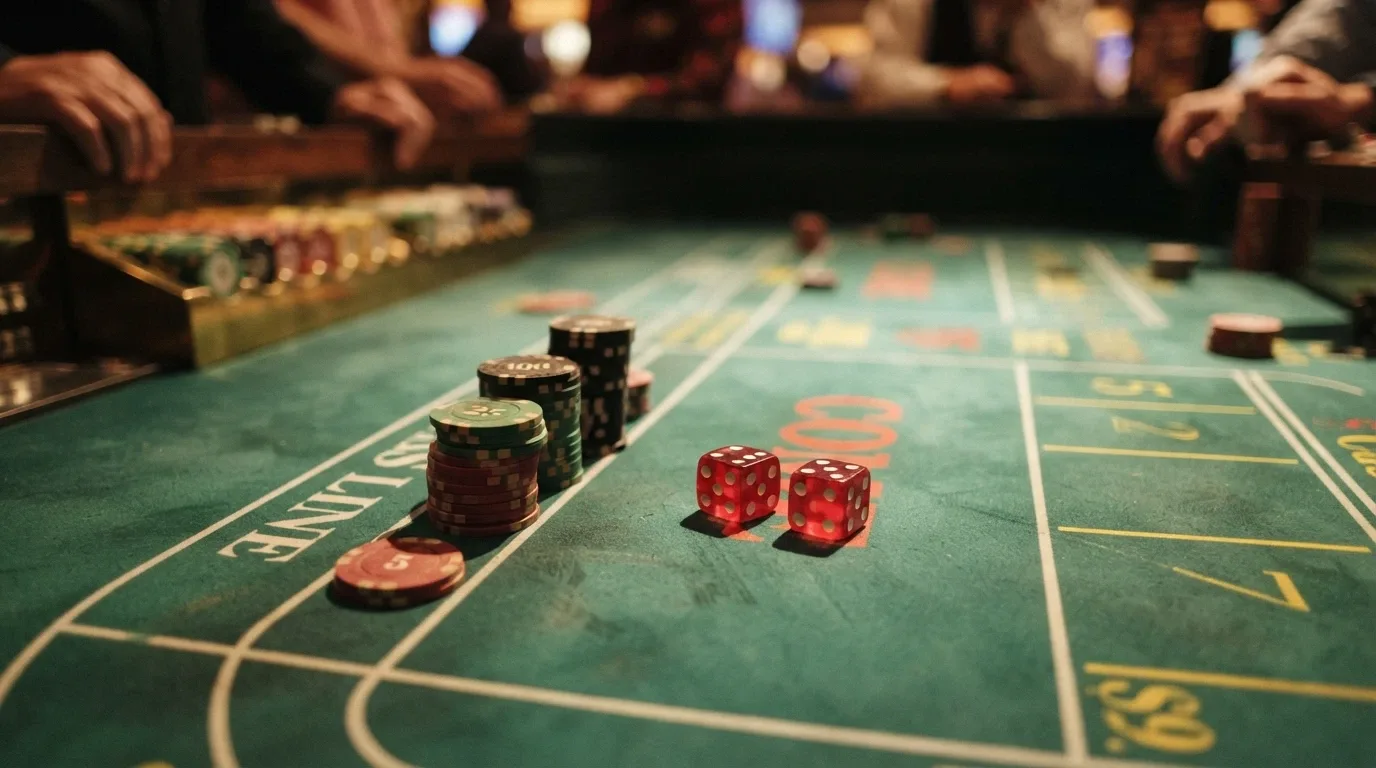
The Pass Line is the bet most players start with, and the one the table is built around. It wins on a come-out roll of 7 or 11, loses on 2, 3 or 12, and rides into the point phase when the come-out is 4, 5, 6, 8, 9 or 10. During the point phase it wins if the point is rolled before a 7, and loses if a 7 comes first. The Pass Line pays 1:1 and carries a house edge of 1.41%. That number is the benchmark against which every other craps bet is measured.
The Don’t Pass bet is the mirror image. It loses on a come-out 7 or 11, wins on a come-out 2 or 3, and pushes — neither wins nor loses — on a come-out 12. During the point phase it wins if a 7 is rolled before the point, and loses if the point comes first. The payout is 1:1, and the house edge is 1.36%, marginally lower than the Pass Line. The 12 push is the rule that makes the difference: without it, Don’t Pass would be a coin-flip with the house.
The Come bet is a Pass Line bet placed after a point is already established. The mechanics are identical: a Come bet wins on 7 or 11, loses on 2, 3 or 12, and moves to its own point number if 4, 5, 6, 8, 9 or 10 is rolled. It pays 1:1 with the same 1.41% house edge as the Pass Line. Many players run a Pass Line plus a Come bet to have action on more than one point at a time.
The Odds bet is the only wager on the craps felt with a 0% house edge. It is placed behind an existing Pass Line, Don’t Pass, Come or Don’t Come bet, after a point is established, and it pays at true mathematical odds rather than at the rounded 1:1 the other bets use. On a point of 4 or 10 the Odds bet pays 2:1. On a point of 5 or 9 it pays 3:2. On a point of 6 or 8 it pays 6:5. Casinos limit the Odds bet to a multiple of the original bet — typically 3x, 4x or 5x — but the edge on the money you do put behind it is exactly zero. No other bet on the table can say that.
Why Most Craps Players Bet Wrong — And Where the Smart Money Goes
Craps gives the player one of the lowest house edges in any casino game — on the right bets. It also offers a thicket of bets in the centre of the felt that run the other way, with house edges north of 5% and as high as 16%. The gap between the two is wider than in any other table game, and it is the single fact that decides whether a craps session is cheap entertainment or a fast drain.
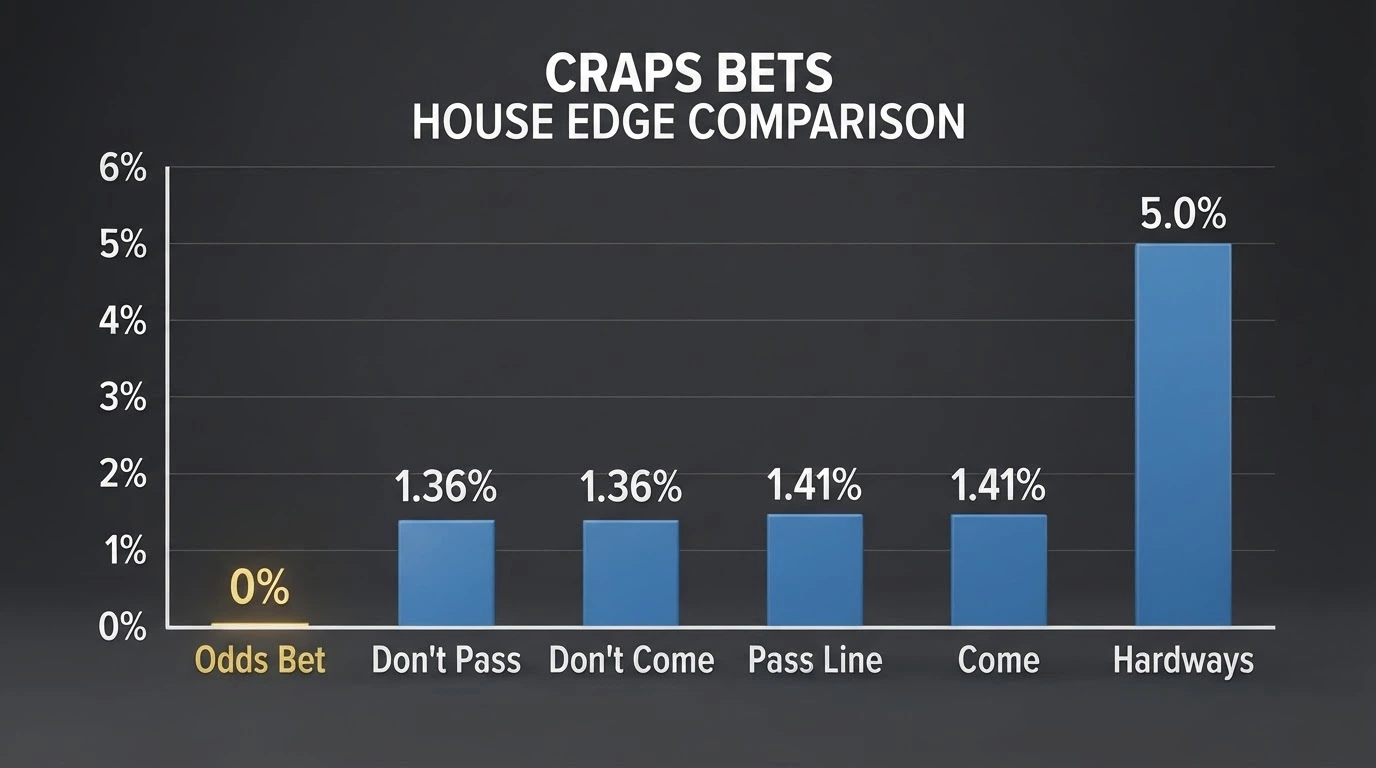
Craps Odds Explained: House Edge on Every Core Bet
The five core bets that matter for a serious player rank on house edge as follows.
| Bet | House Edge | Payout | Notes |
|---|---|---|---|
| Odds bet | 0% | True odds | Only zero-edge wager on the felt |
| Don’t Pass | 1.36% | 1:1 | Contrarian to the table; 12 pushes |
| Don’t Come | 1.36% | 1:1 | Same maths as Don’t Pass |
| Pass Line | 1.41% | 1:1 | Beginner’s anchor bet |
| Come | 1.41% | 1:1 | Pass Line mechanics, placed mid-round |
The Odds bet sits apart. It is not a standalone wager — you need a Pass Line, Don’t Pass, Come or Don’t Come bet to anchor it — but the money placed behind that anchor carries no house edge at all. A A$10 Pass Line with a A$50 Odds bet behind it on a point of 6 gives you A$60 in action with an effective house edge of 1.41% × (10 ÷ 60), or about 0.235%. The more you put behind the line, the closer the blended edge on your total action moves toward zero.
The Don’t Pass and Don’t Come bets shave a fraction more off the house take than the Pass Line and Come bets — 1.36% versus 1.41%, a difference of 0.05 percentage points. On a A$1,000 session of craps, that’s a 50-cent difference in expected loss. The Don’t Pass carries a social cost that the maths doesn’t capture: most of the table is betting Pass, and a winning Don’t Pass roll is a losing roll for the rest of the felt. Most recreational players stick with the Pass Line for that reason alone.
The proposition bets in the centre of the table — Any 7, Any Craps, Hardways, the hop bets — are a different category. House edges there run from around 5% on the safer Hardways to over 16% on the hop bets. They look exciting because they pay 4:1, 5:1, 15:1 or higher. The math says they are the fastest way to drain a craps bankroll. Skip them.
A Craps Strategy That Protects Your Bankroll
The conservative strategy that runs through every serious craps book is the same one the house edge table above implies. Start with a Pass Line bet at the table minimum. Take the maximum Odds bet the table allows behind it on every point. Add a Come bet on each new come-out roll to put action on a second number. Skip the centre proposition bets entirely. Leave the table when either of two conditions is met: a hard session-loss limit reached, or a realistic win target met.
That structure is correct because the maths rewards it. A A$25 Pass Line with A$125 Odds behind it on a 5x table puts A$150 in action per decision with a blended house edge well under 0.5%. Adding a second Come bet with its own Odds stack doubles the action without doubling the per-bet edge.
The piece the strategy book cannot write for the player is the session limit. There is no federal deposit, loss or stake ceiling for online gambling in Australia. The player must set their own limit. A hard rule — stop at A$200 lost, stop at A$300 won, no exceptions — does more for a craps bankroll than any betting system ever designed. Chasing losses at a negative-expectation game destroys bankrolls faster than the house edge alone, because the house edge compounds with the larger bet sizes a frustrated player places to “win it back”. Set the limit before the first roll. Honour it after the last.
The Craps Table: Layout, Variants & Why Crapless Craps Costs You More
Every craps table a player encounters — physical or digital — runs on the same betting zones and the same flow of a round. What changes between formats is who rolls the dice, who controls the pace, and which variants are available. The three variants worth knowing before depositing anywhere are the standard layout that runs the game the rules section describes, the Bubble Craps machines that run an electronic solo version with real dice, and the Crapless Craps variant that quietly triples the house edge on the Pass Line.
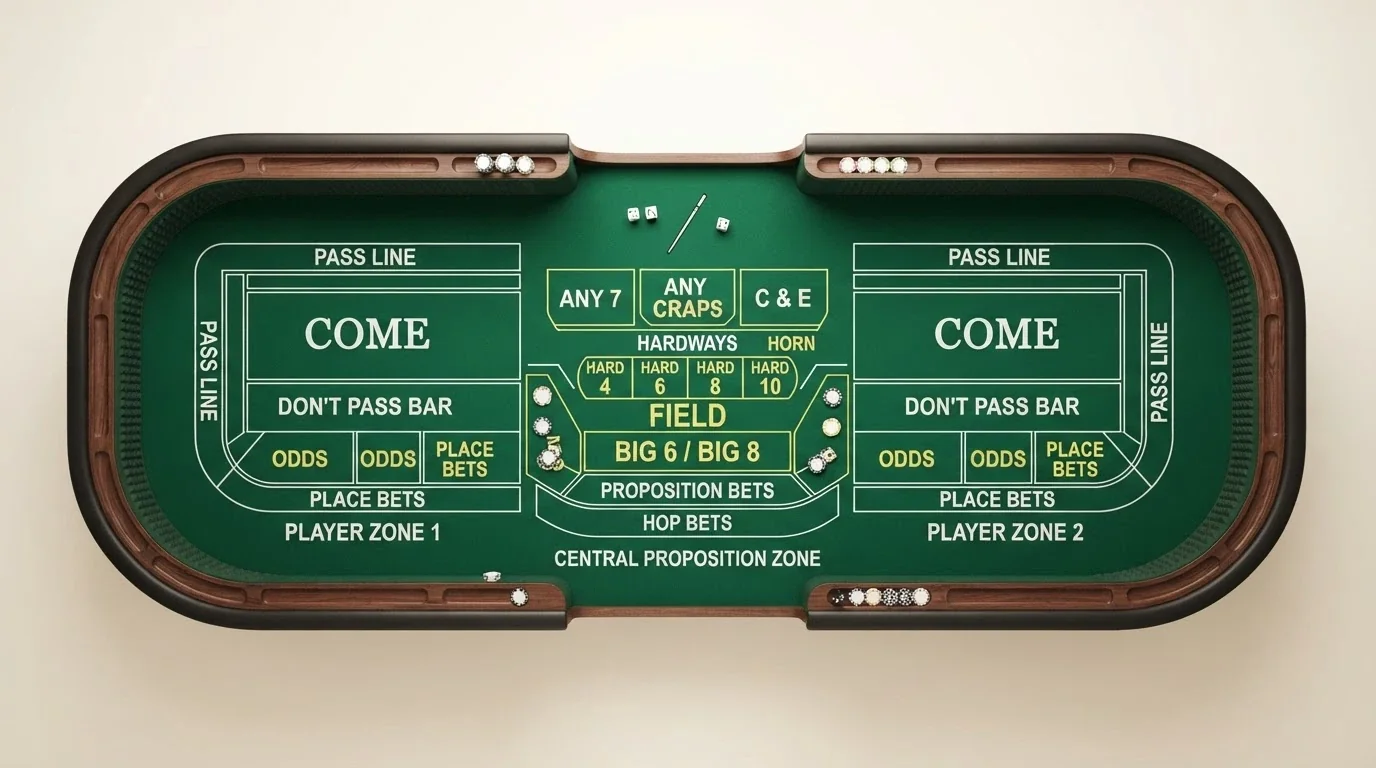
Craps Table Layout: The Three Zones Every Player Needs to Know
A standard craps table is a long oval felt — typically 12 to 14 feet on a real casino floor — with the dealer stations in the middle and the player positions facing the long sides. The felt divides cleanly into three zones, and the three zones charge very different prices for the bets they hold.
The first zone is the self-service rail running along the player’s side of the felt. The Pass Line and Don’t Pass bar sit here, alongside the Come and Don’t Come areas, the Place bets, the Field bet, and the Big 6 and Big 8 wagers. These are the bets a player can place for themselves without the dealer’s help. They also happen to be the low-edge cluster — Pass Line at 1.41%, Don’t Pass at 1.36%, the Odds bet behind them at 0%.
The second zone is the centre of the table, which the stickman controls. The proposition bets live here: Any 7, Any Craps, the Hardways (Hard 4, Hard 6, Hard 8, Hard 10), the hop bets, and the C and E bets. The stickman takes and pays these wagers on the player’s behalf. The bets in the centre carry the highest house edges on the felt — from about 5% on the safer Hardways to over 16% on the hop bets. The centre is where bankrolls go to die.
The third zone is the dealer’s standing area between the rail and the centre, where the dealers handle the Pass Line, Don’t Pass, Come, Don’t Come, Place bets and the Odds stacks. A player buying in hands chips to the dealer, who places them on the felt on the player’s instructions.
Bubble Craps: Electronic Craps with a Real Dice Shaker
Bubble Craps is the electronic version of craps that has spread across casino floors in the last decade and shows up at most offshore online casinos as an RNG title. The machine is a circular cabinet with a transparent dome over a physical dice shaker. The player taps a touchscreen to place bets, and real dice rattle inside the dome after each roll. The result is displayed on the screen and on a small felt-style layout around the dome.
What Bubble Craps preserves that pure software does not is the physical dice. The outcome is not generated by a random number generator — it is the result of two real dice tumbled in a chamber, with the outcome captured by cameras and read by software. For a player who trusts a physical roll more than a software one, Bubble Craps is the version that feels closest to a real table without requiring other players or a dealer.
Bubble Craps also lets a player roll at their own pace. There is no waiting for the stickman, no social pressure from a busy table, no minimum play time between rolls. The lower minimums common on Bubble Craps machines make it accessible to players with smaller bankrolls. At offshore online casinos, Bubble Craps usually appears in the live-casino or specialty-games lobby, and most operators offer it in demo mode for players who want to learn the bets without risking real money.
Crapless Craps: The Variant That Looks Friendlier but Costs Far More
Crapless Craps is a variant played with the same dice and the same general layout, but with one rule change on the come-out roll that quietly costs the player more than almost any other rule variation on a casino floor. In standard craps, a come-out roll of 2, 3 or 12 loses the Pass Line bet immediately. In Crapless Craps, those numbers — along with 11 — are not losing rolls at all. They become points instead. A come-out 2, 3, 11 or 12 in Crapless Craps sets a new point number that the shooter must repeat before a 7 for the Pass Line to win.
The change sounds player-friendly. The losing rolls become points, which means a Pass Line bet never loses on the come-out. The maths says the opposite. Crapless Craps Pass Line carries a house edge of 5.38% — roughly four times the 1.41% on standard craps. The reason is mechanical: by turning the losing 2, 3 and 12 into points, the variant also turns them into numbers the shooter has to hit before a 7 to win, which means the player is now betting on numbers that are statistically harder to repeat than 7. The come-out losses are gone. The harder point numbers replace them. The expected loss per bet rises sharply.
Crapless Craps is offered at some offshore online casinos as a niche variant. The screen looks similar to standard craps and the bets on offer look similar too. It is worth checking the rules page before sitting down, because the 5.38% edge is not visible from the layout itself.
Real Money Craps vs Free Play: When the Risk Is Worth It
Every featured operator on this page offers craps in some form of free-play or demo mode. Most also offers it for real money. The two modes share the same dice and the same bets. The differences are what each one costs, what it teaches, and what it puts at risk. The case for starting in free play is the same one a driving instructor would make about a parking lot before a highway.
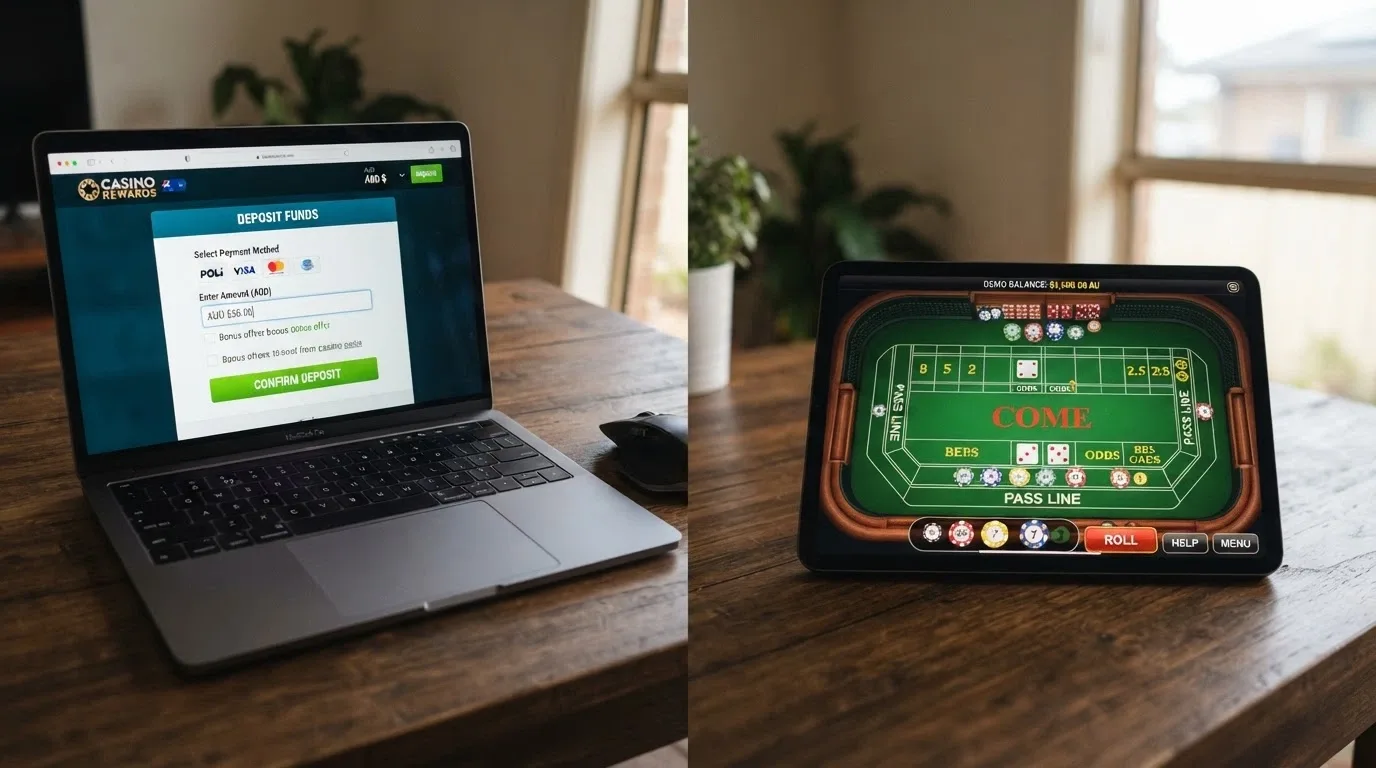
Playing Craps for Real Money Online
Playing craps for real money at an offshore casino means depositing AUD or crypto, claiming (or skipping) the welcome bonus, and wagering real money on the Pass Line, Don’t Pass, Come or Odds bet of the player’s choice. The minimums at the featured set sit between A$1 and A$5 per bet on RNG craps and slightly higher on Evolution’s live-dealer studio. The deposit methods vary by operator, with Visa/Mastercard, Neosurf, Bitcoin, Ethereum, Litecoin, USDT and bank transfer the common routes. Two operators — Stake and Rainbet — run crypto only.
The credit-card ban that applies to Australian-licensed wagering does not stop offshore casinos from processing credit-card deposits. The Interactive Gambling Amendment (Credit and Other Measures) Act 2023 banned credit cards, credit-related products and digital currency as payment methods for licensed online wagering, with penalties of up to A$247,500 for non-compliance. The ban targets licensed operators. Offshore casinos continue to accept credit cards, although the player’s own bank may decline the transaction as a matter of policy. PayID and Osko, and BPAY, are legal deposit routes for Australian-licensed wagering — neither is available at the offshore set on this page.
The real-money commitment extends beyond the deposit. An Australian player at any of these operators has no Australian consumer protection if a withdrawal stalls or a bonus dispute goes sideways. ACMA enforcement against the operator is reactive — site blocking, ISP referral notices — not protective of any individual player. The player’s recourse runs through the operator’s own complaints process, the payment provider’s dispute resolution, or, for credit-card deposits, a chargeback. That is the trade a real-money player accepts.
Free Craps Online: Learn the Game Without Risking a Dollar
Free-play or demo-mode craps at offshore casinos runs the same game with the same layout and the same bets, but the wagers are made with a notional balance the casino refreshes on demand. The player cannot win real money, but cannot lose real money either. The session is a learning environment, and the cost of a mistake is zero.
The free-play access pattern varies by operator. Most offshore casinos in the featured set allow demo play without registration — the player opens the craps title and the game loads with a demo balance. A smaller number require an account before demo access. Live-dealer craps is rarely available in demo mode, because the studio costs the operator money per hour regardless of whether the player bets, and the studios reserve their capacity for real-money play. RNG craps and Bubble Craps are the formats to learn in demo mode.
Free play is the place to make every mistake a beginner is going to make. It is the place to learn that a Pass Line bet loses on a come-out 2, 3 or 12, that the Odds bet pays differently on point 4 than on point 6, that the centre proposition bets cost more than the rail bets, and that the dealer’s “betting window” closes when the stickman picks up the dice. None of those lessons should cost a real dollar to learn. The transition from free play to real money should happen after the player has placed fifty or so rounds and no longer has to think about which bet is which.
Why Your 2026 Craps Bonus Is Harder to Clear Than It Looks
A welcome bonus at an offshore casino looks like free money. It is not. It is a marketing number attached to a wagering obligation that converts the bonus into real withdrawable cash only after a defined amount of play. The obligation runs on a multiplier — the wagering multiplier — and on a clock — the validity window. Both numbers decide whether the offer is worth taking.
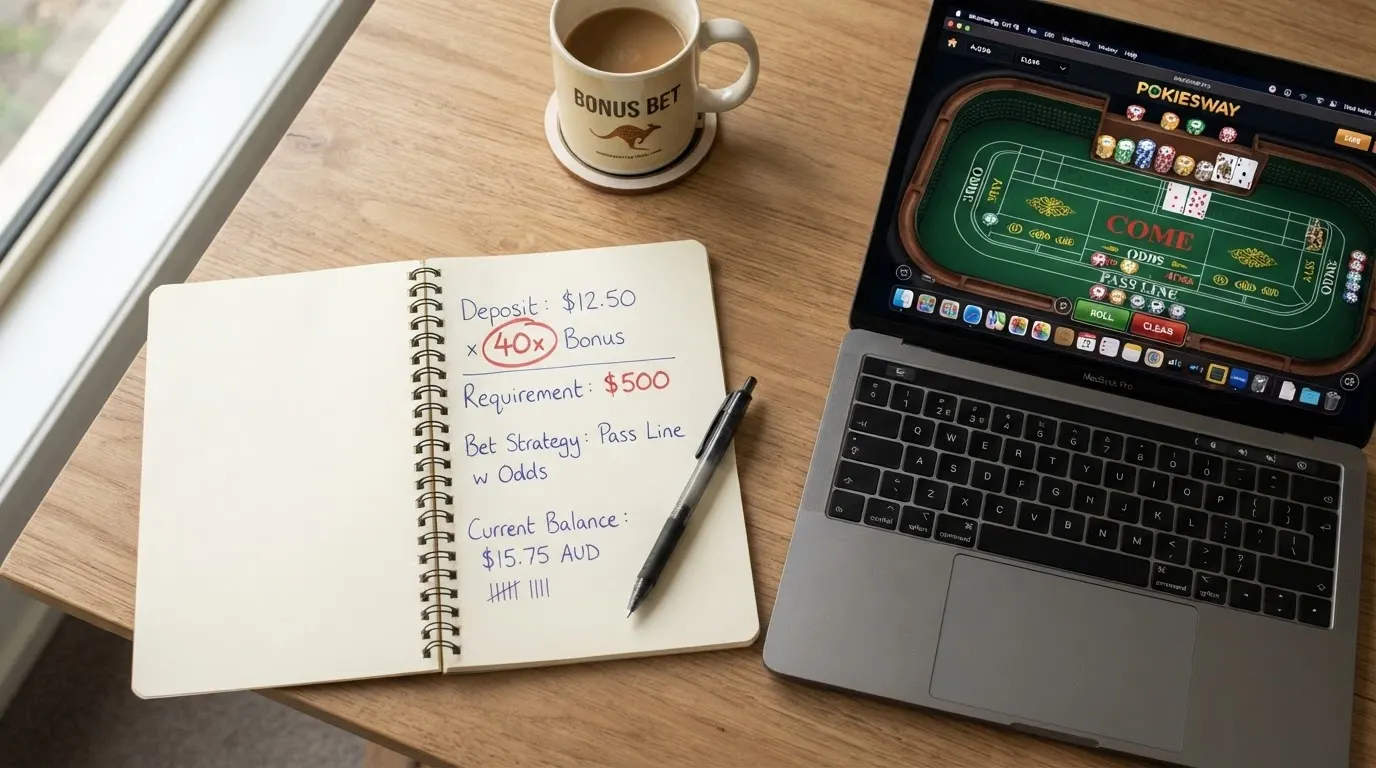
The standard wagering multiplier in the featured set is 40x. That means a A$500 bonus requires A$20,000 of qualifying wagers before any of the bonus converts to withdrawable cash. Royal Reels sits at 30x to 40x depending on the campaign. FairGO is the outlier at 30x. The rest run at 40x or do not apply because the operator uses a non-traditional bonus model (Stake, Rainbet).
The validity window is the second number. Seven days is the common figure — RocketPlay, Scream Casino, Bizzo Casino and WinSpirit all run 7 days. Royal Reels sits at 7 to 14 days. Rocket Casino is at 14 days. FairGO is at 30 days, the longest in the set. The shorter the window, the harder the bonus is to clear, because the player has to fit the entire turnover requirement into a compressed calendar.
Here is the maths the bonus page does not run for the player. Take Skycrown’s A$4,000 welcome bonus at 40x wagering. That obliges A$160,000 of craps turnover before any of the bonus is yours. At a Pass Line house edge of 1.41% — an RTP of 98.59% — the expected cost of clearing that bonus runs at A$160,000 × 0.0141, or A$2,256. The bonus advertises A$4,000. The bonus costs about A$2,256 to convert. The net value to the player is roughly A$1,744 if every assumption holds. The arithmetic is unforgiving.
For smaller offers, the absolute expected cost scales down with the bonus size. A A$1,000 bonus at 40x (RocketPlay) requires A$40,000 of craps turnover and runs an expected loss of around A$564 to clear. A A$1,000 bonus at 30x (FairGO’s five-deposit structure maxed out) requires A$30,000 of turnover and an expected loss of about A$423. Every version of the same calculation ends with the same conclusion: the wagering multiplier, not the bonus amount, is the number that drives the player’s cost. A small bonus at 30x is cheaper to clear than a large bonus at 40x, even when the headline figure on the larger bonus is four times the headline figure on the smaller one.
The craps bonus carries one extra penalty beyond the multiplier and the window. Most offshore casinos count table-game bets at a lower contribution rate than slots — often 10% to 20% of the wager rather than 100%. A A$5 craps bet may count as A$0.50 or A$1 toward the wagering requirement rather than A$5. The turnover obligation does not change, but the time it takes to discharge it stretches, sometimes by a factor of five or ten. Read the bonus terms for the contribution table before claiming.
These figures are statistical averages. They are not guarantees. A player can run above average for a session and clear a bonus for less than the expected cost, or below average and clear it for more. The expectation is the long-run average across many sessions, and the only honest reading of it is the one that says: the bonus is worth approximately its headline figure minus the expected loss.
Payment Methods at Offshore Craps Casinos: What Australians Can Actually Use
The deposit and withdrawal routes at the featured set break into four clusters. Crypto is the dominant one. Bitcoin, Ethereum, Litecoin and USDT are accepted at almost every operator in the table. Stake and Rainbet run crypto only — BTC, ETH, LTC, DOGE and USDT at Stake, plus a wider crypto range at Rainbet. Crypto deposits clear fastest and usually carry no fee from the operator, although the player pays the network fee on the blockchain side.
Neosurf is the second cluster — a prepaid voucher available at Australian newsagents and convenience stores, redeemable at most of the featured operators for a deposit. Neosurf is deposit-only; withdrawals go back through a different route.
Visa and Mastercard processed offshore is the third cluster. The Interactive Gambling Amendment (Credit and Other Measures) Act 2023 bans credit cards and credit-related products as payment for licensed Australian wagering, with penalties of up to A$247,500 for non-compliance. The ban does not reach offshore operators, and most of them continue to accept credit-card deposits — although Australian-issued credit cards often decline the transaction at the bank’s discretion. Debit cards are processed through the same rails and meet the same fate. The result is a higher decline rate on Australian-issued cards at offshore casinos than on the equivalent transactions at licensed Australian operators.
Bank transfer is the fourth cluster. Slower than the other routes — typically two to five business days — but available for both deposits and withdrawals at FairGO, RocketPlay and a few others. Bank transfer is the route an Australian player falls back on when the other three do not work for their bank or their card.
PayID and Osko, and BPAY, are legal deposit routes for Australian-licensed wagering. Neither is in use at the offshore set, and an Australian player who relies on PayID or BPAY for their everyday banking will not find those rails at any of the casinos on this page.
Live Dealer Craps: As Close to the Table as You’ll Get Online
Live-dealer craps is the streamed-table experience the featured set offers as the closest substitute for a real casino floor. A real table, real dice and a real croupier are broadcast from a studio to the player’s screen, and the player’s bets are placed through the studio interface against the outcomes the dice produce. The pace is slower than RNG craps and faster than a busy weekend table at a real casino, but the trust factor — a real dice roll captured on camera — is closer to the physical experience than any software version can match.
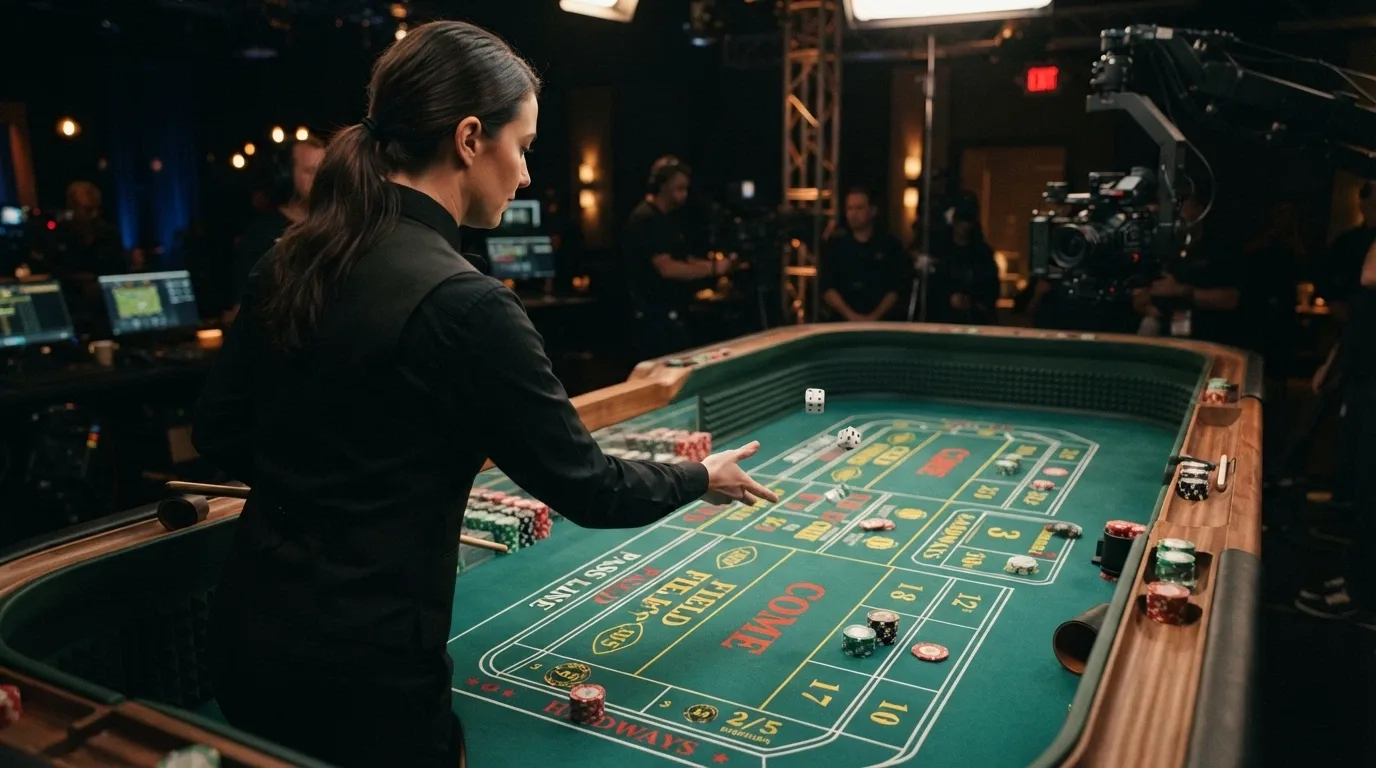
The featured operators that carry Evolution’s live-craps studio are Royal Reels, Skycrown, RocketPlay, Stake, Scream Casino, Bizzo Casino, Rocket Casino, WinSpirit and Rainbet. FairGO does not carry Evolution’s live craps because FairGO runs on RealTime Gaming only. Evolution is the dominant live-craps studio in the offshore market, and an operator that carries Evolution generally carries Evolution’s full live table-game suite. Live-dealer craps is rarer than live blackjack or live roulette — Evolution operates fewer craps tables than either — but every featured operator except FairGO carries at least one craps table on the Evolution platform.
Live-dealer craps carries the same house edges as the RNG version. The dice outcome is the same and the bets are the same. The minimums tend to run higher than RNG craps because the studio cost per player-hour is higher for the operator, and the pace is slower because the dice are rolled by a human stickman rather than generated by software. The slower pace also means a player’s session runs longer per dollar deposited, which is the trade a live-dealer player accepts in exchange for the trust factor.
Live Dealer vs RNG Craps: Which One Suits Your Play Style
The two formats cover the same bets with the same maths, but they suit different players. RNG craps is faster, has lower minimums, requires no waiting for other players and is available in demo mode at most operators. Live-dealer craps is slower, has higher minimums, requires a stake to access, and offers the trust factor of physical dice on camera. Stake Originals craps is the third option in this comparison — a provably-fair RNG game where the outcome is verifiable on the blockchain before the bet settles.
A player with a small bankroll and a limited schedule should default to RNG craps. The lower minimums make a session possible on a A$20 deposit. The pace lets a player fit fifty rounds into an hour. Demo mode is available to learn the bets without risking anything.
A player who treats craps as the social experience it is at a real table should default to live-dealer craps. The studio stickman calls the centre bets and the rhythm of the table approximates the physical version closely enough to recreate the atmosphere. The pace is slower, but the trust factor and the table-energy of a streamed craps game carry a recreational value the RNG version does not.
A player who wants provable fairness in an RNG game should look at Stake Originals. The blockchain verification of each roll means the player does not have to trust the operator’s random number generator, because the outcome is verifiable after the bet settles. Stake Originals is not available at the other operators in the table. For a player who already has a Stake account, the original-craps game is the right version to learn the bets on.
Is Online Craps Legal in Australia? The Offshore Reality
The Interactive Gambling Act 2001 draws a clear line. Online casino games — including craps, pokies, blackjack, roulette and baccarat in their online forms — are prohibited from being provided to a person physically in Australia. The prohibition targets the operator, not the player. An Australian who plays online craps at an offshore casino is not committing an offence. The casino accepting their deposit, however, is operating in breach of the Act.

The Australian Communications and Media Authority is the regulator tasked with enforcing the prohibition. ACMA’s enforcement runs through civil penalties on the operators it can identify and reach, through ISP referrals that ask Australian internet providers to block access to specific sites, and through formal warnings that have caused 225 illegal services to withdraw from the Australian market since enforcement was strengthened in 2017. ACMA has blocked 1,564 illegal gambling and affiliate websites since November 2019. The enforcement numbers are real and they are current, but they are also reactive — each block targets a single site or affiliate, and a new operator can stand up at a new domain within hours.
The 2026 Gambling Reform, passed by Parliament on 19 August 2026, tightens the framework further. From 1 January 2027, banks and payment providers gain express authority to block transactions to illegal gambling operators, the advertising rules tighten (no more than three wagering ads per hour between 6:00 am and 8:30 pm), and direct marketing of inducements is banned for 14 days after a customer signs up and for three months after a person deregisters from BetStop. The bank-blocking power is the change that will most directly affect the offshore set: an Australian bank’s decision to refuse a transaction to an offshore casino is currently a matter of bank policy, and from 1 January 2027 it will be an explicit legal authority.
The minimum age for all commercial gambling in Australia is 18, and the credit-card and crypto ban that took effect on 11 June 2024 carries penalties of up to A$247,500 for licensed operators who fail to enforce it. Both rules apply to licensed Australian wagering services. They do not extend to offshore operators. An Australian player using a credit card at an offshore casino is not in breach of the Act; the offshore casino is in breach of the Act by providing the service in the first place.
For taxation, betting and gambling winnings are not assessable income for ordinary punters under section 6-5 of the ITAA 1997. Recreational players do not declare craps winnings to the ATO. Professional gamblers — those who run craps as a business — face a different tax treatment, but no player on this page is in that category by definition.
Licensed vs Offshore: What Australian Regulation Actually Covers
Australian regulation covers sports betting and racing wagering through licensed operators, principally those licensed by the Northern Territory Racing and Wagering Commission, which acts as the de facto national licensor for online wagering. A licensed Australian wagering operator can offer sports betting, racing wagering and a narrow range of related products. A licensed Australian wagering operator cannot offer online craps, online pokies, online blackjack, online roulette, online baccarat or any other casino game. There is no Australian licence for online casino, and there is no path to one under the current Act.
The offshore operators on this page run under licences issued in Curaçao, Kahnawake and a handful of smaller jurisdictions. Those licences authorise the operator to provide casino games from the licensing jurisdiction. They do not authorise the operator to provide casino games to a person in Australia — the IGA makes that an offence regardless of what the offshore licence says. The enforcement gap between the licence’s home jurisdiction and the player in Australia is the structural reason offshore casinos are accessible to Australians in the first place.
Curaçao’s regulatory framework was reformed in 2023, with the old master-licence structure replaced by a direct-licence system under the Curaçao Gaming Authority. Kahnawake’s Gaming Commission has regulated online operators since 1999 and is the other main jurisdiction the featured set draws from. Neither regulator offers an Australian dispute-resolution pathway. A player who has a complaint about an offshore casino takes it to the operator’s own support team, and if that does not resolve it, to the licensing regulator — which may or may not act, depending on the jurisdiction and the nature of the complaint.
Staying Safe: Responsible Gambling Tools That Actually Work
About 2.1% of Australian adults — roughly 430,000 people — experience problem gambling, and the high-risk gambling prevalence was 1.8% in 2022, according to the Australian Institute of Health and Welfare. The numbers describe a population in which harm from gambling is concentrated but not rare, and in which the protective framework that exists is built around Australian-licensed operators. An offshore casino does not sit inside that framework. Self-exclusion through BetStop does not bind an offshore operator. The player is the only person setting the limits on their own play.

BetStop, the National Self-Exclusion Register, had 67,480 registrations and 41,290 active exclusions as at 31 July 2026. 78% of registrants were under 40, and 38% chose a lifetime exclusion. The register binds Australian-licensed wagering services. ACMA’s own guidance is blunt about the offshore gap: BetStop binds Australian-licensed wagering services, an offshore casino is not licensed here, is not connected to the register, and will keep taking a self-excluded person’s money.
The practical safety tools that work at an offshore casino are the ones the player operates themselves. A hard deposit limit set before the first session — written down, not just remembered — is the most reliable. A session-time limit, enforced by an alarm on the player’s phone, is the second. A loss limit, after which the session ends regardless of how the dice are running, is the third. None of these tools is built into the offshore operator’s software in the way BetStop is built into a licensed Australian operator’s systems, which is why they have to be self-imposed. The 14-day cooling-off period the 2026 Reform introduces after sign-up is a benchmark a player can apply voluntarily to their own behaviour, regardless of where they play.
The National Gambling Helpline — 1800 858 858 — is free, confidential and staffed 24 hours a day, every day. It is the single resource every Australian player should save before depositing anywhere.
Where to Get Help: Australian Gambling Support Services
Gambling Help Online, at gamblinghelponline.org.au, runs 24/7 chat and phone counselling for anyone affected by problem gambling — players, family members, friends. The service is free, confidential and staffed by professional counsellors trained in gambling harm. The National Gambling Helpline, 1800 858 858, routes to the same service network.
State-based services cover the rest of the country: each state and territory runs its own gambling-counselling line with the same 24/7 coverage and the same free-and-confidential terms. Financial counselling for gambling harm is available through the National Debt Helpline on 1800 007 007 and through dedicated gambling-financial-counselling programs in most states.
The hardest step is the first one. Starting a conversation with a family member or a counsellor is the action that opens the door to every other tool on this list. The helpline does not require a commitment to treatment. It requires a phone call.
How We Selected and Ranked These Online Craps Casinos
The ranking on this page is built on three inputs. The first is the Australian Communications and Media Authority enforcement data — the count of blocked sites, the count of withdrawn services, and the public register of BetStop statistics. The second is the operator-licence disclosures published by each featured brand, used to confirm that every operator in the table is offshore rather than Australian-licensed and to identify the regulator behind the licence. The third is third-party market-share tracking, which provides the 2026 Australian-market-share figures used to weigh the ranking.
The Australian-licence whitelist check is the test every featured operator failed. The Interactive Gambling Act 2001 prohibits online casino. There is no Australian licence for it. Every brand in the table — Royal Reels, Skycrown, RocketPlay, Stake, Scream Casino, FairGO, Bizzo Casino, Rocket Casino, WinSpirit, Rainbet — operates from outside the country. The absence of an Australian licence is the baseline, not a knock-out criterion.
The ranking weights five factors: craps-game availability and provider quality, bonus fairness measured by wagering terms and validity, deposit-method range and AUD accessibility, market-share data as a proxy for Australian-player uptake, and the operator’s overall reputation across independent review channels. The market-share figures are weighted lightly: a high share reflects popularity, not safety, and a low share reflects niche positioning, not failure. A player who values the longest clearance window will rank FairGO above the bigger-share operators; a player who values market-tested reliability will rank Skycrown or RocketPlay above the smaller brands.
The featured set is not the entire Australian-facing offshore market. It is a curated ten, drawn from the brands with the largest Australian traffic, the broadest craps coverage and the cleanest published terms. Other offshore operators exist. They are not on this page because they do not clear one or more of the five factors above.
Your 2026 Online Craps Decision: Risk, Reward & the Safer Path
Craps is a low-edge game. The Pass Line plus the Odds bet gives the player an effective house edge below 0.5% with a blended stake of any size, and the table offers a clean decision tree that a beginner can learn in an hour. That is the game’s redeeming mathematical feature, and the reason it has survived three centuries on the casino floor.
The offshore reality is the other half. Every casino on this page runs from outside Australia. ACMA has blocked 1,564 illegal gambling sites since November 2019. BetStop does not bind offshore operators. An Australian player has no domestic regulator to appeal to if a withdrawal stalls. From 1 January 2027, banks and payment providers gain explicit authority to block transactions to illegal gambling operators, which means the deposit routes that work today may not all work tomorrow.
Three checks an Australian player must run before depositing at any of these operators. First, the regulator: confirm the licence number on the operator’s footer resolves to a real licence on the regulator’s public register. Second, the withdrawal record: search independent forums for the operator’s name plus “withdrawal” and read the last six months of complaints. Third, the bonus maths: work the wagering multiplier against the validity window and check whether the contribution rate for craps is 100% or something lower.
Two steps are non-negotiable regardless of the operator. The first is to learn the game in free-play mode before depositing. Fifty rounds of demo craps teach the bets the rule book describes and cost nothing. The second is to set a hard loss limit — a number, written down — before the first real-money session. The National Gambling Helpline, 1800 858 858, is the safety net underneath both steps and every step in between.
The final judgement is this. Online craps is playable for Australians in 2026. The maths of the game rewards the careful player. The offshore reality that the game is played inside punishes the unprepared one. The same advice covers both halves: take the Odds bet behind the Pass Line, set the loss limit before the first roll, save the helpline number before the first deposit.
Frequently Asked Questions
How do I know if an online craps casino is safe for Australian players?
Safety in this market comes down to four checks: the offshore licence the operator holds and whether it resolves on the regulator’s public register, a verifiable withdrawal record from independent forums, a documented KYC route, and a recognised testing body for the games. BetStop does not apply, because every casino on this page is not Australian-licensed. The ACMA blocks sites reactively, and an operator that has not been blocked yet is not the same as an operator that has been approved.
What is the best bet to make in craps for a beginner?
The Pass Line at a 1.41% house edge, paired with the maximum Odds bet behind it at 0% edge. That combination gives a beginner the lowest blended house edge on the table, the simplest decision tree, and the easiest way to learn the flow of a round. Skip the centre proposition bets entirely — they carry house edges above 5%.
Can I use Australian dollars to play craps online?
AUD is accepted at most of the featured offshore brands, usually converted at deposit time. PayID and BPAY are legal deposit routes for Australian-licensed wagering, but the offshore set uses crypto, Neosurf, Visa or Mastercard processed offshore, and bank transfer. The credit-card ban that took effect on 11 June 2024 targets licensed operators and does not reach offshore casinos, which continue to accept cards.
What is the “odds bet” in craps and why is it the best bet on the table?
The Odds bet is placed behind a Pass Line, Don’t Pass, Come or Don’t Come bet after a point is established, and it pays at true mathematical odds with a 0% house edge. On a point of 4 or 10 it pays 2:1, on 5 or 9 it pays 3:2, and on 6 or 8 it pays 6:5. No other bet on the craps felt pays you exactly what the dice say it should.
Why are credit cards banned for online gambling in Australia?
The Interactive Gambling Amendment (Credit and Other Measures) Act 2023 banned credit cards, credit-related products and digital currency as payment methods for licensed online wagering, with penalties of up to A$247,500 for non-compliance. The ban took effect on 11 June 2024 and targets Australian-licensed operators. Offshore casinos continue to accept credit cards, although Australian-issued cards often decline at the bank’s discretion.
Created by the ”Min Deposit 5 Casinos AU” editorial team.