
Online pokies no-deposit free spins in Australia — what you keep, what you give up, and which terms cost the most
A “100 free spins” banner is one of the more seductive images in Australian iGaming marketing. It promises a taste of real-money pokies without the deposit — a chance to win something for nothing, the kind of headline a punter clicks on without reading the next line. The next line, almost always, is where the offer stops being generous. A wagering multiple of 35x, 40x or 60x sits between the win and the wallet. A A$10 to A$100 cashout ceiling sits below that. And beneath the offer sits a legal reality no banner mentions: online pokies are prohibited in Australia, the operator is offshore by definition, and the protections a player takes for granted on a licensed site do not exist on the other side of the border.

The gap between the banner and the bank account is what this read is about. It walks through how no-deposit free spins actually work — what they cost the player in expected value, where the terms erode the win, and which clauses decide whether anything reaches a withdrawal screen. It covers the four offers research could independently verify, sets the ten offshore operators Australians most often reach against each other, and grounds the whole thing in the legal framework that makes the product prohibited in the first place. It is not a directory of where to play. It is the read-before-you-claim read.
Current as of 18 October 2026 against the Australian Communications and Media Authority register and the ACMA site-block list, with bonus terms cross-checked against aggregator listings (NoDeposit365, Slotozilla, Gameindustry.com).
Table of Contents
- Online pokies in Australia: what “free” actually means in 2026
- No-deposit free spins: why the headline number is never the number you cash out
- The casinos Australian pokies players search by name — and what we found
- The 10 offshore casinos reaching Australian players in 2026 — ranked by reach, checked for free-spins value
- The legal reality: what the Interactive Gambling Act actually says about your online pokies play
- When the pokies stop being harmless: help that works — and where the gaps are
- How we checked these casinos — and what we couldn’t verify
- Your move, armed with the facts: what to actually do about online pokies free spins in 2026
- Frequently asked questions about no-deposit free spins in Australia
Online pokies in Australia: what “free” actually means in 2026
A pokies screen — five reels, fruit and gem symbols, a “Free Spins” badge somewhere on the overlay — looks the same on a phone in Sydney as it does in a Las Vegas casino. The maths underneath the screen is the same too. What differs is the regulatory envelope: how the game is licensed, how the operator is paid, and what recourse a player has when the operator stops returning emails.
What online pokies actually are — and how they differ from the pub screen
An online pokie is a digital version of the same game Australians have played in pubs and clubs for decades. The mechanics are translated into software: a Random Number Generator decides each spin’s outcome, the symbols land on a virtual reel set, and the paytable dictates what combinations pay. The aesthetic — fruit, BARs, lucky sevens, expanding wilds — is interchangeable with a Crown Melbourne floor; the engine is not.
The provider ecosystem that builds those engines is concentrated among a handful of studios. Pragmatic Play and NetEnt are the two most visible names on Australian-facing offshore sites. Pragmatic Play publishes the Big Bass Bonanza series — a fishing-themed pokie that has been one of the most-played titles in the offshore market for years and is regularly attached to welcome bonus free spins. NetEnt’s Starburst is older, lower-volatility, and a default option when an operator wants a recognisable title for a free-spins bundle.
What separates an online pokie from a pub screen is not the symbols — it is the audit trail. A land-based machine in a Crown or Star casino is licensed by a state regulator, tested by an approved laboratory, and physically tamper-resistant. An offshore online pokie may or may not be tested by an independent lab, may or may not hold a licence from the regulator whose logo appears on its footer, and almost always lives on a server outside the jurisdiction that would police any of it. The game is real; the framework around it is not the same framework a pub pokie sits inside.
How online pokies work: RNGs, reels, paylines and the maths that runs them
Every spin on a legitimate online pokie is decided by a Random Number Generator — a piece of software that produces a new outcome every time the player presses the button. The reels are a presentation layer; the outcome is chosen before the symbols animate. A 96% return-to-player figure means the game returns A$96 of every A$100 wagered to players, on average, across millions of spins. It does not mean a single player gets A$96 back from a A$100 deposit on any given session.
Big Bass Bonanza — the Pragmatic Play fishing title that anchors many welcome offers — carries a 96.71% RTP and a 25.8% hit frequency, meaning roughly one in four spins produces some kind of return. That hit frequency is high relative to comparable slots; the volatility is high relative to most player expectations. Volatility is the variance around the average: a high-volatility game pays out less often but in larger chunks, while a low-volatility game pays out more frequently but in smaller amounts. Starburst, by contrast, runs at 96.09% RTP with low volatility — fewer big moments, more small returns, a steadier ride.
Paylines are the lines on which matching symbols pay. Starburst uses 10 paylines across 5 reels and pays both ways — left-to-right and right-to-left — which doubles the practical hit surface for the same reel count. Big Bass Bonanza runs on a more conventional 10-line layout. The reel count, the payline structure, the volatility band: none of this is something the marketing page describes, and all of it decides what the player’s session actually feels like.
The statistical edge is baked in across volume. Across millions of spins, a 96.71% RTP game retains 3.29% of every dollar wagered. Across a hundred spins at A$1 each, the player might be up or down — variance dominates. Across a million spins, the house is up 3.29%. That is the engine the marketing copy does not explain.
Real-money pokies vs free-play mode: the difference that costs you nothing — or everything
Most online casinos offer two modes for the same pokie: real-money play and demo (or “fun”) play. The reels, the maths, the symbols are identical. The wallet is not. Demo mode hands a player a fun-balance that cannot be withdrawn and cannot be lost — every spin is rehearsal, the outcome carries no cost and produces no payout. Real-money mode is what the bonus free-spin offers enable: a chance to win a real balance, attached to a real wagering condition, that may eventually be withdrawable.
Casinos offer demo mode for two reasons. The first is regulatory — in many licensed jurisdictions, demo play is permitted while real-money play requires a verified account, an age check, and a deposit. The second is commercial — letting a player try a game builds familiarity and increases the chance the same player will return with a deposit. For an Australian reader searching for no-deposit free spins, the distinction matters more than it looks: a free-play session on a pokie is not what the marketing banner describes. The banner describes real-money free spins with a path to withdrawal. Demo play does not have a path to withdrawal — it has a reset button.
RTP and payout types: what the percentages on the slot sheet actually mean
The percentages on a pokie’s information sheet — the RTP, the volatility, the max win — are the only honest disclosures the game itself makes. Everything else on the offer page is marketing. Reading those three numbers correctly is the difference between a player who knows what they are walking into and one who is not.
RTP is a long-run average across millions of spins. A 96% RTP does not mean a player gets 96 cents back from every dollar wagered in a session; it means the game keeps 4 cents of every dollar wagered, on average, forever. The volatility band decides how that average is distributed: low volatility pays smaller wins more often, high volatility pays bigger wins less often. Max win is the hard ceiling — the most a single spin can pay out, expressed as a multiple of the stake.
| Slot title | Provider | RTP | Volatility | Max win |
|---|---|---|---|---|
| Big Bass Bonanza | Pragmatic Play | 96.71% | High | 2,100x stake |
| Sweet Bonanza | Pragmatic Play | 96.48% (reduced variant ~95.45%) | Medium–High | 21,100x stake |
| Starburst | NetEnt | 96.09% | Low | 500x stake |
These three are the titles research was able to verify from independent testing sources. Big Bass Bonanza is the high-volatility crowd-pleaser: smaller sessions, occasional large payouts, a hit frequency of roughly one in four spins. Sweet Bonanza is the rarer-event game with a max win of 21,100x the stake — a payout profile that explains why it appears on welcome offers even though its bonus round triggers only every 200–250 spins on average without the Ante Bet. Starburst is the steady-Eddie option: low volatility, 500x max win, ten paylines paying both ways. Each title looks similar on the screen; the variance profile underneath is materially different.
No-deposit free spins: why the headline number is never the number you cash out
A no-deposit free-spins offer looks like a gift: open an account, take your spins, keep what you win. The reality is a four-stage pipeline in which value erodes at every transition. The headline number is the spin count. The number that actually lands in the balance is smaller, often by an order of magnitude, and is sometimes zero.
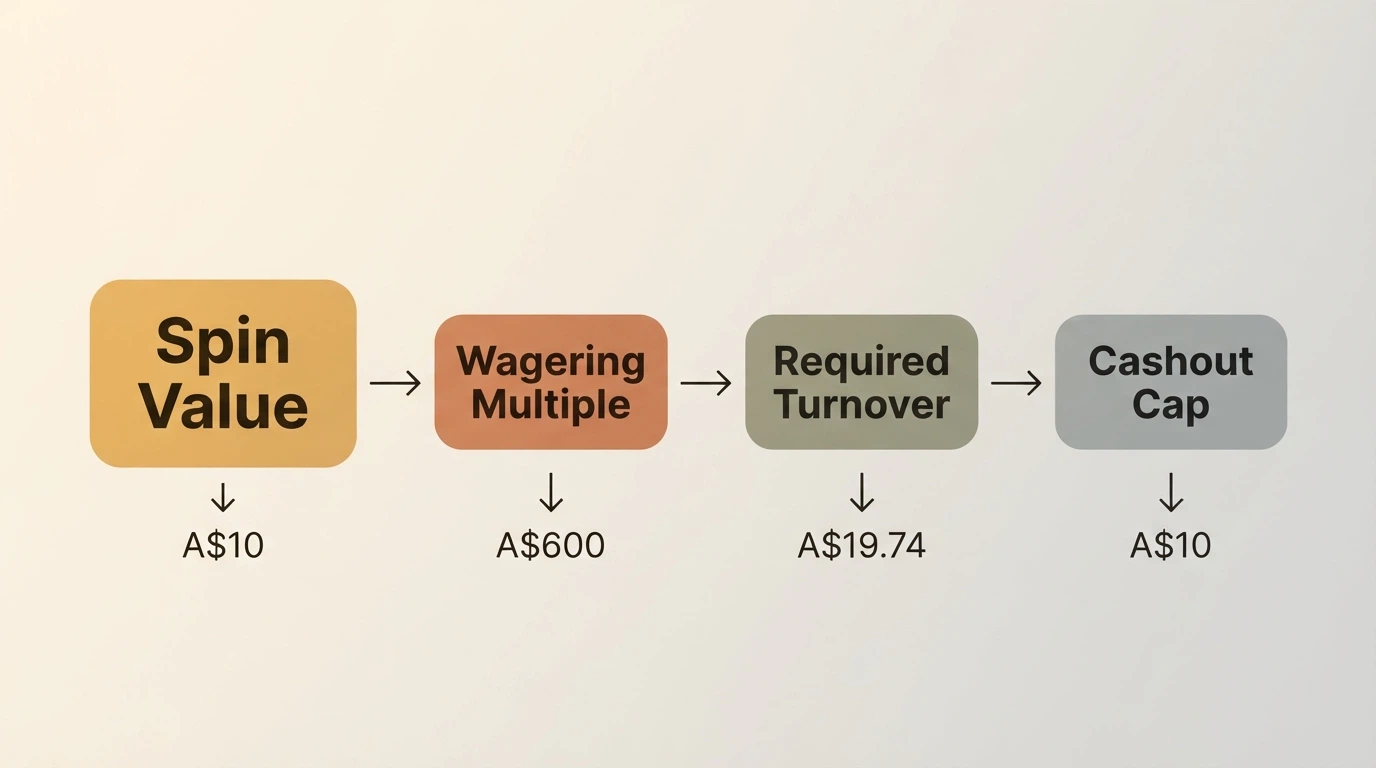
The expected cost, worked through. A A$20 no-deposit bonus carrying a 30x wagering condition — the multiple research pegs to the better end of the offshore market — requires the player to run A$600 of qualifying bets through the eligible games before withdrawal unlocks. Run that A$600 through Big Bass Bonanza at its published 96.71% RTP and the expected house-edge loss is A$600 × (1 − 0.9671) ≈ A$19.74. The headline A$20 free carries a built-in cost roughly equal to the bonus itself. Push the wagering multiple to 40x or 60x and the required turnover rises to A$800 or A$1,200 with a proportional expected loss of A$26 to A$40. The “free” is in the offer’s structure; the cost is in the arithmetic. A statistical estimate, not a guarantee — the figure is an average across millions of spins under the stated assumptions, not a guaranteed outcome for any single player.
How no-deposit free spins actually work — the four hurdles between claiming and cashing out
The path from “100 free spins” to a withdrawal in a bank account has four stages, and each stage has a rule designed to shrink the headline number.
Stage one is the claim trigger. The bonus is unlocked by registration — sometimes with a code, more often by selecting the offer from a welcome card on the casino’s homepage. Account verification (email, mobile, sometimes ID documents) follows before any spins are playable. Stage two is game eligibility. The free spins almost never load on the pokie of the player’s choice; they are locked to one or two specified titles, and any winnings from any other game do not count toward the bonus. Stage three is the wagering turnover. The win from the free spins lands as bonus credit, not cash, and the player must wager that bonus credit a multiple of times — 30x, 40x, 60x — before withdrawal unlocks. Stage four is the cashout cap. Even after the wagering condition is met, the maximum withdrawal from the bonus is typically capped between A$10 and A$100.
The arithmetic in stages three and four is the offer’s actual price. A A$10 win from 100 free spins at A$0.10 stake per spin, run through a 60x wagering condition, requires A$600 in qualifying bets before the win converts to withdrawable cash — and the maximum the player can take out is the cap, which on some offers is the same A$10 they started with. The headline number — 100 spins — and the realised number — A$10 in the worst case, less in the typical case — are not the same number.
Free spins on sign-up: what the welcome screen really offers — and what it doesn’t
The sign-up offer is the casino’s first impression, and it is engineered to land hardest at the moment a player is most willing to act. Welcome free spins are typically the cheapest part of a casino’s marketing budget per player acquired, and the most generous on the headline. The four offers research was able to verify by name:
- Ozwin Casino: 100 free spins on Oz Golden Trail, 60x wagering on bonus winnings.
- Bitstarz: 50 free spins on Alien Fruits, 40x wagering.
- Mega Medusa Casino: 77 free spins on Fjord’s Fortune, 40x wagering.
- A Big Candy Casino: 120 free spins on Tarot Destiny, 35x wagering.
Each is a real offer with real terms — verified against an aggregator listing, not invented. The wagering multiples sit across a wide band: A Big Candy at 35x is at the better end, Ozwin at 60x is at the worst. The game each spins bundle is locked to is the casino’s choice, not the player’s; Alien Fruits and Tarot Destiny are not the names that come up when Australians search for “best pokies to play”, they are the names the casino has selected to attach its bonus to. Read the eligible-game line in the terms before claiming.
Several brands Australians search for by name — Uptown Pokies, Rocket Play, Skycrown, Royal Reels, WinSpirit, Stake, Rainbet, Scream Casino, FairGO, Bizzo Casino, Rocket Casino — could not be verified for current no-deposit free-spins terms in this round of research. The terms either were not published, were not surfaced through the sources checked, or did not exist in the form readers were searching for. The names are popular; the verifiable offer data behind them is thinner than the search volume suggests.
Real-money free spins vs demo-mode spins — the difference that matters
A real-money free spin is one that can, eventually, become withdrawable cash. It is attached to a bonus with terms — wagering, game eligibility, expiry, cashout cap — and the player who meets those terms keeps what is left. A demo-mode spin is a free-play spin on a fun-balance; it never becomes cash and cannot be withdrawn, no matter what the player does. Both look the same on the screen during the spin itself. The difference is everything that happens after.
No-deposit free-spins offers are real-money offers — that is what makes them an offer rather than a demo. They are also, by definition, attached to a bonus framework that takes a cut of any win before the player sees it. A player looking for the genuine no-cost experience will find it in demo mode and miss the withdrawal possibility entirely; a player chasing the headline number of a no-deposit welcome offer is opting into the bonus framework whether they read it or not.
What 25, 50 or 100 free spins actually deliver — the arithmetic behind the spin count
The number on the banner is the spin count. The number that matters is the spin value multiplied by the spin count — the starting bankroll the offer creates before any of the terms bite.
Fifty spins at A$0.20 per spin is a A$10 starting value. Twenty-five spins at A$0.50 per spin is a A$12.50 starting value. A hundred spins at A$0.10 per spin is a A$10 starting value. The arithmetic is the same shape every time: spin count × per-spin stake = gross starting value. The per-spin stake is set by the casino and almost never matches what a player would choose at a real-money pokie — the operator decides the denomination because the denomination is one of the levers that decides how the offer plays out.
Take A$10 of bonus winnings from any of those offers. The wagering multiple of 30x — the better end of the market — requires A$300 of qualifying bets before withdrawal. The same A$10 win at 60x requires A$600. Most of the A$10 will be consumed by the house edge during the wagering playthrough; depending on the eligible game’s RTP, somewhere between A$3 and A$5 of every A$100 wagered is retained by the house as expected loss. The A$10 win that started as the headline value typically produces something closer to zero — and is capped at A$10 to A$100 even when the wagering is met.
No-download, instant-play and Australian eligibility: who actually gets the spins
“No download” and “instant play” are nearly universal on modern online casinos — the entire offshore market runs on browser-based HTML5 games that load in seconds on a phone. The download era ended a decade ago, and any offer page that still sells “no download” as a feature is reaching for a differentiator that has been the baseline for years.
The harder gate is Australian eligibility. The Interactive Gambling Act 2001 makes it an offence to provide online casino games to a person in Australia, which means no offshore casino operating legally accepts Australian registrations — every operator reaching the Australian market is doing so in defiance of Australian law. Some still display an Australian flag or accept AUD; many use geolocation to detect Australian IP addresses and redirect. VPN use to bypass that geolocation is a violation of the casino’s terms of service in nearly every case, and winnings can be voided when an operator discovers the bypass. The headline “available to Australians” is a softer claim than the small print delivers.
Wagering requirements: the multiplier that decides whether you ever see the money
Wagering is the mechanism that turns a free-spin win into real cash, and it is the mechanism that decides how much of the win survives the journey. The multiple — 30x, 40x, 60x — is applied to the bonus amount or to the win from the bonus (the convention varies by operator), and the player must wager that total in qualifying games before withdrawal unlocks.
Pokies are almost universally 100% weighted — every dollar wagered counts in full toward the requirement. Table games often contribute 10% or 0%; live dealer games frequently do not contribute at all. A player who tries to clear a pokies bonus at blackjack will make almost no progress. Most operators also cap the per-spin stake during bonus play at around A$5, so a player cannot speed the playthrough with A$50 spins; doing so voids the bonus and any winnings.
The expected cost of clearing a bonus scales linearly with the multiple. A A$20 bonus at 20x wagering means A$400 of qualifying turnover (the worked figure research gives as a clean illustration); at 30x it is A$600; at 60x it is A$1,200. Apply a 96.71% RTP — the verified figure for Big Bass Bonanza — and the expected house-edge loss on each of those turnovers is roughly A$13, A$20 and A$40 respectively. The bonus headline does not change; the cost the player pays to convert it does.
The casinos Australian pokies players search by name — and what we found
Australian search patterns show a clear bias toward recognisable brand names: Uptown Pokies, Ozwin, Rocket Play, Skycrown, Fair Go, Bizzo. The brands appear in search queries again and again — sometimes as the destination the player is looking for, sometimes as the comparison anchor (“is Uptown Pokies better than Ozwin”). What sits behind the search volume is, in many cases, less verifiable than the names suggest.
Free-spins deals at the casinos the search data names — the offers we could verify
Of the brands Australians search for, four could be verified for a current no-deposit free-spins offer from the aggregators research consulted. Ozwin’s 100 free spins on Oz Golden Trail at 60x wagering, Bitstarz’s 50 free spins on Alien Fruits at 40x, Mega Medusa’s 77 free spins on Fjord’s Fortune at 40x, and A Big Candy’s 120 free spins on Tarot Destiny at 35x were all sourced and recorded with their attached terms. Each is a real offer — the brands operate, the games exist, the wagering multiples are stated. None of the four holds an Australian licence, because none of them can.
The other names Australians search for — Uptown Pokies, Rocket Play, Skycrown, Royal Reels, WinSpirit, Stake, Rainbet, Scream Casino, FairGO, Bizzo Casino, Rocket Casino — returned no independently verifiable no-deposit free-spins terms in this round of research. The brands are real; the offers readers are searching for may exist in a form research did not surface, may have changed since the last published data point, or may not exist in the shape the search query assumes. The honest reading: a player who searches for one of these names should expect to find the casino itself and, on landing, whatever the casino is currently promoting. They should not assume the terms they have seen referenced in a stale blog post still apply.
The 10 offshore casinos reaching Australian players in 2026 — ranked by reach, checked for free-spins value
The table below ranks the ten offshore casinos with the highest tracked Australian traffic and revenue against the only three data points research could verify for every operator: the legal status, the market position, and the revenue figure. Bonus terms, payout speed, game providers and minimum deposits could not be verified independently for any of the ten — they appear in the table as gaps precisely because filling them with anything else would be invention.
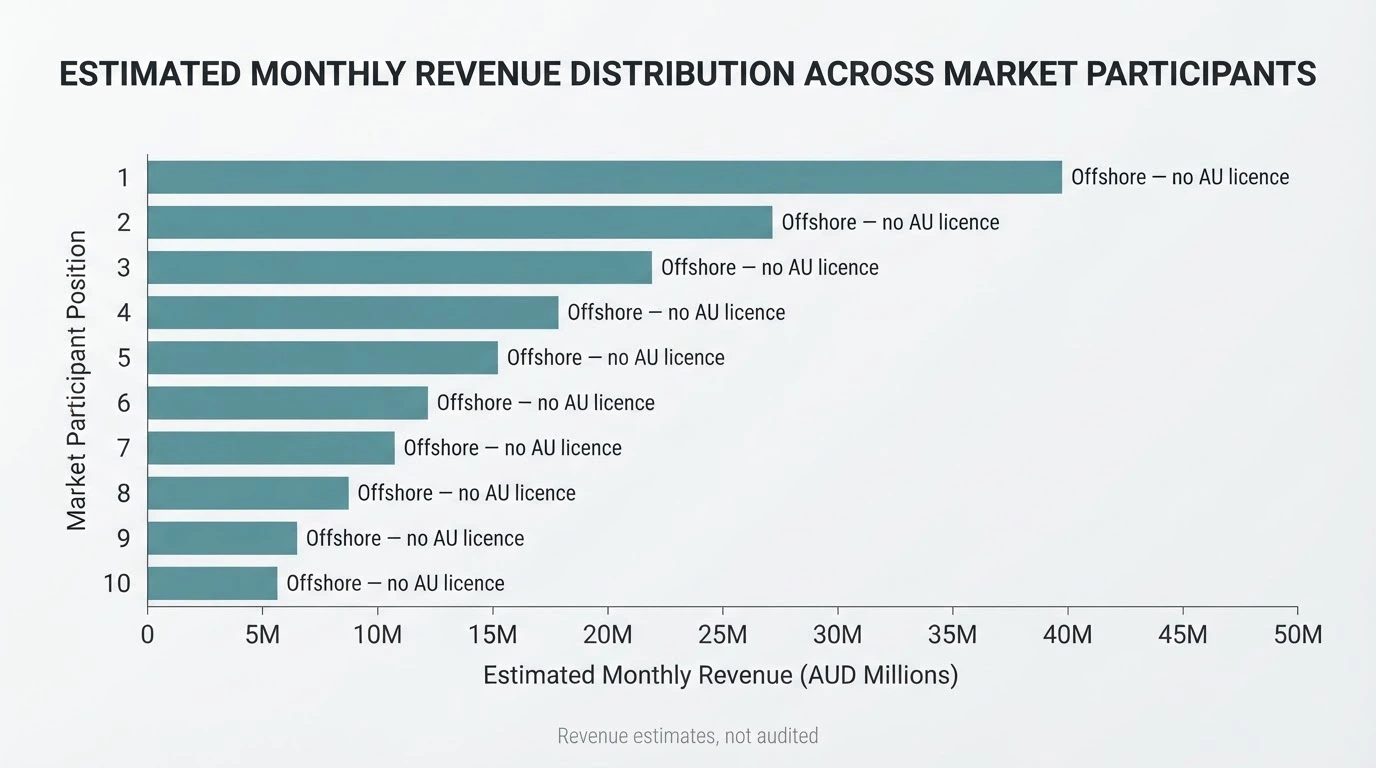
| Operator | Australian legal status | Est. monthly revenue (A$) |
|---|---|---|
| Rocket Play | Offshore — no Australian licence | A$632.69M |
| Skycrown | Offshore — no Australian licence | A$436.07M |
| Royal Reels | Offshore — no Australian licence | A$243.99M |
| Stake | Offshore — no Australian licence | A$115.67M |
| WinSpirit | Offshore — no Australian licence | A$110.30M |
| Scream Casino | Offshore — no Australian licence | A$94.87M |
| Rainbet | Offshore — no Australian licence | A$83.13M |
| FairGO | Offshore — no Australian licence | A$69.11M |
| Bizzo Casino | Offshore — no Australian licence | A$51.38M |
| Rocket Casino | Offshore — no Australian licence | A$43.22M |
The legal status column is identical across all ten rows because the underlying fact is identical across all ten rows: online casino is prohibited in Australia, no licence can exist, every operator reaching Australian players is offshore by definition. The revenue column is the only one that varies; it is the only axis on which the operators can be ranked against each other using verified data.
What makes a no-deposit free-spins offer worth comparing — the criteria that matter
Comparing no-deposit free-spins offers on headline spin count alone is the comparison the marketing page wants the reader to make. The five criteria that actually decide value are below.
The spin count multiplied by the per-spin stake is the starting value — a number the player never sees stated because it is almost always smaller than the headline implies. The wagering multiple is the multiplier applied to that starting value to determine the required turnover. The win cap is the maximum withdrawal allowed from the bonus, even after wagering is met. The game eligibility decides which pokies the free spins are locked to and which games the wagering playthrough is allowed on. The operator’s legal exposure decides what recourse the player has if the operator refuses a withdrawal, voids a win or disappears.
By those criteria, the four verified offers earlier in this read can be sorted without difficulty. A Big Candy’s 120 spins at 35x is the best wagering multiple of the four, though the game lock to Tarot Destiny narrows the playable field. Bitstarz’s 50 spins at 40x is mid-pack on both axes. Mega Medusa’s 77 spins at 40x is a similar profile with more spins. Ozwin’s 100 spins at 60x is the most punishing wagering multiple in the verified set — the headline number is high, the playthrough demand is high, and the win cap almost certainly trims the realised withdrawal to a small number.
The comparison criteria — how we ordered this list
The ten operators above are ordered by estimated Australian revenue, not by bonus generosity. That choice is forced by the data: bonus terms for these ten could not be independently verified in this round of research, and ranking by an unverified axis would be invention. Revenue is the only verified axis on which they can be ranked at all, and it carries information about reach — how many Australian players each operator is currently capturing — rather than about how good any single offer is.
A reader who treats revenue as a proxy for quality will be misled. A reader who treats it as a proxy for how widely a brand is being reached by Australians will be reading the table as intended. Reach is what the ranking measures. The reader’s decision about whether to play at any operator on the list requires the same judgement applied throughout: what is verified, what is not, and what the gap between the two means.
Rocket Play
The largest of the ten offshore operators reaching Australian players by estimated revenue — A$632.69M, roughly 9.4% of the tracked Australian offshore market. Rocket Play sits at the top of a ranking that is, by construction, a ranking of reach rather than quality. No-deposit free-spins terms for Rocket Play could not be verified in this round of research; the bonus headline a player sees on landing is whatever Rocket Play is currently promoting, and the small print attached to it is the only document that determines its real value.
Rocket Play is the operator Australians reach most often. That statistic carries no recommendation; the legal status carries no endorsement. A player who arrives at Rocket Play through search has arrived at an offshore site operating outside Australian law, and the protections a licensed operator would offer — BetStop coverage, ACMA complaint recourse, Australian Consumer Law — are not available.
The verdict, in one number: A$632.69M of estimated Australian revenue per month is the size of the audience that has made the same decision. Reach is not endorsement, but it is information.
Skycrown
Second-largest by estimated revenue at A$436.07M, holding 8.55% of the tracked Australian offshore market. Skycrown is the operator a Rocket Play customer is most likely to compare against on the way to a decision, because the two are running similar offers to similar audiences at similar scale. Verification for Skycrown’s bonus terms was unsuccessful in this round, mirroring the outcome for Rocket Play.
Where Skycrown differs from Rocket Play is harder to state on verified data. Both are large offshore brands reaching Australian players in defiance of Australian law; both rely on the same offshore licence framework; both operate outside the Australian consumer protection regime. The reader comparing them on anything other than the welcome screen is comparing surface presentation, because the underlying regulatory status is identical.
Royal Reels
Third on the list with A$243.99M in estimated monthly Australian revenue — roughly a third of Rocket Play’s reach, but still a meaningful share of the offshore market reaching Australians. Royal Reels sits in the middle of the ten, with no distinguishing feature on the verified data beyond its position in the ranking. No-deposit free-spins terms could not be verified this round.
A mid-ranking operator on a prohibited product is not, on its own, a meaningful signal. Royal Reels is in the same legal position as every other operator on the list; the reader’s decision framework does not change based on which slot in the table the operator occupies. What changes between operators is the bonus headline a player sees on landing — and that headline could not be verified for Royal Reels in this round.
WinSpirit
A$110.30M in estimated Australian revenue, 1.55% of the tracked offshore market — a meaningful but smaller player. WinSpirit operates outside Australian law, like the rest of the ten; verifiable bonus terms are currently unavailable.
What WinSpirit illustrates, sitting at this position in the ranking, is that even the smaller end of the verified top ten is a substantial operator by absolute revenue. A$110M a month from Australian players is a large business; the offshore market reaching Australians is not a fringe phenomenon, and treating it as one understates the decision a player is making when they sign up. The practical caveat: a smaller-share operator may compensate with a more generous welcome headline to attract the same player, but that pattern is a market observation, not a verified fact about WinSpirit’s current offer.
Stake
A$115.67M in estimated Australian revenue, 1.28% market share — slightly above WinSpirit on revenue, slightly below on share, which is a reminder that market share and revenue move together but not identically. Stake is one of the more globally recognised crypto-friendly casino brands; the Australian player base it captures is the subset of that global footprint that lands on Australian-facing pages.
Stake operates outside Australian law; information regarding its current free-spins bonus terms could not be secured. The crypto-friendly positioning is worth flagging separately: from 11 June 2024, credit cards and crypto are banned as payment for online wagering in Australia. A reader who is asked for a crypto deposit by an Australian-facing site is being served by an operator outside Australian rules — the payment method is itself the tell.
Rainbet
A$83.13M in estimated Australian revenue, 1.28% market share — the same share as Stake on a smaller revenue base. Rainbet is one of two operators tied at 1.28% on share, which is the kind of detail the table reveals when read as a ranking rather than a directory.
No current offer data could be confirmed for Rainbet. The legal status is the same as every other entry on the list. A reader choosing between Rainbet and a slightly higher-ranked operator is choosing between two equally unverified offers at two equally offshore operators — the decision factors that matter (wagering multiple, win cap, eligible game, withdrawal reliability) all sit behind the unverified gate. The trade-off the player is actually making is between two unknowns, not between two known offers.
Scream Casino
A$94.87M in estimated Australian revenue, 0.99% market share. Scream Casino sits between Rainbet and FairGO on revenue and below them on share — the share figure lower because the tracked market against which it is calculated is larger than its revenue alone would suggest; bonus terms for this operator remain unverified.
The trade-off at this tier of the ranking is between reach and specialisation: a smaller-share operator may concentrate on a narrower product set, but the verification gap leaves that claim unsupported for Scream Casino specifically. A reader who values variety over recognition gets nothing verifiable here either way.
FairGO
A$69.11M in estimated Australian revenue, 0.8% market share. The name does what the name does — “Fair Go” reads as Australian, as colloquial, as a brand that knows the local market. The legal reality is the same as every other entry on the list: offshore, unlicensed, operating outside Australian law.
The naming-versus-reality gap is the point. A brand name that signals familiarity is a marketing choice, and it tells the reader nothing about whether the operator behind the name is licensed, regulated or reachable through any Australian consumer-protection channel. FairGO is no more or less offshore than Bizzo Casino or Rocket Casino; the name is the only thing that makes it feel otherwise. The verdict: judge the operator by its licence status, not by what its name invites a reader to assume.
Bizzo Casino
A$51.38M in estimated Australian revenue, 0.57% market share. Bizzo is the second-smallest of the ten, sitting just above Rocket Casino at the bottom of the ranking; bonus data for Bizzo is unavailable.
A reader comparing Bizzo Casino against Rocket Casino is comparing two operators at the bottom of a ranking of reach, both offshore, both offering unverified bonuses. The distinguishing factors — game library, payment methods, withdrawal speed — are precisely the factors the verification gap obscures. In the broader market context: Bizzo sits among 316 brands tracked in the Australian market, and its 0.57% share places it well behind the licensed wagering giants (SportsBet, Tab, Bet365) and well ahead of the long tail below it.
Rocket Casino
A$43.22M in estimated Australian revenue, 0.57% market share — the smallest of the featured ten by revenue, tied with Bizzo Casino on share. Rocket Casino closes the list at the bottom of the ranking and offers no distinguishing feature on the verified data beyond that position. No-deposit free-spins terms could not be verified this round.
The smallest operator on a list of operators reaching Australians with a prohibited product is not the safest. None of the ten is licensed. None of the ten offers Australian consumer protection. The reader’s decision framework does not change based on which slot the operator occupies; the only difference between Rocket Casino at the bottom and Rocket Play at the top is scale. For a player who explicitly wants a smaller operator, the appeal is real; for a player who has not decided, the size tells them nothing about safety or value.
The legal reality: what the Interactive Gambling Act actually says about your online pokies play
The market Australians reach for online pokies exists because the legal framework permits it to exist — not by licensing it, but by failing to stop it. Online casino, online pokies and in-play betting are prohibited to provide to a person in Australia under the Interactive Gambling Act 2001, strengthened by the 2017 amendments. There is no licence for it anywhere in the country — not federally, not in any state or territory. The licensed Australian alternative is wagering on races and pre-event sport, which is a different product from a pokies site and is offered by a different set of operators.
The Interactive Gambling Act 2001 — what it actually bans, and who it targets
The IGA 2001 makes it an offence to provide interactive gambling services — online casino, online pokies, in-play betting — to customers physically in Australia. The Act was strengthened in 2017 to extend liability to offshore operators and to cover more product types. The penalty regime runs into the hundreds of thousands of dollars; enforcement has been active since.
Crucially, the IGA targets the provider, not the player. An Australian individual placing bets at an offshore casino is not prosecuted under the Act. The legal exposure sits with the operator offering the product to Australians, which is why every casino reaching the Australian market is technically in breach of Australian law simply by being reachable from an Australian IP address. The offshore bonus advertising that pulls a player to the site in the first place is itself the prohibition breach — not just an advertising rule, but the underlying offence the regulator was given the power to police.
There is no online casino licence available in Australia. No state or territory issues one. No regulator administers one. The absence is structural, not transitional: the product is prohibited, not merely unregulated.
ACMA enforcement: 1,564 sites blocked, 225 services withdrawn — and counting
The Australian Communications and Media Authority is the federal body that enforces the IGA’s online prohibition. Its powers include directing Australian ISPs to block illegal sites, issuing formal warnings, and bringing civil penalty proceedings. The cumulative record since enforcement was strengthened in 2017 is concrete.
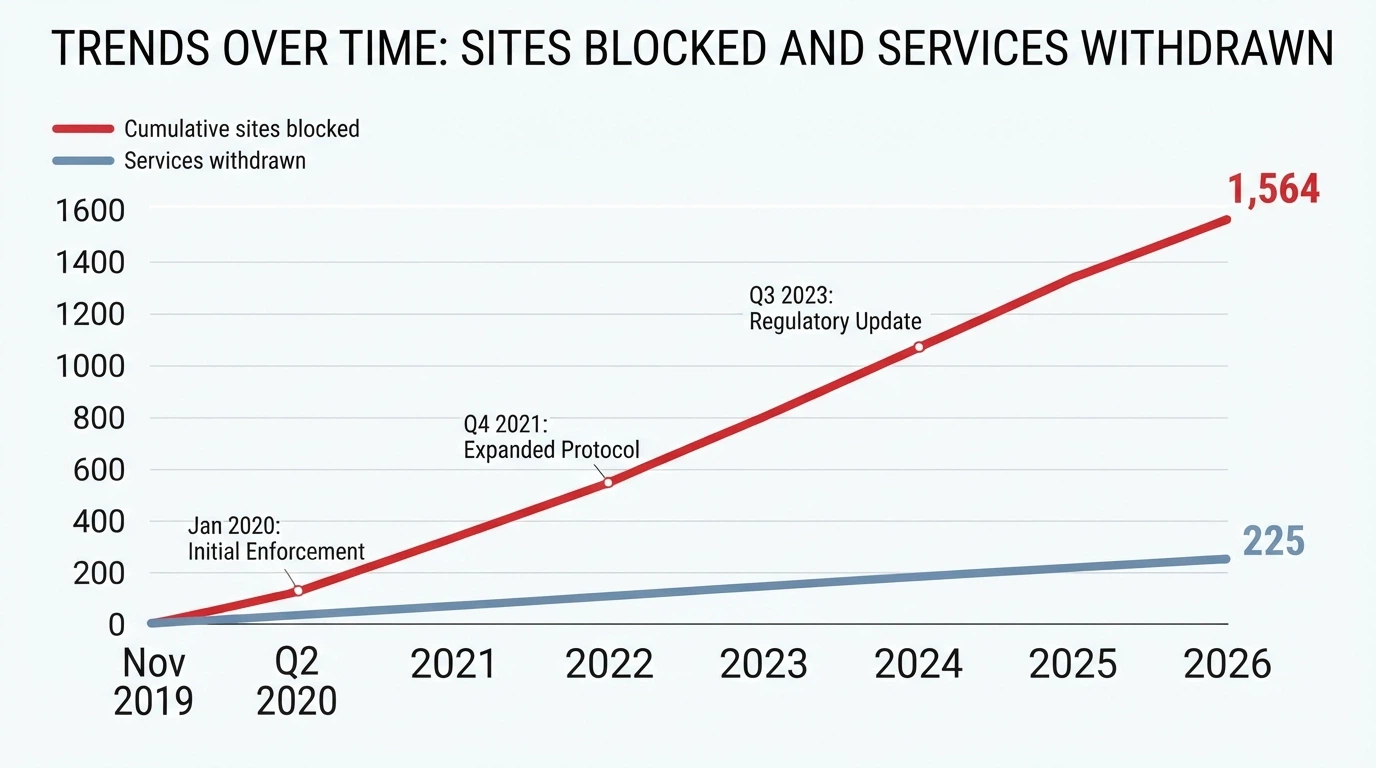
As of March 2026, 1,564 illegal gambling and affiliate websites have been blocked at the ISP level since the ACMA’s first blocking request in November 2019. More than 225 illegal services have voluntarily withdrawn from the Australian market over the same period. The block list is published; the withdrawals are documented. The prohibition is not a paper threat — it is an active enforcement programme with measurable output.
DNS-level blocking is not unbeatable. Operators cycle domains, mirror their sites, and reach Australian players through alternative access routes. The ACMA’s enforcement model accepts this and proceeds anyway, because each blocked site reduces the friction of accidental reach and increases the cost of finding the product. The reader searching for an offshore casino is the audience the enforcement is making harder to convert; it is not an audience the enforcement is trying to punish.
Licensed vs offshore: the two-track system Australian punters actually navigate
The licensed Australian wagering market is a real market, run by real operators with state or territory licences. SportsBet, Tab, Bet365, Ladbrokes, TABtouch, PointsBet, Neds, Betr, Picklebet and Betfair hold Australian licences for pre-event sports and race wagering. None of them offers online pokies, online casino, or in-play betting, because those products are prohibited. A player who wants to bet on Saturday’s AFL or the Melbourne Cup has a fully licensed, fully regulated, fully Australian route.
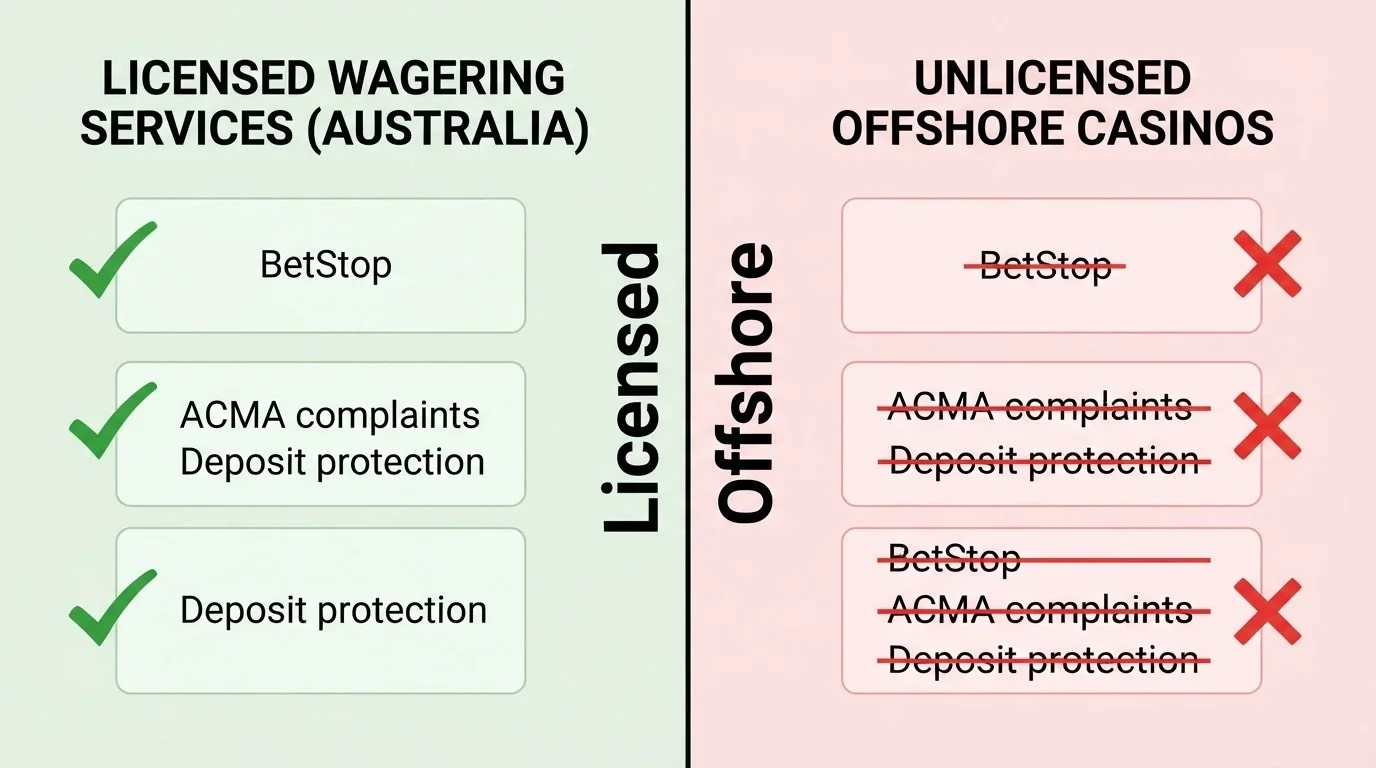
A player who wants to play pokies online does not. The offshore market fills that gap illegally — every operator reaching Australians with online pokies is doing so outside the law, and the protections built into the licensed wagering framework (BetStop coverage, ACMA complaint handling, customer-set deposit limits, activity statements, Australian Consumer Law recourse) do not apply on the other side. The two-track system is the reality: licensed wagering on one side, prohibited online pokies on the other, and a player choosing between them every time they open a casino site.
The payment-method tell is the clearest indicator of which track a player is on. From 11 June 2024, credit cards, credit-related products and cryptocurrencies are banned as payment for online wagering in Australia. An Australian-facing site that requests a credit card or a crypto deposit is being operated outside the Australian rules — the payment request is itself a confirmation that the operator is not subject to the local regime. An operator that fails to enforce the ban faces penalties of up to A$247,500, which is the regulator’s way of putting a price on the tell.
What you give up when you play offshore — protections that don’t cross the border
The licensed Australian wagering framework is built around a set of consumer protections: a National Self-Exclusion Register (BetStop), an enforceable complaints body (ACMA), a code of conduct enforced by state regulators, deposit-limit tools, activity statements, and the backstop of Australian Consumer Law when an operator fails to honour its terms. None of these reach an offshore casino.
BetStop is the most concrete gap. The National Self-Exclusion Register excludes a person from every Australian-licensed online and phone wagering service in a single step — approximately 150 operators, by ACMA’s count, covered in one registration. An offshore casino is not connected to BetStop and will keep accepting a self-excluded person’s money. The same A$50 deposit limit a player can set on SportsBet does not exist on Rocket Play; the same activity statement showing monthly spend does not get generated; the same Australian Consumer Law recourse when a withdrawal is refused does not apply.
And the offshore operator itself is not a permanent feature. The ACMA can direct an ISP to block the site at any time, including while a player has a balance on it. The 1,564 sites already blocked include operators that Australian players had accounts on; the next 1,564 will too. The withdrawal risk is real, and it sits entirely on the player’s side of the border.
When the pokies stop being harmless: help that works — and where the gaps are
Online pokies are a real-money product with a real-money edge and a real-money impact on the people who play them. Around 2.1% of Australian adults — roughly 430,000 people — experience problem gambling; the Australian Institute of Health and Welfare put high-risk gambling at 1.8% in 2022. These are not abstract numbers; they are the population for whom the help infrastructure on this page exists.
The numbers: how many Australians problem gambling actually affects
The 2.1% figure translates to roughly 430,000 Australian adults experiencing problem gambling at any given time. The AIHW’s 1.8% high-risk figure is a related but distinct measure — people whose gambling behaviour is causing or likely to cause harm to themselves or others, even if they do not yet meet the full clinical threshold for problem gambling. Both numbers come from the AIHW’s 2022 prevalence work; both are widely cited in Australian policy discussion.
A free-spins page is not the place most readers expect to meet these figures. They belong here anyway, because the offers described on this page are aimed at exactly the population these figures describe. A punter with a healthy relationship to gambling reads the wagering math above and decides whether the offer is worth claiming. A punter whose gambling has crossed into harm reads the same text and decides whether to keep playing at all — and that decision is more important than any comparison between two offshore brands.
BetStop self-exclusion — where it protects you and where the gap opens
BetStop is the National Self-Exclusion Register, live since August 2023. It excludes a registered person from every Australian-licensed online and phone wagering service in a single step. As at 31 July 2026, 67,480 people had registered; 41,290 exclusions were still active. Seventy-eight per cent of registrants were under 40; 38% chose lifetime exclusion. Exclusion periods range from a minimum of three months to lifetime, with no removal possible in the first three months.
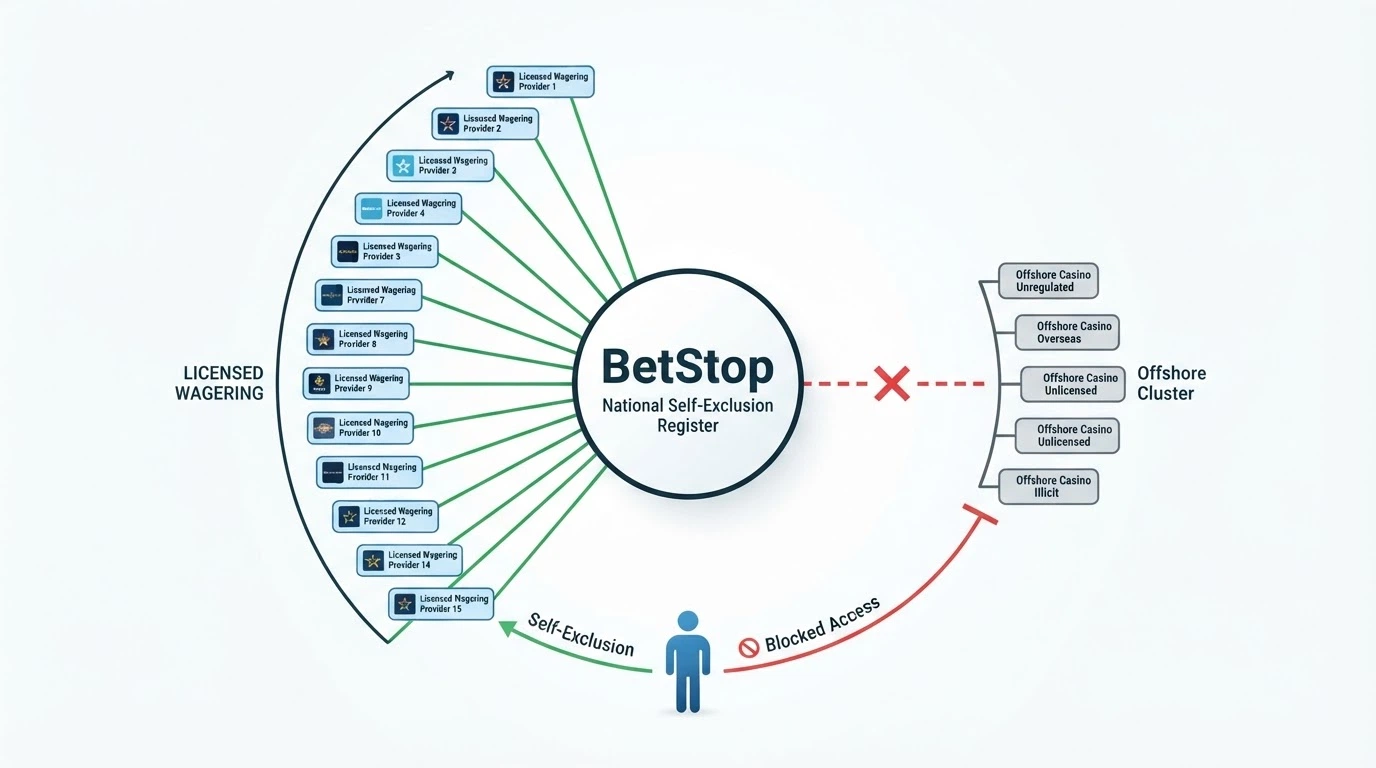
BetStop works. The problem is what it does not reach. BetStop binds only Australian-licensed wagering providers — approximately 150 of them. An offshore casino is not connected to the register, will not see the registration, and will continue to accept deposits and process bets from a self-excluded person. From 1 January 2027, the framework tightens further: direct marketing of inducements is prohibited for three months after a BetStop deregistration, and indefinitely for customers identified as at risk of gambling-related harm. Those rules apply to licensed Australian operators — offshore casinos are not in the regime.
The offshore gap is the most concrete harm described on this page. A reader who has registered with BetStop has done the right thing and removed themselves from the licensed market, and a single offshore casino account — opened in a moment of weakness, funded by a credit card or crypto despite the ban — returns them to play. Self-exclusion works for the Australian-licensed track; it does not work for the offshore track.
Practical help: the helpline, the tools, and what to do right now
The National Gambling Helpline is 1800 858 858 — free, confidential, staffed 24 hours a day. Gambling Help Online, at gamblinghelponline.org.au, provides online chat and counselling for people who prefer not to phone. Both services are operated by qualified counsellors and are available to anyone affected by their own or someone else’s gambling — players, family members, partners.
The licensed wagering operators offer customer-set deposit limits and activity statements under their state or territory conditions. A player who has not yet self-excluded can set a deposit ceiling on SportsBet, Tab, Bet365, Ladbrokes and the other licensed brands and have it enforced by the operator. The same tools are not available on offshore sites, because the same operator is not subject to the same conditions.
The credit-card and crypto ban that took effect on 11 June 2024 is also a harm-minimisation measure in practice. Removing credit as a payment method takes the worst-affordability option off the table for Australian-licensed wagering. An offshore site that asks for credit or crypto is asking for a payment method that exists specifically because the operator is outside Australian rules.
If the gambling has already become a problem, the next step is the helpline. The next step after the helpline is BetStop. The next step after BetStop is to recognise that the offshore casino in the browser tab is not covered by either, and to close it.
How we checked these casinos — and what we couldn’t verify
The methodology behind this read is honest about its limits. The legal framework is grounded in the IGA 2001, the ACMA’s published enforcement record, and the 2026 Gambling Reform Bill. The prevalence data is grounded in the AIHW’s 2022 work. The slot specifications are grounded in independent slot-testing sources (GeekyGambler, Slotfruit, SlotExpanse, RacingPost). The four verified no-deposit free-spins offers are grounded in aggregator listings (NoDeposit365, Slotozilla, Gameindustry.com).
The ten featured operators are ordered by estimated Australian traffic and revenue data from BLASK BRANDS, a third-party market tracking source. Revenue figures are estimates, not audited statements; they are the best available proxy for which operators Australians actually reach, which is the only axis on which the operators could be ranked with verifiable data. Every operator on the list is offshore and unlicensed in Australia — that is a structural fact, not a research finding, because no Australian online casino licence exists.
What was not verifiable this round: no-deposit free-spins terms for the ten featured operators (the table reflects what could be verified, not what could be invented); payout speeds; game provider lists; minimum deposits; licence details for any operator’s offshore jurisdiction. Where the table carries the same legal-status text in every row, that is because the underlying fact is the same in every row. Where the prose describes an operator, the description is grounded in the verified revenue and legal-status figures and nowhere else.
The verification gap is itself information. A reader who cannot independently confirm an offer’s terms before claiming it is reading the same data this read had to work from. The text describes what could be verified; the reader should treat any claim an operator makes on its own landing page with the same scepticism. The 2026 reform package — passed by Parliament on 19 August 2026, with most measures commencing 1 January 2027 and broader advertising changes taking effect 1 July 2027 — is law with a start date. It is not yet in force, but it is not speculative either, and the inducement ban that lands in January is the one most likely to affect how welcome offers are marketed to Australian accounts in the year ahead.
Your move, armed with the facts: what to actually do about online pokies free spins in 2026
The free-spins offer is never as generous as the headline. A A$20 bonus carries an expected cost of roughly A$20 in house-edge loss on the playthrough; a 60x wagering multiple triples the turnover the player must run; a A$10–A$100 win cap sits between the win and the wallet. The marketing word on the banner — “free” — names the only stage of the offer that is genuinely free, which is the moment before the player presses the button. The cost arrives at every other stage.
The legal framework is real and active. 1,564 sites blocked, 225 services withdrawn, penalties of up to A$247,500 for operators that breach the credit-card or crypto ban, bank-blocking authority arriving on 1 January 2027. None of that reaches the player directly — the IGA targets the provider, not the player — but it shapes the environment the player operates in. An offshore casino is offshore for a reason: it cannot be licensed in Australia, because the licence does not exist.
BetStop is the most effective single tool for a player whose gambling has become a problem, and it covers only the licensed wagering market. The offshore casino is not in the regime. The credit-card and crypto ban is a tell: a site asking for either is operating outside Australian rules. The helpline — 1800 858 858 — is staffed 24/7 by qualified counsellors and is free. Gambling Help Online is one click away at gamblinghelponline.org.au. The minimum age for any commercial gambling product in Australia is 18; an operator that does not check is an operator that does not enforce.
A reader who proceeds despite the gap should do three things. Read the full terms before claiming any offer, especially the wagering multiple, the game eligibility, the win cap and the maximum stake per spin. Verify the operator’s licence through the regulator named in the footer — not the offshore licence the operator claims, but whether any licence applies to Australian players at all. Set a personal deposit limit before the first deposit, and treat it as a hard ceiling rather than a guideline. The arithmetic on a A$20 bonus at 30x wagering is around A$20 of expected loss; the arithmetic on ignoring the cap on a A$50 win is losing the entire win to a clause the player never read.
A reader who pauses has the better of the two options. The offers on this page will exist next week in the same form. The decision about whether the offshore casino is the right place to play does not become easier with time, and the cost of pausing is zero. The helpline is one call away. BetStop is one form away. The bonus will still be there when the question is settled.
Frequently asked questions about no-deposit free spins in Australia
Can I win real money from no-deposit free spins at online pokies in Australia?
Yes — but only after the bonus’s wagering condition is met and any win cap is applied. A no-deposit free spin is a real-money spin once the player has completed registration and the casino has credited the spins; the win lands as bonus credit and must be wagered a multiple of times (typically 30x–60x) before withdrawal unlocks. Most offers cap the maximum withdrawal from the bonus at between A$10 and A$100.
What is the maximum I can cash out from a no-deposit free spins bonus?
The maximum is set by the casino in the bonus terms, and most no-deposit free-spins offers in the offshore market cap withdrawals between A$10 and A$100. A player who meets a 60x wagering condition on a bonus win and is then told the maximum withdrawal is A$10 has done the work and still cannot take more out. Always check the cashout cap before claiming — it is the clause that most often turns a headline win into a smaller realised withdrawal.
Do I need a bonus code to claim no-deposit free spins at Australian online casinos?
Some offers require a code at registration; many do not. Where research was able to verify the offers named above, the terms are recorded as published by the source; any code requirement would appear in those terms. Most modern welcome pages activate the bonus automatically when the player registers and selects the offer from a welcome card on the landing page, with no separate code entry required.
How does BetStop self-exclusion work, and does it cover offshore casino sites?
BetStop is the National Self-Exclusion Register, run by the ACMA. A single registration excludes the person from every Australian-licensed online and phone wagering provider — approximately 150 operators. Exclusion periods run from three months to lifetime, and the minimum three-month period cannot be shortened. BetStop does not cover offshore casinos; an offshore operator is not connected to the register and will continue to accept a self-excluded person’s money, which is the single largest gap in the Australian harm-minimisation framework.
Which pokies have the highest RTP for free spins bonus play?
Of the titles with independently verified RTP data, Big Bass Bonanza sits at 96.71% (high volatility, 2,100x max win), Sweet Bonanza at 96.48% (medium-to-high volatility, 21,100x max win — though some operators run a reduced ~95.45% configuration), and Starburst at 96.09% (low volatility, 500x max win). A higher RTP means the house edge is smaller across volume, but the volatility band decides how the session actually feels: high volatility pays less often in larger amounts, low volatility pays more often in smaller amounts. The eligible-game line on the bonus terms usually overrides the player’s preference, which is why the locked game matters as much as the published RTP.