
NDB Casino Australia: How No-Deposit Bonuses Work, What They Cost, and Where Every Offer Sits Offshore in 2026
A no-deposit bonus is the smallest possible door into an online casino: an offer that credits a new account with free spins or a small cash chip the moment the player registers, with no deposit required to claim it. In Australia, every door labelled “no-deposit bonus casino” leads offshore. The Interactive Gambling Act 2001 prohibits online casino games for Australians — there is no Australian licence for the product, and never has been. What follows is a working guide to the ten offshore operators currently running no-deposit offers pitched at Australian players, the real arithmetic behind the headline values, and the legal and consumer-protection ground an Australian punter stands on while playing at any of them.

Current as of 16 October 2026 — verified against the ACMA register, the Interactive Gambling Act 2001 and its 2023 and 2026 amendments, the Northern Territory Racing and Wagering Commission licensing record, and the operator bonus terms pages cited throughout.
Table of Contents
- What an NDB Casino Really Is — and What It Isn’t
- Why Your No-Deposit Bonus Costs More Than It Looks
- The Best NDB Casinos Accessible From Australia in 2026
- Skycrown
- BitStarz
- 7Bit Casino
- KatsuBet
- MIRAX Casino
- Fair Go Casino
- Heaps O Wins Casino
- Ozwin Casino
- PlayCroco Casino
- Pacific Spins Casino
- The Pokies Your No-Deposit Bonus Actually Works On
- Crypto NDB Casinos — Fast Payouts, Zero Australian Protection
- New NDB Casinos in 2026 — Fresh Faces, Same Offshore Risks
- The Australian Law on Online Casinos: No Licence, No Loophole
- Playing Safe When the Safety Net Doesn’t Reach
- How We Chose These NDB Casinos
- What You Should Actually Do With a No-Deposit Bonus
- Frequently Asked Questions
What an NDB Casino Really Is — and What It Isn’t
The acronym is shorthand for “no deposit bonus”. The mechanic is simple: a casino credits a new account with something playable — usually free spins on a single pokie, occasionally a small cash chip — without the player depositing first. The trick is what comes after. The winnings from that bonus are not freely withdrawable. They sit behind a turnover requirement, and almost always behind a maximum cashout cap as well.
A page about “the best licensed online casinos in Australia” is describing something that does not exist. There is no Australian casino licence. The product the IGA prohibits is online casino — online pokies, table games, live dealer rooms. What the IGA does allow is licensed wagering on racing and sport placed before the event starts, lotteries and keno, through operators authorised by a state or territory. The Northern Territory Racing and Wagering Commission, administered by Licensing NT, is the de facto national licensor for online bookmakers; Sportsbet, bet365, Ladbrokes and about fifty other brands sit under that one umbrella. None of them offers a casino product, because the law does not let them.
The casino offers pitched at Australian players all sit on offshore licences — most commonly Curaçao, occasionally Malta or Anjouan. Those licences give the operator legal standing in the jurisdiction that issues them. They give the operator nothing in Australia. The IGA targets the provider, not the player: no Australian has been prosecuted for gambling at an offshore casino. But the player is also outside Australian consumer protection, outside Australian complaints processes, outside BetStop, and outside any practical recourse if the operator declines a withdrawal.
What “NDB” Stands For — and What It Gets You
NDB is industry shorthand for “no deposit bonus”. In casino marketing, a no-deposit bonus is an offer credited to a new account that requires no deposit to claim — no credit card, no crypto transfer, no PayID. The punter registers, verifies (sometimes only an email address; sometimes a phone number), and the bonus lands in the account as either a fixed number of free spins on a specific pokie or a small cash credit that can be staked across the casino’s games.
The two forms are not interchangeable. Free spins are locked to a single pokie title chosen by the operator; the player has no choice of game. Free chips — small AUD-denominated credits, usually between A$10 and A$50 — can typically be staked across a wider game set, but the operator’s terms decide exactly where. Either form is paid out as bonus money, not real money. The bonus itself is the player’s to play with; what the player wins from it is theirs only after the wagering requirement and any maximum-cashout cap have been satisfied.
The standard no-deposit offer sits in the 20 to 100 free spin band, or the A$10 to A$50 free chip band. Wagering requirements on these bonuses typically run from 30x to 50x the bonus value. That range is the benchmark for the rest of the page; every figure an operator publishes should be read against it.
Online NDB Casinos: How the Model Works
The model is built on the assumption that almost nobody clears the wagering. The bonus is a marketing cost designed to put a new player in front of a real-money product. The few who do clear it pay for the rest of the funnel through the gap between the bonus’s headline value and the house edge accumulated while clearing the turnover requirement.
The sign-up path on an offshore NDB casino is intentionally short. Email and password; sometimes a phone number for an SMS code; in most cases nothing resembling the identity verification a licensed Australian wagering operator would apply. The Australian punter is typically playing within minutes. There is no Australian credit check, no linkage to BetStop, no deposit limit enforced at the platform level, and no requirement that the player set one. The whole flow is built around frictionless entry.
What the operator gets is a registered user with a real email address and a verified phone number, who has just spent enough time on the platform to recognise the brand. The conversion path is the same one every consumer SaaS business runs: register, deliver value, monetise on the back end. In a casino context, the back end is the player’s first deposit, which is where the real money flows. The no-deposit bonus is the loss-leader that gets the player through the door.
Australian Players and the Offshore Reality
An Australian-facing domain and Australian dollar balances do not change what an offshore casino is. They are marketing signals, not legal ones. Australian-dollar display and an “.com.au” landing page are easy to put up. The licence is what matters, and every operator offering no-deposit bonuses to Australian players holds an offshore licence that does not extend to the Australian market at all.
The visible traces of the offshore status show up in two places. The first is the payment screen: an Australian who is asked for a credit card or a crypto deposit by a gambling site is being served by someone outside the Australian rules. The payment method is itself a tell. The second is the fine print: offshore operators write their own bonus terms, set their own RTP configurations on games they host, and answer to their own regulator for the conduct of the site.
The consumer-protection cost of that gap is real but easy to miss. There is no Australian complaints body an offshore casino is answerable to. There is no AU ombudsman scheme. If the operator declines a withdrawal, the player is left with whatever private dispute resolution the operator itself offers — and many offer very little. The site itself can be blocked by the ACMA, leaving any balance sitting on it in an unclear state. Australians lose an estimated A$3.9 billion a year to illegal sites, and the share of gambling flowing to licensed Australian operators has dropped from 74% in 2021. That is the market these no-deposit offers reach into.
Why Your No-Deposit Bonus Costs More Than It Looks
A$10 of free chips looks free. The terms behind it turn that A$10 into A$400 of required turnover before a cent can be withdrawn, on a 40x wagering requirement. The headline value is what the player sees at registration; the real cost is what the bonus demands in exchange for a withdrawable win, and what the wagering requirement takes back from the player in expected house edge.
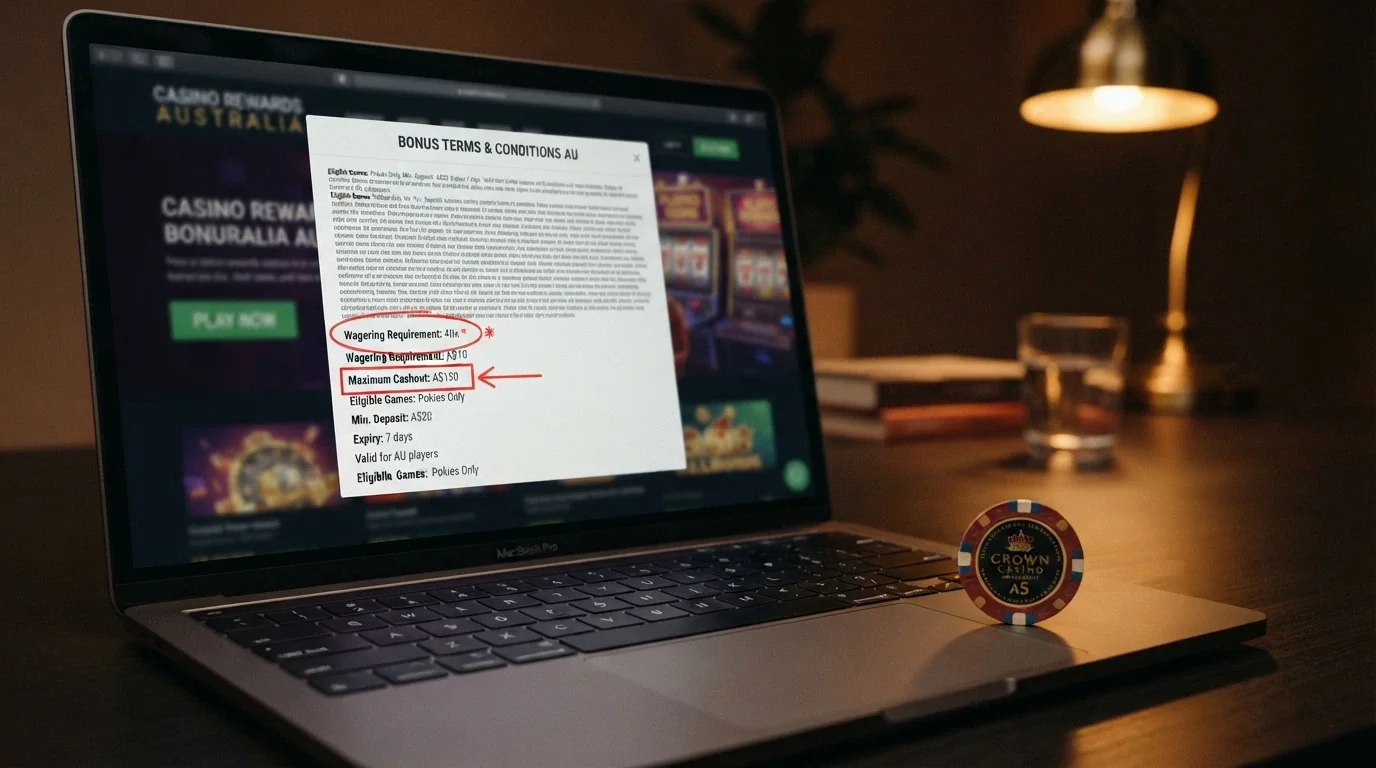
The mechanism is older than online gambling. Casinos have always known that the value of a bonus to the player and the cost of clearing it to the player are two different things. The bonus is real money the operator is willing to pay out — but only after the player has first put their own money at risk against the house edge. The arithmetic works out cleanly when written down. A player who claims a A$10 free chip and clears it on a pokie with a 96.50% RTP is wagering A$400 and losing, on average, A$14 along the way. The expected loss is small relative to the headline value — and that is exactly the point. The bonus is not free; the bonus is a small gambling session the operator funds.
The max-cashout cap is the second mechanic. Even when a player beats the house edge during the wagering requirement — a rare event, but not unheard of on a high-volatility pokie — the bonus terms usually cap the withdrawable win. A$150 is a typical cap for the offers in the featured set; some are lower, some are not stated. A player who wins A$2,000 on a 100-spin bonus will keep, in most cases, no more than A$150 of it.
What a No-Deposit Bonus Actually Is
A no-deposit bonus is a marketing credit issued by an online casino to a new account that requires no deposit to claim. The credit comes in one of two forms: a fixed number of free spins on a single named pokie, or a small AUD-denominated free chip that can be wagered across a defined set of games. The credit itself is bonus money. Any winnings generated by wagering the bonus are also bonus money until the wagering requirement is satisfied.
The wagering requirement is the turnover multiplier. A 40x multiplier on a A$10 bonus means the player has to wager A$400 — stake A$400 in total across the eligible games — before any of the winnings convert to real, withdrawable money. The 30x to 50x range is the typical band for offshore no-deposit offers; the lower the multiplier, the cheaper the bonus is to clear. The 5x wagering requirement at one operator in the featured set is genuinely unusual; the 60x wagering at two others is on the high end of what the market charges.
A free chip of A$35 on offer at one Australian-facing casino is a useful illustration of the mechanic in scale. With typical 40x wagering and a 96.50% RTP, the chip converts into A$1,400 of required turnover, with an expected house edge of roughly A$49 along the way. The cap on what the player can withdraw from a free-chip bonus is typically tighter than the cap on free-spin winnings, often A$100 or less. The chip is the most generous headline figure in the AUD-credit band and the most expensive to clear, dollar for dollar.
Bonus Codes — Where They Come From and How to Use Them
A bonus code is not value. It is a distribution token — a string that tells the operator’s system which offer to credit to the registering account. The code itself does nothing on its own; the terms attached to it do all the work.
Codes appear in three places. Affiliate comparison pages publish them next to operator reviews; the casino’s own promos page publishes them when an offer is active; and bonus-aggregator sites, which collect offers across dozens of operators, list them under each brand. Affiliate pages are the primary distribution channel for the offers an Australian punter is most likely to see, and the bonus terms published beside the code are usually a condensed version of the operator’s full Bonus Terms. The condensed version is what the player reads; the operator’s full Bonus Terms are what the player has agreed to.
Claiming the bonus is mechanical. Most operators credit the offer automatically on registration; some require the code to be entered into a designated field during sign-up or at the cashier before the first deposit. A code that arrives by email is one the player has opted in to receive — usually by signing up to an affiliate mailing list or the operator’s own newsletter. The code is a claim token; once entered, it routes the offer to the account.
What matters is not the code but what is written behind it. The wagering requirement, the maximum cashout, the eligible games, the validity period, the maximum stake while the bonus is active — those are the rules the bonus plays under. The condensed version on the affiliate page is rarely the full set. The operator’s own Bonus Terms are the binding document, and they should be read before the code is entered.
Free Chips vs Free Spins: What Each One Is Worth
The two no-deposit forms answer different questions. Free spins price the bonus at the operator’s chosen per-spin stake — usually A$0.10 — and lock the play to one specific pokie. Free chips price the bonus in dollars and allow the player to spread the stake across a set of games. The total headline value, the cost of clearing it and the maximum win a player can take out all move differently between the two forms.
Free spins are the dominant no-deposit form across the featured set. Skycrown offers 100 free spins at a 40x wagering multiplier with a A$150 maximum cashout. Pacific Spins offers 150 free spins at a 5x wagering multiplier, which is the lowest multiplier in the set. Heaps O Wins offers 77 free spins at 40x on a named pokie. Ozwin and PlayCroco each offer 100 free spins at 60x. The headline count varies — and so does the wagering cost. Pacific Spins at 5x is dramatically cheaper to clear than the 60x offers at Ozwin and PlayCroco, even though Pacific Spins issues more spins.
Free chips are the rarer form. Fair Go’s A$10 free chip is the only AUD-denominated no-deposit offer in the featured ten. The headline value is modest; the cleared value depends on the wagering multiplier, which Fair Go does not publish prominently and which the player has to dig into the operator’s Bonus Terms to find. A A$10 free chip at 40x, played on a pokie with a 96.50% RTP, costs the player an expected A$14 along the way to clearing A$400 in turnover. The maximum cashout on a free-chip bonus is typically tighter than the cap on free-spin winnings.
The practical ceiling on each form tells the player where to look. Free spins offer a higher theoretical ceiling on the headline value — Pacific Spins at 150 spins × A$0.10/spin is A$15 of nominal value, and Ozwin at 100 spins is A$10 of nominal value — but the wagering multiplier is what makes the difference. A player who values the lowest clearance cost looks first at Pacific Spins. A player who values the highest spin count at standard wagering looks first at Skycrown.
The Best No-Deposit Offers on the Table in 2026
The spread across the featured set runs from 150 free spins at 5x wagering to 100 free spins at 60x. The clearance cost varies twelvefold across that range. Three offers stand out on terms, not on headline count.
Pacific Spins is the outlier. The 150 free spins on Liberty Rockets are paired with a 5x wagering multiplier, where the rest of the set sits at 40x or 60x. A player who claims the bonus at A$0.10 per spin is looking at A$15 of bonus value and A$75 of required turnover — small numbers, and the smallest clearance hurdle in the set by a wide margin. The max cashout cap was not confirmed by the sources reviewed for this page; a player should check the operator’s terms before claiming.
Skycrown runs the highest verified volume at standard wagering: 100 free spins, phone verification required, 40x wagering, A$150 maximum withdrawal. The headline is the largest free-spin count in the set with the cashout cap made explicit. Heaps O Wins is the third stand-out: 77 free spins on Buffalo Mania Deluxe at 40x, with the cashout cap unconfirmed in the sources reviewed.
Ozwin and PlayCroco each offer 100 free spins, both at 60x wagering. The high multiplier is the catch: a player who claims either bonus is looking at A$600 of required turnover on A$10 of headline value, against the A$400 a Skycrown player wagers. The clearance cost is half again as high at 60x as it is at 40x. The headline count of 100 spins is identical to Skycrown; the wagering is not.
BitStarz is the case study in reading the fine print. BitStarz has long been listed by affiliate pages as an Australian no-deposit option, with sources quoting anywhere from 20 to 100 free spins. The number does not matter for an Australian player: Bonus Terms Section 1.6 explicitly lists Australia among the countries ineligible for no-deposit free spins. Whatever the headline count, the offer is not available to an Australian registering from an Australian IP address.
What the bonus really costs. A worked example using the standard 40x wagering band and a pokie with a 96.50% RTP — typical of what the eligible games return over the long run — gives the expected loss the bonus imposes on the player. A A$10 free chip, or 100 free spins at A$0.10 per spin, requires A$400 of turnover to clear. At a 96.50% RTP, the player’s expected loss across that turnover is roughly A$14 — the house edge applied to the volume the bonus requires. The same offer at 60x wagering pushes the turnover to A$600 and the expected loss to roughly A$21. Pacific Spins at 5x wagering sits at A$75 of turnover and an expected loss of around A$2.60 — small enough that the bonus is genuinely close to its “free” label, ignoring the max-cashout cap. These are statistical averages across many spins, not guarantees; the player’s actual outcome on any individual session will diverge from them, sometimes by a lot.
The expected loss figure is the real cost of the bonus. It is what the wagering requirement takes back from the player on the path to a withdrawable win. A 40x bonus at A$10 of headline value costs the player an expected A$14 to clear. A 60x bonus at the same headline value costs an expected A$21. The max-cashout cap is the second cost — the win the player would have walked away with is, in most cases, capped at A$150 or less. The two costs together are what the bonus is actually worth, and they sit well below the headline.
The Best NDB Casinos Accessible From Australia in 2026
| Operator | NDB Offer Type | Value (Free Spins or A$) | Wagering Multiplier | Eligible Slot |
|---|---|---|---|---|
| Skycrown | Free spins | 100 | 40x | Phone verification only |
| BitStarz | Free spins | 20¹ | 40x | Gold Rush¹ |
| 7Bit Casino | Free spins | 20 | — | West Town |
| KatsuBet | Free spins | 30 | — | Wild Cash |
| MIRAX Casino | Free spins | 25 | — | Miss Cherry Fruits |
| Fair Go Casino | Free chip | A$10 | — | n/a |
| Heaps O Wins Casino | Free spins | 77 | 40x | Buffalo Mania Deluxe |
| Ozwin Casino | Free spins | 100 | 60x | Oz Golden Trail |
| PlayCroco Casino | Free spins | 100 | 60x | Elemental Adventures |
| Pacific Spins Casino | Free spins | 150 | 5x | Liberty Rockets |
¹ BitStarz’s Bonus Terms Section 1.6 explicitly excludes Australia from no-deposit free spins. Affiliate sources conflict on whether 20 or 50 free spins apply and which slot is tied to the offer; the offer is not available to an Australian registrant regardless.
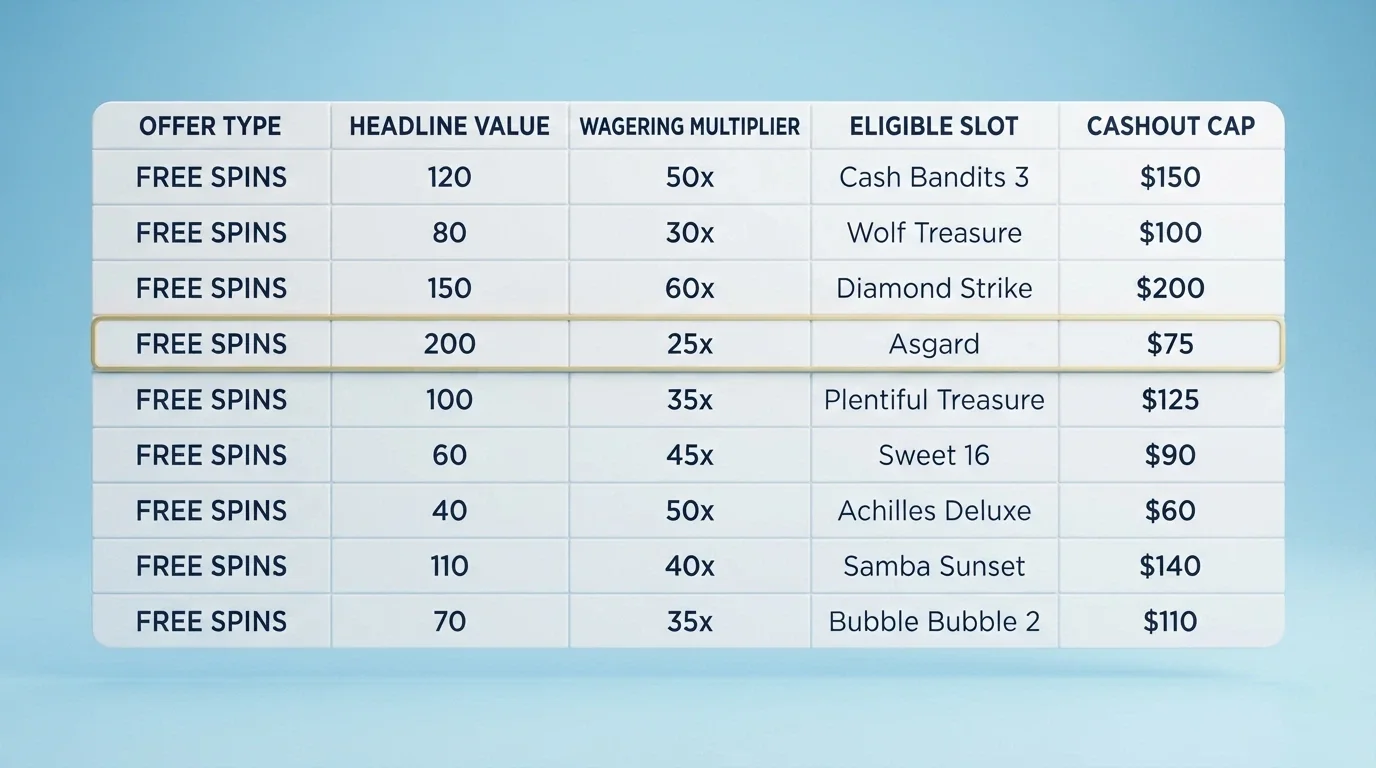
The table is a side-by-side of what each operator in the featured set offers and what each one costs to clear. The five columns are the ones research was able to verify — operator, offer type, headline value, wagering multiplier, eligible game. Every operator in this table is offshore. None holds an Australian casino licence. The product itself cannot be licensed in Australia under the Interactive Gambling Act 2001.
How the Comparison Works
The ranking in the table is ordered by the terms that could be verified across sources, not by a composite “safety” score. The five columns are the ones where the research record holds a specific number; missing terms sit as gaps. No mystery weighting, no editorial score. The order reflects how much of the offer a player can confirm before claiming.
Two columns carry gaps across most rows. The wagering multiplier at 7Bit, KatsuBet, MIRAX and Fair Go is not confirmed in the research reviewed for this page; readers should check each operator’s own Bonus Terms before claiming. The maximum cashout cap is confirmed only for Skycrown (A$150) and BitStarz (€100 / A$150 depending on source); the rest are unverified. Pacific Spins’ 5x wagering is the lowest in the table by a margin of 35x, and Ozwin and PlayCroco’s 60x is the highest. The middle of the band — 40x — is what Skycrown, BitStarz and Heaps O Wins share.
The BitStarz row carries a footnote for a reason. BitStarz is the most heavily promoted brand in the AU-facing affiliate circuit, but the operator’s own Bonus Terms Section 1.6 lists Australia among the jurisdictions explicitly excluded from no-deposit free-spin offers. Affiliate pages that list BitStarz as an Australian NDB option are describing a promotion that does not apply to the audience they are addressing. The headline figures published for BitStarz — 20, 50 or 100 free spins, depending on the source — do not change the exclusion.
The table is what the research verified; the rest of the section is what each operator looks like at the page level.
Skycrown
Skycrown runs the highest free-spin count in the featured set with the most fully verified terms. The bonus is 100 no-deposit free spins, activated through phone number verification — an unusual mechanism for an NDB offer, since most credit the bonus on email registration alone. The wagering requirement is 40x. The maximum withdrawal from the bonus is A$150, the only one of the cashout caps in the featured set that research confirms on the record.
Skycrown hosts games from 79+ providers, which is a wide catalogue for an offshore casino. The licence is Curaçao, which is the standard offshore licence across the set. The operator is pitched squarely at Australian players — Australian dollar balances, AUD pricing on offers, English-language support. None of that changes the offshore status. A Curaçao licence gives Skycrown legal standing in Curaçao; it gives Skycrown nothing in Australia. An Australian player has no Australian complaints body to turn to if a withdrawal is refused.
The offer’s value sits in the verification of its terms. Skycrown publishes the wagering multiplier and the cashout cap clearly, which is rarer than it should be in the offshore NDB market. A player who clears the bonus at 40x wagering on a 96.50% pokie is looking at A$400 of turnover and an expected loss of around A$14 along the way, with any withdrawable win capped at A$150. The arithmetic is straightforward, the terms are published, and the operator does what the page says it does.
BitStarz
BitStarz is the biggest brand in the offshore crypto-casino space, and the case study in why the affiliate headline is not the same as the offer available to the player reading it. The catalogue runs to more than 6,000 game titles; over 500 cryptocurrencies are accepted, alongside AUD balances. E-wallet and crypto withdrawals clear within 0–1 hours; card and bank transfers take 1–5 business days. The welcome package spans four deposits, denominated in bitcoin and worth up to 5 BTC overall — 100% up to 1 BTC plus 180 free spins on the first deposit, then three further deposit matches. Minimum deposit €20. Wagering 40x. Maximum bonus stake €5.
The no-deposit offer is where the conflict lives. Affiliate sources publish numbers between 20 and 100 free spins for an AU player; the eligible-game slot varies between Gold Rush and Alien Fruits depending on the source. None of the headline numbers matter. BitStarz’s own Bonus Terms Section 1.6 lists Australia among the countries explicitly ineligible for no-deposit free spins. The operator is not offering the bonus to the audience these affiliate pages are pitching at. The 40x wagering multiplier and the €100 / A$150 maximum withdrawal both confirm: the offer is structured for other markets.
For an Australian player, BitStarz is a deposit-match venue, not a no-deposit venue. The welcome package is the operator’s real offer, denominated in BTC. A punter comfortable converting AUD to BTC for the deposit bonus gets a wide catalogue and fast crypto withdrawals. A punter after the no-deposit free-spin offer — what the affiliate pages lead with — does not get one. Read the operator’s own Bonus Terms, not the affiliate summary.
7Bit Casino
7Bit Casino offers 20 no-deposit free spins on West Town. The wagering requirement and the maximum cashout cap remain unavailable in public records — and that is the substantive thing to know about the offer before claiming it. 7Bit does not publish these numbers prominently; they sit inside the operator’s full Bonus Terms, which a player has to navigate to.
A 20-free-spin offer is on the low end of the featured set’s spin-count band, which is one reason the wagering and cap terms matter more than usual. At A$0.10 per spin, the nominal bonus value is A$2; the player is relying on the wagering multiplier to be reasonable and the max cashout to be high enough to make the cleared bonus worth claiming. Both of those figures are unverified. A player who wants to claim should open the operator’s own Bonus Terms before signing up, and read the West Town RTP — the slot is a BGaming title and BGaming allows operators to configure the RTP as low as 94%, so the published RTP figure may or may not match what 7Bit is actually running.
7Bit is a mid-sized offshore casino with a Curaçao licence. The catalogue is broad, the registration flow is quick, and the platform supports both fiat and crypto deposits. None of which changes the offshore status. An Australian player has no Australian complaints body to turn to. Read the terms, check the RTP, and size the session accordingly.
KatsuBet
KatsuBet offers 30 no-deposit free spins on Wild Cash — a mid-range spin count for the featured set, sitting between 7Bit’s 20 and Skycrown’s 100. Specific figures for the wagering multiplier and maximum cashout cap remain unavailable in public records. The same caveat that applies to 7Bit applies here, with one wrinkle: the bonus slot is BGaming, and the published RTP figure may not match what KatsuBet is running. BGaming allows operators to configure RTP as low as 94%.
30 free spins at A$0.10 per spin is A$3 of nominal value, which is a small bonus by the set’s standards. The wagering multiplier is the entire ballgame: at 30x, the player is looking at A$90 of required turnover and an expected loss of around A$3; at 50x, the turnover is A$150 and the expected loss around A$5; at 60x, A$180 and around A$6. The difference between the low and high end of the standard band is roughly A$3 per bonus — not huge in absolute terms, but a doubling of the bonus’s cost to clear. A player who wants the offer should check the operator’s own Bonus Terms page for the wagering multiplier before claiming.
KatsuBet’s broader offering is standard offshore-casino fare: a Curaçao licence, a reasonable game catalogue, both fiat and crypto deposits, no Australian consumer protection. The no-deposit bonus is the marketing hook; the deposit offers are where the operator’s economics live.
MIRAX Casino
MIRAX Casino offers 25 no-deposit free spins on Miss Cherry Fruits — a smaller free-spin batch than most of the featured set, on a themed slot that does not appear on the larger operators’ eligible-games lists. Key terms including the wagering requirement, cashout cap, and validity period are not currently available in public records. The offer is one of the thinnest-data entries in the set: the headline value is the only specific figure research was able to verify.
For a player evaluating the offer, the gap matters more than usual. 25 free spins at A$0.10 per spin is A$2.50 of nominal value; the wagering multiplier determines whether that is worth claiming at all. A 30x multiplier on Miss Cherry Fruits costs the player an expected A$0.90 to clear; a 60x multiplier costs an expected A$1.80. The cap on what can be withdrawn is the second question, and it is the one MIRAX does not publish prominently. The player has to read the operator’s full Bonus Terms to find it — and that is the minimum reading before claiming.
MIRAX is a smaller offshore operator with a Curaçao licence, both fiat and crypto deposits, and a standard registration flow. The casino carries the same offshore-player risk as every other name in the set: no Australian complaints body, no BetStop coverage, no Australian recourse if a withdrawal is refused. The bonus itself is small enough that the player is not risking much to claim it; the risk is the engagement the operator is designing the bonus to drive.
Fair Go Casino
Fair Go Casino is the only free-chip offer in the featured set. The bonus is a A$10 no-deposit credit — small in headline terms compared to the 100+ free-spin offers elsewhere, but a different kind of value because the credit is cash, not spins locked to one pokie. The player has flexibility: the credit can be staked across a set of games Fair Go names in its Bonus Terms, rather than on a single named pokie.
The terms are unavailable in public records. The wagering multiplier, the maximum cashout cap, the eligible games and the validity period all sit inside the operator’s full Bonus Terms. Fair Go does not publish them prominently. The headline A$10 figure is the entry point; the cost of clearing it depends on the multiplier. A 40x multiplier on a 96.50% RTP pokie costs the player an expected A$14 in house edge along the way to A$400 of turnover. The cashout cap on a free-chip bonus is typically tighter than on free-spin offers — A$100 is common; A$50 is not unusual. The player needs to read Fair Go’s Bonus Terms before claiming to know which.
Fair Go is one of the Australian-facing offshore casinos that has been around long enough to be a recognisable name in the AU punter community. The branding is pitched directly at Australian players — AUD balances, Australian-dollar pricing on bonuses, English-language support. None of that changes the licence: Curaçao, offshore, no Australian consumer protection. A A$10 free chip is a cheap trial of the platform, and that is the honest frame for the offer.
Heaps O Wins Casino
Heaps O Wins Casino offers 77 no-deposit free spins on Buffalo Mania Deluxe, with a 40x wagering multiplier — the middle of the standard band, sitting between Skycrown’s 40x and the 60x at Ozwin and PlayCroco. The maximum cashout cap remains unavailable in public records; players should check the operator’s full Bonus Terms before claiming.
77 free spins is a useful spin count for an NDB offer. At A$0.10 per spin the nominal value is A$7.70; the 40x wagering requirement means the player is looking at A$308 of turnover to clear the bonus. At a 96.50% RTP, the expected loss along that path is around A$11. The arithmetic is similar to Skycrown’s 100-free-spin offer, scaled down by the smaller spin count. The max cashout cap, once confirmed, determines whether a strong session turns into a withdrawable win or is capped before it gets there.
Buffalo Mania Deluxe is a themed pokie with an Australian-facing branding tilt. Heaps O Wins is itself an Australian-facing operator, with AUD balances and Australian-dollar pricing on its offers. The licence is offshore; the consumer protection is offshore; the only thing Australian about the offer is the marketing and the currency. The bonus itself is a fair-sized no-deposit trial of a single pokie — a useful frame for an NDB player who knows what they are signing up for.
Ozwin Casino
Ozwin Casino runs one of the steepest wagering requirements in the featured set: 100 no-deposit free spins on Oz Golden Trail, with a 60x wagering multiplier. The maximum cashout cap is not confirmed in the sources reviewed for this page.
The headline is the same as Skycrown’s — 100 free spins — and the wagering is 50% higher. A Skycrown player wagers A$400 to clear A$10 of bonus value; an Ozwin player wagers A$600. The expected loss on Oz Golden Trail at a 96.50% RTP is around A$21, against Skycrown’s A$14. The headline figures match; the clearance cost does not. The 60x multiplier is the cost of the headline.
Oz Golden Trail is the named eligible slot — a themed pokie with Australian outback branding. The name is part of the marketing; the RTP and volatility are what determine whether the bonus is worth playing. The published RTP for Oz Golden Trail is not in the sources reviewed; the operator’s RTP configuration for the slot is not confirmed. Players should check the operator’s own Bonus Terms and the in-game help screen before claiming.
Ozwin is an Australian-facing offshore casino with AUD balances and Australian-dollar pricing. The licence is offshore; the consumer protection is offshore. The bonus is a fair-sized spin offer with a higher-than-standard clearance cost — a player who knows the math should weigh the 60x before claiming.
PlayCroco Casino
PlayCroco Casino mirrors Ozwin on the headline: 100 no-deposit free spins, 60x wagering, with the eligible slot being Elemental Adventures rather than Oz Golden Trail. The maximum cashout cap is not confirmed in the sources reviewed for this page.
The arithmetic is the same as Ozwin’s. A$10 of nominal bonus value at A$0.10 per spin, A$600 of required turnover at 60x, expected loss around A$21 on a 96.50% RTP slot. The two offers are interchangeable on cost; the difference is the game. Elemental Adventures is a themed pokie, distinct from Oz Golden Trail, and the player’s preference for one over the other is the only reason to choose PlayCroco over Ozwin (or vice versa) on the no-deposit offer alone.
PlayCroco is an Australian-facing offshore casino with a crocodile in the branding, AUD balances and Australian-dollar pricing. The licence is offshore; the registration flow is fast; the consumer protection is offshore. Players should read the operator’s full Bonus Terms to confirm the max cashout before claiming — a cap is the variable that turns a strong session into a withdrawable win or caps it out before it gets there.
Pacific Spins Casino
Pacific Spins runs the standout offer in the featured set: 150 no-deposit free spins on Liberty Rockets, with a 5x wagering multiplier. The maximum cashout cap is not confirmed in the sources reviewed for this page.
The 5x multiplier is what makes the offer. A Skycrown player wagers A$400 to clear A$10 of nominal bonus value; an Ozwin player wagers A$600. A Pacific Spins player wagers A$75. The clearance cost is roughly one-fifth of Skycrown’s, one-eighth of Ozwin’s. At a 96.50% RTP, the expected loss on Liberty Rockets is around A$2.60 — a small number that genuinely earns the “free” label the marketing uses for no-deposit offers. The max cashout cap, once confirmed, determines how much of a strong session a player can take home.
Liberty Rockets is a themed slot. The RTP configuration on the game at Pacific Spins is not confirmed in the sources reviewed; the slot’s published RTP may differ from what the operator is running. The player should check the in-game help screen on the slot for the RTP figure Pacific Spins has set before spinning.
Pacific Spins is an offshore casino with a Curaçao licence. The platform supports both fiat and crypto deposits. The bonus itself is the lowest-cost no-deposit offer in the featured set by a wide margin; that is the honest frame for the offer. For a player who values the cheapest path to a withdrawable win, this is the name to look at first.
The Pokies Your No-Deposit Bonus Actually Works On
Almost every no-deposit free-spin offer in the featured set is locked to a single pokie title. The operator picks the game; the player has no choice. The choice is not arbitrary. Operators configure eligible slots at RTP settings that can sit below the game’s published default — BGaming allows configurations as low as 94% on titles such as Elvis Frog in Vegas. The bonus the player thinks is a free trial is, in some cases, a free trial of a worse-paying version of the game than the one the player would find at a competing venue.

The single-game lock is one of the most consistently overlooked terms in NDB marketing. Affiliate pages publish the headline spin count and the wagering multiplier; the eligible game sits in smaller text underneath. A player who has not checked the eligible slot before claiming has not actually agreed to the terms they think they have.
The games themselves are a mix of themed pokies — Buffalo Mania Deluxe, Oz Golden Trail, Elemental Adventures, Liberty Rockets — and a handful of BGaming and Pragmatic Play titles that recur across multiple operators in the set. None of the NDB-eligible slots have independently verified RTPs in the sources reviewed for this page. Gates of Olympus and Elvis Frog in Vegas are included in the table for context; both are well-known titles with verified default RTPs, and both illustrate the gap between a slot’s published RTP and the version an operator may be running.
The Pokies Your NDB Free Spins Are Tied To
| Slot Title | Provider | Default RTP | Volatility | Max Win |
|---|---|---|---|---|
| West Town | BGaming | — | — | — |
| Wild Cash | BGaming | — | — | — |
| Miss Cherry Fruits | BGaming | — | — | — |
| Buffalo Mania Deluxe | — | — | — | — |
| Oz Golden Trail | — | — | — | — |
| Elemental Adventures | — | — | — | — |
| Liberty Rockets | — | — | — | — |
| Gates of Olympus (context) | Pragmatic Play | 96.50% | Very high (5/5) | 5,000x |
| Elvis Frog in Vegas (context) | BGaming | 95.3% | Medium-high | 2,500x |
The first seven rows are the slots the featured operators tie their no-deposit offers to. None of them carry an independently verified RTP in the sources reviewed for this page. The last two rows are included for context: Gates of Olympus by Pragmatic Play, with a 96.50% default RTP and very high volatility, and Elvis Frog in Vegas by BGaming, with a 95.3% default RTP and medium-high volatility. Both are well-known titles that appear across the offshore NDB market. Both illustrate why the lack of an independently verified RTP on the NDB-eligible slots is a real gap — the default figure is what the slot was designed to return; what the player is actually getting depends on the operator’s configuration.
RTP and Volatility — Why They Matter for Bonus Play
RTP is the slot’s long-run return to player. A 96.50% RTP pokie returns A$96.50 for every A$100 wagered, on average, across millions of spins. It is the inverse of the house edge — a 96.50% RTP means a 3.50% house edge. The number is a statistical average, not a session guarantee. A player can run well above or well below the long-run return in any individual session; over a long enough stretch of play, the slot converges on its published figure.
For bonus play, the RTP determines the expected loss on the wagering requirement. A 96.50% RTP pokie played through A$400 of turnover costs the player an expected A$14. A 95.30% RTP pokie played through the same turnover costs an expected A$19. A 94.00% RTP pokie costs an expected A$24. The arithmetic is the same; the rate is what moves. This is why BGaming’s allowance for operators to configure RTP as low as 94% on titles such as Elvis Frog in Vegas matters: the operator can run the slot at a rate that adds a third again to the player’s cost to clear the bonus.
Volatility shapes the session itself. A very high volatility pokie pays out rarely but in large chunks when it does. A medium-high volatility pokie pays out more often in smaller amounts. For a free-spin player working through A$400 of turnover on a 96.50% RTP pokie, high volatility means long stretches without wins, followed by occasional larger payouts — and a higher variance around the expected loss. Low volatility means steadier small wins and a tighter distribution around the average. Neither changes the long-run return; both change what the session feels like and how likely the player is to clear the bonus before the spins run out.
The practical point for an NDB player is short. The eligible slot is the operator’s choice; the RTP and volatility are what the slot is configured to. A player who can find the in-game help screen or the operator’s published RTP for the eligible slot can read the rate they are actually playing at. A player who cannot find it is taking the slot’s published figure on trust — and the published figure may not match the operator’s configuration.
Crypto NDB Casinos — Fast Payouts, Zero Australian Protection
The offshore NDB market runs on crypto. The deposit rail is bitcoin, ethereum, USDT and a long tail of altcoins; the withdrawal rail is the same, in reverse. Crypto is the default at most of the operators in the featured set, and the only rail at some of them. Speed is the headline benefit: e-wallet and crypto withdrawals at BitStarz clear within 0–1 hours, against 1–5 business days for card and bank transfer.
The protection gap is what crypto does not solve. A fast withdrawal does not change who the operator is answerable to, and it does not change the fact that an offshore casino is not answerable to any Australian regulator. The speed is real. The protection is not. The 0–1 hour window is between the operator releasing the funds and the crypto network confirming them; the dispute path, if anything goes wrong, runs through the operator’s own support channels and whatever private mediation the operator has signed up for.
The Australian law on the payment method itself has changed. Since 11 June 2024, credit cards, credit-related products and digital currency — crypto — have been banned as payment for online wagering in Australia. The ban applies to licensed wagering operators. An offshore casino accepting bitcoin from an Australian player is not bound by the ban, because the offshore casino is not bound by Australian law at all. What changes from 1 January 2027 is the bank’s authority: financial institutions gain express power to block transactions to illegal gambling operators. The crypto deposit rail an Australian player uses to fund an offshore casino account is a candidate for that block.
Bitcoin NDB Casinos: What Changes When the Currency Is Crypto
The headline change is speed. A bitcoin withdrawal clears when the network confirms the transaction — typically under an hour, sometimes in minutes. A card or bank withdrawal runs through the payment processor’s normal settlement cycle, which is 1–5 business days at most operators in the featured set. For a player cashing out a cleared bonus, the difference is the difference between seeing the funds today and seeing them next week.
The second change is value volatility. A bitcoin-denominated bonus is worth whatever bitcoin is worth at the moment of conversion. A bonus credited at A$100 worth of BTC on Monday may be worth A$97 worth of BTC by Friday if the market moves. The wagering requirement is denominated in BTC; the cleared win is denominated in BTC; the conversion to AUD happens at the player’s chosen moment. The volatility risk is small over the short period a bonus is being cleared, but it is not zero. A player who clears a bonus in a session that runs into a sharp BTC price move has either gained or lost on the conversion, on top of the gambling outcome.
The third change is anonymity — partial, not full. Crypto wallets do not require a name to set up; the transactions are pseudonymous on the blockchain. An offshore casino accepting bitcoin does not need to verify the player’s identity to take the deposit. That is the privacy trade-off crypto offers, and it is the trade-off an Australian player is making by using a payment rail that sits outside the licensed system entirely. The privacy is real; the consumer protection that goes with it is zero.
The Crypto Payment Ban and What It Means for Casino Deposits
The Interactive Gambling Amendment (Credit and Other Measures) Act 2023 banned credit cards, credit-related products and digital currency — crypto — as payment for online wagering in Australia. The ban commenced 11 June 2024. Penalties for non-compliance run up to A$247,500. The ban applies to operators providing wagering services to Australians — which, given the prohibition on online casino under the IGA, is licensed wagering operators only. Sportsbet, bet365, Ladbrokes and the rest of the NT-licensed cohort cannot legally accept a credit card or a crypto deposit from an Australian customer.
The offshore casino is not bound by the ban. The offshore casino is not bound by Australian law at all. An Australian who deposits bitcoin at an offshore casino is not committing an offence under the credit/crypto ban — the ban targets the operator, not the player. The bank block from 1 January 2027 changes that picture. From that date, financial institutions gain express authority to block transactions to illegal gambling operators. The mechanism is not specific to crypto — it covers any payment the bank identifies as flowing to an unlicensed operator — but crypto is a likely target because the transactions are easier to identify at the network level.
The practical consequence for a player funding an offshore casino account with bitcoin in 2026 is that the transaction is currently legal at the player level, may be legal or may not be at the operator level depending on jurisdiction, and may become blocked at the bank level from 1 January 2027. The crypto rail is fast and pseudonymous. It is also the rail most exposed to the new enforcement machinery.
New NDB Casinos in 2026 — Fresh Faces, Same Offshore Risks
The Australian-facing affiliate circuit is constantly refreshed with new operators. The featured set runs from established names — BitStarz has been operating since 2014 — to newer entrants whose launch dates sit inside the research record but outside the published headlines. A new casino typically offers a more generous no-deposit bonus than an established one, partly because it has no track record to sell and partly because it is paying for sign-ups at a higher rate than a brand players already know.
The generous launch offer is the trade the player is being offered: more bonus value in exchange for zero operating history. An established casino has a withdrawal track record a player can check; a new casino has nothing to check against. An established casino has a complaint history visible in player forums; a new casino has complaints that have not accumulated yet. An established casino has had time to test its bonus terms against player behaviour; a new casino is still calibrating.
The risk factors compound. A new casino may have a Curaçao licence that is genuine, or it may have a licence that has not been verified. A new casino may publish bonus terms clearly, or it may have terms that have not yet been stress-tested. A new casino may process withdrawals cleanly, or it may have a payout process that has not been seen enough times to call. None of these risks is unique to new casinos — every offshore operator carries them — but new casinos carry them in amplified form.
Recently Launched NDB Casinos Worth Knowing
The featured set is mixed on recency. BitStarz has been operating since 2014, which is established by any standard. Skycrown, Fair Go, Ozwin, PlayCroco and Heaps O Wins are recognisable names in the Australian-facing affiliate circuit, with launch dates that sit further back than the current 2026 crop but not as far back as BitStarz. Pacific Spins, MIRAX and KatsuBet sit closer to the recent end of the set — newer offshore operators running on standard Curaçao licences, with no operating history a player can verify before signing up.
The standard launch-era NDB offer is a higher-than-market spin count at standard wagering, with bonus terms that read cleanly on the surface but may not have been tested against player behaviour. Pacific Spins is the clearest example in the featured set: 150 free spins at 5x wagering is a generous launch offer by the offshore market’s standards, and the 5x multiplier is so far below the 30x–50x norm that it reads as a launch promotion designed to seed registrations. The terms are real; the question is whether the rest of the operator — the withdrawal process, the customer support, the dispute path — has had the time to settle into a track record a player can rely on.
What to Check Before You Join a Brand-New NDB Casino
The check is short, and the absence of a check is the most common reason new-casino players get caught. Five things to look for before claiming any NDB offer at an operator the player has not used before.
The licence. The operator should display a licence number and a licensing authority — typically Curaçao, sometimes Anjouan, occasionally Malta. A licence number that resolves to a real regulator’s register is a baseline; a licence number that does not resolve is a red flag.
The bonus terms. The operator’s own Bonus Terms page should state the wagering multiplier, the maximum cashout cap, the eligible games and the validity period of the offer clearly. BitStarz’s Bonus Terms Section 1.6 is the case study in why the operator’s own terms matter: affiliate pages list Australia as eligible for the no-deposit offer, and the operator’s own terms list Australia as ineligible. The operator’s terms are the binding document.
The withdrawal complaints. A short search of player forums and complaint sites will surface any pattern of declined withdrawals, delayed payouts or disputed bonus terms. New casinos will not have many complaints; established ones will have a track record that is at least visible.
The domain age. A whois lookup on the operator’s domain tells the player how long the site has been live. A domain registered in the last six months is consistent with a genuinely new casino; a domain registered in the last six months that claims to have been operating for years is a red flag.
The eligible-game RTP. Most NDB-eligible slots do not have an independently verified RTP in the public record. A player who can find the in-game help screen on the eligible slot and read the configured RTP is taking the operator’s word with one fewer unknown variable.
The Australian Law on Online Casinos: No Licence, No Loophole
Online casino is prohibited to Australians under the Interactive Gambling Act 2001, strengthened by the Interactive Gambling Amendment Act 2017. There is no licence for online casino in Australia — not federally, not in any state or territory. The product is banned outright, and the prohibition targets the provider with civil penalties up to A$2,475,000 per day for an individual and A$12,375,000 per day for a corporation.
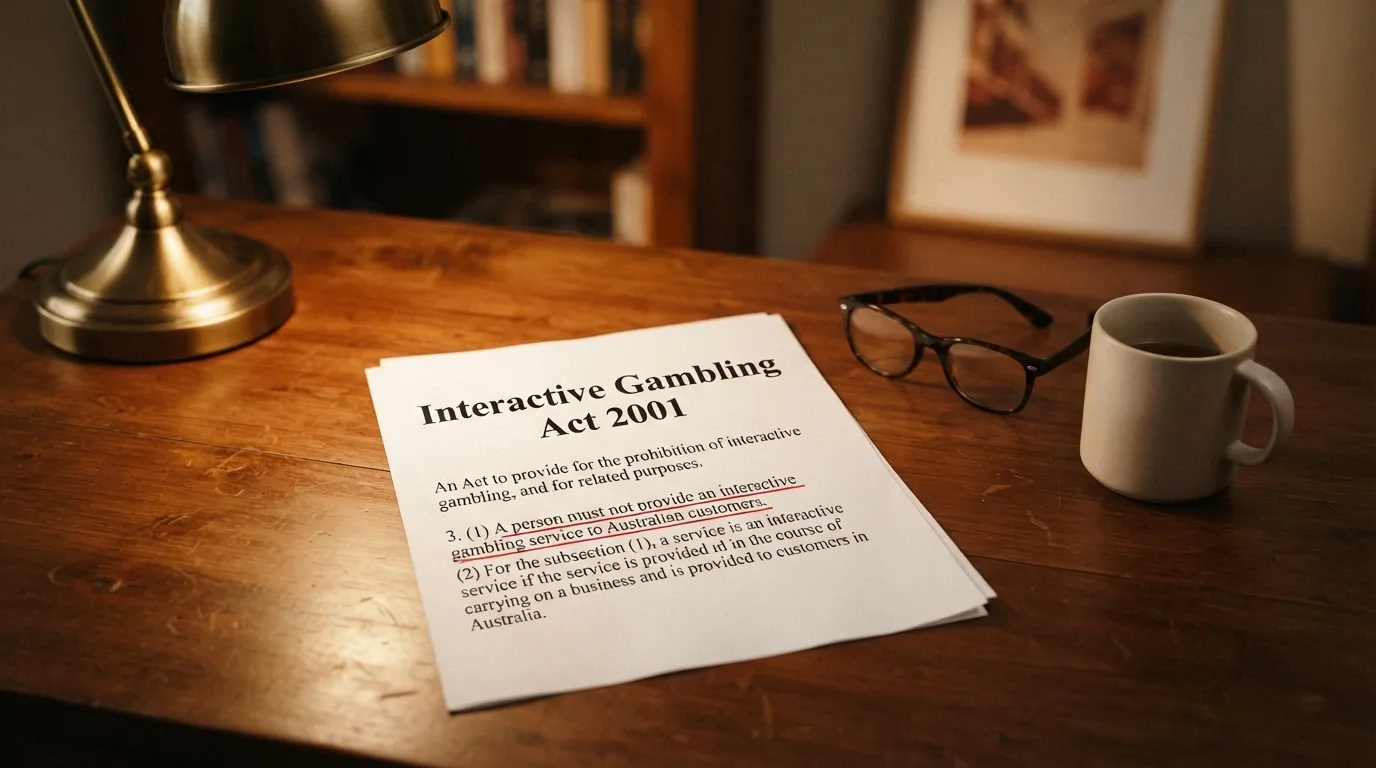
The 2026 reform tightens what was already a prohibition. The Interactive Gambling Amendment (Gambling Reform) Bill 2026 passed the House of Representatives on 18 August 2026 and the Senate on 19 August 2026. Substantive measures commence 1 January 2027. The reform adds new bank-blocking authority for transactions to illegal gambling operators, a three-ads-per-hour cap on wagering advertising between 6:00 am and 8:30 pm, a live-sport blackout from 15 minutes before a live sporting event until 5 minutes after it ends, a ban on direct marketing of inducements for 14 days after sign-up, three months after BetStop deregistration, and indefinitely for at-risk customers, and a legislated national wagering advertising opt-out register — AdStop — that is not expected to be operational by 1 January 2027 and will commence on a later day fixed by proclamation.
What the IGA does not prohibit is wagering on racing and sport placed before the event begins, lotteries and keno, through operators licensed by a state or territory. The Northern Territory Racing and Wagering Commission, administered by Licensing NT, is the de facto national licensor for online bookmakers. Sportsbet, bet365, Ladbrokes and about fifty other brands sit under that one umbrella. None of them offers a casino product, because the law does not let them.
The Interactive Gambling Act: What It Actually Bans
The IGA targets the provider. Civil penalties run up to A$2,475,000 per day for an individual and A$12,375,000 per day for a corporation under subsection 15(2A). The 2026 penalty-unit rate puts the daily fine at over A$2.4 million per day at the unit rate — the section 15(2A) figures sit above that rate for a body corporate. The penalty is on the operator, not the player. No Australian player has been prosecuted for gambling at an offshore site; the IGA does not extend that far.
The Australian Communications and Media Authority is the federal regulator that enforces the prohibition. ACMA investigates complaints, issues formal warnings and civil penalty proceedings, and directs ISPs to block illegal sites. In May 2026, ACMA issued formal warnings to six illegal gambling operators for providing prohibited interactive gambling services. Earlier in 2026, ACMA ordered ISPs to block eight sites including Lucky Mate, Vegastars, Wombet, Cosmobet, Fortune Play, Fortunica, Rolletto and Velobet. A later action added 12 more: 7Signs, ChromaBet, Donbet, Duospin, Freshbet, Slots Gem, Jacks Club, Lucky Start, Pointsbetz.com, Spinrise, Vinyl Casino and Wildsino. Since November 2019, ACMA has blocked 1,751 illegal gambling and affiliate marketing websites in total, and more than 230 unlicensed gambling services have exited the Australian market since enforcement strengthened in 2017.
The block is at the ISP level. An Australian player whose casino is blocked can no longer reach the site through an Australian internet connection. Any balance on the account at the moment of blocking is, in practice, stranded — the player cannot reach the operator to withdraw, and the operator is not bound by Australian law to release it. The site may be mirrored on a different domain; the operator may continue under a new name; the balance may or may not survive. None of this is a hypothetical; it is the documented pattern of the ACMA enforcement record.
Offshore Casinos vs Licensed Australian Wagering: the Difference
The two markets share the word “gambling” and almost nothing else. A licensed Australian wagering operator holds an NT (or state) licence, is bound by Australian consumer law, accepts payment only through rails the IGA permits (debit card, bank transfer, PayID/Osko, BPAY), verifies the customer’s identity, enforces BetStop on self-excluded customers, enforces deposit limits at the platform level, and is answerable to an Australian complaints body. Sportsbet, bet365, Ladbrokes and the rest of the NT-licensed cohort operate inside the Australian regulatory perimeter; the rules apply to them because the rules are their licence.
An offshore casino holds a Curaçao (or similar) licence, accepts payment through any rail including crypto, does not verify the customer’s identity beyond the registration form, is not connected to BetStop, does not enforce an Australian deposit limit, and is answerable to whatever complaints process the operator has chosen to set up — which is often very little. The rules of Australian consumer protection do not apply to the offshore casino because the offshore casino is not an Australian entity.
The payment method is the visible boundary. An Australian who is asked for a credit card or a crypto deposit by a gambling site is being served by someone outside the Australian rules. The payment method is itself a tell. The licensed wagering operator will not offer crypto or credit; the offshore casino will offer both, because both are how it gets paid.
The IGA does not extend consumer protection offshore. The licensed wagering operator carries BetStop, an Australian complaints process, an Australian ombudsman, and a regulator that can compel action. The offshore casino carries none of those. The two products are not different versions of the same thing; they are different things, and the difference matters the moment something goes wrong.
Playing Safe When the Safety Net Doesn’t Reach
The Australian harm-prevention infrastructure is real. The National Gambling Helpline — 1800 858 858 — is free, confidential and staffed 24 hours a day, 7 days a week, with online chat and counselling through Gambling Help Online. BetStop — the National Self-Exclusion Register — has been live since August 2023, with 67,480 registrations as at 31 July 2026, of which 41,290 exclusions were still active. About 2.1% of Australian adults — roughly 430,000 people — experience problem gambling, with high-risk gambling at 1.8% according to the Australian Institute of Health and Welfare.
The gap is what the offshore casino falls into. BetStop binds Australian-licensed wagering services only; an offshore casino is not connected to the register. A person who has self-excluded through BetStop and then signs up at an offshore casino will pass the offshore casino’s registration process without the offshore casino ever checking. The offshore casino has no obligation to check, no access to the register, and no incentive to refuse the registration. The BetStop registration covers every Australian-licensed online and phone wagering service; it covers nothing offshore.
The 2.1% figure puts the demand for self-exclusion in proportion. Roughly 430,000 Australian adults experience problem gambling; BetStop’s 67,480 registrations represent a fraction of that population. The gap is not a comment on BetStop; it is a comment on how many Australians who could benefit from self-exclusion have not yet registered. For those who have, the offshore casino sits outside the protection the registration gives.
BetStop, Self-Exclusion and Why Offshore Casinos Are Not Covered
BetStop works as designed for licensed wagering. One registration, processed at betstop.gov.au, excludes a person from every Australian-licensed online and phone wagering service in a single step. The exclusion periods run from three months to a lifetime; 38% of registrants choose the lifetime option. The licensed operators check BetStop at registration; they cannot onboard a self-excluded person. The protection is comprehensive within the licensed market.
The offshore casino is a different market. The offshore casino is not a signatory to BetStop; the offshore casino is not subject to Australian privacy laws that would let it query the register; the offshore casino has no Australian regulator it has to satisfy by participating. A self-excluded Australian can register at an offshore casino and start playing within minutes. The offshore casino will not check; the offshore casino does not have to check.
The consequence for a self-excluded player is direct. The exclusion the player signed up for covers licensed wagering only. The offshore casino accepts the player as a new customer, the no-deposit bonus lands, and the wagering begins. The protection the player thought they had does not extend to where they are playing.
The same gap applies to the player-protection machinery licensed operators carry. Licensed operators enforce deposit limits at the platform level; offshore casinos do not. Licensed operators publish activity statements; offshore casinos do not, beyond what their own terms require. Licensed operators answer to an Australian complaints body; offshore casinos answer to their own. None of the licensed-market protection reaches the offshore casino floor.
Where to Get Help: Gambling Support in Australia
The National Gambling Helpline is 1800 858 858 — free, confidential, staffed 24 hours a day, 7 days a week, with online chat available through Gambling Help Online at gamblinghelponline.org.au. The helpline is the entry point for anyone who is worried about their own gambling or someone else’s; the counsellors are trained, the conversation is confidential, and there is no cost to the caller.
Gambling Help Online — gamblinghelponline.org.au — is the online counselling service operated under the same national framework. Online chat, web-based counselling, and self-help resources are all available through the site. The service is structured to support people who prefer text-based or self-guided help to phone calls, and it includes modules on controlling spend, recognising problem gambling, and supporting someone the caller is concerned about.
BetStop — betstop.gov.au — is the National Self-Exclusion Register. One registration, processed online, excludes a person from every Australian-licensed online and phone wagering service in a single step. Exclusion periods range from three months to lifetime. The registration does not cover offshore casinos; the registration covers everything inside the licensed Australian wagering market.
For financial counselling related to gambling debt, the National Debt Helpline — 1800 007 007 — runs the same 24/7 model and refers callers to free financial counsellors in their state. Gambling-related debt is one of the commonest reasons people contact a financial counsellor in Australia.
How We Chose These NDB Casinos
The interactive gambling market in Australia begins with the Interactive Gambling Act 2001 itself. Every operator offering a no-deposit bonus to an Australian player is offering an unlicensed product — there is no Australian casino licence, and there cannot be one under the current law. The list does not include a single licensed Australian operator, because licensed Australian operators do not offer casino games. Sportsbet, bet365, Ladbrokes and the rest of the NT-licensed cohort are absent from the table because the law keeps them out of the Australian online casino space.
The verification sources were the ACMA register of blocked sites, the ACMA formal-warning record, the AU regulation record for legal status, the operator’s own bonus terms pages for offer details, and the operator comparison pages that aggregate NDB offers across the Australian-facing affiliate circuit. Each operator was checked against the ACMA blocking record — no featured operator appears in the recent ACMA blocking lists, though that is a snapshot, not a guarantee. Each offer was checked against the operator’s own bonus terms where research was able to verify them; where the operator’s own terms did not confirm a specific figure, the gap is marked in the table and in the operator write-up.
The ranking in the table is ordered by the offer terms that could be verified across sources, not by a composite “safety” score. No mystery weighting, no editorial score out of ten, no proprietary trust index. The five columns are the ones where the research record holds a specific figure; missing terms sit as gaps. A reader who wants to verify a specific term should open the operator’s own bonus terms page.
The page does not endorse any operator, does not guarantee offer availability, and does not represent any operator as safer than any other. The offers change; the terms change; the operators come and go. What the page does is describe what is on the table in 2026, what each offer costs to clear, and what an Australian player is — and is not — protected by when they sign up.
What You Should Actually Do With a No-Deposit Bonus
A no-deposit bonus is a genuine no-cost trial of a pokie or a casino platform. The headline value is small — A$10 of free chip, or 20 to 150 free spins at the operator’s chosen per-spin stake. The bonus lands in the account on registration; no deposit is required. The bonus itself is yours to play with.
The wagering requirement makes a withdrawable profit unlikely. At 30x to 50x on a typical A$10 bonus, the player is wagering A$300 to A$500 to clear the bonus — and the house edge is taking roughly A$10 to A$18 along the way, on average, on a pokie with a 96.50% RTP. The expected loss is small relative to the headline value, but it is not zero. A player who wants to extract real money from the bonus is taking a statistical position against the house edge across a high volume of wagering, with a max-cashout cap standing between them and any large win.
The max-cashout cap is the second cost. A$150 is a typical cap; the exact figure varies by operator. A player who runs the bonus up to A$2,000 will keep, in most cases, A$150 of it. The cap is the variable that turns a strong session into a withdrawable win or caps it before it gets there. Always read the cap before claiming.
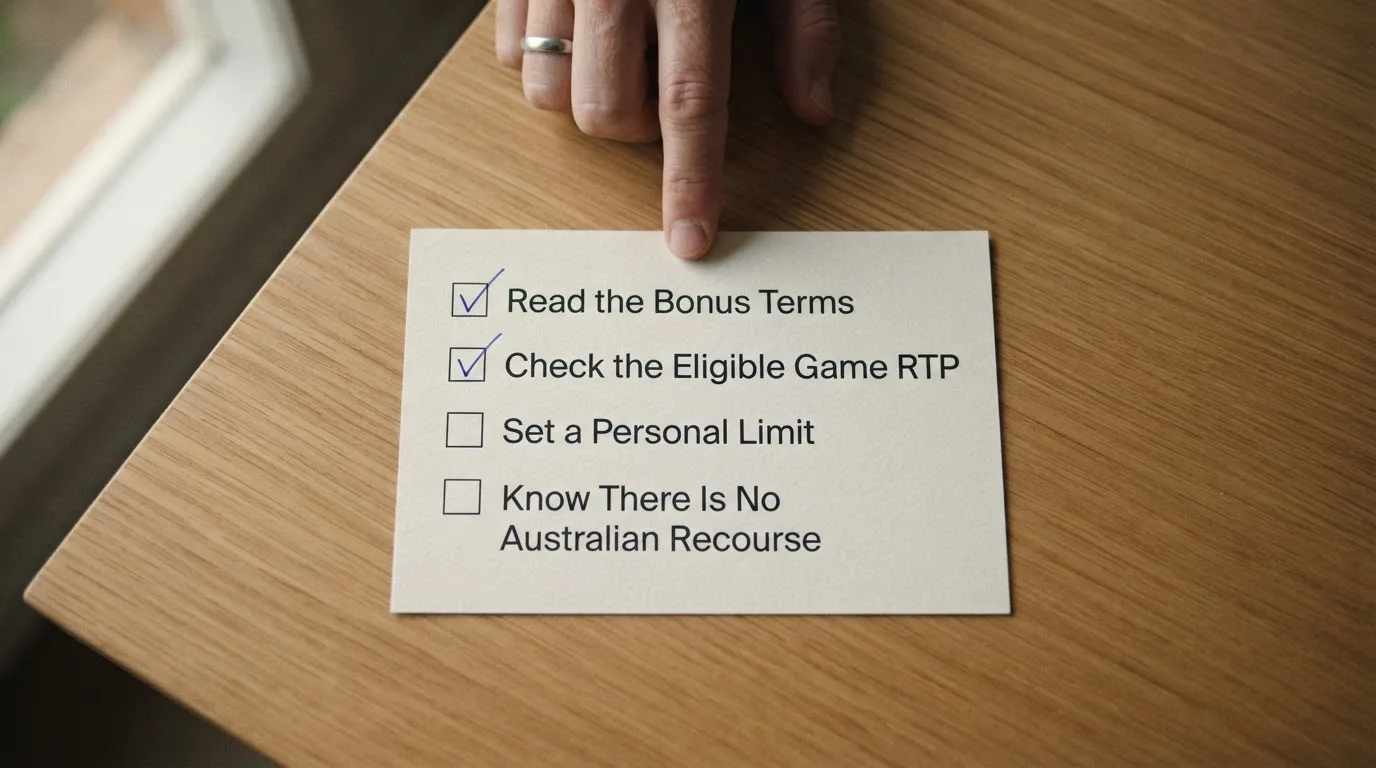
The four practical steps. Read the operator’s own Bonus Terms, not just the affiliate summary — BitStarz’s Section 1.6 is the case study in why the operator’s terms are the binding document. Check the eligible-game RTP — most NDB-eligible slots do not have an independently verified RTP in the public record, and BGaming allows operators to configure RTP as low as 94% on titles such as Elvis Frog in Vegas. Set a personal stop-loss even on a zero-deposit session — the bonus is free, but the player’s time is not, and the operator’s design is to extend the session toward the player’s first deposit. Know that no Australian complaints body will help if a withdrawal is refused — BetStop does not cover offshore casinos, no Australian regulator can compel an offshore casino to pay, and the operator’s own dispute process is the only path available.
The bonus is worth claiming as a trial. The bonus is not worth chasing as an income. The arithmetic is on the operator’s side; the only thing the player controls is how much they engage with the offer before walking away.
Frequently Asked Questions
How do wagering requirements work on a no-deposit bonus?
A wagering requirement is the multiplier the casino applies to the bonus before any winnings can be withdrawn. A 40x requirement on a A$10 free chip means the player has to stake A$400 in total across eligible games. At a 96.50% RTP pokie, the expected house edge across that turnover is roughly A$14. Standard wagering on offshore NDB offers runs from 30x to 50x; Pacific Spins offers 5x and Ozwin and PlayCroco offer 60x. The wagering is what the player pays, in expected house edge, to convert bonus money into withdrawable winnings.
What is the maximum amount I can withdraw from a no-deposit bonus?
The cap varies by operator and is set in the bonus terms. Skycrown publishes a A$150 cap on its 100 free-spin offer; BitStarz publishes €100 or A$150 depending on the source. Free-chip bonuses typically cap lower — A$50 to A$100 is common. The cap is the figure that turns a strong session into a withdrawable win; everything above it is forfeited. The cap is binding even when the wagering requirement has been met, which is why reading it before claiming matters.
Can I use a no-deposit bonus on any pokie, or only specific games?
Almost always on one specific game. Operators lock the free spins to a single named pokie — West Town at 7Bit, Buffalo Mania Deluxe at Heaps O Wins, Liberty Rockets at Pacific Spins. The eligible slot is the operator’s choice; the player has no choice. Free-chip bonuses typically allow a wider game set but the operator’s terms decide exactly where the credit can be staked. Always read the eligible-games list in the bonus terms before claiming — the single-game lock is one of the most consistently overlooked terms in NDB marketing.
Can I deposit with cryptocurrency at an Australian NDB casino?
Yes, at the offshore casino. Crypto deposits are not bound by the credit/crypto payment ban of 11 June 2024 — that ban applies to licensed Australian wagering operators, not to offshore casinos. From 1 January 2027, banks and payment providers gain express authority to block transactions to illegal gambling operators, which may include crypto transactions to offshore casinos. Crypto withdrawals at BitStarz clear within 0–1 hours; card and bank withdrawals take 1–5 business days. The Australian player is currently legal in funding the offshore account but exposed to the new enforcement machinery.
What happens to my balance if the ACMA blocks the casino I am playing at?
The casino becomes unreachable through Australian ISPs. The ACMA blocking record includes 1,751 illegal gambling and affiliate marketing sites since November 2019, with 12 more added in a recent action. Any balance sitting on the casino at the moment of blocking is stranded — the player cannot reach the site to withdraw, and the offshore casino is not bound by Australian law to release the funds. The balance may or may not survive a domain change; the operator’s own terms apply, and Australian regulators cannot compel payment. This is one of the structural risks of offshore play that BetStop does not address.
How do I know if an NDB casino is trustworthy or a scam?
There is no Australian regulator an offshore casino is answerable to, and no Australian complaints body that can compel payment. The check is one a player runs themselves: verify the licence number against the issuing regulator’s register; read the operator’s own bonus terms rather than the affiliate summary; search player forums for withdrawal complaints; check the domain age; verify the eligible-game RTP in the in-game help screen. No single check is conclusive; the cumulative absence of red flags is what the player is working with. The page describes the offer, not the operator’s reliability, and the two are different things.