
Casino VIP Programs for Australian Players: The Promise, the Terms, and the Law
Every casino VIP program pitched to an Australian player runs from offshore. No online casino anywhere in the country holds an Australian licence, because none exists — the Interactive Gambling Act 2001 prohibits it. The ten programs on the operator list below all sit offshore, and several hold a Curaçao licence; all are subject to the Australian Communications and Media Authority’s blocking power at the ISP level. What a VIP tier earns you in cashback is real. What an ACMA block takes from you in the same moment is also real, and no offshore operator is on the hook for it.
Data current as of 16 October 2026 and checked against ACMA’s register of blocked services and the Curaçao licence holders named in each operator section.
Table of Contents
- What a Casino VIP Program Actually Gives You — and What It Takes Back
- The Legal Reality Every Australian VIP Player Needs to Know
- The 10 VIP Casino Programs Australians Can Access in 2026
- RocketPlay — Dual-Tier VIP With Deposit Insurance and 91 Studio Partners
- SkyCrown — Points-Driven VIP Program With 3x Cashback Wagering
- Royal Reels — Offshore VIP Operator
- WinSpirit — Offshore VIP Operator
- Stake — Curaçao-Based VIP Platform
- Bizzo Casino — No-Wager Free Spins Across Five VIP Tiers
- Rainbet — Offshore VIP Operator
- Scream Casino — Offshore VIP Operator
- FairGO — Offshore VIP Operator
- Rocket Casino — Curaçao-Licensed, Previously ACMA-Blocked
- Why Your VIP Bonus Is Smaller Than the Headline Number
- VIP Pokies, Tables and Live Dealer: What You Can Actually Play
- Crypto VIP Casinos: Faster Withdrawals, Zero Australian Protections
- When the VIP Perk Becomes a Risk: Staying in Control
- How We Evaluated These VIP Casino Programs
- What the Numbers Say About Offshore VIP Programs — and Whether They’re Worth Your Risk
- Frequently Asked Questions
What a Casino VIP Program Actually Gives You — and What It Takes Back
A casino VIP program is a tiered loyalty scheme that rewards volume of play with progressively richer perks: higher cashback percentages, larger withdrawal ceilings, faster payouts, a personal account manager, bespoke bonus offers, and entry to closed tournaments. Standard loyalty schemes hand out a flat rate of comp points or a single cashback tier regardless of spend. VIP programs escalate that reward structure as the player climbs, on the logic that a high-volume player is worth more to the house than a casual one — and therefore worth more to keep.
The casino gets something in return: a player’s loyalty makes the player’s future play more predictable, and the cashback and bonus load attached to higher tiers is calibrated so that, on average, the player still loses more than the operator returns. Cashback is a fraction of losses, not a refund. The arithmetic is what the rest of this article is about.
The Australian context cuts against every other sentence in this paragraph. Online casino is prohibited to people in Australia under the IGA 2001, strengthened by the Interactive Gambling Amendment Act 2017. There is no Australian licence for online casino games, online pokies or in-play betting. The Northern Territory Racing and Wagering Commission issues licences for sports and racing wagering, not for casino games. The individual player is not prosecuted under the Act — it targets the provider — but playing offshore means forfeiting BetStop coverage, consumer protection, and any formal dispute route if a withdrawal is refused or a balance disappears. Every VIP program that markets to Australians is, by definition, an offshore operation.
How Casino VIP Tiers and Point Systems Actually Work
Tier ladders vary by operator, but the shape is consistent: an entry tier, three to seven middle tiers, and one or two elite tiers at the top. The number of levels matters less than what each level unlocks and how the player progresses through it.
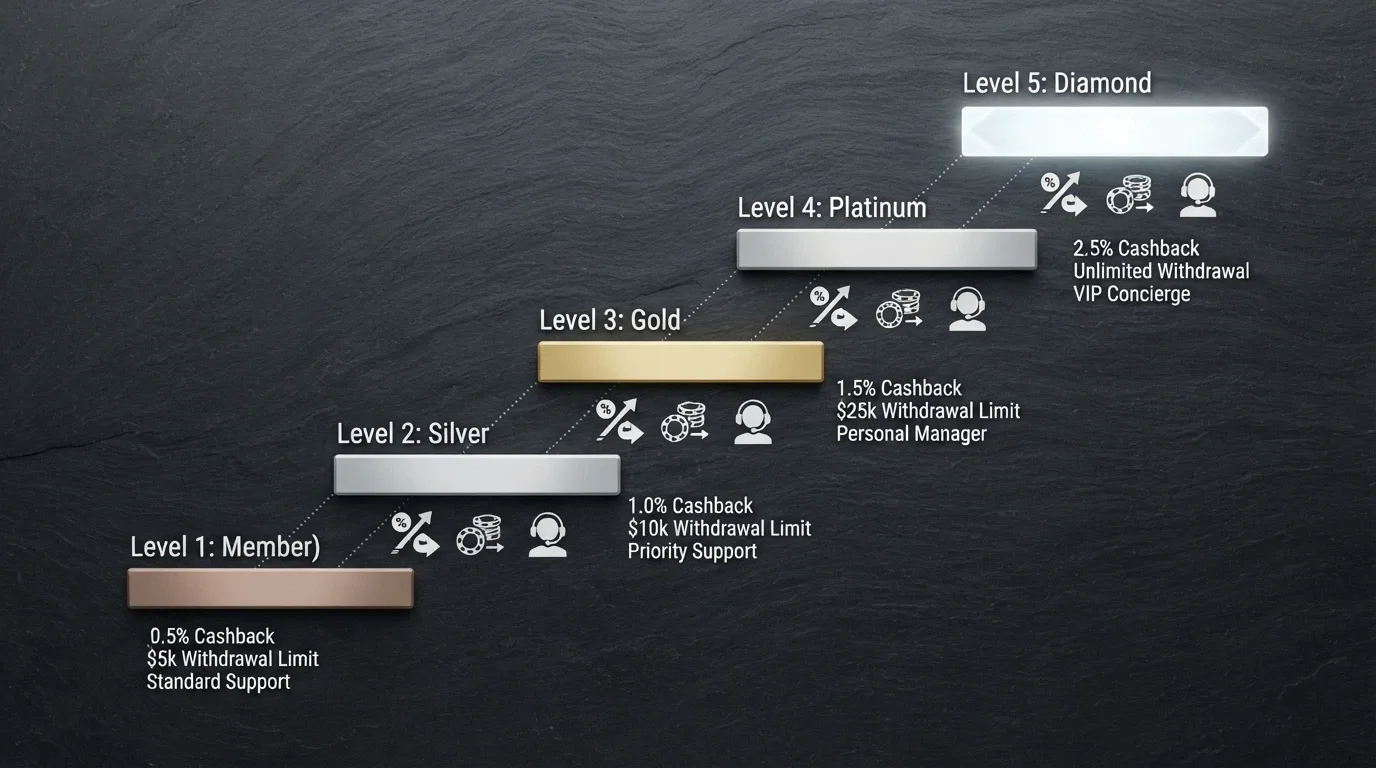
SkyCrown runs a 10-level structure. The earn rate is straightforward: A$15 wagered on pokies or live dealer games earns 1 Comp Point. A pokie player turning over A$15,000 in a month banks 1,000 Comp Points. What those points convert into at each level is published on the operator’s VIP page, and the level-up thresholds rise steeply through the upper tiers.
RocketPlay splits its ladder into two parallel tracks. The Lifetime track runs Quark through Alloy and never expires — once you reach a level, it stays reached. The Seasonal track runs Bronze to Diamond and resets every three months, so a player who fails to maintain the required XP can drop back down. The first rung on the Seasonal track, Bronze, requires enough play to accumulate the entry XP, and the Iron threshold sits at 15,000 XP. The dual-track design gives the player one stable rung under their feet while keeping seasonal pressure on them to keep wagering.
The distinction between lifetime and seasonal tiers is more than cosmetic. A lifetime tier protects a player who takes a break. A seasonal tier punishes one. A player who wants predictability and not pressure should look for lifetime-only structures; a player chasing the highest seasonal perk should expect to keep wagering through the season or lose it.
The earn rate is where the cost of climbing becomes visible. A$15 wagered for 1 CP at SkyCrown means a player needs to bet A$225,000 to bank 15,000 CPs — and that is before any of it is converted to a perk that has actual cash value. Comp points are not dollars. They are the casino’s own unit of account, redeemable at rates the operator sets and the player does not control.
Comp Points, Status Levels and How Operators Calculate Your Worth
Comp points and tier points are not the same thing, even when a casino calls them by one name. SkyCrown’s Comp Points are redeemable — they convert to bonus credit or cash at published rates. Tier points are the meter that moves the player up the ladder. Some operators fuse the two: every dollar played earns a single point that both moves the tier and converts to a perk at higher levels. Others separate them, so a player’s tier position and their comp-point balance diverge.
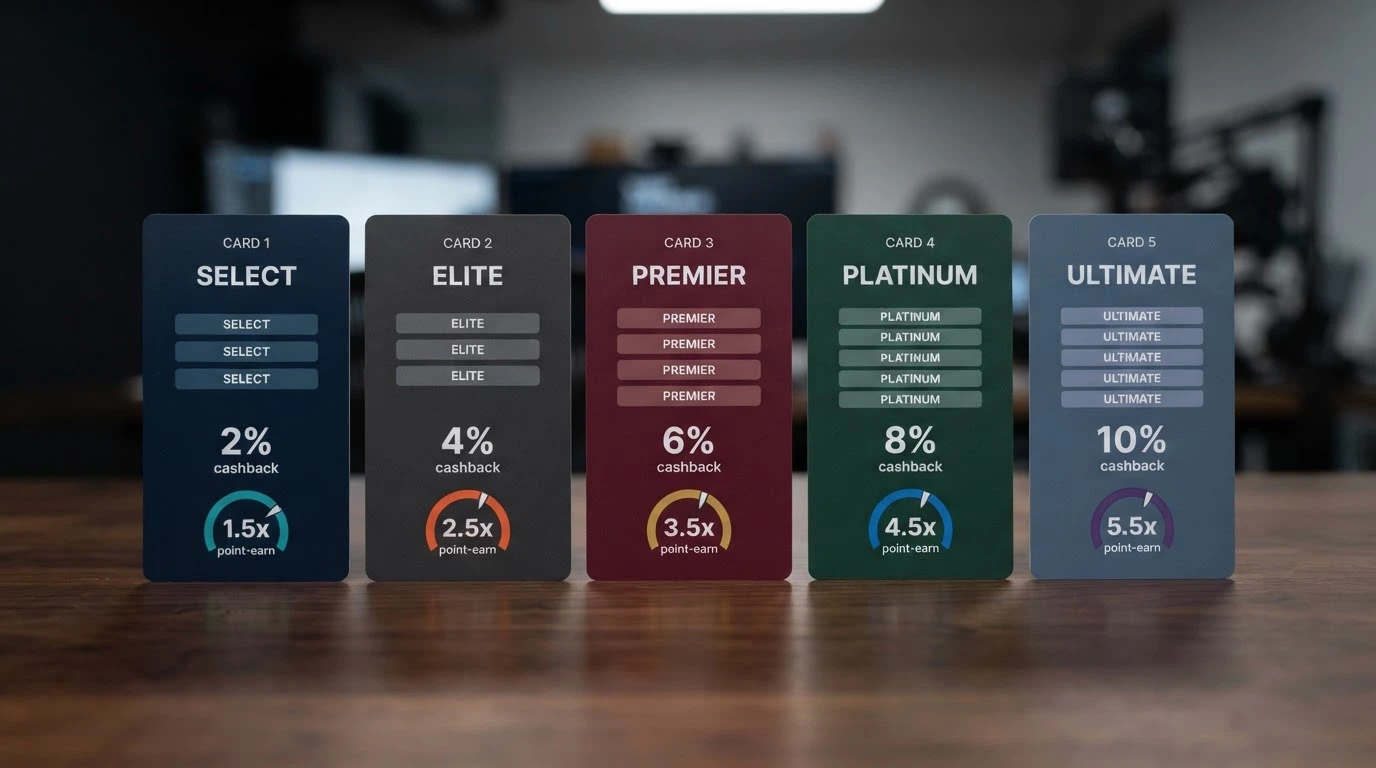
The arithmetic behind VIP status is the casino’s quantification of your value, not yours. Operators track cumulative deposits, lifetime wagering, or a combination of the two, and assign tiers from those numbers. The earn-rate spread — the gap between what a low-tier player earns per A$100 wagered and what a top-tier player earns — is the operator’s way of pricing the player’s continued play. A spread of 0.5% to 2% of turnover, paid back as cashback, means a player churning A$500,000 a year is worth A$2,500 to A$10,000 in cashback at the high end. The same player likely lost several times that on the way up.
How a player’s tier tracks cumulative deposits versus lifetime wagering matters because the two are different exposures. A deposit-based tier rewards the size of bankrolls handed over. A wager-based tier rewards volume of play, regardless of how the bankroll is topped up. A wager-based ladder escalates faster for the same dollar value because every spin counts.
VIP Clubs, Lounges and the Venue-Style Perks Online Casinos Mimic
The “club” language — VIP lounge, VIP room, members-only floor — is borrowed from the physical casino floor, where a high roller walks past a velvet rope into a quieter room with higher-limit tables and a host who knows their name. Online, the same language refers to a login portal, a tier badge in the player’s account dashboard, and a section of the lobby they did not see at the standard tier.
What online operators actually replicate from the venue experience is narrower than the marketing suggests: priority support, exclusive tournaments, faster withdrawals, and a higher withdrawal ceiling. A handful of brands offer something more direct: Slotozen and Slots Gallery let a player pay between A$300 and A$1,500 to immediately unlock basic VIP advantages, including 24-hour support, higher withdrawal ceilings, and tournament entry. The paid-entry model is the closest an offshore VIP program comes to the physical-club metaphor: a fee at the door, perks on the other side.
The VIP dashboard is the online equivalent of the physical room. It shows current tier, points balance, progress to the next level, and the perks attached to each rung. Where the dashboard gets thin — and several operators leave it thin — is in the disclosures: cashback rates published in the account area may differ from the headline on the promotions page, and tier thresholds are sometimes hidden behind opaque XP formulae.
Personal Account Managers — What They Do and When You Qualify
A personal account manager, sometimes called a dedicated host or VIP concierge, is the player-facing representative of the VIP program. In practice, the manager handles bonus offers tailored to the player’s recent activity, escalates withdrawal requests ahead of the standard queue, fields complaints the live chat will not, and acts as a single point of contact instead of a rotating cast of support agents.
The tier at which a manager appears varies. Some operators assign one at the second or third rung. Others reserve a manager for the top two tiers only, leaving the bulk of the ladder unsupported. The presence of a manager is a signal of player value to the operator, not of value to the player — a manager exists because the operator wants to keep a high-volume player from drifting to a competitor, and the perks that come with one are calibrated accordingly.
A player who does not yet qualify for a manager is not necessarily missing out. The dedicated host is most useful when withdrawals stall, when bonus terms read ambiguously, and when the player is moving enough volume that the standard support queue delays matters. A low-volume player will rarely hit those cases.
VIP Login, Account Dashboards and Tracking Your Progress
The VIP login is the same login as the standard casino account. What differs is what the dashboard shows once the player is inside: a tier badge, a points meter, the perks attached to the current level and the next, and sometimes a tab for exclusive promotions. Some operators segment the lobby so that VIP-eligible games appear first, or that certain tournaments are visible only to players above a threshold.
From an Australian player’s seat, the offshore VIP dashboard is reached through the same browser-based access they would use for the standard site. The ACMA’s blocking power extends to the operator’s domain, so a blocked site will not load — and a blocked site leaves the VIP balance inside it inaccessible, regardless of what the dashboard would show. That point belongs in the legal section below; it is raised here because the dashboard is where a player would otherwise check on a balance.
The Legal Reality Every Australian VIP Player Needs to Know
The VIP perks are not the reason this section exists. The reason is that every operator on this page sits outside the Australian regulatory perimeter, and every fact about tier mechanics has to be read against that fact.

The Interactive Gambling Act: Why No Online Casino Holds an Australian Licence
The Interactive Gambling Act 2001 makes it an offence to provide online casino games, online pokies or in-play sports betting to a person in Australia. The Interactive Gambling Amendment Act 2017 strengthened the prohibition and extended it to online in-play wagering. There is no Australian licence for any of those products. What is licensed is wagering on races and sport placed before the event begins, lotteries, and keno — through operators licensed by a state or territory, with the Northern Territory Racing and Wagering Commission as the de facto national licensor for online wagering.
Casino games are a different product. The Northern Territory Racing and Wagering Commission does not issue a casino-game licence because no such licence category exists. Sportsbet, bet365, Ladbrokes and the rest of the licensed Australian bookmakers are licensed for wagering only; their platforms do not offer online casino or pokies. The online casino product that an Australian player reaches through an offshore VIP program has no Australian licensing counterpart.
The Act targets the provider, not the player. An Australian player opening an offshore casino account is not prosecuted. The risk the player carries is the consumer-protection gap: no Australian dispute resolution, no fund segregation, no BetStop coverage, no formal complaint route, and the standing possibility that the operator is added to the ACMA’s blocked-sites list.
The Northern Territory’s tax regime on licensed wagering — a 5% wagering tax plus a 0.05% racing levy — and the state point-of-consumption taxes of 10–15% of net wagering revenue apply only to licensed wagering operators. The offshore casino operators in this article pay none of these taxes to any Australian jurisdiction. That is one of the costs the licensed wagering sector carries and the offshore casino sector does not.
ACMA Enforcement, Site Blocks and What They Mean for Your VIP Balance
The ACMA has blocked 1,564 illegal gambling and affiliate websites since November 2019. More than 225 illegal services have withdrawn from the Australian market since enforcement was strengthened in 2017. The blocking power sits in section 313 of the Telecommunications Act 1997, exercised by the ACMA through Australian internet service providers. A blocked site is unreachable from an Australian IP address, and the block is not lifted by changing device, browser, or connection — it is enforced at the network level.
The practical consequence for a VIP player is straightforward. A balance held at a blocked site is not retrievable through the Australian consumer-protection system, because no Australian regulator has jurisdiction over the operator. The player cannot escalate to the ACMA, because the ACMA’s role is to block, not to arbitrate. The player cannot approach an Australian dispute resolution service, because no Australian dispute resolution service has standing with a Curaçao-licensed operator. What the player can do is pursue the operator through whatever dispute channels the operator itself publishes, if any. That is the limit.
From 1 January 2027, banks and payment providers gain express authority to block transactions to illegal gambling operators under the 2026 Gambling Reform Bill. The bank-blocking power sits beside, not in place of, the ACMA’s ISP-level blocking. A player whose bank declines a transfer to a flagged operator will not have that transfer quietly reversed — they will be unable to fund the account at all from that bank.
The 2026 reform’s other payment measure predates it. Credit cards, credit-related products, and digital currency have been banned as payment for online wagering since 11 June 2024. Penalties for non-compliance reach A$247,500. An offshore casino asking for a credit card or a crypto deposit is serving a payment method that Australian rules do not permit — and a player using one is on the wrong side of that rule.
The 10 VIP Casino Programs Australians Can Access in 2026
The ten operators below were chosen because they sit in the set Australian players can reach. They were not chosen because they are the safest or the best, because the underlying market is prohibited and every name on the list is offshore. What separates one from the next is what each operator’s published VIP terms actually say, and what research confirmed from publicly available sources.
| Operator | Australian casino licence |
|---|---|
| RocketPlay | No — Curaçao OGL/2024/1307/0748 |
| SkyCrown | No — Curaçao OGL/2023/176/0095 |
| Royal Reels | No — offshore, not Australian-licensed |
| WinSpirit | No — offshore, not Australian-licensed |
| Stake | No — Curaçao-licensed, offshore |
| Bizzo Casino | No — offshore, not Australian-licensed |
| Rainbet | No — offshore, not Australian-licensed |
| Scream Casino | No — offshore, not Australian-licensed |
| FairGO | No — offshore, not Australian-licensed |
| Rocket Casino | No — Curaçao 8048/JAZ2019-015, previously ACMA-blocked 2023 |
How to Compare VIP Programs: The Criteria That Actually Matter
The welcome-bonus headline is the easiest number to find and the least useful one to compare. A 100% match up to A$1,000 with 40x wagering is not the same product as a 100% match up to A$1,000 with 20x wagering, and the difference is what the player will actually spend to clear it. For VIP-specific value, the comparison framework is shorter and sharper.
Cashback percentage and the wagering multiple attached to it are the two numbers that determine real VIP value. SkyCrown’s VIP Weekly Cashback is 10% up to A$1,500 on pokie losses with 3x wagering. RocketPlay’s VIP weekly cashback scales from 7% at Iron to 10% at Diamond, with 5x wagering, capped at EUR 5,000. A higher headline percentage paired with a higher wagering multiple can cost more than a lower percentage with a lower multiple, because the cashback itself has to be played through before it is withdrawable.
Tier transparency is the second filter. SkyCrown publishes its 10-level ladder and the earn rate; RocketPlay publishes both Lifetime and Seasonal tracks and the Iron threshold at 15,000 XP. Operators that hide tier thresholds behind opaque XP formulae or that do not publish the perk attached to each level are asking the player to climb a ladder they cannot see the top of.
Withdrawal limits at VIP tiers are the third filter. RocketPlay’s standard withdrawal ceiling is A$9,000 per week and A$35,000 per month, with enhanced limits for VIP members. The enhanced ceiling is where VIP status pays off for high-volume players, and an operator that does not publish the VIP-specific ceiling is asking the player to find out at the moment of withdrawal.
Licence quality is the fourth. A Curaçao licence does not provide the fund segregation, dispute resolution, or formal complaint route that an MGA or UKGC licence does. The Curaçao-licensed operators in this article are not bad operators by default; they are operators whose regulatory perimeter does not extend to Australian consumer protection.
RocketPlay — Dual-Tier VIP With Deposit Insurance and 91 Studio Partners
RocketPlay runs on a Curaçao licence (OGL/2024/1307/0748, Curaçao Gaming Authority), owned by Scores55 Tech B.V. and established in 2020. The platform carries games from 91 providers including NetEnt, Pragmatic Play, Evolution Gaming, Play’n GO, Nolimit City, Yggdrasil, Big Time Gaming, and Blueprint. That depth is what makes the VIP program worth comparing on substance rather than marketing.
The dual-tier structure is the program’s distinctive design. Lifetime levels run Quark through Alloy and never expire; Seasonal levels run Bronze to Diamond on a three-month expiry and can drop. The first rung of the Seasonal track requires enough play to reach entry XP, and the Iron threshold sits at 15,000 XP. A player building a steady presence at RocketPlay should treat the Lifetime track as their stable position and the Seasonal track as the upside they maintain.
Weekly cashback scales from 7% at Iron to 10% at Diamond, with a 5x wagering requirement and a maximum payout of EUR 5,000 or currency equivalent. The 5x multiple on cashback is materially lower than the 30x–40x multiple on the welcome bonus, which is what makes the cashback the more achievable recurring perk.
Daily loss rebates run alongside the cashback and are the more unusual feature. From VIP Bronze, the program covers up to 25% of daily losses back to the player, with thresholds of A$1,000 at Bronze, A$1,500 at Silver, and A$2,000 at Gold and Diamond. Loss rebates are structured differently from cashback: they kick in on a daily basis rather than weekly, and the coverage ceiling is what the player can recover on a single bad day rather than over a week.
The bonus terms place a hard cap on how fast a player can clear wagering: the maximum bet during wagering is A$7.50, and the cashback activation window is three days after credit. Both limits are standard for the offshore market but worth treating as the actual speed limit on bonus clearance.
Standard withdrawal limits sit at A$9,000 per week and A$35,000 per month, with enhanced limits for VIP members — the exact VIP ceiling is published inside the VIP dashboard rather than on the public terms page, which means a high-volume player should confirm the figure with support before assuming the standard ceiling applies.
For an Australian player: RocketPlay is the most comprehensively documented VIP program in the featured set, with a clear two-track ladder, a published cashback range, a daily insurance feature that few competitors offer, and a Curaçao licence that does not extend Australian consumer protection. The right reader is one who wants the depth of a published ladder and can live without Australian recourse. The wrong reader is anyone uncomfortable playing offshore at all.
SkyCrown — Points-Driven VIP Program With 3x Cashback Wagering
SkyCrown operates under Curaçao Gaming Control Board licence OGL/2023/176/0095 and runs a library of around 7,000 titles from studios that include NetEnt, Pragmatic Play, Evolution Gaming, Play’n GO, and Yggdrasil. The library size puts it in the upper tier of the featured set, and the VIP program is designed to match it.
The Comp Points ladder runs 10 levels with an earn rate of A$15 wagered on pokies or live dealer games earning 1 CP. A player turning over A$15,000 in a month banks 1,000 Comp Points, and what those points convert into at each level is published on SkyCrown’s VIP page. The earn rate is mid-range for the offshore market; what sets SkyCrown apart is what the points unlock.
The VIP Weekly Cashback is the standout figure. SkyCrown offers 10% cashback up to A$1,500 on pokie losses with 3x wagering — against the standard Weekly Sky Cashback at the same 10% up to A$1,500 but with 10x wagering. The 3x multiple on the VIP version is materially lighter than the 5x–10x range common across offshore competitors and is the cleanest cashback wagering figure in the featured set. The qualifying thresholds are also tighter at the VIP tier: a minimum A$150 cumulative weekly deposit against the standard A$45.
The welcome package is a different product. The 4-tier offer stacks to A$8,000 plus 400 free spins, with the first deposit at 120% up to A$1,200 plus 125 free spins on a minimum A$30 deposit. Wagering across the package runs at 40x on bonus and free spins. The 40x multiple is the upper end of the market range and is the figure the calculation section below works against.
For an Australian player: SkyCrown is the operator to pick if cashback terms are the deciding factor. The 3x VIP multiple is the best documented in the featured set, the cashback ceiling is high, and the published earn rate makes tier progression visible. The trade-off is the welcome package’s 40x wagering, which is steep against the rest of the market.
Royal Reels — Offshore VIP Operator
Royal Reels sits in the Australian-accessible offshore market without holding an Australian licence. The brand’s positioning in the offshore space has been documented through the standard affiliate and review channels, but the VIP-specific terms — tier structure, cashback rates, wagering multipliers, withdrawal ceilings — were not confirmed from the sources reviewed for this article. What this means in practice is that a player considering Royal Reels cannot rely on a third-party comparison for the VIP program details and should read the operator’s own published VIP terms at the point of sign-up rather than rely on a fixed summary.
The absence of confirmed VIP specifics is not the same as the absence of a VIP program. Offshore brands in this tier almost universally run some form of tiered loyalty scheme; what differs is whether the terms are published clearly, whether the tiers have published thresholds, and whether the cashback and bonus terms are auditable from outside the player account.
For an Australian player: Royal Reels is a candidate brand for the reader who wants an offshore option and is willing to verify the VIP terms directly with the operator. The right reader is one who treats the absence of third-party confirmation as a flag to ask, not as a disqualifier.
WinSpirit — Offshore VIP Operator
WinSpirit sits in the same offshore-accessible set as Royal Reels. No Australian licence is held. The brand’s presence in the Australian-facing market is documented, but the VIP program specifics — tier count, earn rate, cashback percentage, wagering terms, withdrawal ceiling — were not confirmed from the sources reviewed here.
The pattern is familiar: a brand with a recognised name in the offshore market, running some form of loyalty scheme, whose specific terms live inside the operator’s own published pages rather than in third-party comparison material. The implication for an Australian player is the same as for any operator in this group — read the current terms on the operator’s VIP page at the moment of sign-up, and confirm the cashback and wagering figures before claiming anything that depends on them.
For an Australian player: WinSpirit suits the reader who is comfortable with the offshore market and willing to verify terms directly. The verdict is a caveat, not an endorsement — what can be said from the reviewed sources is limited, and the operator’s own current terms are the authoritative source.
Stake — Curaçao-Based VIP Platform
Stake is the best-known brand in this set outside the Australian-facing comparison pages. The operator runs on a Curaçao licence, sits firmly in the offshore market, and is not licensed for any Australian casino product. Stake’s brand recognition rests on its crypto-native platform and its high-profile sponsorships across sport and streaming. What those recognitions do not tell an Australian player is the VIP program’s specific terms, which were not confirmed from the sources reviewed here.
The crypto-native positioning matters in two directions. Stake accepts cryptocurrency as a payment method, which places it on the wrong side of Australia’s 11 June 2024 ban on digital currency as a payment for online wagering. An Australian player depositing crypto at Stake is in breach of that rule, and the operator accepting the deposit is exposed to the A$247,500 penalty regime. The crypto angle is also where the VIP tier mechanics meet the KYC question: a crypto-first platform pushes identity verification later in the player journey, but VIP tiers with enhanced withdrawal ceilings will require verification before the higher limits are unlocked. The promise of crypto anonymity runs into the limits of the tier structure.
For an Australian player: Stake is the brand in this set whose recognition outpaces its verifiable VIP details from outside sources. The right reader is one who treats the brand’s reputation as a starting point and the operator’s own current terms as the deciding document — and who accepts that the crypto payment method is not available for Australian wagering under current rules.
Bizzo Casino — No-Wager Free Spins Across Five VIP Tiers
Bizzo’s distinguishing feature in the VIP space is the no-wagering free spins structure: up to 255 free spins across the first five VIP tiers, with no wagering requirement attached to winnings from those spins. Free spin winnings land as cash, not as bonus credit. Against the rest of the featured set, where free spin winnings typically carry 30x–40x wagering, the no-wager design is the cleanest free-spin offer on the list.
What sits alongside the no-wager spins is less documented. The cashback percentage, tier thresholds, wagering multiple, and VIP withdrawal ceiling are not publicly listed for Bizzo. The multi-tier structure is implied by the “first 5 VIP tiers” reference, but the level names, XP thresholds, and perk escalation curve were not publicly available for confirmation.
The contrast with SkyCrown is sharp. SkyCrown’s VIP cashback is 10% with 3x wagering; Bizzo’s free spins carry zero wagering. Both are cleaner than the 30x–40x market standard, but they sit on different sides of the cashback-versus-spins divide. A player whose VIP value comes from cashback will weight SkyCrown’s offer more heavily; a player whose VIP value comes from free spin volume will weight Bizzo’s.
For an Australian player: Bizzo is the right pick for the reader who values no-wager free spins more than cashback or tier perks. The right reader is one who understands that the no-wager feature is documented but the surrounding VIP terms are not, and who will read the operator’s current terms before treating the offer as fixed.
Rainbet — Offshore VIP Operator
Rainbet sits in the Australian-accessible offshore market without an Australian licence. Brand presence is documented, but the VIP program details—including tier count, earn rate, cashback, and wagering—remain unverified by third-party sources. The standard offshore pattern applies: a loyalty scheme almost certainly exists, the specifics live inside the operator’s own pages, and third-party verification from outside the player account is not available at the time of writing.
The reader who chooses an operator on the basis of a comparison table is making a decision without a full data set. The right move with Rainbet, as with the other operators in this group, is to verify the published terms at the moment of sign-up and to treat any specific figure quoted from a third party as a snapshot rather than a current commitment.
For an Australian player: Rainbet is a candidate for the reader who has shortlisted the brand independently and is willing to verify terms directly. The verdict sits in the same place as the other “not confirmed” operators — a brand in the market, not a recommendation.
Scream Casino — Offshore VIP Operator
Scream Casino operates offshore and is accessible to Australian players without holding an Australian licence. The VIP program specifics — tier structure, cashback, wagering terms, withdrawal ceilings — were not confirmed from the sources reviewed here. Brand presence in the offshore market is documented through standard affiliate channels.
The absence of confirmed VIP terms places Scream Casino alongside the rest of the “not confirmed” group on this page. The advice is the same: read the operator’s own published VIP terms at the point of sign-up, confirm the cashback rate and wagering multiple before claiming any bonus tied to those terms, and recognise that third-party comparison material cannot substitute for the operator’s own current document.
For an Australian player: Scream Casino is a name in the offshore market, not a recommended pick. The right reader is one who treats the absence of confirmed VIP terms as a reason to ask, not as a reason to dismiss.
FairGO — Offshore VIP Operator
FairGO is an offshore casino brand accessible to Australian players without holding an Australian licence. The brand positions itself in the offshore market with Australian-facing marketing. VIP program specifics — tier count, earn rate, cashback percentage, wagering terms, and withdrawal ceilings — were not confirmed from the sources reviewed here.
The pattern holds across this group of operators. What can be said is the licensing status and the brand’s presence in the market. What cannot be said from the reviewed sources is the VIP program’s specific shape. The third-party comparison material that exists for FairGO covers the welcome offer and the game library rather than the VIP terms.
For an Australian player: FairGO is the candidate brand for the reader who is already familiar with the operator and willing to verify VIP terms directly. The verdict is the same caveat that runs through the rest of this group — what is verified is limited, and the operator’s own current terms are the source that matters.
Rocket Casino — Curaçao-Licensed, Previously ACMA-Blocked
Rocket Casino sits under Curaçao registration 144359 (Hollycorn N.V.) and an Antillephone licence (8048/JAZ2019-015), which was active as of October 2024. The platform carries over 3,000 titles from studios including BGaming, IGTech, Belatra, Yggdrasil, and Playtech. The library size is solid for the offshore market.
The ACMA blocking history is the relevant Australian-facing fact. Rocket Casino appeared on the register of blocked illegal gambling websites in 2023. A site that has been blocked once can be blocked again, and the operator’s domain is reachable from an Australian IP only when the ACMA has not added the current URL to the block list. The balance a player holds at the operator when a block is in place is governed by the same rule that governs every other offshore balance: no Australian dispute resolution, no fund segregation, and no guarantee that the operator’s published withdrawal terms survive a block.
VIP program specifics—including tier structure, cashback, wagering, and withdrawal ceilings—are not publicly documented. The Antillephone licence and the ACMA blocking history are documented; the VIP terms are not.
For an Australian player: Rocket Casino is the operator in this set with the clearest “buyer beware” signal — a published ACMA blocking history is not the same as a current block, but it is a record that any Australian player should weigh before depositing. The right reader is one who understands that a previously blocked site is a known example of exactly what ACMA enforcement can do, and who is willing to verify the operator’s current VIP terms directly.
Why Your VIP Bonus Is Smaller Than the Headline Number
A headline figure of A$8,000 plus 400 free spins is what a player sees on the welcome-bonus tile. What the player actually receives is a conditional liability: bonus credit locked behind a wagering multiple, a maximum bet cap during play, and a bonus-validity window that closes whether the player has cleared the requirement or not. The headline is the marketing layer. The wagering term is the real product.
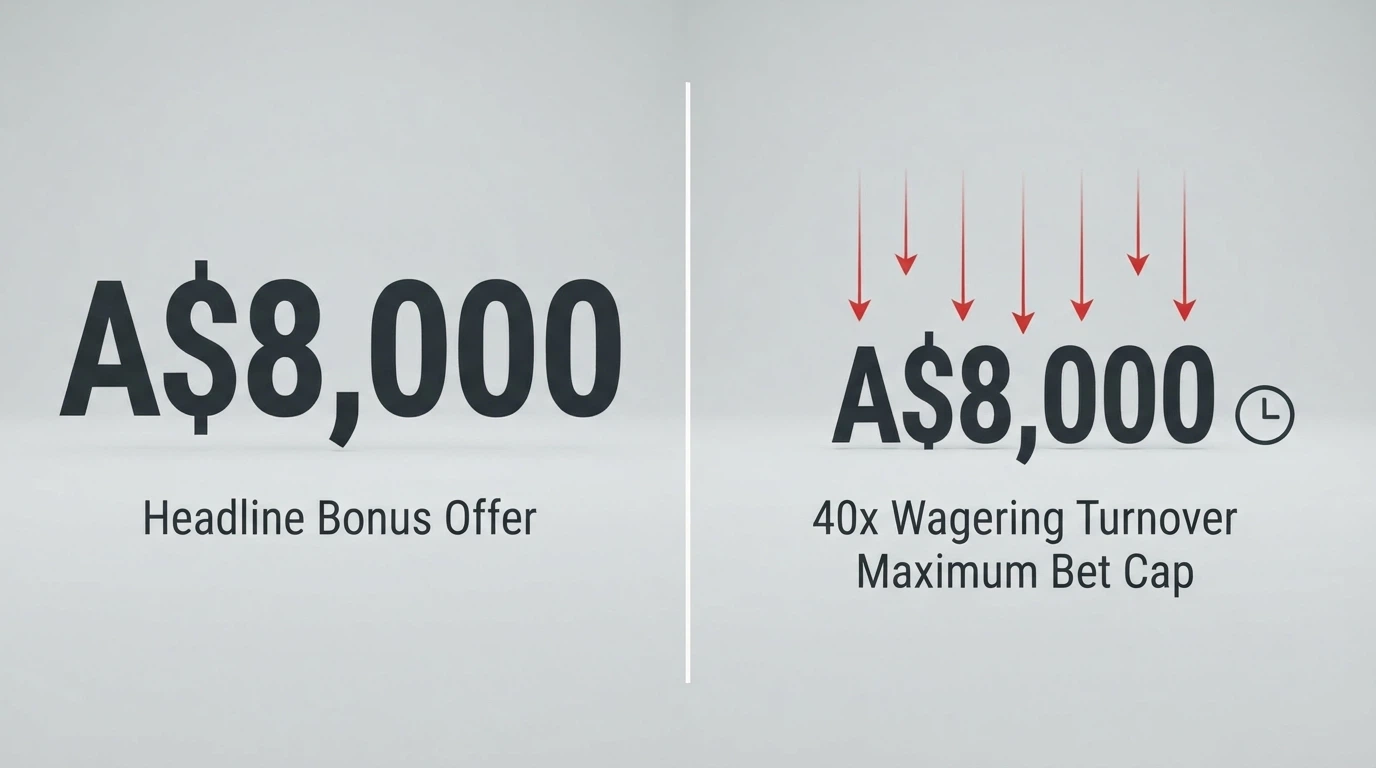
SkyCrown’s 4-tier welcome package stacks to A$8,000 plus 400 free spins at 40x wagering across the board. The first deposit alone — 120% up to A$1,200 plus 125 free spins — sits behind the same 40x multiple. The first deposit’s bonus of A$1,200 against a A$1,000 deposit requires the player to wager A$1,200 × 40 = A$48,000 in bonus turnover, plus the deposit in some configurations, before the bonus converts to withdrawable cash. At the industry-standard max bet of A$7–A$10 during bonus play (the average is A$8), that A$48,000 turnover represents roughly 4,800 to 6,000 individual bets, each capped at A$7.50–A$10. The clearance time at five seconds per spin runs to six to nine hours of continuous play.
The cashback figure does not behave the same way. SkyCrown’s VIP Weekly Cashback runs at 10% up to A$1,500 with 3x wagering, against the standard Weekly Sky Cashback at the same 10% up to A$1,500 but with 10x wagering. A player who has lost A$1,500 on pokies in a week and claims the VIP cashback has to wager A$1,500 × 3 = A$4,500 before the A$1,500 cashback converts to withdrawable cash. The same player on the standard cashback has to wager A$15,000. The 3x multiple is what makes the VIP cashback achievable; the 10x multiple is what makes the standard version largely cosmetic.
RocketPlay’s VIP cashback scales from 7% to 10% at 5x wagering, capped at EUR 5,000. The 5x multiple sits between SkyCrown’s VIP and standard figures. RocketPlay’s daily deposit insurance runs without a documented wagering requirement, which makes it the cleanest recurring perk in the featured set for a player who treats insurance as cash-equivalent recovery rather than bonus credit.
Bizzo’s 255 no-wager free spins across the first five VIP tiers is the clearest contrast. Free spin winnings at Bizzo’s VIP structure land as cash, not as bonus credit. The 30x–40x wagering that would normally apply to free spin winnings is removed entirely. The trade-off is volume — 255 spins is a finite number, and the per-spin value is constrained by the game and bet size — but the wagering arithmetic is what makes the offer legible.
The A$300 to A$1,500 paid VIP entry at Slotozen and Slots Gallery is the alternative model: a player pays for the perks directly rather than earning them through volume. A A$1,500 entry fee in exchange for immediate access to 24-hour VIP support, higher withdrawal ceilings, and tournament entry is a different shape of transaction from the earn-through-play ladder.
| Bonus type | How it works | Typical wagering in featured set | Best example found |
|---|---|---|---|
| Match deposit (welcome) | Operator matches your deposit by a percentage up to a cap | 30x–40x on bonus + deposit | SkyCrown 4-tier up to A$8,000 + 400 FS at 40x |
| Free spins | A fixed number of spins on a nominated pokie, winnings paid as bonus or cash | 30x–40x on winnings, where applicable | Bizzo 255 FS at 0x across first 5 VIP tiers |
| Weekly cashback (VIP) | Percentage of net losses on pokies returned as bonus credit | 3x–5x on the cashback amount | SkyCrown VIP 10% up to A$1,500 at 3x |
| Daily deposit insurance | Up to a capped percentage of daily losses returned without further wagering | 0x (no wagering) where published | RocketPlay up to 25% from Bronze (A$1,000–A$2,000) |
| Paid VIP entry | A flat fee unlocks a tier of perks without volume of play | N/A — fixed entry fee | Slotozen / Slots Gallery A$300–A$1,500 |
Match Deposits, Free Spins and Cashback: How VIP Bonus Types Differ
The three bonus formats do not cost the same to clear, and the difference is large. A 120% match deposit up to A$1,200 at 40x wagering on the bonus alone requires A$48,000 in turnover. The same match at 40x on bonus-plus-deposit requires A$88,000 — close to double. Operators state the base of the wagering in the bonus terms; a player who skips that line is running the arithmetic against the wrong number.
Free spins divide cleanly into two camps: those that pay winnings as bonus credit (subject to wagering) and those that pay winnings as cash (no wagering). Bizzo’s no-wager VIP free spins sit in the second camp. The SkyCrown welcome’s 400 free spins, by contrast, carry the same 40x wagering as the match deposit. The wagering treatment is what makes the difference; the headline spin count is secondary.
Cashback and loss rebates are the VIP-specific formats that carry the lowest wagering load. SkyCrown’s 3x VIP cashback, RocketPlay’s 5x VIP cashback, and RocketPlay’s no-wager daily loss rebates are all materially lighter than the welcome bonus’s 30x–40x. The reason is straightforward: cashback and loss rebates are paid on losses already incurred, and the operator’s cost is a fraction of the player’s net loss rather than a fresh liability. The bonus headline number is smaller, but the cost-to-clear ratio is what matters.
Wagering Requirements and Why They Eat Your Bonus Before You See a Dollar
Wagering applies in two configurations: on the bonus alone, or on bonus-plus-deposit. The two configurations look similar in the bonus terms and behave very differently in arithmetic. A 40x multiple on a A$1,200 bonus alone is A$48,000 turnover. A 40x multiple on the A$2,200 bonus-plus-deposit is A$88,000 turnover. Operators state the base in the terms; the player should confirm it before assuming the figure is for one or the other.
The max-bet cap during wagering is the speed limit. Most Australian-accessible casinos cap the maximum wager per hand during active bonus play at around A$7–A$10, with an average around A$8. RocketPlay’s published maximum is A$7.50. At A$7.50 per spin, a A$48,000 turnover requirement is 6,400 individual spins. At five seconds per spin, that runs to 32,000 seconds, or about 8.9 hours of continuous play, before the bonus converts.
RocketPlay’s 3-day cashback activation window is the third pressure point. The player has three days from the cashback being credited to start the wagering; if the wagering is not started in that window, the cashback expires. The window is tight against a 5x wagering requirement that requires sustained play to clear, and the practical effect is that some players forfeit cashback they would otherwise clear because they did not return to the platform within the activation window.
The expected-loss calculation is the figure that tells the player what the welcome bonus actually costs. Working through SkyCrown’s 4-tier welcome package: a player who takes the full A$8,000 bonus and 400 free spins at 40x wagering, playing through the bonus at a NetEnt-average RTP of 96.39%, faces an expected loss of A$8,000 × 40 × (1 − 0.9639) ≈ A$11,520. The A$8,000 bonus costs the player roughly A$11,520 in expected loss over the turnover required to clear it, before any of the bonus itself is withdrawable. That figure is a statistical estimate — an average over many spins under the stated assumptions, not a guaranteed outcome for any single player.
The wagering arithmetic on its own does not tell the player the bonus is bad. The wagering arithmetic tells the player what they have agreed to do. The expected loss tells them what it costs in expected value. The two figures together are what the welcome-bonus tile is actually selling.
VIP Pokies, Tables and Live Dealer: What You Can Actually Play
The catalogue at the featured operators is dominated by pokies. RocketPlay runs games from 91 providers including NetEnt, Pragmatic Play, Evolution, Play’n GO, Nolimit City, Yggdrasil, Big Time Gaming, and Blueprint. SkyCrown’s library runs to around 7,000 titles. Rocket Casino’s library is over 3,000 titles from BGaming, IGTech, Belatra, Yggdrasil, and Playtech. Live dealer studios — Evolution and Pragmatic Play Live — sit within that same catalogue.

The RTP spread across studios is wide enough to matter to a high-volume VIP. NetEnt sits at the top with an average RTP of 96.39% across 392 qualifying games. Big Time Gaming averages 96.25%. Push Gaming averages 96.15%. The studio-level RTP spread of around 0.25 percentage points sounds small; for a player churning A$500,000 a year, it is a difference of roughly A$1,250 in expected loss.
Pragmatic Play carries the largest tracked slot catalogue at 763 titles. Nolimit City and Relax Gaming share the highest tracked max-win tier at approximately 150,000x. Gates of Olympus 1000 (Pragmatic Play) sits at 96.50% RTP with high volatility and a 15,000x max win on a 6×5 grid. A high-volatility title suits a bonus hunter with a bankroll that can absorb dry spells; it punishes a player whose bankroll cannot.
VIP Pokies: The Australian Slot Selection at Offshore Casinos
“VIP pokies” is a status term, not a separate game category. The same catalogue is available to a standard-tier player and to a VIP player; what changes is the rate at which the player earns comp points and the cashback attached to their losses. A NetEnt title at 96.39% RTP is the same game at both ends of the ladder. The VIP position earns the player more back on what they lose, not a better house edge on what they play.
For a high-volume player, the studio choice is the lever. A player wagering A$500,000 a year on NetEnt’s 96.39% catalogue faces an expected loss of A$18,050. The same volume on Push Gaming’s 96.15% catalogue faces A$19,250. The A$1,200 difference is the studio-choice cost over a year of play, and the choice compounds with the cashback tier above it.
The volatility dimension is the second lever. Gates of Olympus 1000’s 15,000x max win sits at high volatility — long stretches without significant returns, occasional very large wins. A bonus hunter with the bankroll to absorb the dry stretches will see the volatility as upside; a player whose bankroll cannot absorb them will see it as a fast route to the deposit-insurance tier at RocketPlay or the cashback tier at SkyCrown. The high-volatility choice is a bankroll decision as much as a game-preference decision.
Live Dealer VIP Tables and High-Stakes Play
Live dealer VIP tables at the featured operators run on the same studio infrastructure as the standard tables — Evolution Gaming and Pragmatic Play Live are the dominant providers. What changes between a standard live table and a VIP-tagged live table is the table limit, the dealer rotation, and the pace of play.
Higher-limit tables carry higher minimum bets and faster gameplay rounds. A VIP live table at Evolution’s top tier runs minimums that exceed standard tables by a factor of five to ten, depending on the game. The dealer’s pace is faster because the player’s bet size justifies the quicker cadence.
Dedicated VIP-lounge tables are reserved for high-volume players and require either a published tier threshold or a host’s invitation to access. RocketPlay’s 91-provider catalogue includes Evolution among the live dealer studios; the per-table VIP limits and dedicated-room access vary by operator and are not uniformly documented in the publicly available terms.
The VIP position at a live dealer table is not a different game with a different house edge. The house edge on blackjack, baccarat, and roulette does not change with the player’s tier. What changes is the table’s mechanics — faster play, higher limits, dedicated dealer — and the player’s expected loss per hour scales with the bet size and the rounds per hour rather than with the tier.
Crypto VIP Casinos: Faster Withdrawals, Zero Australian Protections
Crypto-friendly offshore casinos run on the same loyalty mechanics as fiat-only operators — the tier structure, the cashback, the comp points, the personal manager. What changes is the payment and withdrawal rail. Crypto deposits typically settle faster than bank transfers, and crypto withdrawals can clear in hours rather than days. For a VIP player moving larger sums, the rail difference is the difference between waiting two business days and waiting ten minutes.
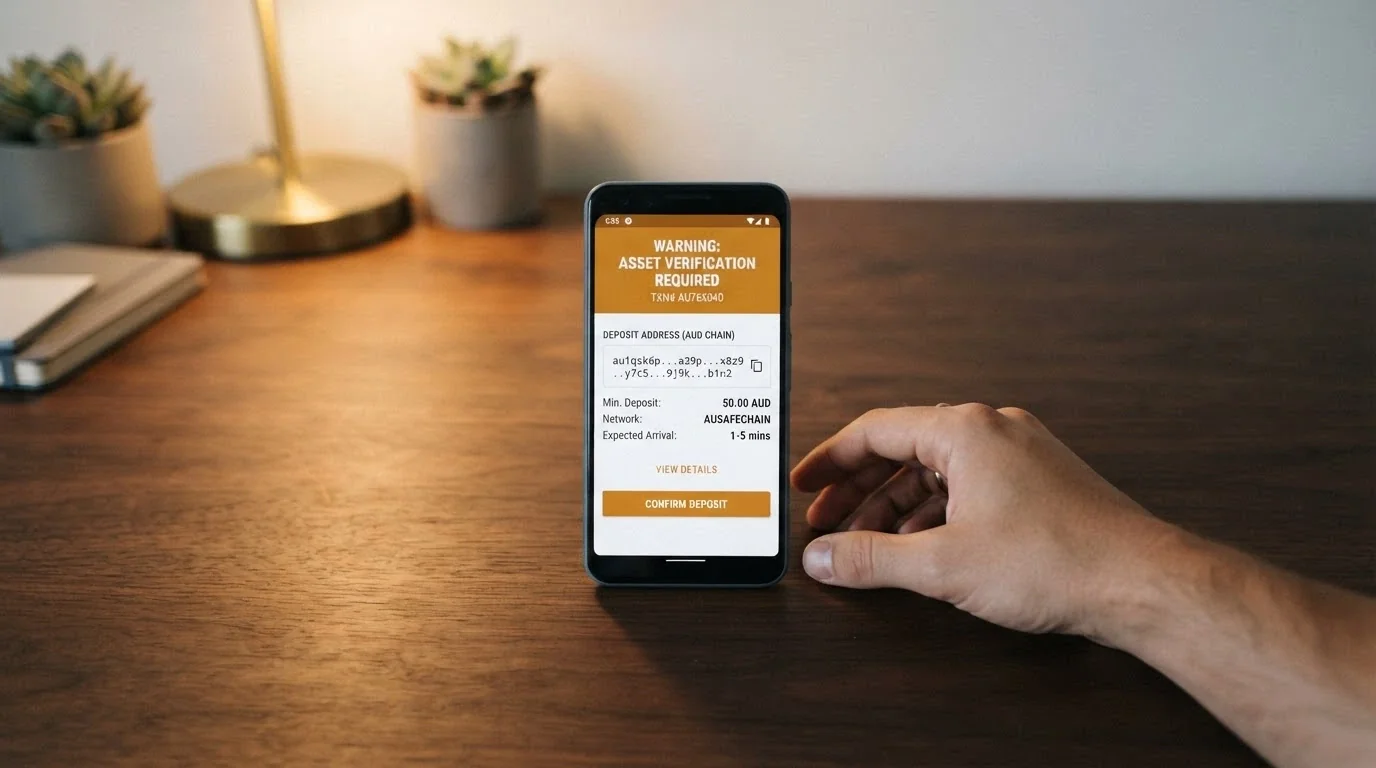
The Australian side of the rail is closed. Crypto has been banned as a payment for online wagering in Australia since 11 June 2024. The ban sits in the Interactive Gambling Amendment (Credit and Other Measures) Act 2023, with penalties for non-compliance reaching A$247,500. An Australian player depositing crypto at an offshore casino is on the wrong side of that rule. The operator accepting the crypto deposit is also exposed to the penalty, although enforcement under the rule has so far targeted the operator side more than the player side.
The other side of the crypto question is regulatory perimeter. Crypto deposits do not bring the player back inside the Australian system. The offshore casino’s Curaçao licence still does not extend Australian consumer protection. A crypto deposit that is lost to a blocked or vanished operator is lost in the same way a fiat deposit is lost — the speed of the rail does not insulate the balance from the regulatory gap.
Bitcoin and Crypto VIP Programs: What Changes and What Doesn’t
The tier mechanics at a crypto VIP casino do not change. The cashback percentage, the wagering multiple, the comp-point earn rate, and the personal manager threshold are the same figures. What changes is the deposit and withdrawal rail and the player’s exposure to the payment-method ban.
The withdrawal-speed advantage is real. A fiat withdrawal at an offshore casino typically clears in one to three business days. A crypto withdrawal can clear in minutes, depending on the coin and the network. For a VIP player moving larger sums and treating the casino balance as a working float, the rail difference is operational. For a player who deposits once and withdraws once a month, the difference is negligible.
The KYC tension sits underneath the crypto pitch. Crypto platforms often defer identity verification until the withdrawal stage. A player can deposit and play without submitting documents; the verification request comes when the player asks to withdraw. For a VIP tier with enhanced withdrawal ceilings, the verification request will arrive earlier and will be more demanding — a higher withdrawal ceiling requires a more thorough customer due diligence process. The promise of crypto anonymity runs into the limits of the tier structure, and the higher the tier, the more thoroughly the player is identified.
The Australian legal risk is the last layer. A crypto deposit at an offshore casino is a breach of the 11 June 2024 ban. The bank-blocking power that commences on 1 January 2027 may catch the fiat side of the same transaction — a player funding the crypto deposit from a bank account flagged for gambling-related transactions could find the transfer declined. The crypto angle removes the bank from the loop, and with it, the bank’s ability to refuse the transaction — but it does not remove the rule.
When the VIP Perk Becomes a Risk: Staying in Control
The VIP model rewards volume of play. The Australian harm data shows what that volume looks like when it tips into harm.

About 2.1% of Australian adults — roughly 430,000 people — experience problem gambling. Around 3.29 million Australians are affected annually by their own or another person’s gambling. Out of every 100 Australian adults, approximately 14 are directly affected by gambling harm, with around 9.2 classified as at-risk or problem gambling. Aboriginal and/or Torres Strait Islanders face a sharply elevated risk: 27.1% are at risk of gambling harm, compared to 14.6% of non-Indigenous Australians.
The VIP mechanic is calibrated to the same player behaviours the harm data measures. Higher cashback at higher tiers rewards more play. Personal account managers are deployed to keep high-volume players from drifting to competitors. Exclusive tournaments create a reason to keep returning. Each perk is individually defensible and collectively incentive-compatible with harm.
Deposit Limits, Reality Checks and Session Tools at Offshore VIP Casinos
Responsible operators — including the licensed Australian wagering operators — offer customer-set deposit limits, reality checks, session-time reminders, and activity statements. The state and territory conditions vary, but the toolkit is standard. None of these tools is imposed federally as a deposit, loss, or stake ceiling — the prohibited product means no federal ceiling regime exists.
Offshore VIP casinos sit outside this toolkit by design. The deposit-limit tools that licensed operators offer run on systems connected to Australian regulatory reporting. Offshore operators are not connected to those systems. A player who wants deposit limits at an offshore casino is setting them inside the operator’s own platform, with no Australian safeguard that the limit will be honoured and no Australian recourse if it is not.
The VIP program’s incentive structure runs counter to limit-setting. A player who sets a strict deposit limit and holds to it will not climb the tier ladder. The cashback rate, the personal manager, and the tournament access all require the volume that the limit prevents. The player who wants both — strict limits and VIP perks — is asking for two products that the operator has not designed to coexist.
A player who wants limits can set them independently of what the operator offers. A weekly deposit cap loaded into a separate bank account, a session-time alarm on the phone, and a hard rule on the number of sessions per week are all tools that sit outside the operator’s reach.
BetStop, Self-Exclusion and Where to Get Help in Australia
BetStop — the National Self-Exclusion Register — launched on 21 August 2023. To the end of Q3 FY 2025–2026, 59,830 people registered to self-exclude from all licensed online and phone wagering providers in Australia. As of 31 March 2026, 37,247 people had active exclusions. Exclusion periods run from a minimum of three months up to a lifetime.
The coverage gap is the central fact for an offshore VIP player. BetStop binds Australian-licensed wagering services only. An offshore casino is not connected to the register and will continue to accept a self-excluded person’s money. The 37,247 active exclusions protect those players at the licensed wagering providers; the same players are not protected at the offshore operators covered in this article.
The reach of BetStop is narrower than the harm data suggests. Dr Kei Sakata, Executive Manager of the Australian Gambling Research Centre at the Australian Institute of Family Studies, puts the gap plainly: “Despite an estimated five million wagerers nationwide, including 400,000 high-risk gamblers, just 30,000 individuals currently have active exclusions through BetStop.” His conclusion is direct: “BetStop is not reaching those most at risk.” The 400,000 high-risk figure sits against the 30,000 active exclusions; the gap is the reach of the tool. Awareness is part of the gap: only 33.5% of wagerers know BetStop exists, and around one in four Australian adults (26.5%) know about it.
For an Australian player who wants help, the National Gambling Helpline is 1800 858 858 — free, confidential, and staffed 24 hours a day, 7 days a week. Gambling Help Online (gamblinghelponline.org.au) provides online chat, email, and forums. Gambler’s Help (gamblershelp.com.au) is the Victorian state-level service. These resources are Australian, confidential, and free. They do not require the player to be enrolled with any operator.
How We Evaluated These VIP Casino Programs
The evaluation drew on affiliate comparison sites (Australian Gamblers, Casino Guru, Mr Gamble), the operators’ own published VIP pages where available, the ACMA register of blocked services, the Curaçao licence numbers cited in the operator sections, and the Australian Institute of Family Studies for the harm-prevalence and BetStop reach data. Each operator’s licence status was checked against the Curaçao numbers in the public record; each operator’s blocking status was checked against the ACMA register; each VIP-specific figure was drawn from the operator’s own published terms where available and from the affiliate comparison sites where the operator had not published a number.
The evaluation criteria are the same ones applied throughout the article: VIP program depth, cashback rates and wagering terms, tier transparency, withdrawal limits for VIPs versus standard players, licence quality, game library breadth, and the operator’s blocking history where one exists. The criteria are not weighted — no operator was scored on a numeric rubric — and the comparisons are presented as observations rather than rankings.
The limitation is the one that runs through the “not confirmed” operator sections: for several brands, the published VIP terms were not available in third-party sources, and the operator’s own pages did not carry an auditable tier structure. Where research did not confirm a figure, this article did not write one.
What the Numbers Say About Offshore VIP Programs — and Whether They’re Worth Your Risk
The expected-loss arithmetic is what the welcome bonus actually costs. SkyCrown’s A$8,000 + 400 free spins welcome package at 40x wagering, played through at NetEnt’s 96.39% average RTP, carries an expected loss of roughly A$11,520 across the turnover required to clear it. The A$8,000 bonus headline costs the player around A$11,520 in expected value before any of the bonus is withdrawable. That figure is a statistical estimate — an average over many spins under the stated assumptions, not a guaranteed outcome for any single player.
The legal reality sits on top of that arithmetic. No Australian consumer protection, no BetStop coverage, and no formal dispute resolution sit behind any of the operators in this article. Every balance held at any of them is held under the operator’s own house rules, and the operator is reachable from Australia only when the ACMA has not blocked the domain. The 1,564 sites blocked since November 2019 are the record of what ACMA enforcement has done; the record of what enforcement will do over the next year is open.
The responsible-gambling framing is the uncomfortable one. The VIP model rewards volume. The Australian harm data — 430,000 problem gamblers, 3.29 million affected annually, 27.1% at-risk among Aboriginal and/or Torres Strait Islanders — measures the population the model is calibrated against. BetStop reaches 30,000 of an estimated 400,000 high-risk gamblers. The reward structure of a VIP program and the reach of the country’s main self-exclusion tool are on opposite sides of the same question.
The verdict is not a recommendation. It is the position the article’s own figures support. An offshore VIP program offers cashback terms, no-wager free spins, and tier perks that are not available in any Australian-licensed product — because no Australian-licensed product exists. The same program sits outside Australian consumer protection, outside BetStop coverage, and inside the ACMA’s enforcement perimeter. The trade is a real one, and the reader who makes it is making it with full knowledge of what is given up and what is taken on.
The right reader of this article is one who is already considering offshore play and wants the comparison to be honest. The wrong reader is one who would be better served by the licensed Australian wagering market — and the licensed market does not include casino games, so that reader’s options are limited to sports and racing wagering under Australian licence.
Frequently Asked Questions
Is online casino legal in Australia and can I legally join a VIP program?
Online casino is prohibited in Australia under the Interactive Gambling Act 2001 and the 2017 amendment. No online casino licence exists in the country — not federally, not in any state or territory. Every VIP program marketed to Australian players is offshore. The individual player is not prosecuted; the Act targets the provider. The player forfeits Australian consumer protection, BetStop coverage, and dispute resolution.
Do offshore casino VIP programs cover me under BetStop self-exclusion?
No. BetStop — the National Self-Exclusion Register — binds Australian-licensed wagering services only. Offshore casinos are not connected to the register and will continue accepting a self-excluded person’s money. As of 31 March 2026, 37,247 people had active BetStop exclusions, but those exclusions protect them only at the ~150 licensed wagering providers, not at the offshore operators in this article.
What happens to my VIP balance if an offshore casino is blocked by the ACMA?
The balance is not retrievable through the Australian consumer-protection system, because no Australian regulator has jurisdiction over the operator. The ACMA’s role is to block, not to arbitrate. The player cannot escalate to an Australian dispute resolution service, and the operator’s own dispute channels are the only available route. The ACMA has blocked 1,564 illegal gambling and affiliate websites since November 2019, and a previously unblocked operator can be added to the list at any time.
Can I use crypto to join a VIP casino program in Australia?
No. Credit cards, credit-related products, and digital currency have been banned as payment for online wagering in Australia since 11 June 2024 under the Interactive Gambling Amendment (Credit and Other Measures) Act 2023. Penalties for non-compliance reach A$247,500. An Australian player depositing crypto at an offshore casino is in breach of that rule, regardless of whether the offshore operator accepts the deposit.
Are VIP cashback bonuses subject to wagering requirements?
Yes, in most cases. SkyCrown’s VIP Weekly Cashback is 10% up to A$1,500 with 3x wagering. RocketPlay’s VIP cashback scales from 7% at Iron to 10% at Diamond with 5x wagering. The standard (non-VIP) cashback at SkyCrown is 10% up to A$1,500 with 10x wagering, materially heavier than the VIP multiple. The VIP multiple is what makes the cashback achievable as a recurring perk.
How much do I need to deposit to reach the top VIP tier?
The figure depends on the operator. SkyCrown’s 10-level ladder runs on A$15 wagered = 1 Comp Point, with the higher-level thresholds not publicly itemised beyond the entry-level rate. RocketPlay’s Lifetime track runs Quark through Alloy; the Seasonal track’s first rung requires 15,000 XP. The dollar figure depends on the earn rate and the per-tier XP threshold, both of which vary by operator and are published on each operator’s VIP page. A player chasing the top tier should read the operator’s specific ladder rather than assume a market-wide benchmark.