
Fifty free spins without a deposit in 2026: what the offer costs an Australian player
Data current as of 16 October 2026; licence claims verified against the ACMA register.

A$25 in spin value. A$1,250 in turnover before a cent becomes withdrawable. An expected cost of roughly A$43.75 just to convert the bonus into cash, even before the offshore risk premium is counted. That is what a 50-free-spins-no-deposit offer usually amounts to once the marketing copy is put aside and the small print is read. This page is the small print, with the offer costs, the operators and the legal landscape an Australian player is actually dealing with in 2026.
The headline is everywhere in the search results. Every casino affiliate in the country seems to be running a “best 50 free spins no deposit Australia” list, each one ranking the same handful of offshore brands by placement rather than by what the offer actually delivers. The problem is not that the offers are fake — most are real enough at the registration stage. The problem is what happens between sign-up and withdrawal. A typical offer looks like this: 50 free spins on registration, no deposit required, on a named pokie like Book of Cats or Big Bass Splash. The terms attached are where the gap between advertised and delivered opens up.
A study by SlotSpeak tested 31 advertised A$50 no-deposit offers across 24 operators and found only six produced an actual A$50-equivalent credit on sign-up. The remaining 25 either required a hidden deposit, applied a maximum cashout cap so tight that even a moderate win was largely written off, voided a wagering-cleared payout under an “irregular play” clause, or were stale codes that no longer credited. The deliverability gap is the entire story of this market, and the rest of this page is a working through it.
One thing needs to be said up front, because most competing pages do not say it. Online casino is not licensed anywhere in Australia. The Interactive Gambling Act 2001 prohibits the provision of online casino games to a person physically in Australia, and no licence for online casino exists at federal or state level. Every operator on this page operates from an offshore jurisdiction — Curaçao being the most common — and is not licensed to offer casino games to Australians. The ACMA has blocked 1,564 illegal gambling and affiliate websites since November 2019, with more than 225 services having withdrawn from the Australian market since 2017. This page describes those operators because Australians access them in practice, not because they are legal. That distinction shapes everything below: the wagering terms, the payment methods, the self-exclusion coverage and the recourse available if a withdrawal is refused.
Table of Contents
- What 50 Free Spins No Deposit Actually Means in 2026
- Free Spins Without a Deposit: What 50 of Them Really Cost You
- Where Australians Are Claiming Free Spins in 2026 — What 10 Operators Actually Deliver
- New Casinos Rolling Out 50 Free Spins in 2026
- 50 Free Spins on Your Phone: Mobile Apps vs Browser Play in 2026
- Are Online Casinos Legal in Australia? The Real Answer for 2026
- Responsible Gambling: Controls, Self-Exclusion and Where Australians Get Help
- How We Assessed These 50 Free Spins Offers
- What the Numbers Say About Claiming 50 Free Spins in 2026
- Frequently Asked Questions About 50 Free Spins No Deposit in Australia
What 50 Free Spins No Deposit Actually Means in 2026
The core promise of a 50-free-spins no-deposit offer is straightforward: register an account, claim the bonus, run fifty spins on a named pokie without entering a payment method. Whatever the spins return is the player’s, subject to the small print. No deposit, no commitment, free play with the chance of a real payout.
The gap opens the moment the player finishes the spins. A “genuine” no-deposit offer is almost always paired with three conditions: a wagering requirement that multiplies any winnings into a larger turnover figure, a maximum cashout cap that limits what can actually be withdrawn, and a time window in which both must be completed. The “no deposit” in the headline refers to the absence of a payment at registration. It does not mean the offer is free of conditions, and it certainly does not mean the offer is worth the headline figure.
Across the Australian market, the typical per-spin value of a no-deposit free spin sits between A$0.10 and A$0.50. That means 50 free spins carry a face value of between A$5 and A$25 — modest on its own. A lucky session might return 10x to 20x the spin value in winnings, lifting the screen balance to A$50 or more. From that balance, the wagering requirement then multiplies the winnings into a turnover figure, and the maximum cashout cap cuts the resulting amount down to what is actually withdrawable.
What “genuine” means in this market is also worth pinning down. A 50-free-spins offer with no wagering requirement — winnings paid out as cash — is rare. Most offers carry wagering multipliers in the 40x to 60x range, calculated on the free-spin winnings rather than on the spin value. Some operators advertise “no wagering” only to attach game restrictions that exclude the higher-paying titles. The SunVegas review of the market put it plainly: true 50 free spins no-deposit offers in Australia are few and far between, and when they do appear they often come with high wagering requirements or tight game restrictions.
The Australian context makes all of this more complicated, not less. No operator on this page is licensed in Australia. The licence is offshore, the regulator is offshore, the dispute resolution is offshore, and the offer terms reflect a market where Australian consumer protection does not reach. The headline figure is genuine. The conditions behind it are the rest of the story.
Pokies or Slots? How Australians Talk About Free Spins
An Australian walking into a physical club will play a “pokie”. An Australian reading an online casino bonus page will see “free spins”. The two words describe the same game: a reel-based slot machine with random outcomes, governed by an RNG and a published RTP. Australian casino marketing uses both terms interchangeably — “50 free spins on Big Bass Splash” and “50 pokies spins on Big Bass Splash” point to the same offer at the same operator.
This is not a distinction worth sweating. The terminology difference is regional, not mechanical. A player who searches for “free spins” and a player who searches for “free pokies” land on the same offers, with the same wagering terms and the same cashout caps. The only practical thing to keep in mind is that “pokies” is the word an Australian reader will recognise on a casino site’s Australian-facing page, and “slots” or “free spins” is what the same site will call them on its international-facing material. The terms travel together.
Free Spins Without a Deposit: What 50 of Them Really Cost You
A 50-free-spins no-deposit offer is not the gift the headline suggests. It is a structured marketing product with three levers the operator uses to convert headline appeal into a sustainable acquisition cost: the wagering requirement, the maximum cashout cap and the bonus validity window. Each lever pulls the offer’s real value down from what the spin balance on the screen suggests. The next few sections work through each lever in turn, with the arithmetic the player can run themselves.
The deliverability data adds a fourth dimension. Of the 31 advertised A$50 no-deposit offers SlotSpeak tested across 24 operators, only six actually produced an A$50-equivalent bonus credit on sign-up. The other 25 broke down in roughly equal numbers across four failure modes: a hidden deposit requirement that only became visible during the registration flow, a maximum cashout cap so low it crushed even a moderate win, an “irregular play” clause that voided wagering-cleared payouts, or a stale bonus code that no longer credited at all. That is not a 1-in-5 chance of the offer working as advertised. It is a 1-in-5 chance of the offer being real, with the rest sitting somewhere between materially worse than advertised and not deliverable at all.
No Deposit Means Just That — Here Is Where the Conditions Kick In
“No deposit” refers only to the absence of an upfront payment. The conditions begin the moment the spins finish. The most common terms attached to a 50-free-spins no-deposit offer in the Australian market are these.
A wagering requirement on the free-spin winnings — usually between 40x and 60x, calculated on whatever the spins returned rather than on the spin value. A maximum cashout cap, typically A$50 to A$150, that applies to the winnings after wagering has been cleared. A bonus validity window — usually 7 to 14 days — within which both the wagering and the cashout must be completed. Game restrictions — the spins are tied to specific pokies, and only those pokies contribute 100% toward the wagering. Table games and live casino titles typically contribute between 0% and 20%, which means they cannot be used to clear the bonus in any practical sense. KYC verification — every licensed operator requires full identity verification before any withdrawal is processed, regardless of how the bonus was earned.
The KYC requirement is worth its own note. It is not optional and it is not negotiable. A player who wins A$150 from a no-deposit offer and tries to withdraw without completing identity verification will not see the money. The verification typically requires a government-issued photo ID, a proof of address dated within the last three months, and sometimes a proof of payment method. It is the single most common reason a no-deposit bonus “doesn’t work” — the offer delivers, the wagering is cleared, and then the withdrawal stalls in verification for weeks.
The validity window is where most players actually lose the bonus. Seven to fourteen days is not a long time to clear 40x to 60x wagering on a pokie that contributes 100%. A player who returns to the casino three days after registration will find the bonus and any associated winnings already removed from their account. The clock starts at registration, not at the first spin.
The Wagering Multiplier: 40x, 50x, 60x — What Each Step Costs
The wagering multiplier is the number that turns the spin winnings into a turnover figure the player must run through before any withdrawal. At 40x, A$25 in winnings becomes A$1,000 of required turnover. At 60x, the same A$25 becomes A$1,500. The figure sounds abstract until it is set against the time and money it costs to clear.

The arithmetic of expected cost is direct. The house edge on a pokie with a 96.5% RTP is 3.5%. Apply that edge to the required turnover and the result is the player’s expected loss over the wagering tunnel. At 40x wagering on A$25 of winnings, the turnover is A$1,000 and the expected loss is A$1,000 × 3.5% = A$35. At 60x, the turnover rises to A$1,500 and the expected loss to A$52.50. At a mid-range 50x multiplier, with A$25 in winnings and a 96.5% RTP, the turnover is A$1,250 and the expected loss is A$43.75 — already more than the player just won from the spins.
Read it the other way and the picture sharpens. The 50 free spins carry a face value of A$12.50 at a typical A$0.25 per-spin mid-point. The expected cost of clearing a moderate win is roughly three to four times that face value. The bonus is, in expected-value terms, a small loan the casino makes on terms that compound unfavourably for the borrower. The marketing word “free” is doing a lot of work here, and the wagering multiplier is where it earns its keep.
What the multiplier does not control is equally important. Pokies contribute 100% toward wagering at most Australian-facing casinos, which is why free-spin offers are always tied to specific pokies and never to blackjack, roulette or live game shows. Table games and live casino titles typically contribute 0% to 20%, which makes them effectively unusable for bonus clearance. A player who tries to clear wagering on a live blackjack table will watch their bonus balance stay frozen while their real money disappears.
Max Cashout Caps: Why Your Winnings Shrink at the Withdrawal Screen
The maximum cashout cap is the second lever, and it is the one most players overlook. A typical cap sits between A$50 and A$150 on a no-deposit offer. A player who runs a lucky session, clears the wagering requirement, and arrives at the withdrawal screen with a A$400 balance will receive at most the cap — typically A$100 or A$150. The rest of the balance is removed from the account at the moment of withdrawal.

This is why the cap matters as much as the wagering multiplier. A 30x wagering bonus with a A$20 max cashout is worth less than a 40x bonus with a A$100 cap, because the higher turnover is more than offset by the larger withdrawable ceiling. The Australian Gamblers review of the market put it plainly: max cashout is equally important as wagering, and a player who reads only the wagering multiplier is reading half the offer.
In practice, the cap does most of its work quietly. The player clears the wagering. The balance looks healthy. The withdrawal screen applies the cap and the remaining funds disappear. There is no second chance to clear further wagering; the cap is applied to whatever is in the account at the moment of withdrawal. Operators do not advertise the cap in headline copy, and the figure is usually buried in the bonus terms page that few players open.
The combination of high wagering and tight caps is where the gap between advertised and delivered becomes a chasm. A 60x wagering offer with a A$50 cap leaves the player with a negative expected value almost regardless of how well the spins run, because the cost of clearing the wagering exceeds what the cap will pay out. The cashout cap is not a backstop. It is a second discount on the offer, applied after the first.
How to Claim: Sign-Up, Verification, and When a Bonus Code Matters
The registration path is broadly the same across the Australian-facing operators. The differences are in the details — bonus code fields, automatic versus manual credit, mobile-specific offers — and those details are where the player either gets the spins or does not.

- Enter your name, email address, date of birth and mobile number on the registration form.
- Confirm your email address or mobile number via the one-time code the operator sends.
- Enter a bonus code in the designated field where the offer requires one — usually during registration or in the cashier section before the first deposit.
- Trigger the credit automatically on email confirmation, or claim the spins manually via the promotions tab or a live-chat request.
- Complete KYC verification — photo ID, proof of address dated within three months, sometimes proof of payment method — before requesting any withdrawal.
The wagering clock starts at registration rather than at the moment the spins are claimed, so a delay between sign-up and credit can quietly eat into the validity window. A player who registers on Monday, returns on Friday and finds the bonus already removed from the account has lost the offer through delay, not through failure to clear.
Bonus codes are not always required, and the question of whether one is needed is a frequent cause of an offer “not working”. A player who searches for “50 free spins no deposit bonus code” and lands on an affiliate page listing a code from six months ago will find, more often than not, that the code has expired or has been replaced. The SlotSpeak testing showed stale codes as one of the four main reasons the advertised offer did not deliver. The safe practice is to open the operator’s own promotions page on the day of registration and use the code listed there.
No-Wagering Free Spins: The Exception Worth Looking For
A no-wagering free-spin offer pays out winnings as withdrawable cash, with no turnover requirement and no multiplier to clear. Whatever the spins return is the player’s, subject only to any maximum cashout cap and the standard identity verification. In a market where 40x to 60x wagering is the norm, a no-wagering offer is a different product — and a different value proposition.
The honest framing is that such offers are rare. Genuine 50-free-spins no-wager deals are few and far between in Australia, and when they do appear the terms often restrict the spins to specific lower-paying pokies or attach tight caps that limit the upside. A 20-free-spin no-wagering offer on a medium-volatility pokie with a A$50 cap is, in expected-value terms, a better deal than a 50-free-spin offer with 60x wagering and a A$100 cap — the no-wagering version costs the player nothing to convert, while the high-wagering version can cost more in expected loss than the cap will pay out.
The reason to look for a no-wagering offer is arithmetic, not sentiment. The house edge still applies during the spins themselves, and it still applies to any further play the player does after the bonus is cleared. But the absence of a wagering multiplier means there is no turnover tunnel to fund, and the absence of a turnover tunnel means there is no expected loss to clear before the cash is in the player’s account. The offer becomes a flat lottery on the spin outcomes rather than a layered product with a marketing headline and a smaller real value behind it.
The Pokies Behind the 50 Spins — RTPs, Volatility and What They Mean
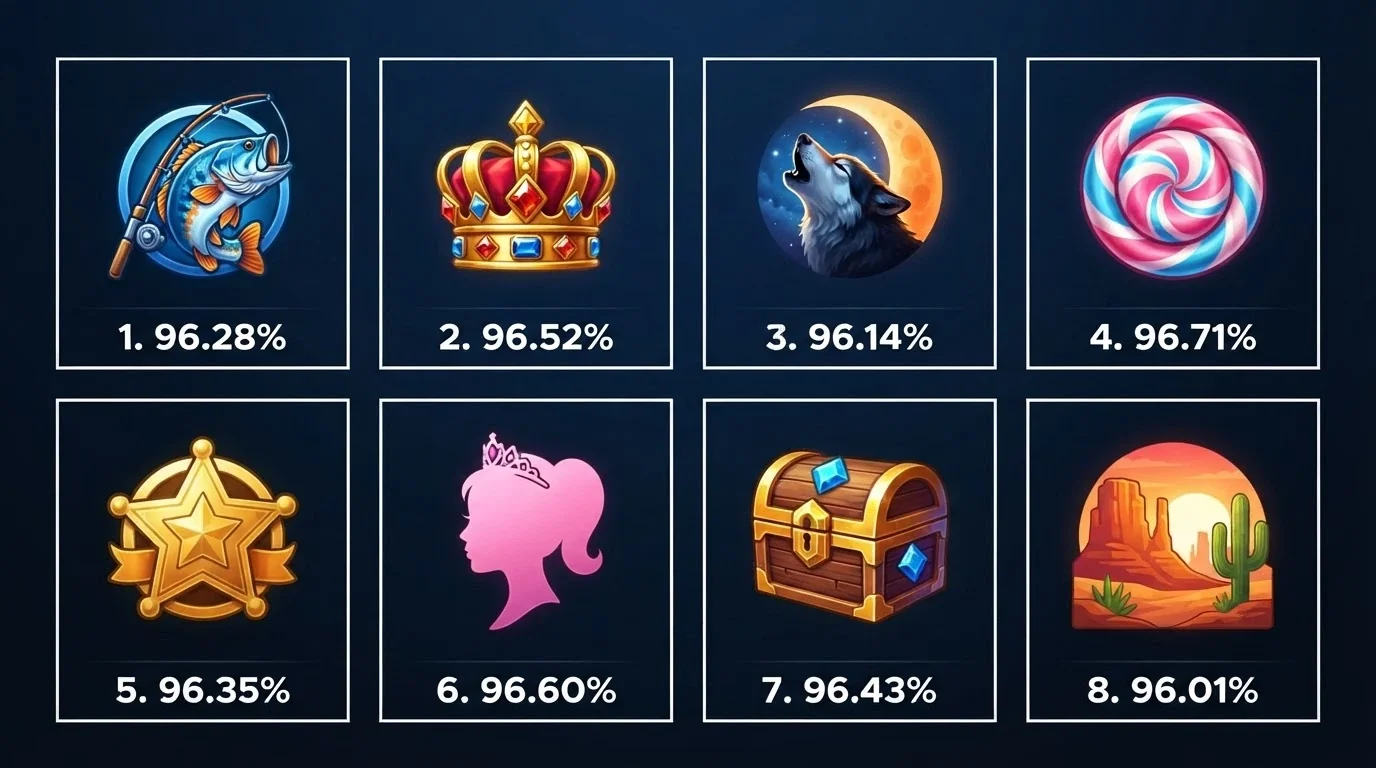
The specific pokie the spins are tied to matters more than the spin count, because the RTP and volatility of that pokie determine the expected return across both the free spins and the wagering tunnel. Pragmatic Play is the dominant provider behind the bonus-eligible pokies in this market, with eight titles recurring across the offers. Their specifications are summarised below.
| Slot Title | Provider | RTP | Volatility | Max Win |
|---|---|---|---|---|
| Big Bass Splash | Pragmatic Play / Reel Kingdom | 96.71% | Medium-High (4/5) | 2,100x |
| Sweet Bonanza 1000 | Pragmatic Play | 96.53% | High | 25,000x |
| Gates of Olympus 1000 | Pragmatic Play | 96.50% | High | 15,000x |
| Gates of Olympus | Pragmatic Play | 96.50% | High (5/5) | 5,000x |
| Wolf Gold | Pragmatic Play | 96.01% | Medium (3/5) | 2,500x + Mega jackpot |
| Wild West Gold | Pragmatic Play | 96.51% | Very High (5/5) | 10,000x |
| Starlight Princess 1000 | Pragmatic Play | 96.50% | Very High (5/5) | 15,000x |
| Sweet Bonanza | Pragmatic Play | 96.51% | High (5/5) | 21,100x |
RTP, or return to player, is the long-run percentage of wagered money a pokie returns to players across millions of spins. A 96.71% RTP pokie returns A$96.71 for every A$100 wagered, on average, over the full spin population. The remaining A$3.29 per A$100 is the house edge — and that house edge is what compounds across the wagering tunnel to produce the expected loss calculated above. A 0.2 percentage point difference in RTP is a 6% difference in house edge, which is meaningful across the turnover required to clear a bonus.
Volatility is the other half of the picture. A high-volatility pokie pays out less often but in larger amounts when it does. A medium-volatility pokie pays out more often in smaller amounts. For a free-spin offer with a tight max cashout cap, a high-volatility pokie is mathematically friendlier: the player is more likely to either hit a payout that approaches the cap or hit nothing at all, with fewer small wins eating into the bonus balance in between. For an offer with a high cap and a long validity window, a medium-volatility pokie is the steadier choice.
The max win figures in the table describe the ceiling the pokie itself can pay on a single spin. A 25,000x max win on Sweet Bonanza 1000 means a single A$0.25 spin can theoretically return A$6,250. In practice, max wins land at odds in the millions of spins, and the free-spin offer’s max cashout cap will cut any payout well before the pokie’s own ceiling is reached. The ceiling is the reason these pokies are the ones operators choose for bonus offers: a pokie with a 25,000x ceiling can carry marketing copy that promises “win up to thousands”, and the cap does the rest.
Crypto Casinos and Free Spins: Bitcoin Bonuses for Australian Players
Crypto-focused operators sit in a particular corner of the Australian offshore market. Stake and Rainbet are both in the Australian market’s top 15 by tracked traffic, and both accept Bitcoin and other cryptocurrencies as primary deposit methods. Their bonus models tend to differ from the traditional free-spin package — rakeback, reload offers and time-limited promotions are more common than a deposit-gated welcome bonus — but they are part of the same offshore landscape, and the free-spin offers they do run operate under the same terms as their fiat-funded competitors.
The more interesting question is the payment-rule tension. Credit cards, credit-related products and digital currencies have been banned as payment methods for licensed online wagering in Australia since 11 June 2024. The ban applies to operators licensed under Australian state and territory regimes — which cover wagering on races and sport, not online casino, since no online casino licence exists. For Australian-facing offshore casinos, the ban is irrelevant: an offshore operator is not subject to Australian payment law, and an Australian depositing with a credit card or Bitcoin at an offshore casino is being served by someone outside Australian rules.
This is a diagnostic tell, not a recommendation. An offshore casino that still accepts credit cards and crypto is, by definition, operating outside the Australian regime. The 2026 reform extends that logic further: from 1 January 2027, banks and payment providers gain express authority to block transactions to illegal gambling operators. A player using a Visa or a Bitcoin wallet to fund an offshore casino today is using a payment route the next reform package is designed to interrupt. The offer itself is the same. The rails beneath it are shifting.
Where Australians Are Claiming Free Spins in 2026 — What 10 Operators Actually Deliver
The table below ranks the 10 featured offshore operators by deposit-free offer shape and wagering terms. The columns reflect what is confirmed this run, with no inferred or projected values. Operators whose no-deposit terms were not confirmed appear with the article-language no-data marker.
| Operator | Licence / Legal Status | Deposit-Free Offer | Wagering on Winnings |
|---|---|---|---|
| RocketPlay | Curaçao Gaming Authority; offshore, not licensed in AU | 50 FS on Book of Cats | 35x–40x |
| SkyCrown | Curaçao (Hollycorn N.V.); offshore, not licensed in AU | 40 FS + A$10 chip equivalent | 45x |
| Fair Go | Curacao-rooted (no public licence number); first site ACMA blocked 19 Nov 2019 | 15 FS on Bubble Bubble 2 via coupon + chip offers | 60x |
| Bizzo | Offshore, not licensed in AU | 10 FS for mobile app download | 40x |
| Royal Reels | Curaçao; offshore, not licensed in AU | AUD 10 sign-up chip | 30x–40x |
| Rocket Casino | Offshore, not licensed in AU | Up to 120 FS via missions (requires A$30 deposit) | 45x |
| Stake | Offshore, not licensed in AU; crypto-focused | — | — |
| WinSpirit | Offshore, not licensed in AU | — | — |
| Rainbet | Offshore, not licensed in AU; crypto-focused | — | — |
| Scream Casino | Offshore, not licensed in AU | — | — |
The table is a snapshot, not a recommendation. Each operator sits in the same offshore legal category — not licensed in Australia, subject to ACMA enforcement if the site is added to the blocking list. The differences between them are in their bonus terms and trust signals, and the rest of this section works through each one in turn.
RocketPlay: A 9.8 Safety Index and 50 Real No-Deposit Spins on Book of Cats
RocketPlay is the highest-trust operator in the featured set. Casino.Guru has scored it a “very high” Safety Index of 9.8, which is the strongest independent safety signal any operator in this comparison carries. The licence is a Curaçao Gaming Authority credential — offshore, not recognised in Australia, but standard for this market.
The no-deposit offer is straightforward: 50 free spins on Book of Cats, credited without a deposit, with wagering in the 35x to 40x range on the winnings. The deposit welcome bonus sits separately at 100% up to AU$200 plus 50 additional free spins on a popular slot. The deposit-based and no-deposit offers are distinct products, with their own wagering and their own game restrictions.
The wagering multiplier sits at the favourable end of the Australian market range. At 35x, A$25 in winnings becomes A$875 of turnover — meaningfully less than the A$1,250 a 50x offer would impose. The max cashout cap on the no-deposit offer was not confirmed this run, which leaves a gap in the offer’s full picture. A 35x offer with a A$50 cap is a different proposition from a 35x offer with a A$150 cap.
Verdict: the best trust signal in the set, with a real no-deposit offer and market-favourable wagering. The cap is the gap worth confirming before any claim.
SkyCrown: 450% Deposit Match and a No-Deposit Equivalent Worth Testing
SkyCrown’s headline is the biggest in the set: a 450% deposit match up to A$8,000 plus 400 free spins across four deposits, with 40x wagering on both the deposit match and the free-spin winnings. The minimum deposit is A$30, the bonus validity is 14 days, and the maximum bet during wagering is A$7.50.
The no-deposit equivalent is a different product. SlotSpeak testing found it as 40 free spins plus a A$10 chip, with 45x wagering, an A$80 maximum cashout, and a 10-day expiry. The headline 450% is for funded players; the no-deposit entry point is the more modest 40 FS + A$10 chip combination, and the cap is tighter than the headline suggests.
The library is large — Pragmatic Play, Evolution Gaming, IGTech and 300+ titles — and the deposit bonus has enough structure to be worth modelling for a player who intends to fund an account. The no-deposit component is best read as a low-cost entry point to test the cashier, the verification flow and the withdrawal experience before committing a deposit.
Verdict: a large deposit welcome on a well-stocked platform, but the no-deposit entry point carries tight caps. Best treated as a sampler rather than as the offer to maximise.
Fair Go: The First Casino ACMA Blocked — Still Operating, Still Offering Free Spins
Fair Go is the longest-standing entry on the ACMA’s enforcement record. It was the first illegal offshore gambling site the regulator ordered blocked, on 19 November 2019, and it remains operational under a Curacao-rooted licence with no public licence number. The site is a single-provider RTG casino, which means the game library is narrower than the multi-provider competitors — but the free-spin and chip offers are well established.
The wagering multiplier is the highest in the featured set: 60x on no-deposit chips and free-spin winnings, well above the Australian market average of around 35x. The max cashout on no-deposit offers sits between A$150 and A$180, which is at the favourable end of the cap range. The free-spin offer is 15 spins on Bubble Bubble 2 via a coupon code, with 100 free spins on Sparkling Fortunes also available at A$0.10 per spin (total A$10 face value) at the same 60x wagering.
The arithmetic is the story. A$25 in winnings at 60x wagering produces A$1,500 in required turnover, and the expected loss at a 96.5% RTP is A$52.50 — more than double the spin win. The A$150-A$180 cap is what saves the offer from being a strict money-loser, but only for a player who hits a payout that approaches the cap.
Verdict: the longest ACMA record in the set and the most punishing wagering. Worth knowing about; worth treating the small print with extra care.
Bizzo: 10 Free Spins for Downloading the App — A Modest But Genuine No-Deposit Offer
Bizzo is unusual in this set because its no-deposit offer is conditional on a behaviour rather than a deposit: 10 free spins for downloading the mobile progressive web app, with 40x wagering, a 7-day expiry, an A$75 maximum win and an A$0.10 per-spin value. The offer is small — A$1 in total spin value — but the terms are clearly stated and the wagering sits in the middle of the market range.
The wider casino carries an 8,000+ game library across a multi-provider aggregator, which is one of the larger game counts in the Australian-facing offshore market. The deposit welcome bonus is up to A$7,250 plus 175 free spins plus a bonus game, but the no-deposit entry point is the app-download spin package.
The cap is the constraint. An A$75 maximum win on 10 spins at A$0.10 each is a 75x return on the spin value — achievable in a lucky session, but mathematically tight. A player who hits A$75 will need to clear A$3,000 in turnover at 40x wagering, with an expected loss of A$105 at a 96.5% RTP. The cap saves the player from the worst of that, but only barely.
Verdict: small but transparent. The terms are stated clearly, which is more than most no-deposit offers manage. Best treated as a low-risk test of the platform.
Royal Reels: A A$10 No-Deposit Chip Instead of Free Spins
Royal Reels takes a different shape. The no-deposit entry point is an AUD 10 sign-up chip rather than a free-spin package — same no-deposit principle, but the form is cash bonus rather than spins. The deposit welcome bonus is 100% up to AUD 500 on a minimum AUD 30 deposit, with 30x to 40x wagering across the package.
The game library is 2,000+ titles across 30+ providers including Pragmatic Play and Evolution Gaming, which is competitive for the market. The chip bonus carries a different expected-value profile from a free-spin offer: there is no spin count and no per-spin value to multiply, but the wagering applies to the chip itself, and the cap on no-deposit chip winnings was not confirmed this run.
The chip form is worth noting for one reason. A player who prefers table games or live casino titles can sometimes use a chip bonus more flexibly than a free-spin offer, because the chip is not tied to a specific pokie. The contribution rate still matters — table and live games typically contribute 0% to 20% toward wagering — but the chip at least allows the player to choose where to attempt the turnover.
Verdict: a different shape of no-deposit offer, with a wider game library than most of the set. The cap is the gap to confirm before claiming.
Rocket Casino: Up to 120 Free Spins — But the Missions Require a Deposit First
Rocket Casino’s headline is up to 120 free spins through a missions system, with 45x wagering on the winnings. The detail that matters is the deposit requirement: at least one A$30 deposit is required to unlock the missions, which means the offer is not genuinely deposit-free. It is gamified, deposit-gated free-spin allocation dressed as a no-deposit headline.
The wider casino carries a multi-provider library and a deposit welcome of 150% up to A$1,500 plus 150 free spins, with 45x wagering. The no-deposit-style missions sit alongside the deposit bonus rather than in place of it, which makes sense for an operator that wants both entry tiers.
The arithmetic on the missions depends on how the player chooses to run them. The A$30 deposit is a sunk cost — it does not return unless the player wins — and the 120 free spins at a typical A$0.10 to A$0.25 per spin carry a face value of A$12 to A$30. If the player wins A$20 from the missions spins and clears at 45x wagering, the turnover is A$900 and the expected loss at 96.5% RTP is A$31.50. The deposit has already cost A$30, and the spin winnings have cost another A$31.50 in expected loss. The cap is what determines whether the offer pays out.
Verdict: not a true no-deposit offer. The missions system is a deposit-gated free-spin allocation, and the subject of this page does not fit. Worth knowing the operator exists; worth reading the deposit requirement carefully before claiming.
Stake: A Crypto Giant With No Confirmed 50 Free Spins Offer This Run
Stake sits in the Australian traffic top 15 alongside Rainbet, and it operates as a crypto-focused offshore casino rather than a traditional fiat-funded welcome-bonus venue. Its bonus model typically runs through rakeback, reload offers and time-limited promotions rather than a deposit-gated welcome package, and no confirmed 50-free-spins no-deposit offer was identified this run.
This does not mean Stake is without free-spin promotions — the operator runs regular game-specific spin drops and prize-drop campaigns tied to Pragmatic Play and other providers — but those promotions are not the deposit-free sign-up offer this page is built around. A player looking for a 50-free-spin no-deposit sign-up package will not find one at Stake this run.
The crypto focus carries its own context. Stake accepts Bitcoin and other cryptocurrencies as primary deposit methods, and Australian players using crypto to fund an offshore casino are operating outside the credit-and-crypto ban that applies to licensed Australian wagering from 11 June 2024. The offshore route is the only available route, but it is a route the next reform package is designed to narrow from 1 January 2027.
Verdict: a major crypto casino in the AU traffic rankings, but not a fit for the page’s subject this run. Treat any free-spin promotion as a separate, game-specific campaign rather than a sign-up bonus.
WinSpirit: A Welcome Package With Free Spins — Specifics Unconfirmed This Run
WinSpirit is a multi-provider offshore operator whose welcome package typically includes a deposit match plus free spins, but the specific no-deposit free-spin count and wagering terms were not confirmed this run. The game library is wide, covering pokies and live games across multiple providers, which gives a player plenty of room to use any bonus funds that do appear.
The absence of confirmed no-deposit terms is itself a signal. A welcome package that includes free spins is one thing; a no-deposit free-spin offer is another. WinSpirit’s marketing suggests the former, and the operator’s full terms page would be the place to verify whether a deposit-free sign-up offer exists separately. This page does not have that confirmation.
Verdict: a standard offshore welcome package with specific no-deposit terms unverified. Confirm on the operator’s own page before claiming.
Rainbet: A Crypto-Focused Operator in the AU Top 15 — Bonus Terms Unconfirmed
Rainbet sits in the Australian traffic top 15 alongside Stake, with a crypto-focused model and a multi-provider game library. No confirmed free-spin or welcome-bonus terms were identified this run, and the operator does not appear to run a traditional 50-free-spin no-deposit sign-up offer in the form this page covers.
The traffic ranking is worth noting because it implies a meaningful Australian player base. A high-traffic offshore casino is operating with the awareness that ACMA enforcement is active, and the next reform package adds bank-level transaction blocking from 1 January 2027. A player funding an account at Rainbet today is using payment routes the regulator is actively working to interrupt.
Verdict: a traffic-significant offshore operator with no confirmed no-deposit bonus this run. Treat any offer as unverified until checked on the operator’s own terms page.
Scream Casino: A Newer Entrant With Unconfirmed Bonus Terms
Scream Casino is a multi-provider offshore operator with no confirmed free-spin or welcome-bonus terms this run. The absence of confirmation is consistent with a newer operator that has not yet built a track record, and a newer operator is the higher-risk end of the offshore spectrum — no consumer protection, no BetStop coverage and a smaller body of withdrawal-experience evidence from other players.
The standard caution applies. A player evaluating any bonus offer at Scream Casino should read the full terms on the operator’s own page before claiming, with particular attention to the wagering multiplier, the max cashout cap, the validity window and the game contribution rates. None of those were confirmed in this run.
Verdict: a newer offshore entrant with no track record and no confirmed terms. Higher risk than the established operators in the set.
New Casinos Rolling Out 50 Free Spins in 2026
Brand-new offshore casinos use free-spin offers as their primary acquisition tool. A new operator has no track record, no reputation and no existing player base — and the cheapest way to build one is to give away free play. The 50-free-spin no-deposit offer is the workhorse of the category, and the past two years have seen a steady stream of new entrants running them.
The pattern is consistent: a generous launch offer, a short operational history, and a smaller body of evidence about how the operator handles withdrawals once a player actually wins. The SlotSpeak deliverability data shows many of the 25 failed offers came from newer or less-established operators, and the failure modes — hidden deposit triggers, tight cashout caps, “irregular play” voids, stale codes — concentrate in the same places for new entrants as for the rest of the market.
A new casino is not inherently worse than an established one. The bonus terms on the page are what they are, and a new operator with clear terms is a better offer than an established one with buried conditions. The risk is in the gap between the page and the withdrawal: an operator with no track record has not yet been tested at scale by the player community, and a refused payout is much harder to escalate when there is no body of complaints to draw on.
What a Fresh Offshore Casino Means for Your Free Spins
The trade-off is between a generous launch offer and an operator with no history. A new casino has every incentive to make the sign-up attractive — it needs players more than the players need it — and that incentive is reflected in the headline figures. A 50-free-spin no-deposit offer from a new operator is often larger, in headline terms, than the equivalent from an established one.
The arithmetic of generosity is also the arithmetic of risk. A larger headline implies a more aggressive acquisition budget, which is funded by tighter terms somewhere down the page: higher wagering, lower caps, shorter validity windows, or game restrictions that exclude the higher-paying pokies. None of these are inherently illegitimate, and none of them is unique to new operators. They concentrate at the new end of the market, and a player should read the page with that concentration in mind.
The practical test is the same as for any offshore operator: read the full terms, confirm the licence status, check the maximum cashout cap, and look for a track record of withdrawal handling. A new operator with all four boxes ticked is a reasonable bet. A new operator with a generous headline and absent terms is the gap the SlotSpeak deliverability data describes.
50 Free Spins on Your Phone: Mobile Apps vs Browser Play in 2026
Mobile is the default way most Australians access an offshore casino. The bonus terms do not change between desktop and mobile — the wagering multiplier, the cashout cap, the validity window and the game restrictions all carry over identically — but the route to claiming the spins does. Some operators use the mobile channel to add an extra offer on top of the desktop one, and one operator in this set uses the mobile app download as the trigger for the entire no-deposit entry point.

Bizzo’s 10-free-spin offer is conditional on downloading the mobile progressive web app. The desktop sign-up does not include the no-deposit offer — only the mobile app installation does. The spins credit on first launch of the app and carry the same 40x wagering, 7-day expiry and A$75 max win as the desktop equivalent would. The mobile channel here is not a parallel offer but the only channel.
The broader landscape splits three ways. Browser-based mobile play is the default at most Australian-facing casinos, with a responsive site that adapts to phone screen sizes and a touch interface for the games. Progressive web apps are a middle ground: a player adds the casino to the home screen and the site behaves like a native app without an app-store download, which is the route Bizzo uses for its spin offer. Native apps — downloadable from the App Store or Google Play — are rare among offshore AU-facing operators because the major app stores restrict real-money gambling apps by jurisdiction, and an offshore casino targeting Australians is in the restricted category by design.
Are Online Casinos Legal in Australia? The Real Answer for 2026
The short answer is no. Online casino is not licensed anywhere in Australia, and it is not legal for an operator to offer online casino games to a person physically in Australia. Every casino on this page operates from an offshore jurisdiction, holds an offshore licence, and is not licensed to offer its product to Australians.
This is not a grey area. The Interactive Gambling Act 2001 is unambiguous on the question of online casino, and the ACMA’s enforcement record — 1,564 websites blocked since November 2019 — shows the regulator treats the prohibition as a live operational matter. The legal uncertainty lives elsewhere: in the payment-method bans that began in 2024, in the 2026 reform package that adds bank-level transaction blocking from 1 January 2027, and in the gap between what the law prohibits (operator behaviour) and what it does not (player conduct).
The Interactive Gambling Act 2001: What It Actually Prohibits
The Interactive Gambling Act 2001 makes it an offence to provide a prohibited interactive gambling service to a person physically in Australia. The prohibited services include online casino games, online pokies and in-play sports betting. There is no licence available — federally, in any state, in any territory — for the provision of these services to Australians. The Act targets the provider, not the player: an Australian who plays at an offshore casino is not prosecuted, but the operator offering the service is.
The minimum age for any commercial gambling activity in Australia is 18, with no exceptions for online play. The Australian-facing offshore casinos in this set enforce 18-plus at registration, and the identity verification step before withdrawal is the practical mechanism that enforces the age limit.
The 2026 reform package extends the regime further. The Interactive Gambling Amendment (Gambling Reform) Bill 2026 was introduced to Federal Parliament on 2 July 2026 and passed on 19 August 2026, with most measures commencing on 1 January 2027. The reforms add a cap on wagering advertising (three ads per hour between 6:00 am and 8:30 pm, with a live-sport blackout 15 minutes before until 5 minutes after a live event), a ban on inducement marketing for 14 days after sign-up, three months after BetStop deregistration and indefinitely for at-risk customers, and an explicit grant of authority to banks and payment providers to block transactions to illegal gambling operators from 1 January 2027. Online keno and foreign-matched lotteries are also banned under the same package.
ACMA Enforcement: 1,564 Sites Blocked and Counting
The ACMA is the federal regulator that enforces the online prohibition. Its tools are investigation, civil penalty proceedings and — most visibly — directing Australian ISPs to block illegal gambling websites. Since the first blocking request in November 2019, the ACMA has had 1,564 illegal gambling and affiliate websites blocked. More than 225 illegal services have withdrawn from the Australian market since enforcement was strengthened in 2017.
Fair Go was the first site blocked, on 19 November 2019. That site remains operational today under a different URL or routing arrangement, and its continued presence on the ACMA’s list is the practical evidence that enforcement is iterative rather than terminal. The regulator does not stop the operator. It makes the operator harder to reach.
The ACMA also issued eight infringement notices to Tabcorp on 16 January 2026, each for A$19,800 and totalling A$158,400, for BetStop non-compliance. The notices targeted the licensed side of the market, where the regulator has direct authority over the operator. The offshore side sits outside that authority, and enforcement there is limited to blocking, withdrawal-of-service pressure and the payment-route narrowing that the 2027 reform enables.
State Licensing vs Offshore Operators: The Two Markets
Australia does have a licensable wagering market — it just does not include online casino. State and territory regulators license wagering on races and sport placed before the event, lotteries and keno. The Northern Territory Racing and Wagering Commission, operating through Licensing NT, is the de facto national licensor for online wagering, with most major Australian-facing wagering brands holding an NT licence.
The licensed market and the offshore casino market do not overlap. An operator licensed in the Northern Territory cannot offer online casino to Australians because no such licence exists. An operator offering online casino to Australians cannot be licensed in Australia because no such licence exists. The two markets are governed by separate regimes, separate regulators and separate legal frameworks, and a player who moves from one to the other crosses a line that has practical consequences for consumer protection, dispute resolution and self-exclusion coverage.
A Curaçao licence — the most common offshore credential in this set — is not recognised in Australia. It is issued by the Curaçao Gaming Authority, governed by Curaçao law, and disputes are resolved under Curaçao jurisdiction. A player who has a complaint against a Curaçao-licensed operator has no Australian complaints body to escalate it to, no ACMA channel to file through, and no BetStop registration that binds the operator. The licence is real. The protection it offers is not calibrated for an Australian consumer.
What You Give Up Playing Offshore: No Recourse, No BetStop, No Safety Net
The concrete costs of the offshore route fall into four buckets, and each one removes something an Australian player would otherwise have.
There is no Australian consumer protection or complaints body. An offshore operator refusing a withdrawal, voiding a wagering-cleared payout under an “irregular play” clause, or applying a bonus term in a way the player disputes sits outside any Australian regulator’s reach. The player can complain to the offshore licensing authority — usually Curaçao — but the process is slow, the operator is in a different legal jurisdiction, and the outcome is uncertain.
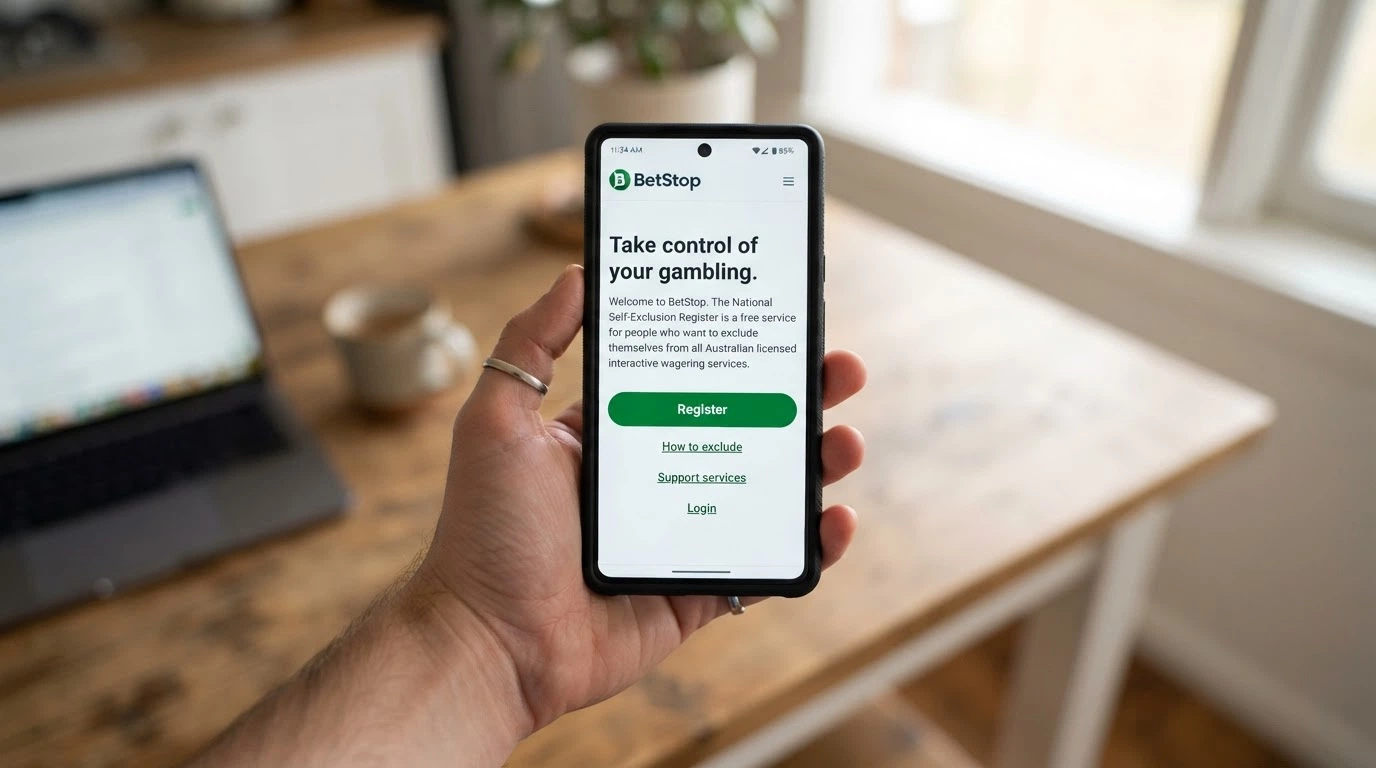
There is no BetStop coverage. BetStop, the national self-exclusion register, binds approximately 190 Australian-licensed wagering providers. An offshore casino is not among them. A person who has self-excluded through BetStop and then opens an account at an offshore casino will be accepted, deposited to and emailed bonus offers just as any other player would. The self-exclusion only covers the licensed market, and the offshore market is structurally exempt.
There is no recourse if the operator refuses a withdrawal. The KYC verification step that licensed operators run under Australian conditions still applies offshore, but the verification is governed by the operator’s own policies, not by an Australian regulator. A player whose documents are repeatedly rejected, whose withdrawal is held in “pending review” indefinitely, or whose account is closed after a win has limited options. The site’s terms usually describe a dispute process, and that process is the only one available.
Sites can be blocked while balances remain. The ACMA’s blocking action does not require the operator to process pending withdrawals. A player with A$200 in a casino account that is added to the ACMA blocking list may find their access interrupted before they can withdraw, and the operator has no obligation under Australian law to refund them. The player’s recourse is the same offshore complaints process that applies in any other dispute.
The credit card and crypto ban that took effect on 11 June 2024 applies to licensed wagering, not to offshore casino. An offshore operator still accepting credit cards or Bitcoin is, by definition, outside Australian payment law — which is itself a diagnostic tell about the operator’s regulatory relationship with Australian consumer protection. A player using those payment routes at an offshore casino is using routes the next reform package is designed to interrupt from 1 January 2027.
Responsible Gambling: Controls, Self-Exclusion and Where Australians Get Help
The offshore route removes most of the Australian responsible-gambling infrastructure from the player’s reach, but the infrastructure still exists for the licensed market and is worth knowing about in full. Three pieces matter: the self-exclusion register, the deposit and session controls at licensed operators, and the help services that operate independently of any casino relationship.
BetStop launched on 21 August 2023 and as of 31 March 2026 had 59,830 registrations with 37,247 active exclusions. The register is free, confidential and binds all approximately 190 Australian-licensed wagering providers. The 2026 reform package strengthens BetStop further, including the prohibition on inducement marketing to people who have recently deregistered.
The prevalence data is worth sitting with. Approximately 2.1% of Australian adults — roughly 430,000 people — experience problem gambling, with the Australian Institute of Health and Welfare putting high-risk gambling at 1.8% in 2022. A 2026 model from the Journal of Gambling Studies estimates approximately 3.29 million Australians aged five and over are affected annually by their own or another person’s gambling, including approximately 1.97 million adults with at-risk or problem gambling. Eleven per cent of Australians had gambled online in the previous six months as of 2022, up from 8% in 2020. These figures cover the licensed market, the offshore market, the lottery, the pokies in the club and every other form of gambling Australians engage with.
BetStop and the Offshore Blind Spot: What Self-Exclusion Actually Covers
BetStop covers all approximately 190 licensed wagering providers. An offshore casino is not among them, and the register binds only the licensed side of the market. A self-excluded person who opens an account at an offshore casino will be accepted, will not be flagged by any responsible-gambling check, and will continue to receive promotional material from the operator until they actively unsubscribe or close the account.
The outcomes for self-excluded registrants are encouraging on the licensed side. Seventy-seven per cent of BetStop registrants surveyed reported a better overall quality of life after self-excluding. Seventy-nine per cent reported improved mental health. Ninety-six per cent had either completely stopped or decreased their betting. The register works — but only within the licensed perimeter, and the offshore casino market sits outside it.
The ACMA’s BetStop enforcement has teeth on the licensed side. Eight infringement notices issued to Tabcorp on 16 January 2026, totalling A$158,400, addressed BetStop non-compliance specifically. An offshore casino that ignores a self-excluded person’s registration has no equivalent exposure, because the operator is not bound by BetStop in the first place.
Deposit Limits, Session Controls and the Scale of Harm in Australia
The licensed wagering market offers customer-set deposit limits and activity statements under state and territory licence conditions. There is no federal deposit, loss or stake ceiling for online gambling in Australia — and there cannot be one in the usual sense, because the product those ceilings would govern is banned outright. The controls that exist are operator-set, customer-configurable and not transferable to the offshore market.
The scale of harm in the licensed market is the reason those controls exist. Approximately 2.1% of Australian adults experience problem gambling. The 2026 model estimates 3.29 million Australians are affected annually by their own or another person’s gambling. The 2022 figure of 11% of Australians having gambled online in the previous six months, up from 8% in 2020, shows the digital channel growing faster than the population’s general gambling participation.
The offshore casino market sits outside these figures in a strict accounting sense, but the underlying behaviour overlaps. A player who self-excludes from licensed wagering and then opens an offshore casino account has not solved the underlying problem. The offshore account is harder to monitor, harder to limit and harder to walk away from. The licensed controls are useful for the licensed market. They are not a substitute for the harder work the offshore route demands of the player themselves.
Where to Get Help: Helplines, Counselling and Free Support
The National Gambling Helpline — 1800 858 858 — is free, confidential and staffed 24 hours a day, seven days a week. The service is operated by Turning Point and funded by the Victorian Government, with national coverage through referral. Gambling Help Online, at gamblinghelponline.org.au, offers online chat, email support and counselling sessions, also free and confidential. BetStop, at betstop.gov.au, is the national self-exclusion register described above, with online registration and a range of exclusion periods from three months to a permanent exclusion.
These services operate independently of any casino, any licence and any payment method. They are available to anyone in Australia, regardless of whether they have played at a licensed wagering operator, an offshore casino or both. The offshore gap in self-exclusion coverage does not extend to the help services themselves.
How We Assessed These 50 Free Spins Offers
The evaluation drew on four primary sources. ACMA enforcement records provided the legal context — the IGA 2001 prohibition, the blocked-sites list and the 2026 reform package — and identified which operators had Australian-facing enforcement history. Operator licence registers (the Curaçao Gaming Authority public register where applicable) provided the offshore licence credentials, though individual licence dates were not confirmed for any operator in this run. Casino.Guru’s Safety Index scores provided the independent trust signal, with RocketPlay’s 9.8 the strongest in the set. SlotSpeak’s 31-offer test provided the deliverability benchmark — the 6-out-of-31 figure that anchors the gap between advertised and delivered.
The ranking criteria, in order of weight: real deliverability of the deposit-free offer, wagering fairness relative to the Australian market average, max cashout reasonableness, transparency of terms and operator trust signals. The criteria are qualitative rather than weighted, and the ranking reflects what the terms say and what the independent sources confirm, not a composite score.
Operators whose no-deposit terms were not confirmed this run appear in the table with the article-language no-data marker rather than estimated values. The audit fails an inferred number faster than it fails an empty cell, and the empty cell tells the player the operator’s terms need to be checked on the operator’s own page before claiming.
The legal context shaped the write-ups as much as the bonus terms did. Every operator in the featured set is offshore and not licensed in Australia. The legal status appears in the table and is restated in each write-up, because a reader choosing between offers is choosing between legal categories as well as bonus packages.
What the Numbers Say About Claiming 50 Free Spins in 2026
The arithmetic of a 50-free-spin no-deposit offer, once the wagering multiplier and the maximum cashout cap are applied, leaves most players with a small fraction of the headline value. The expected loss on a 50x wagering requirement at 96.5% RTP is A$43.75 on A$25 of spin winnings — already more than the spin win itself. The cap then cuts the resulting balance down to what is actually withdrawable, and the offshore risk premium sits on top, because an operator refusing a payout is a non-zero outcome no term sheet addresses.
The clear case where an offer is worth claiming is the no-wagering or low-wagering offer with a generous cap. A 30x wagering bonus with a A$100 cashout cap is mathematically worth more than a 40x bonus with a A$20 cap, because the higher turnover is more than offset by the larger withdrawable ceiling. A no-wagering offer is worth more than both, because the absence of a turnover tunnel removes the expected loss entirely. Genuine no-wagering offers are rare in this market. They are worth looking for.
The equally clear case where an offer is not worth the sign-up is the high-wagering, low-cap combination. A 60x wagering bonus with a A$50 cap is worth less than the time it takes to clear, because the expected loss on the turnover exceeds what the cap will pay out for any result short of the cap itself. The player who runs the spins, wins A$50 and clears the wagering is still down on expected value. The player who runs the spins and wins nothing has spent nothing. The player who runs the spins, wins A$500 and clears the wagering has hit the cap and gets A$50 — but the journey there cost A$52.50 in expected loss at a 96.5% RTP, and the gap is paid in time, not money.
The reader’s decision, at this point, is a calculation they can run themselves. The numbers are on the page. The wagering multiplier, the cashout cap, the RTP and the spin value are all knowable in advance. The expected loss on the wagering tunnel is one multiplication away. The offshore risk premium is not a number but a probability — a non-zero chance of zero payout regardless of terms — and the only way to neutralise it is to play only what the player is prepared to lose in full. The arithmetic is not on the player’s side. The choice of whether to play at all is, and it is the choice the page is built to support.
Frequently Asked Questions About 50 Free Spins No Deposit in Australia
Can you win real money from 50 free spins with no deposit required in Australia?
Yes, but the real-money value is rarely the headline figure. A 50-free-spin no-deposit offer pays the spin winnings as a bonus balance, subject to a wagering requirement (typically 40x to 60x) and a maximum cashout cap (typically A$50 to A$150). A player who wins A$25 from the spins, clears the wagering and arrives at the withdrawal screen will receive at most the cap. Everything above the cap is removed at withdrawal.
How do wagering requirements work on a 50 free spins no deposit bonus?
Wagering multiplies the free-spin winnings into a turnover figure the player must run through before any withdrawal. At 40x, A$25 in winnings becomes A$1,000 of required turnover. At 60x, the same A$25 becomes A$1,500. The turnover must be completed on pokies, which contribute 100% toward wagering at most Australian-facing casinos. Table games and live casino titles typically contribute 0% to 20%, which makes them effectively unusable for bonus clearance. A 7-to-14-day validity window is standard.
What is the maximum you can cash out from a 50 free spins no deposit bonus?
The maximum cashout cap on a 50-free-spin no-deposit bonus is typically between A$50 and A$150 in the Australian market. The cap applies to the winnings after wagering has been cleared and is applied at the withdrawal screen. Anything above the cap is removed from the account at the moment of withdrawal. Operators do not advertise the cap in headline copy, and the figure is usually buried in the bonus terms page.
How do I claim 50 free spins without making a deposit at an Australian casino?
The standard path is registration with a name, email, date of birth and mobile number; email or SMS confirmation; bonus code entry where required; and automatic or manual credit of the spins. KYC verification (photo ID, proof of address, sometimes proof of payment method) is required before any withdrawal is processed, regardless of how the bonus was earned. The wagering clock starts at registration rather than at the moment the spins are claimed, so a delay can quietly shorten the validity window.
Do I need a bonus code to get 50 free spins no deposit in Australia?
Some offers require a bonus code and some do not. The code is usually entered during registration or in the cashier section before the first deposit. Codes sourced from third-party affiliate pages are frequently stale — expired or replaced — which is one of the four main reasons advertised offers fail to deliver. The safe practice is to use the code listed on the operator’s own promotions page on the day of registration.
What happens if I win big from no deposit free spins — can the casino refuse to pay?
Yes, in practice. Offshore operators can void a wagering-cleared payout under an “irregular play” clause if they judge the player’s betting pattern to fall outside their terms. The clause is broad by design and the operator’s interpretation is final. Even where the payout is honoured, the maximum cashout cap cuts the balance down to what is actually withdrawable. An Australian player has no ACMA complaints channel, no BetStop coverage and no Australian consumer protection body to escalate a refused withdrawal to. The dispute resolution process is offshore, slow and uncertain in outcome.
Casino Apps, PWAs and Mobile-Optimised Sites — Does the Platform Change the Offer?
The short answer is no. The bonus terms — wagering, cap, validity, game restrictions — are identical across browser, PWA and native app. The offer is the same product, accessed through a different surface. The only practical differences are in app-specific promotions like Bizzo’s 10-spin download bonus, and those are exceptions designed to drive a specific behaviour rather than standard features of the mobile channel.
A player who prefers mobile play should treat the platform as a delivery mechanism rather than a different product. The same caveats apply: offshore operator, no Australian consumer protection, no BetStop coverage, withdrawal subject to KYC verification. The convenience of playing on a phone does not change the underlying risk of the offer.
The choice between browser and PWA is mostly cosmetic. A browser-based mobile casino does not require an installation step but does not sit on the home screen as an app icon. A PWA is one tap away once installed, with the bonus terms identical and no app-store friction. Native apps, where they exist, are a small minority of the market and rarely change the offer in any meaningful way.